

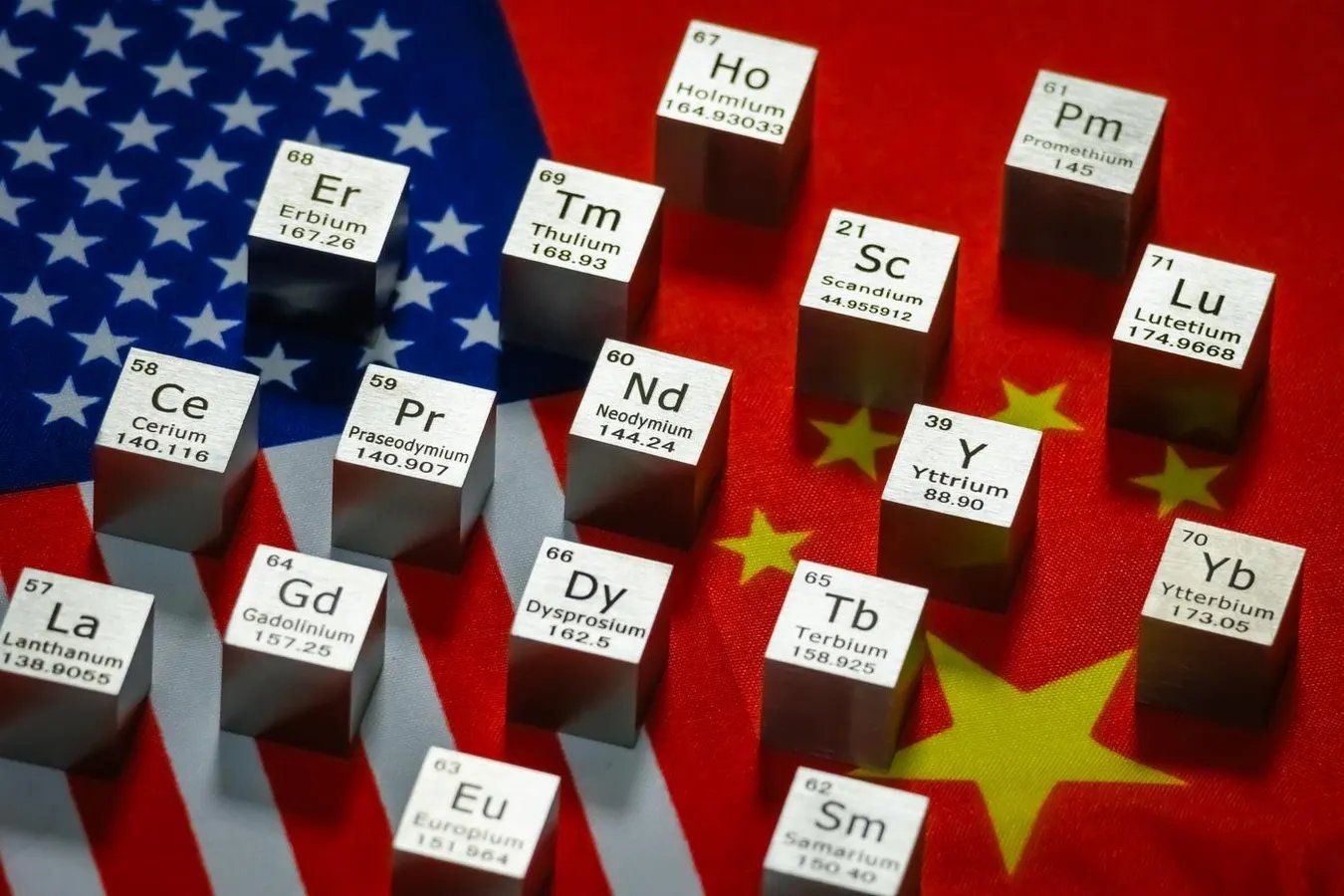
CHONGQING, CHINA – JULY 26: In this photo illustration, metal cubes representing rare earth elements including Neodymium (Nd), Praseodymium (Pr), Dysprosium (Dy), Terbium (Tb), and othersare displayed with their symbols and atomic numbers on overlapping flags of the United States and China on July 26, 2025 in Chongqing, China. (Photo illustration by Cheng Xin/Getty Images)
Getty Images
When tensions in the Middle East escalated this spring, the Strait of Hormuz turned into a focal point of global concern. Oil prices surged, markets tightened. Governments scrambled to assess exposure.
Roughly a quarter of global seaborne oil trade passes through this narrow corridor. Any disruption would be felt instantly across the global economy. So much so that the International Energy Agency (IEA) described the situation as the “greatest global energy security challenge in history.”1
For many, this only reinforces the case for accelerating the clean energy transition.
Renewable energy sources are largely independent of fuel price fluctuations, offering a more stable and lower-cost base. Countries with higher shares of clean electricity and electrified end uses are already proving more resilient to current fuel price shocks.2
But that is only half of the picture.
A MarineTraffic map showing ship movements in the Strait of Hormuz is pictured through a magnifying glass in this photo illustration, as commercial vessel traffic through the key oil shipping lane drops sharply amid the escalating conflict involving Iran. Taken in Brussels, Belgium, on March 15, 2026. (Photo by Jonathan Raa/NurPhoto via Getty Images)
NurPhoto via Getty Images
Clean Energy Still Depends on Global Supply Chains
Chokepoints like Hormuz are not just affecting fossil fuel flows. They also disrupt the industrial inputs needed to build clean technologies.
Nearly half of global seaborne sulfur trade passes through the Strait, with sulfur playing a critical role in processing nickel and cobalt for EV batteries. At the same time, supply constraints are affecting aluminum – around 9% of global production originates in the Middle East – which is widely used across renewable infrastructure, as well as graphite feedstocks essential for battery anodes. 3
As electrification accelerates, so does demand for lithium, nickel, cobalt, graphite and rare earth elements. The IEA estimates that demand for these materials could more than triple by 2040.
TO GO WITH China-Japan-technology-commodities FOCUS by D’Arcy Doran In a picture taken on September 5, 2010 a man driving a front loader shifts soil containing rare earth minerals to be loaded at a port in Lianyungang, east China’s Jiangsu province, for export to Japan. China’s restrictions on exports of rare earths are aimed at maximising profit, strengthening its homegrown high-tech companies and forcing other nations to help sustain global supply, experts say. China last year produced 97 percent of the global supply of rare earths — a group of 17 elements used in high-tech products ranging from flat-screen televisions to iPods to hybrid cars — but is home to just a third of reserves. CHINA OUT AFP PHOTO (Photo credit should read STR/AFP via Getty Images)
AFP via Getty Images
A More Concentrated, Less Visible Risk
These supply chains are among the most geographically concentrated of any global industry.
In many cases, a small number of countries dominate not only extraction, but processing and refining. China, in particular, has spent decades building a strategic position across these value chains. Today, it accounts for around 60% of global rare earth mining and as much as 90% of processing capacity. In some downstream segments, its dominance is even more pronounced: around 95% of global permanent magnets are produced in China, up from roughly 50% just two decades ago.4
In other words, the transition does not eliminate dependency – it redistributes it. From oil to minerals.
A worker at Fortech company shows metals recycled from electric car batteries in Cartago, Costa Rica,on February 20, 2023. – The Fortech company in Costa Rica recycles lithium batteries from telephones, computers, electric cars and other items to sell the resulting materials for the construction of new batteries. (Photo by Ezequiel BECERRA / AFP) (Photo by EZEQUIEL BECERRA/AFP via Getty Images)
AFP via Getty Images
Circularity Can Reduce Pressure
If the transition is becoming more material-intensive, reducing pressure on primary supply becomes critical. One of the most immediate levers is circularity.
Recycling and reusing materials already in circulation can significantly reduce reliance on new extraction, potentially lowering primary demand for critical minerals by up to 35% by 2035.
Current recycling rates remain far below their potential. For key materials such as nickel, copper and aluminum, they stand at around 40%, despite technical potential exceeding 90%. Unlocking this gap will depend on innovations, both to increase recovery rates and to make recycling processes more efficient and economically viable.
Recovered materials – from batteries, industrial waste and end-of-life technologies – can form a secondary supply base that is more localized and less exposed to geopolitical disruption.
As argued previously, circularity can reduce geopolitical risk by lowering exposure to volatile global supply chains without changing underlying material demand.
But circularity does not fundamentally change what the system depends on.
laboratory specialist examines the data obtained on a special apparatus for analyzing samples Close-up portrait
getty
Alternative and Advanced Materials: Reducing Dependency At The Source
This is where innovation in materials and chemistry becomes strategic.
New battery technologies are already reducing reliance on scarce inputs such as cobalt and nickel. At the same time, alternative materials – from advanced carbon-based compounds to bio-based inputs – are beginning to reshape supply chains at their core.
In some cases, substitution is moving from concept to reality. Graphene-based materials are being explored as alternatives to traditional battery components, while nanocoating and new electrolysis technologies are reducing dependence on scarce metals such as iridium or platinum. Biological materials like lignin are also entering the equation, opening new avenues for material innovation rooted in abundant, renewable sources.
This is also where a new wave of startups is translating advances in chemistry into industrial applications. Sublime Systems, for example, is rethinking cement production by redesigning the process around more abundant feedstocks and simpler supply chains, while also co-producing critical minerals. Others are targeting strategic materials more directly: Kore Metals* is developing electrolysis-based processes to produce high-purity silicon from abundant silica, pointing to a more localized and resilient supply chain.
For regions with limited domestic resources, like Europe, this represents a strategic opportunity. Competing on raw material extraction will remain challenging, but competing on substitution, efficiency and advanced materials offers a different pathway to resilience.
WASHINGTON, DC – FEBRUARY 04: US Vice President JD Vance speaks at the first Critical Minerals Ministerial in the Loy Henderson Conference Room at the State Department’s Harry S. Truman Building on February 04, 2026 in Washington, DC. About 50 countries attended the ministerial, a gathering to discuss the creation of tech supply chain partnerships that can bypass China. The United States has been looking for alternative sources for rare earth minerals since Beijing cut the U.S. off from its supply last year. (Photo by Chip Somodevilla/Getty Images)
Getty Images
Policy Is Starting to Catch Up
Governments are increasingly treating access to critical materials as a strategic issue.
In the United States, measures such as the Inflation Reduction Act have already started to reshape supply chains by incentivizing domestic production and allied sourcing of critical minerals. While recent changes under the One Big Beautiful Bill Act have weakened some incentives5, newer initiatives, such as establishing a national raw materials reserve, point in the same direction: critical materials are increasingly seen as essential to national security and industrial resilience.
Europe is pursuing a parallel, though more complex, approach. Through the Critical Raw Materials Act and related initiatives, the European Union is seeking to reduce strategic dependencies by scaling domestic production, strengthening partnerships with resource-rich countries and building mechanisms for joint procurement and stockpiling.6 These efforts are also tied to broader ambitions to increase recycling and processing capacity within Europe itself.
18 September 2024, Saxony-Anhalt, Bitterfeld-Wolfen: An AMG Critical Materials employee works in the production plant of the lithium hydroxide refinery in Bitterfeld-Wolfen. AMG is commissioning Europe’s first lithium refinery here. Up to 20,000 tons of lithium hydroxide will be produced here for e-car batteries in the future. The company estimates its own investment costs at 140 million euros, with 5.5 million euros also coming from regional economic development funds. In Bitterfeld, 80 jobs have been created in the first module. Customers for the lithium hydroxide are cathode and cell manufacturers of batteries in Hungary and Poland. Photo: Hendrik Schmidt/dpa (Photo by Hendrik Schmidt/picture alliance via Getty Images)
dpa/picture alliance via Getty Images
Execution Still Lags
Delivery, however, continues to lag behind demand.
Diversification is progressing, but too slowly. Planned projects outside dominant producers are expected to cover only a limited share of future demand – especially in refining and downstream manufacturing, where gaps are most pronounced.7 In other words, the parts of the value chain that matter most strategically are also the hardest to rebalance.
New supply is also much harder to build than policy frameworks suggest. Higher costs, long permitting timelines and structural investment uncertainty continue to delay projects, while development cycles often span more than a decade.8 9
This is why ambition alone will not be enough. Closing these gaps will require sustained capital, faster permitting, industrial coordination and a longer-term approach to building resilience across the full value chain – from extraction and refining to recycling, advanced materials and substitution.
Critical battery mineral ores, copper, graphite, nickel, lithium, manganese. Reflection in mirror. Symmetry. Mine, mining. Industry, finance and business
getty
The Next Phase Of Energy Security
The events around the Strait of Hormuz have once again exposed how vulnerable global energy systems remain to geopolitical shocks.
But they also point to a broader shift that is still not fully understood.
As the world moves away from fossil fuels, it is not moving away from dependency. With the global economy electrifying, risk is shifting from oil fields and shipping lanes to mines, refineries and material processing hubs.
That changes the logic of energy security. In the next phase of the transition, resilience will not be defined only by how much clean power a country can generate, but by whether it can secure the materials, processing capacity and substitute technologies that make electrification possible in the first place.
Countries that recognize this shift early, and act on it, will be best positioned to lead in the clean energy economy. Not simply by building more wind turbines or electric vehicles, but by ensuring that the supply chains behind them are more resilient, diversified and, increasingly, circular.
Otherwise, the next global energy security crisis will not be about oil but about minerals.
*Disclaimer: InnoEnergy is an investor in Kore Metals.
