

Updated April 29, 2026 07:00AM
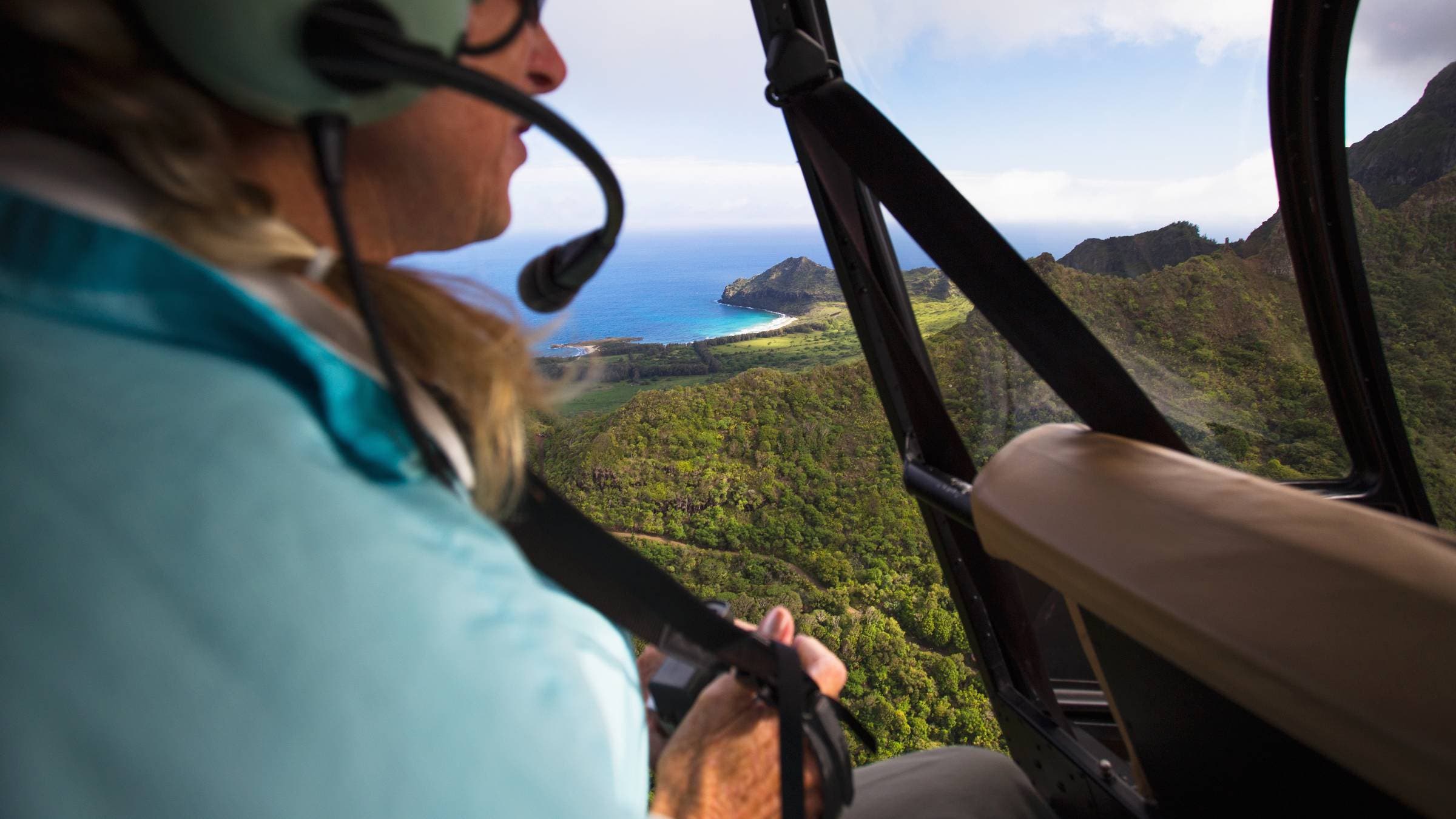
I’ve viewed some of the world’s most dramatic landscapes from the passenger seat of a helicopter: Botswana’s Okavango Delta, Everest Base Camp, the Grand Canyon, South Africa’s Wild Coast, the peaks of Denali in Alaska and Mount Aspiring in New Zealand. But nothing was as thrilling as the doors-off flight I took over Kauai with tour company Jack Harter Helicopters in 2018.
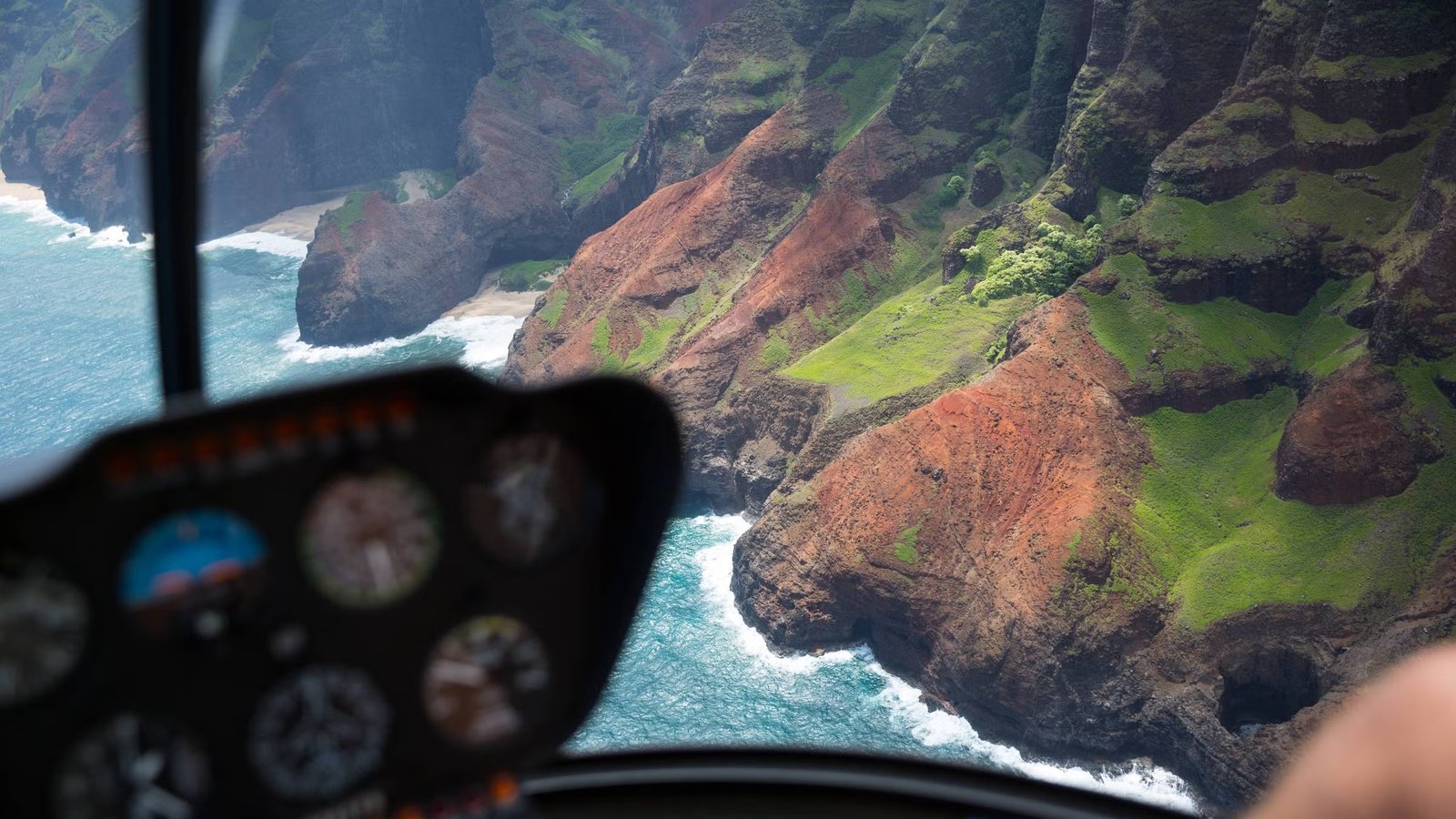
Kauai’s landscapes—made famous by Jurassic Park— are awe-inducing when viewed from land and even sea. But from the air they take on a whole new level of grandeur. As we flew over the island’s cinematic Na Pali coastline, I saw waterfall-striated emerald peaks, lush rainforests, and soaring sea cliffs. I felt an exhilarating rush as the salt-air whipped my face. We dipped in so close to a waterfall that I could feel the mist from its cascades tickle my skin. At times, the sound of the rotor was drowned out by the thunderous crash of the waves on the cliffs below. Without the barrier of a door and window, I wasn’t just observing the elements, I was one with them. Not once during the tour did I feel unsafe, though my pulse was certainly racing throughout the entire 60-minute flight.
However, the alarming number of sightseeing helicopter crashes in Hawai’i has made me reconsider whether I’d do it again. On March 26, a doors-off helicopter flight operated by Airborne Aviation, a trusted company with a background in rescue work, flew the same approximate route I did with Jack Harter.
When the aircraft reached the Na Pali Coast, something went awry, and the helicopter crash-landed on a sandbar around 100 yards offshore of Kalalau Beach with five people aboard. Three people died and one of the two survivors remained trapped in the wreckage in the ocean for more than an hour.
WHAT TO KNOW
- On March 26, a doors-off helicopter flight crash-landed on a sandbar around 100 yards offshore of Kauai, Hawai’i, with five people aboard. Three people died.
- A preliminary report released by National Transportation Safety Board (NTSB) on April 17 did not identify a suspected cause of the crash.
- Doors-off helicopter tours originated in Hawai’i with Jack Harter Helicopters on Kauai in 1962.
- Today, more than 1 million people take an aerial tour of Hawai’i each year, equating to one out of every 10 visitors to the islands.
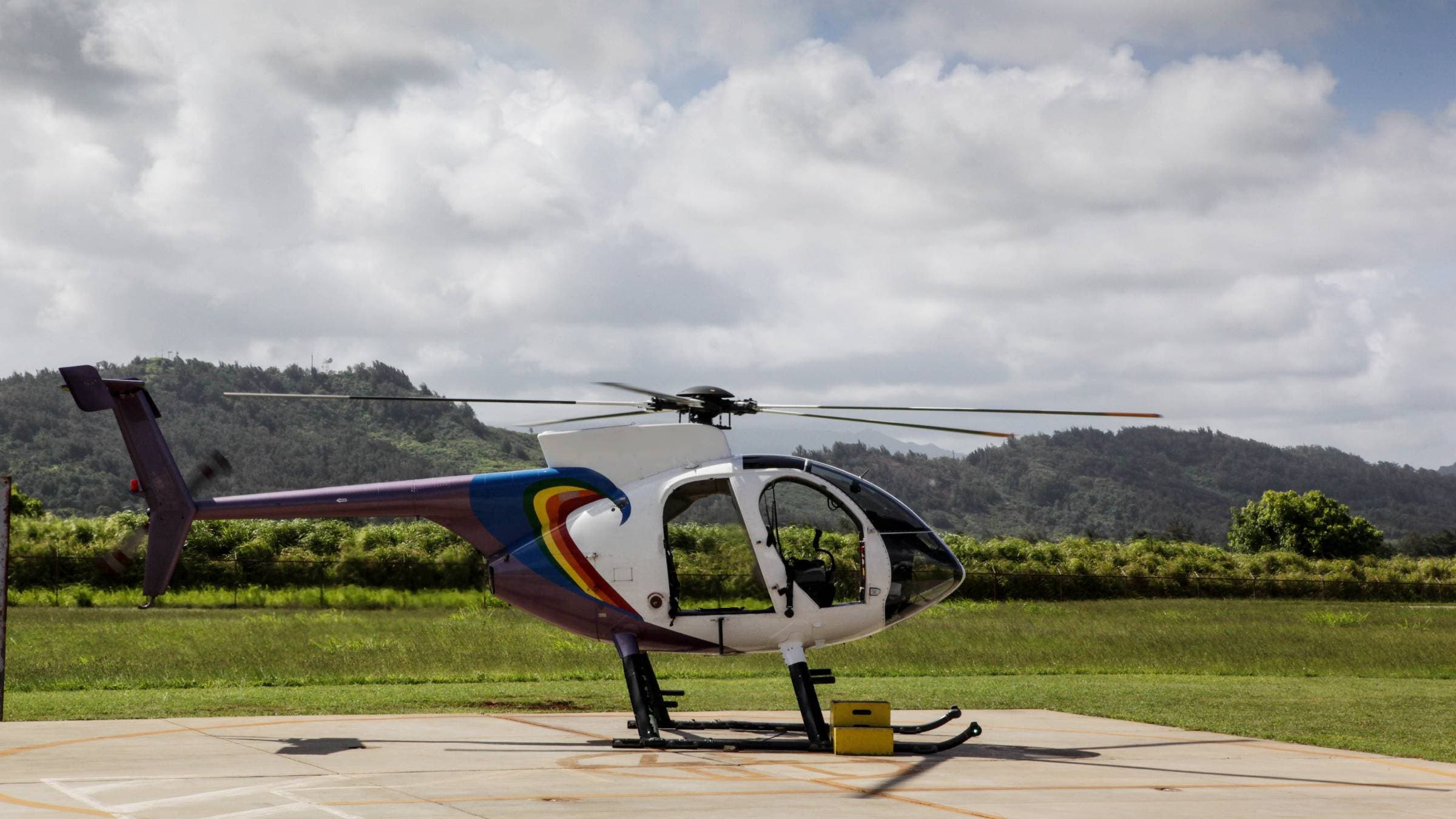
The crash is currently under investigation by the National Transportation Safety Board (NTSB). Public flight records released April 8 show the aircraft was a Hughes 500 model built in 1979. It had already completed five flights before the crash that day and that a turbulence advisory was active across all Hawaiian islands on March 26.
A preliminary report released by NTSB on April 17 did not identify a suspected cause of the crash. But the surviving pilot told investigators that the helicopter experienced severe vibrations and a loss of directional control as the helicopter turned toward the Kalalau shoreline, which is known for its erratic weather patterns. According to the report, the lone surviving passenger told investigators that she heard a change in the helicopter’s sound and noticed it slowing down before it rotated toward the water and “nosedived” into the ocean.
Ladd Sanger, a Dallas-based pilot and attorney who’s been doing aviation litigation for more than 20 years and who has handled lawsuits for three crashes on Kalalau Beach in Kauai offered one possible theory based solely on his review of the NTSB’s preliminary report.“The fact that the rotor stopped spinning after the pilot initiated autorotation combined with the change in sound leads me to think the tail rotor or anti-torque system had an issue,” he says. “I imagine the pilot was trying to stretch the glide to get the helicopter to the beach. Typically when you do an autorotation you pull the nose up, but the rough seas off that coast make depth perception very difficult so he may have made a mistake on the pitch.” The NTSB’s final report, which will contain official findings, is not expected until some time in 2027.
Airborne Aviation did not respond to my calls for comment. After a brief suspension of operations, the company has reinstated its normal flight tour schedule.
The Birth of Doors-Off Helicopter Tours in Hawai’i
The late Charles “Jack” Harter is credited with pioneering scenic helicopter flights in Hawai’i. A U.S. army veteran and helicopter pilot, Harter moved to Kauai in 1962 and founded Kauai Helicopters, offering charters, rescue flights, as well as tourist flights. The State of Hawai’i granted him permission to land at a handful of scenic destinations, like Honopu and Kalalau, along the Na Pali Coast.
As tourism took off in Hawai’i, Harter faced competition. By the seventies, 14 helicopter companies with a total of 44 aircraft offered similar tours of Kauai. Helicopter companies also sought rights to land along the coast. Harter ultimately sacrificed his landing permit to prevent the state from awarding future companies landing rights along the coast.
Between 1982 and 1991, helicopter tours across the islands increased from 63,000 to 101,000 annually. Brochures advertised flights “close enough to waterfalls to feel the cooling mist” and “into the heart and heat of an active volcano.” Wanting to differentiate himself, Harter introduced the state’s first doors-off tours in 2005, allowing photographers to snap photos without the glare from windows and passengers to be fully immersed in the environment.
In the last decade, the number of tour operators in Hawai’i has more than doubled and flight volumes have increased by nearly 67 percent in the same period. Today, more than 1 million people take an aerial tour of Hawai’i each year. That equates to one out of every 10 visitors to the islands. Most of the tours are in helicopters.
As Heli Tourism Grows, Accident Rates are Rising
Fast-forward to the modern era, and aerial tourism is booming globally, particularly in North America. In 2020, a research company called The Insight Partners valued the helicopter tourism market at $745 million, and projected it to reach more than $1 billion by 2028. The growth in air tour sightseeing has also correlated with an escalation in accidents.
Scrutiny has increased around the safety gaps in doors-off helicopter flights, once reserved for professional photographers. Since 2008, there have been more than 80 commercial sightseeing helicopter accidents, with over 75 deaths, in the United States, according to the NTSB. Hawai’i has had the most, with 21 accidents and 22 fatalities, followed by Florida, Nevada, Texas and Alaska.
Unlike commercial airline pilots, sightseeing helicopter pilots primarily rely on judgment and less on prescriptive rules. The Federal Aviation Administration (FAA) has been criticized for allowing many sightseeing flights to operate under more lenient rules than other commercial aviation when it comes to aircraft maintenance, pilot qualifications, acceptable conditions to fly, and pilot rest time.
Hawai’i’s Flight Accident Rate Has Raised Concerns for Years
An alarming number of air tour accidents in Hawai’i in the eighties and nineties—20 accidents and 24 fatalities during the three-year period between 1991 and 1994 alone—prompted the FAA to take action. According to NTSB data, contributing factors to the causes and seriousness of accidents included inadequate preflight planning for weather and routes, lack of survival equipment, and flying at low altitudes, which does not allow time for recovery or forced landing preparation in the event of a power failure.
On September 26, 1994 the FAA issued Special Federal Aviation Regulation (SFAR) No. 71 to establish additional operating procedures, including minimum safe altitudes, minimum equipment requirements, and operational limitations for air tour aircraft in the state of Hawai’i.
The new regulation had some impact. A study compared crashes between 1981-1994 with those between 1995 and 2008 and found the enactment of SFAR No. 71 was followed by a 47 percent decrease in crash rates, with the number of crashes into the ocean dropping from eight to one. However, the study showed an increase in VFR-IMC (Visual Flight Rules into Instrumental Meteorological Conditions) from 5 percent to 32 percent, which resulted in 16 fatal crashes between 1995 and 2008.
Visual flight rules is a set of regulations that govern the conditions under which a pilot can operate an aircraft using their eyesight without relying on instruments. Those guidelines require pilots to maintain three or more miles of visibility and at least 1,000 feet above clouds, 500 feet below clouds, and 2,000 feet horizontally separated from clouds. Air tours in Hawai’i, however, must be flown at a minimum altitude of 1,500 feet versus 1,000 feet.
According to the Airport Owners and Pilots Association, VFR-IMC leads to the highest number of weather-related accidents each year. It occurs when a pilot flying under visual flight rules encounters weather that impedes visual reference, leading to spatial disorientation. Most tour flights in Hawai’i follow basic visual flight rules, which include no requirement for onboard terrain awareness, black box recorders, and often no filed flight plan.
Since 2008, Hawai’i has still experienced deadly helicopter accidents, many of them VFR-IMC related. In 2019, there were ten fatalities between two crashes, including a Safari Helicopters tour of Kauai’s Na Pali Coast that crashed on a steep, forested slope, killing all seven passengers, including the pilot. Federal investigators at the NTSB blamed the crash on the pilot’s decision to keep flying into deteriorating weather. In its official report the NTSB accused regulators of lax oversight of air tours in Hawai’i, including a delay in installing aviation weather cameras that might have alerted the pilot to the foggy conditions in a mountainous area. They also said the FAA failed to do enough to ensure that tour pilots in Hawai’i are trained in handling bad weather. Recommendations for precautions like cue-based pilot training, onboard safety cameras and flotation devices for over-water flights have still not been universally adopted.
“There was minimal FAA oversight of the safety of air tour operations in Hawai’i,” said NTSB safety board chair Jennifer Homendy in the statement. “The NTSB previously made 11 recommendations to the FAA to prevent accidents like this one, but our recommendations only work when they are implemented.” Those 2019 incidents led the FAA to tighten Hawai’i VFR flight rules, specifically targeting air tour operators, creating a new process to authorize pilots to fly at altitudes lower than 1,500 feet to avoid bad weather.

What Makes Hawai’i Extra Challenging for Flying?
The same features that make Hawai’i so beautiful—rugged coasts, jagged cliffs, varying microclimates—also make it more difficult for helicopter pilots.
“The wind here often has extreme spikes and the entire weather pattern can change without much warning,” Kasia Hayden, a helicopter pilot in training on Maui, told Outside. “Hawai’i has no buffer from the full impact of weather fronts snowballing across the Pacific Ocean before they crash into our partially-submerged mountain range.” She likens the effect to ripples in the North Pacific eventually becoming 60-foot waves at Pipeline or Peahi.
“Unfortunately, unlike states on the mainland, we lack a dense network of weather sensors surrounding us from neighboring states that provide accurate, real-time readings,” Hayden added. “We have only a fraction of the sensors, relying on buoys and twice-daily weather balloons to inform mathematical weather prediction models.”
Kauai’s Na Pali Coast is one of the most popular routes for sightseeing helicopters. But its confined geography, shifting winds, downdrafts, sheer cliffs, and sudden changes in visibility also make it one of the riskiest.
“There is very little margin for error regarding where to land if things go wrong,” said Hayden. “Will an incredibly strong gust of wind hurtle you into an unrecoverable state? And if you experience a mechanical failure and enter autorotation, can you find a nearby place to crash land that isn’t a turbulent ocean, a spiky cliff, or a jungle of trees that could impale you? The most scenic routes often involve dramatic terrain with few level and clear landing pads.”
Don Shearer, owner of Windward Aviation on Maui, an operator specializing in utility work, describes the flightseeing industry as “crazy as shit” on the Na Pali Coast. “At any given time you have 10 to 15 helicopters within a five-mile area,” he told Outside. He noted that pilots flying lighter helicopters, such as a Robinson R44, a model involved in multiple fatal crashes across Hawai’i over the decades, are often underpowered and when you get high wind gusts in consequential terrain things can get wild fast.
Shearer started flying in high school in 1977 and worked as a FAA production test pilot for Robinson Helicopters. When he came to Hawai’i in 1985, he was at the highest level a certified pilot could reach with over 4,000 hours of flying under his belt. “Hawai’i was a whole different playing field,” he said. “You get sustained wind over 30 knots almost every day, torrential rain of up to two to three inches an hour, mountains over 10,000 feet high,” Shearer said. “I’ve had to rely on superb skills not superb judgment. It’s a place that demands you pay close attention. It’s taken me 40 years to learn every island like the back of my hand.”
When Shearer first arrived in Hawai’i he flew scenic tours for 14 months and said he quickly got out. “Back then it was the Wild West with a lot of guys acting like cowboys,” he said. While government officials have tightened the safety reins, Shearer believes that the industry still has problems with pilot training and experience in Hawai’i.
He puts his pilots on salary, but most scenic tour operators pay by flight time, giving pilots incentive to take off in marginal weather or in an unairworthy helicopter. Windward Aviation requires 8 to 10 years of pilot experience and a minimum of 3,000 hours of flight-time and Shearer personally flies with every applicant. “Most scenic tour operators just want to see that you can take off and land,” he said.
Ladd Sanger, a Dallas-based pilot and attorney who’s been doing aviation litigation for more than 20 years, agreed pilot training in Hawai’i should be more robust. “There’s a lot of inadequate training across operations in Hawai’i,” he said. He represented the family of a victim of the fatal air tour crash of Blue Hawaiian Helicopters on the island of Molokai in 2011 and alleged the operator’s pilot training had been “pencil whipped.”
Hawai’i’s humid, salt-laden environment is also hard on materials, and many operators handle their own maintenance as mechanics are hard to come by on the islands, said Sanger. He also pointed to Hawai’i’s lack of operating procedures. Sanger has handled lawsuits for three crashes on Kalalau Beach in Kauai, the location of the March 26 accident.
“These accidents were all preventable,” he says. “Pilots come out of the valley over a hill and make a turn down to the ocean. If they are adhering to the rules this shouldn’t happen. Instead, we see pilots hovering in front of waterfalls and getting too low and there don’t seem to be repercussions.”
Kauai officials have underscored that air tours are integral to the local economies. Hopefully, lessons from this tragedy can help implement rules that will allow visitors to continue to experience the Islands’ beauty in this unique way, but with higher safety standards.
Editor’s note: This article reflects information available at the time of publication. Helicopter tour operators, safety records, regulatory requirements, and flight conditions in Hawai’i change frequently. Readers should research current operator certifications, safety histories, and FAA compliance records independently before booking any aerial tour. Outside does not endorse any specific operator mentioned in this article.
Jen Murphy is a regular contributor to Outside. She splits her time between Colorado and Maui and has already flown in a helicopter more than a dozen times in 2026. Previously, she wrote about what travelers should know about Hawai’i’s historic flooding.
