


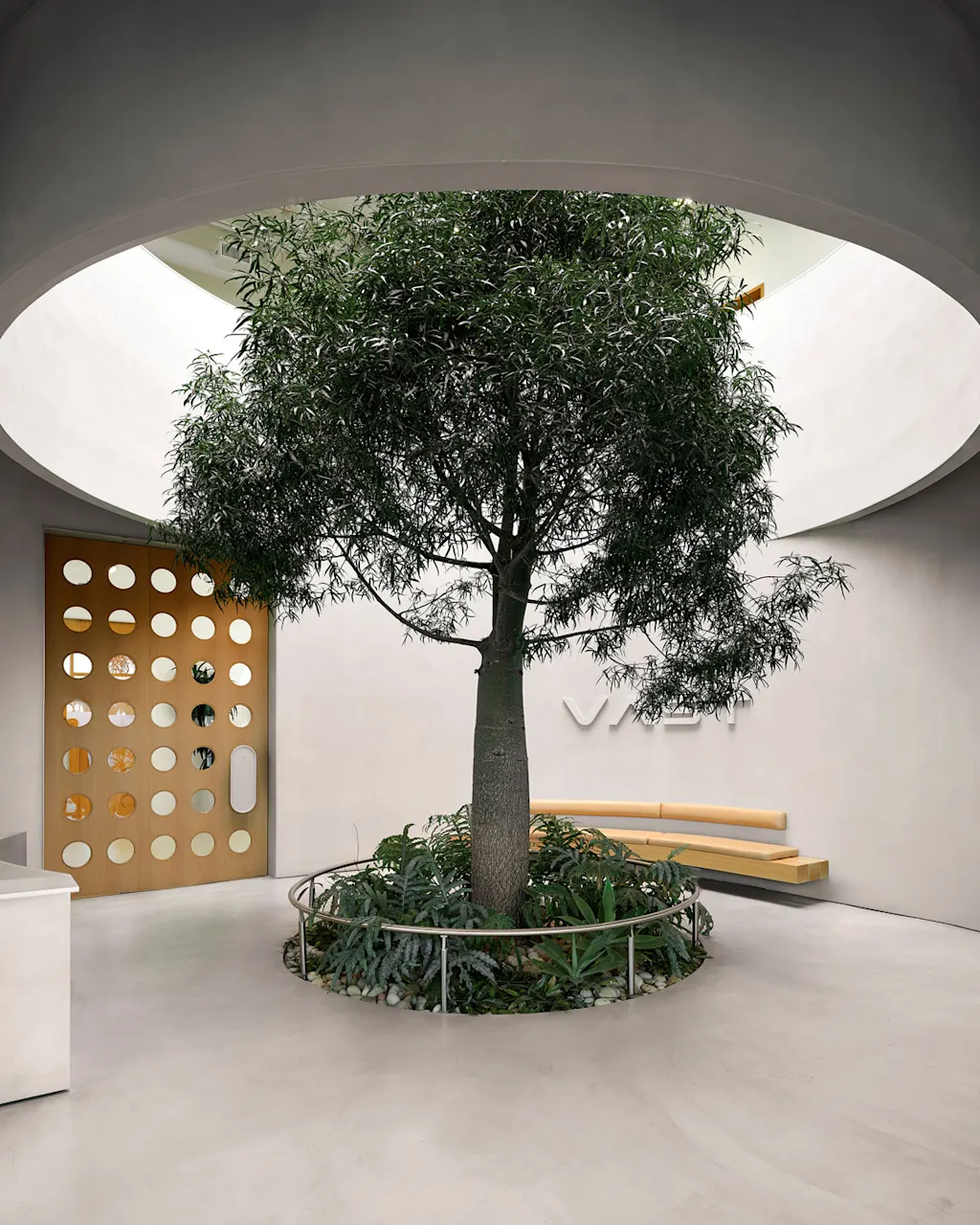
A tall baobab tree greets people inside the Long Beach, California, headquarters of Vast, an aerospace company that is building the space station of the future. It’s planted beneath a skylight in the center of a white-painted circular lobby furnished with a sleek aluminum reception desk and built-in wood banquette that follows the curve of the walls.
The tree and the room are symbolic. The former references trees in The Little Prince, a 1943 novella with a character who travels between planets, and the latter has the same diameter of a Haven-1 module, which the Vast team hopes will become home to researchers, astronauts, and travelers and eventually succeed the International Space Station.
“There are these timeless stories of, ‘Why is humanity reaching for the stars? Why are we going to space?’” says Hillary Coe, Vast’s chief design and marketing officer. “Those Easter eggs start to ground you in the ‘why’ while you’re simultaneously understanding the ‘what’—the important engineering and structural feats that we’re doing.”
The space race of the 21st century is tourism, with new companies like Vast rapidly developing the technology and physical infrastructure that will enable human habitation in the cosmos. Here on Earth, they’re also inventing new types of workspaces for this growing industry, which is expected to reach $87 billion by 2035.
Vast’s new 49,000-square-foot headquarters, a collaboration between its in-house team and the New York-based multidisciplinary design studio Civilian, does all those things, in a sophisticated expression of how architecture can support high-performance work and reinforce brand.
“Form empowering function”
The space is minimalist, with polished concrete floors, custom-made white oak doors, and a palette of white and gray. But this wasn’t merely a stylistic choice; it reinforces the work Vast is seeking to do.
“Form being able to empower function is really the core of what we’re dealing with,” Coe says. “And when you see that clean aesthetic, it’s very much for the sake of capability and efficiency.”
