

Published May 11, 2026 03:54AM
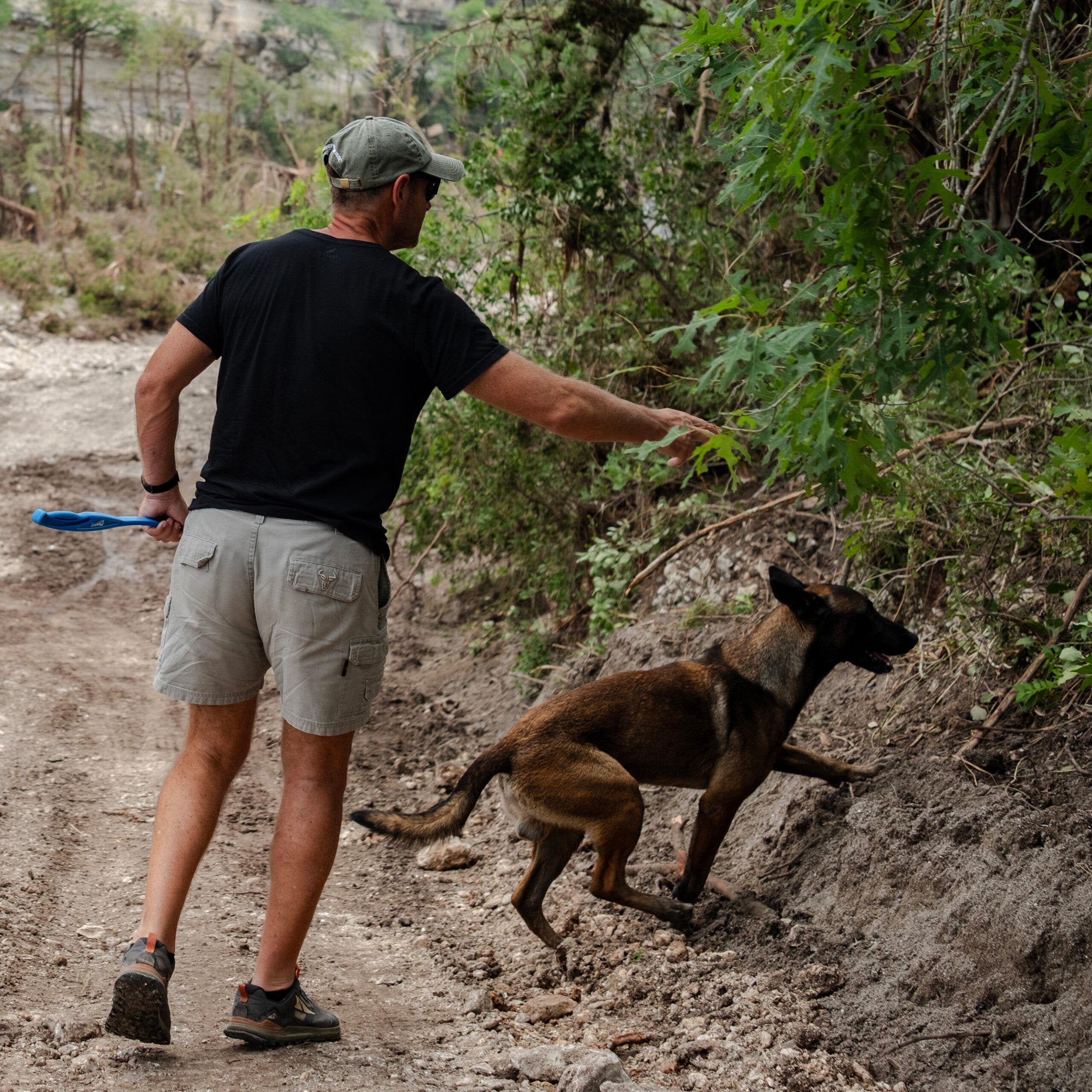
Lawrence Ervin leans down and unleashes Aurnia, a seven-year-old Belgian Malinois. Sniffing for a scent, Aurnia weaves her pointed black snout through the air. A shepherding dog by lineage, Aurnia’s smooth coat of chestnut fur covers a muscular but tired body. She’s been working in this heat for four days now, sunrise to sundown. Lawrence, a flight paramedic from Del Rio, Texas, wears desert camo, a chest pack, and medical supplies strapped around his waist.
He whispers into Aurnia’s pointed ear, find ghost. And she begins to run.
The search team’s leader, Logan, sets a timer for 20 minutes. (Because he still assists with covert law enforcement missions, Logan asked that I not use his last name.) He’s been on the river since the storm came, over three weeks now. An equine dentist and Air Force veteran, Logan was driving to Kerrville the weekend of July 4 when raindrops began hitting his windshield.
Logan’s friend, who works for the County Sheriff, called. “We need help,” she said.
During the first day or two after the flood, Logan assisted with rescues. The job soon turned to recovering the bodies of flood victims.
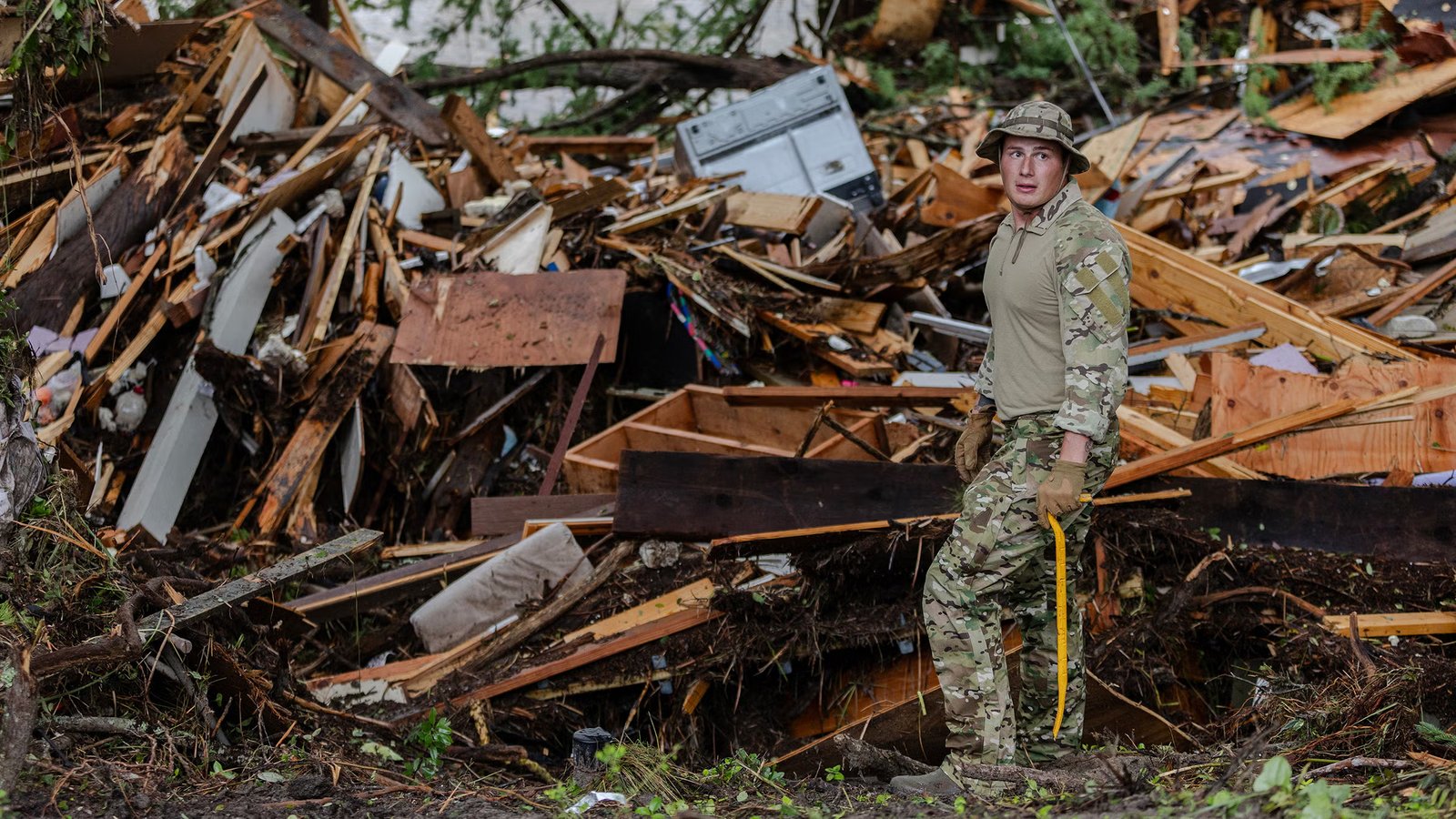
The dozen or so searchers who’ve coalesced on Logan’s team are working under the banner of the United Cajun Navy, a disaster relief non-profit that formed after Hurricane Katrina. Here in Kerrville, the United Cajun Navy is one of at least a half dozen volunteer organizations doing the painstaking job of searching for flood victims who are presumed to be dead. Searching isn’t for everyone. Many of the search team members still combing the river this long after the flood are ex-military and special ops.
“Ninety-nine percent of the people who volunteered with us left after lunch,” says Shaun Schraeder, a burly search team member who looks a bit like a modern-day Paul Bunyan. The team travels light: T-shirts, jeans, and boots. Pistols holstered at their hips. Their ethos: “No logos, no egos.”
As climate change produces deadly weather events with increasing frequency and severity, the need for people willing and able to search for the deceased victims of these disasters has also increased. According to the Federal climate agency NOAA, Texas has suffered more billion-dollar disasters over the last 45 years than any other state. The Texas agency that responds to mass casualty events, the Texas Emergency Medical Task Force (EMTF), has subsequently seen an exponential increase in deployments—from four in 2017 to 28 mass casualty deployments by the end of 2023.
Logan knows the search dogs will work themselves to complete exhaustion. Especially the Malinois, like Aurnia. Today, the last government-sanctioned day of the volunteer search effort, Logan needs Aurnia to run as much as she can. Two victims officially remain missing, Jeff Ramsey, 63, and Cecilia “Cile” Steward, 8, who disappeared from Camp Mystic.
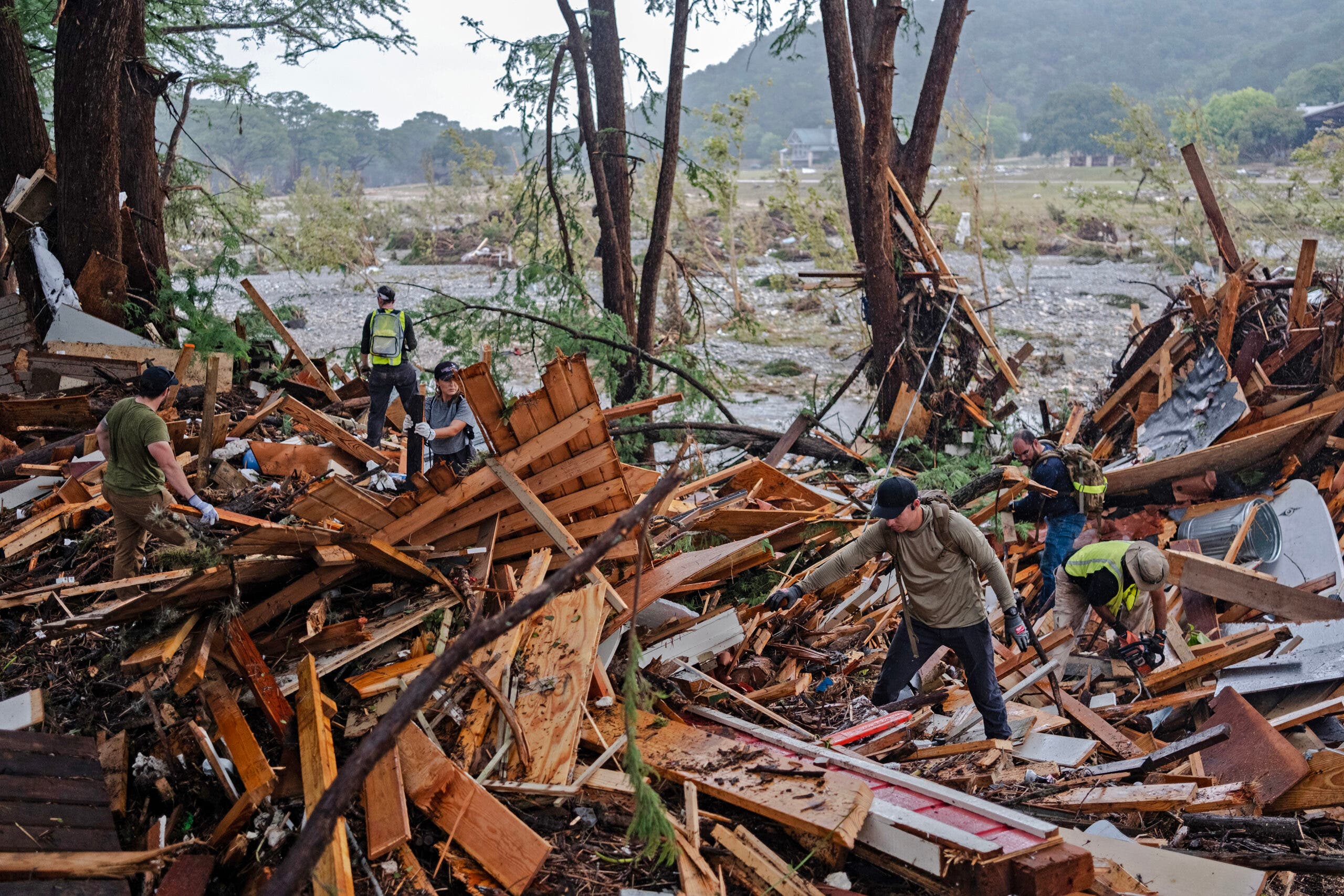
Aurnia’s scrambling under downed tree trunks on a lopsided piece of land just beneath downtown Kerrville. The flood waters pushed against a tall cliff wall here, atop which the county courthouse and town square are located, and spilled across a field where families gather for summertime concerts. As the flood hit this densely treed section below a small dam, where Aurnia is searching, the centuries-old cypress trees gave way. The tilting trunks and sunken root systems pulled at the earth, making the riverbank tilt awkwardly.
Six flood victims, maybe more, ended up in this tangle of downed limbs and flood debris—clothes, cars, a concert stage. Logan hopes we can find at least one more body.
On the nearby walking and biking trail that parallels this portion of the river, someone from an earlier search team wrote in red spray paint, “need cadaver dogs, hit wood piles,” with an arrow pointing our way. Cadaver dogs are dogs like Aurnia. They smell dead people.
At around 1 A.M. on July 4, a dense rain cloud moved over the headwaters of the Guadalupe River’s South Fork, one of the most popular recreational rivers in Texas. Radar maps from that night show the storm’s center as the deepest shade of purple. Nearly a foot of water fell from the sky, like a bucket emptying. But in drought-stricken Texas, no one seemed to expect rain. Nearly every camp, cabin, and vacation rental within the narrow Guadalupe River valley was booked. The flood wall rose as high as 50 feet and moved downstream at about 20 miles per hour.
Increasingly dire flash flood warnings went to silenced phones. The County’s emergency coordinator was sick in bed. The county judge was away at his lake house. The sheriff was asleep. Would-be rescuers soon required rescue. When a sheriff’s deputy got out of her SUV to close a low water crossing, her police cruiser was swept away by the rushing water.
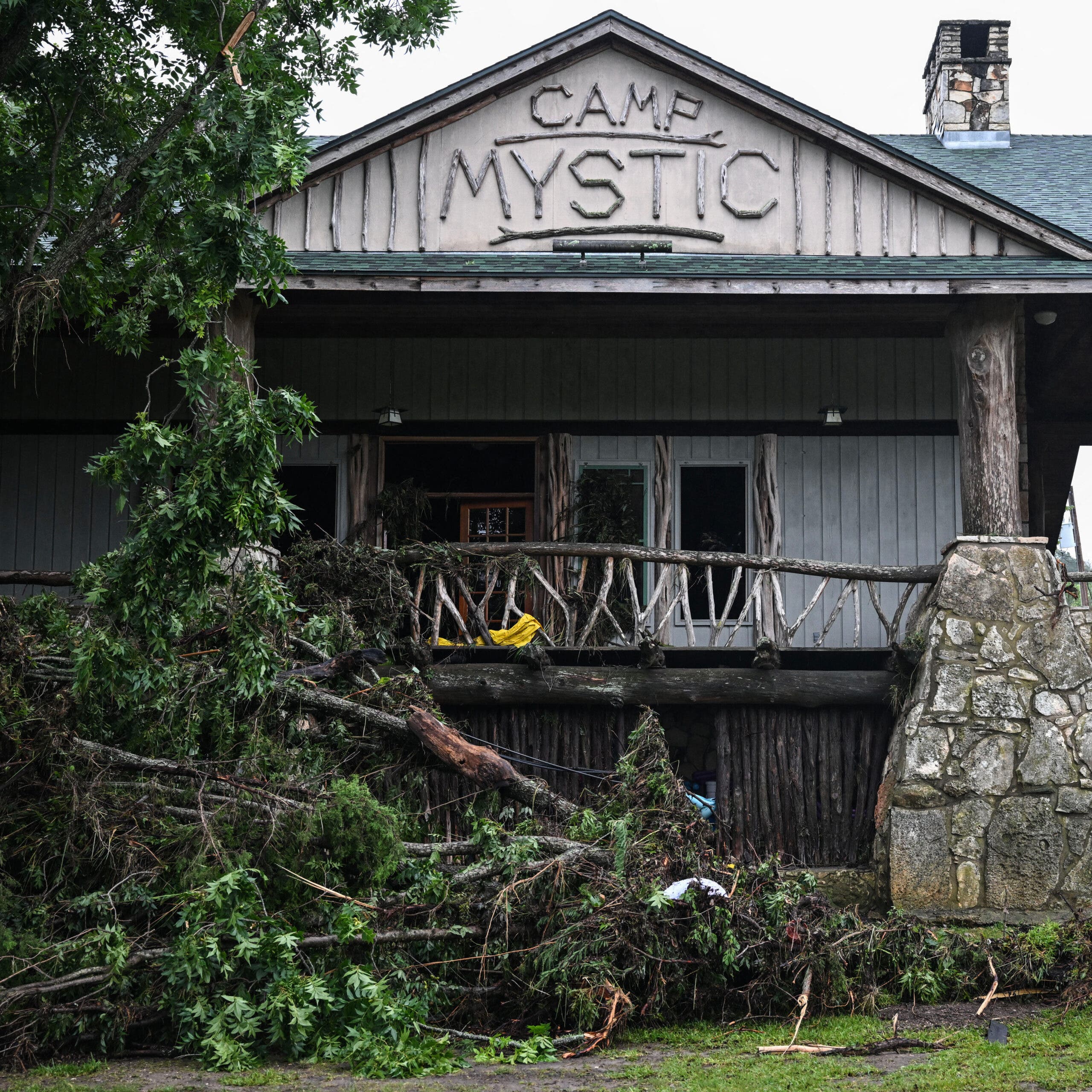
Cile (pronounced seal) Steward was staying in the Twins II cabin at Camp Mystic, in a low-lying area, a few hundred feet downstream from the camp’s recreation hall, where many of the other campers sought safety. With water running around the ankles of the Twins II campers, Cile adhered to Camp Mystic’s flood emergency protocol: to stay in her cabin and wait for help.
Jeff Ramsey and his wife had parked their airstream trailer at the HTR campground, on the banks of the Guadalupe. The campground’s previous owner often roused guests when the river began to flood, urging them to seek higher ground. But an investment group had purchased the property in 2021, and on July Fourth the warning came too late. Neighbors of the HTR campground woke that evening to the sound of screams, as the river took away vacationers still trapped in their RVs.
Entire families were killed—mothers, fathers, grandparents, and grandchildren. Twenty-five girls, aged eight to nine years old, and two teenage counselors went missing from their Camp Mystic cabins. Thirty seven HTR guests died. In April, 2026 Camp Mystic withdrew its application with the Texas Department of State Health Services to operate for the upcoming summer amid a tense hearing on how the camp responded to the floodwaters.
The tragedy activated people across the country. Over 12,300 volunteers came to Kerr County, which encompasses the upper portion of the Guadalupe River. Many of the volunteers belonged to non-profit search and rescue organizations from across Texas and around the U.S. Two SAR teams arrived from Mexico, 150 miles to the south.
Amongst the SAR teams were dogs and dog handlers certified in human remains detection (HRD) on land and water, drone operators providing aerial reconnaissance, and divers who searched the river bottom for flood victims. Deemed “unpaid professionals,” these SAR specialists undergo hundreds of hours of training in preparation for such a deployment without receiving a paycheck.
But the Guadalupe River stretches over 90 river miles from its headwaters above Camp Mystic to Canyon Lake, a large reservoir north of San Antonio. And victims could be anywhere. Every search team also needed people to drive ATVs into thick brush, chainsaw debris, and dig through rubble for missing kids. Local volunteers and people from surrounding counties filled many of these roles.
Four days after the flood, Texas Governor Gregg Abbott held a press conference in front of the demolished Hunt Store, a community gathering place where the north and south forks of the Guadalupe River merge. More than 100 lives had been claimed by the Guadalupe River flood, Abbott said, making it the state’s most deadly storm. At the time, the Texas Division of Emergency Management estimated 160 people might still be missing.
“Texas will not stop,” the Governor vowed, “until we identify and recover every single body.”
A half dozen United Cajun Navy searchers are waiting on their next assignment beneath the shade of a concrete bridge. They lean against the bed of a pick-up truck and down ice-cold energy drinks. With so many sites to search and search again, FEMA’s given Logan access to the entire river, telling him, “You’re the team we need on this.”
Overnight, the State issued a sweeping update to the missing persons count. There had been 97 people still believed missing. Now it’s just Jeff and Cile. Dump trucks belonging to debris removal contractors roll into Kerr County and the disaster response moves toward restoration of the river. The volunteer search effort is being shut down by FEMA—leaving the Texas Rangers in charge of finding the two remaining victims. FEMA’s begun removing supplies from the volunteer fire departments. It’s a Friday afternoon. After coordinating with the Federal and State SAR teams, the United Cajun Navy is extended access to the river through Sunday.
Logan gets a call. “Yes sir, yes sir,” he hangs up
“We’re going back to the gorilla,” he says, with a little grin.
“Monkey Island?” Shaun groans, “I don’t know if I can find it.”
The dirt road entrance to Monkey Island is guarded by a life-size statue of a black gorilla, giving a Monalisa stare. Around the gorilla’s neck, someone tied a green rope in the shape of a bow, the unifying memorial symbol of the flood. Monkey Island is located a few miles north of Center Point, an unincorporated community of roughly 1,700 residents, 27-miles downriver from Camp Mystic. The Guadalupe River valley widens as it approaches Center Point, and the receding flood waters left dozens of bodies on and around Monkey Island.
“This is Death Valley right here,” Shaun points across the river. “We had four recoveries on that bank, ten between the bridge and here.” Logan looks at CalTopo, the app that most of the volunteer teams use to track their searches and mark their recoveries. He adds out loud, “four, ten, twelve.” Then says, “Twenty-eight total along this stretch of river.”
Because the flood killed so many living things in its path, both animals and humans, with the receding waters came the stench of rotting flesh. At Monkey Island, what the search team members refer to as the “smell of death,” makes me dizzy and worried I might vomit. The search team members appear unfazed.
As the Center Point Volunteer Fire Department rescued people during the flood—saving a woman who clung to a tree after being carried 20-miles by the river—the rushing water came into their fire station. Much of the department’s equipment washed off. When word got out, donated supplies poured in—along with an army of volunteers. The fire chief, Charles Holt, assessed each volunteer’s skill set and assigned them various sections of the river.
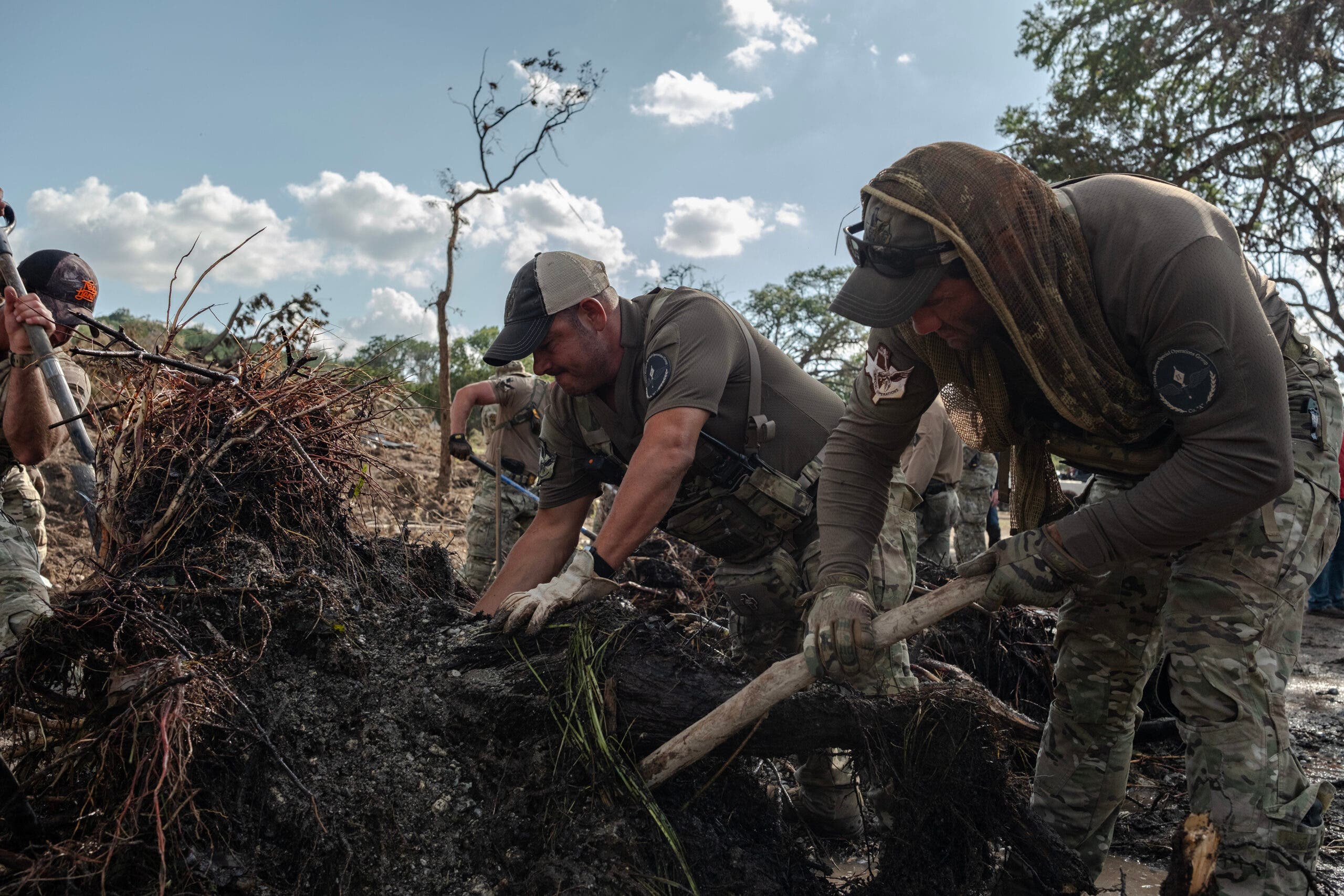
The United Cajun Navy’s incident commander, Josh Gill, felt called to Center Point, “by some driving force.” Josh, an emergency management professional who has worked well over 100 disasters, arrived in Texas from Louisiana two days after the flood. Shaun was standing amidst a crowd of volunteers when Logan pointed at him and said, “Come with me.” Luke Van Ryn, 31, joined the team not long after and soon found himself helping Shaun and Logan remove a deceased woman from a floating root ball on Monkey Island. To keep the body intact, the team spent four and a half hours excavating the woman by hand.
Someone says, “we’re trauma-bonded now,” and Luke can’t help but laugh. He’s become like a little brother to Shaun during the three weeks they’ve searched together. The pair trails the HRD dogs, prepared to dig if a dog alerts on human remains. “I swing the big mattock,” says Shaun, hoisting a heavy pickaxe that he also uses as a seat. Luke lifts a lighter digging tool, “And I swing the little mattock.”
To access the Monkey Island site that Logan has been tasked with searching today, the team climbs aboard an amphibious Ukrainian tank, known as a Sherp. The vehicle has giant, tractor-like wheels that deflate and inflate at the flip of a button and can roll over treacherously uneven river rubble. The Sherp operator, Mike Gavit, works directly with the factory in Kyiv to import Sherps from Ukraine to Houston, where they’re often bought by oil companies. As the glorified “bus driver” for search teams working Monkey Island, Gavit tells us, “I’ll try to keep your feet dry. But it is a river.”
In the hull of the Sherp, dog handler Crystal “Red” Fields is bouncing along next to Ensey, a thin shepherd who’s nicknamed “Coyote.” Red runs Team Texas K9s, the dog team working alongside the United Cajun Navy, and drove a sprinter van containing four HRD-certified search dogs to the Guadalupe River. The Sherp reaches a narrow section of the river, where rapids twist through a stand of cypress trees that somehow survived the flood. Gavit steers into the rapids and the Sherp starts to float. As we round a bend, he reverses the vehicle and runs the river while driving backwards. The Sherp teeters at a seemingly precarious angle, like we could all tumble out of the hull. Red looks anxious. “I can’t swim,” she divulges. Ensey wags her tail and calmly shifts her weight.
The Sherp finally crawls up onto a stone-strewn embankment and stops. Ensey and Red climb out and begin their search, systematically combing the area. A dog can smell eight feet into the earth, Red says. (As a training exercise, Red has her dog team members find the unembalmed remains of her dad at a cemetery.) But within this flood debris, a body could be buried much deeper. Gavit takes a drag off a cigarette and waves across a vast bank of white stones, “All this rock was dumped here by the flood.”
He asks if we saw the image of a Ford F-150, submerged vertically in the riverbank? “They dug that up right there,” he says, pointing to a wide depression left by the filled-in hole.
Red reaches down and picks up smooth stones to give to one of her grandchildren as fidgets. Of her seven grandbabies, three are on the spectrum, and living in the country, she worried they might wander off—so she began training her dogs to track. Her work escalated when the Sheriff’s office asked Red to help find missing people. Now, she trains HRD dogs for multiple counties.
Ensey doesn’t alert to any remains and the Sherp returns to Monkey Island’s volunteer aid station. There, a hollow-eyed young man, Matthew King, offers the searchers snacks and fresh socks. With the government ending the volunteer search, he’s packing up all the supplies donated for the searchers. He teaches high school math in Bandera, but after three weeks working with the search teams, he’s not sure he can return to a classroom full of kids.
In a 2010 study in the Journal of Nervous and Mental Disease, assessing the mental health of disaster response workers, scientists found volunteers suffer PTSD, intrusive thoughts, anxiety, and other negative psychological effects at a significantly higher rate than professionals, who have training, experience, and access to mental health care. Scientists also found volunteers frequently adopt a changed perspective, reporting additional “appreciation and care for their loved ones, an increased appreciation of life itself, the intensity of life, and an increased appreciation for people’s strengths.”
At Monkey Island, a lean, older man who caps wild oil wells for a living, Roy Hefley, oversaw the volunteer effort. The searchers looked forward to seeing Roy. Now, Roy’s deep into a case of Coors Light and offering teary goodbyes. He hands a couple of beers to Shaun and Luke. They stand in the river below a limestone ledge and let the cool water rush over their legs.
“You couldn’t pay me to come back here,” Shaun says. “That’s why I’m doing it for free.”
The next morning, the search teams congregate just upriver from Kerrville, in a dusty field below the Ingram Volunteer Fire Department, a steel barn near the bank of the Guadalupe. Below the rising sun, it’s muggy and already 80 degrees—the day’s high will reach well over 100.
The searchers working with the United Cajun Navy clasp hands in prayer. Josh Gill, who describes himself as spiritual but not overtly religious, paraphrases a piece of scripture the team has embraced, Isaiah 6:8. “Hey Lord, give me the hardest shit you got,” Josh says. “We wanna bleed. We wanna cry. We wanna sweat. We wanna be sore at the end of the day.” He takes an extended breath, “Give us the hard shit to do. We are here. Send us.”
Josh shows the team a picture of Cile Steward, a blonde third grader with light brown freckles who loved to ride bikes. “This is who we’re working for,” he says, as tears stream down the cheeks of tattooed and thickly bearded searchers.
The day starts at a vacation rental property owned by Jon and Robin Perrin, a middle-aged couple who returned to Robin’s hometown of Kerrville after spending 13-years as Christian missionaries in Europe. Robin rests on a concrete wall, the remnants of a riverside dock, and watches Josh paddle a green canoe carrying Lawrence and Aurnia. They look for bubbles rising to the surface of the river and patches of oily, rainbow-streaked residue, both signs of decomposing tissue. Aurnia is certified to search on water and can smell as deep as 60 feet down. Logan puts on a wetsuit and uses a handheld sonar device to scan beneath the river’s surface for human remains. Another searcher, Heather Reagan, wades into an eddy swirling with flood debris and pushes it back into the river flow.
Previous search teams found the bodies of two flood victims on the Perrin’s property, a two-story house overlooking a city park called Tranquility Island. Families booked the rental almost year-round, but Robin’s not sure they will ever re-list the home. When the searchers arrive, Robin’s childhood friend, Kim Richards, also comes over. Richards makes small talk and invites the searchers to a cookout at a ranch in Mountain Home, where they can fire semi-automatic rifles and enjoy a Bourbon cocktail. Josh gladly accepts. He knows talking helps and that the community wants to connect with the searchers, to thank them.
What floods do to bodies is disturbing, Josh tells me. Spear-like flood debris strips the body bare. They only found one person wearing clothing—and it was just the person’s shoes. Ears and noses are removed from heads. Arms and heads are separated from torsos. The search team hopes to give the Perrin family some solace that the property is “clear,” a word the searchers spray paint on brush piles and tree trunks. The marking means their team didn’t find any bodies.
Success for search teams isn’t necessarily measured by finding people—or not finding people. The team members focus on how diligently they search and how many sites they can search in a single day. Still, anytime they can provide some closure? That’s a good day.
To quickly scale response efforts following major disasters, government and volunteer organizations use a tiered flowchart called the Incident Command Structure, or ICS. Using the common language of ICS, federal and state agencies like FEMA and the Texas Department of Emergency Management can effectively coordinate with local entities, such as County Sheriffs and fire departments. Government agencies with local knowledge typically lead the ground-level rescue and recovery efforts, and often outsource the search for victims to volunteer groups like the United Cajun Navy.
As the incident commander for the United Cajun Navy, Josh says his first point of contact was the Center Point Volunteer Fire Department. “We reached out and said, ‘Hey, here’s who we are and here are the assets we have,’” says Josh. “We’re going to mobilize and help you out, but we want to fall under your command and control so you’ve got full visibility on everything we’re doing.”
As the need for search teams in Center Point lessened, the FEMA department that oversees search, rescue, and recovery operations (Emergency Support Function #9) reassigned the United Cajun Navy to the area around Hunt, 22-miles up the Guadalupe River, where Josh’s team assisted another non-profit organization, Aerial Recovery. “We do not self-deploy,” Josh says. “We work under the auspices of the lead local law enforcement or come in under the request of the family, who help coordinate our presence with law enforcement.”
Funded entirely by donations, the United Cajun Navy does not offer any compensation, instead relying on a network of volunteers numbering in the thousands. In some instances, volunteers are reimbursed for travel and lodging expenses. Rather than manage and support its own dog teams, the United Cajun Navy partners with certified non-profit groups like Team Texas K9s, which specialize in training and equipping dogs and dog handlers to find missing disaster victims.
Prior to the Guadalupe River Flood, in 2025 the United Cajun Navy had already deployed to flooding in Washington state, Hurricane Melissa, Typhoon Halong in Alaska, and a tornado in Tylertown, Mississippi. Listing off the various disaster responses a few months into 2026—Winter Storm Fern in the Southeast U.S., fires in Oklahoma, Kansas, and Mississippi, and tornadoes in Illinois, Josh says, “We’ve had a lot, it’s been a busy year.”
The Guadalupe River flood stands out, though, Josh says. Due to the sheer geographic area along the length of the river, “every square inch had to be searched, which was a monumental effort.” Beyond those directly affected by the floods, Josh says the horror of the disaster impacted more people than we know. “The whole nation watched it on TV,” he says.
I ask Josh if he thinks climate change plays a role in the increasing number of severe storms. “The strength of storms, and the frequency of storms, it’s very concerning,” he tells me. “But I’m not a meteorologist that can say, hey, climate change is the cause of them. It wouldn’t be fair for me to answer that one.”
In 2024, the climatologist for the State of Texas, John Nielsen-Gammon, produced a government-sponsored report titled “Assessment of Historic and Future Trends of Extreme Weather in Texas,” from 1900 looking forward to 2036. Nielsen-Gammon, a professor of atmospheric sciences at Texas A&M University, wrote that “Texas ranked highest amongst the United States in flood-related fatalities during 1959-2005.” Due to climate change, Nielsen-Gammon expected extreme rainfall to increase by 100 percent in comparison to the period from 1950 to 1999. “Increased precipitation intensity will lead to more precipitation-runoff events that suggest more river flooding in the future,” the report stated.
Summarizing the impact of climate change on the state, Neilson Gammon wrote: “The future of Texas depends on its resilience to the natural hazards of the future. It is up to Texans, both individually and collectively, to decide what level of resilience is appropriate, and at what cost, compared to the costs of damage and recovery on both an economic and societal level.”
Few of the searchers I talk to along the Guadalupe River believe the State’s assessment that the flood claimed 119 victims in total, and that only two remain missing. They’re certain more people were killed by the flood—and more remain missing. “I recovered 25 bodies,” a drone operator from North Carolina, Charlie Golden of GB Rescue, tells me. “How many did everyone else find?”
The searchers ask about the homeless population and immigrant families. Were they accounted for? Walking a river tributary with Josh one afternoon, I ask him, “But why would the government lie?” Josh is blunt. “They don’t want to look bad,” he says.
“So they just don’t count the poor people?” I say.
“Nope,” he replies.
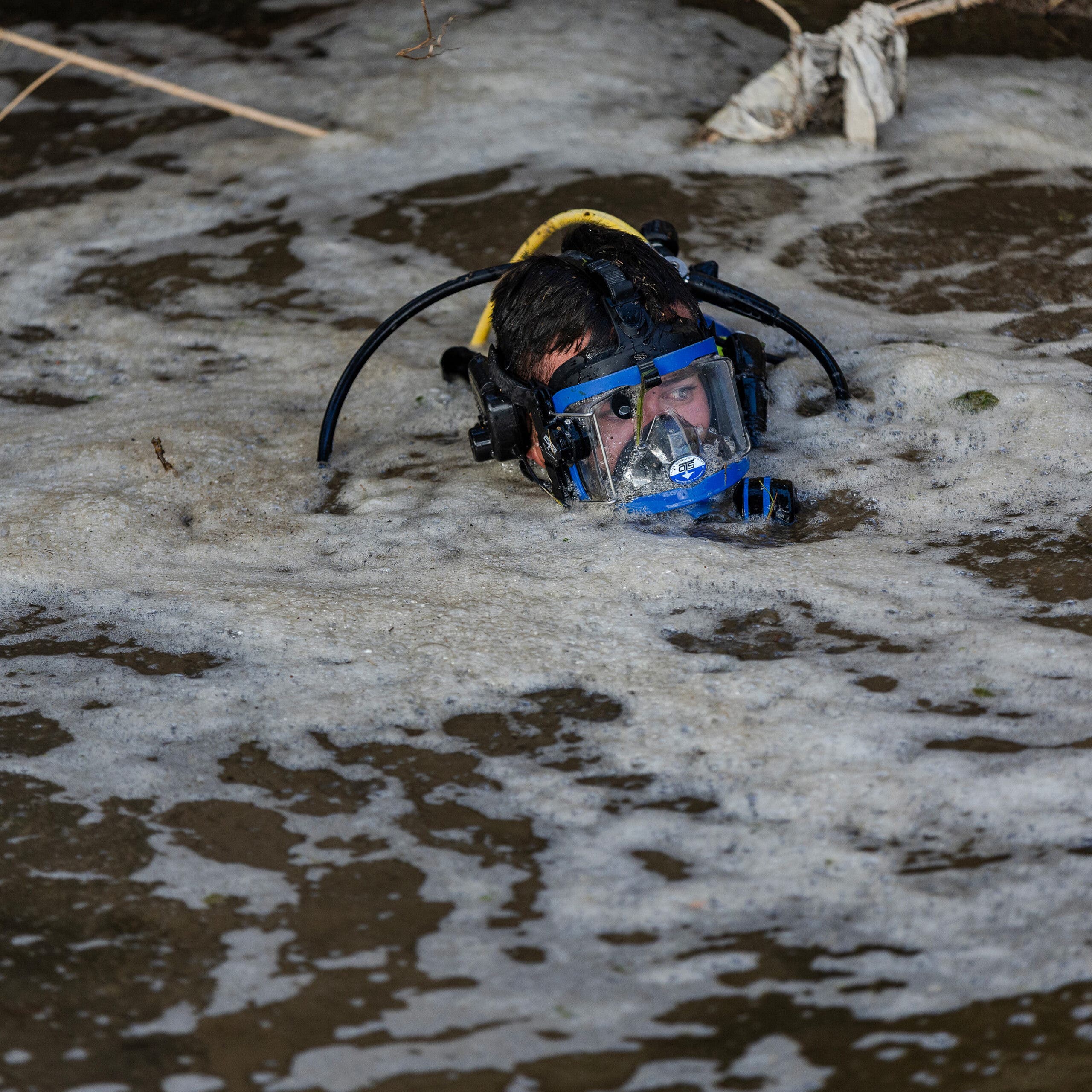
On the final day of the volunteer search effort, family members arrive at the river, praying for news. One of the families follows a search team composed of former Navy SEALs, Valor Response. The team is using multi-million-dollar sonar equipment donated by Oceaneering and Garmin to scan the river bottom. James Jackson, who founded Valor Response, calls the search “Operation Closure.”
Staring out at the river, watching a member of his team paddle Lawrence and Aurnia out to a brush-laden island, I ask James how this mission compares to those he performed as a SEAL. “So much harder,” he says quietly. Long after the flood, he continues to think about the ravine where he came across the body of a teenage counselor from Camp Mystic. When state legislators convene in Kerrville for a hearing on the flood, Jackson waits 14 hours to offer public testimony. He wants to make sure the victim’s families learn where the searchers found their children.
At a site not too far downstream from Kerrville, dozens of volunteers have congregated at a property where the bodies of ten flood victims were found.
A fresh crop of volunteers, eager to help. Someone pulls a cow bone out of a grocery bag and asks if Aurnia can smell it. “That’s not human,” Lawrence tells the volunteer. This is the first disaster Aurnia has worked on, and she hasn’t helped make a recovery yet. Lawrence desperately wants Aurnia to alert on potential remains, to help find someone, but he trusts her and the training they’ve done.
Josh calls the dog handlers and searchers he worked with on the Guadalupe River, “the best I’ve ever seen.” A month after returning to Louisiana from the Guadalupe River, he oversees a United Cajun Navy search for Bryan Vasquez, a 12-year-old boy from New Orleans who’s been missing for almost two weeks. “We need you,” he tells Red and Lawrence. Red brings her hound dog, Boogie, who tracks Vasquez from his bedroom, down a neighborhood street to a nearby pond. Aurnia leads Lawrence to the same place. They put the dogs on a boat, and both Boogie and Aurnia alert to human remains. A drone operator soon locates Vasquez’s body in the pond. An autopsy later states the boy was killed by an alligator.
Shaun and Luke get a similar call from Josh in January. The United Cajun Navy needs help finding another 12-year-old boy, Ryan “RJ” Cole, who disappeared in rural Oklahoma and hasn’t been seen for nine days. Oklahoma state police charge RJ’s stepfather with multiple counts of abuse and mobilize hundreds of people to search for the boy. Shaun, Luke, and another search team member they worked with on the Guadalupe River, Thomas Gentile, find the boy alive, hiding in a shack. When RJ sees the search team, he begins apologizing, “I’m sorry, I’m sorry.” Luke hugs the boy, “You’re safe. No one is going to hurt you anymore.”
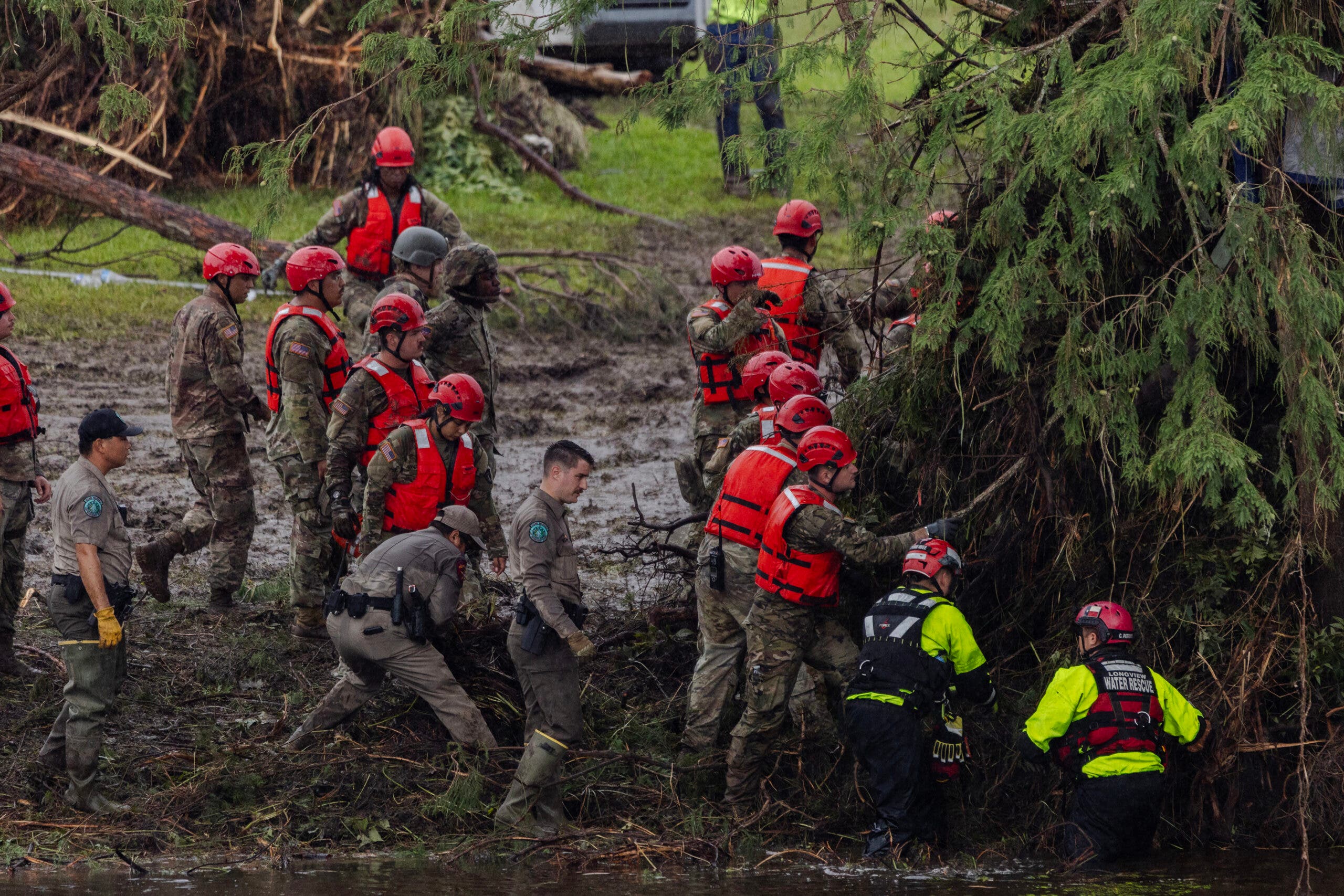
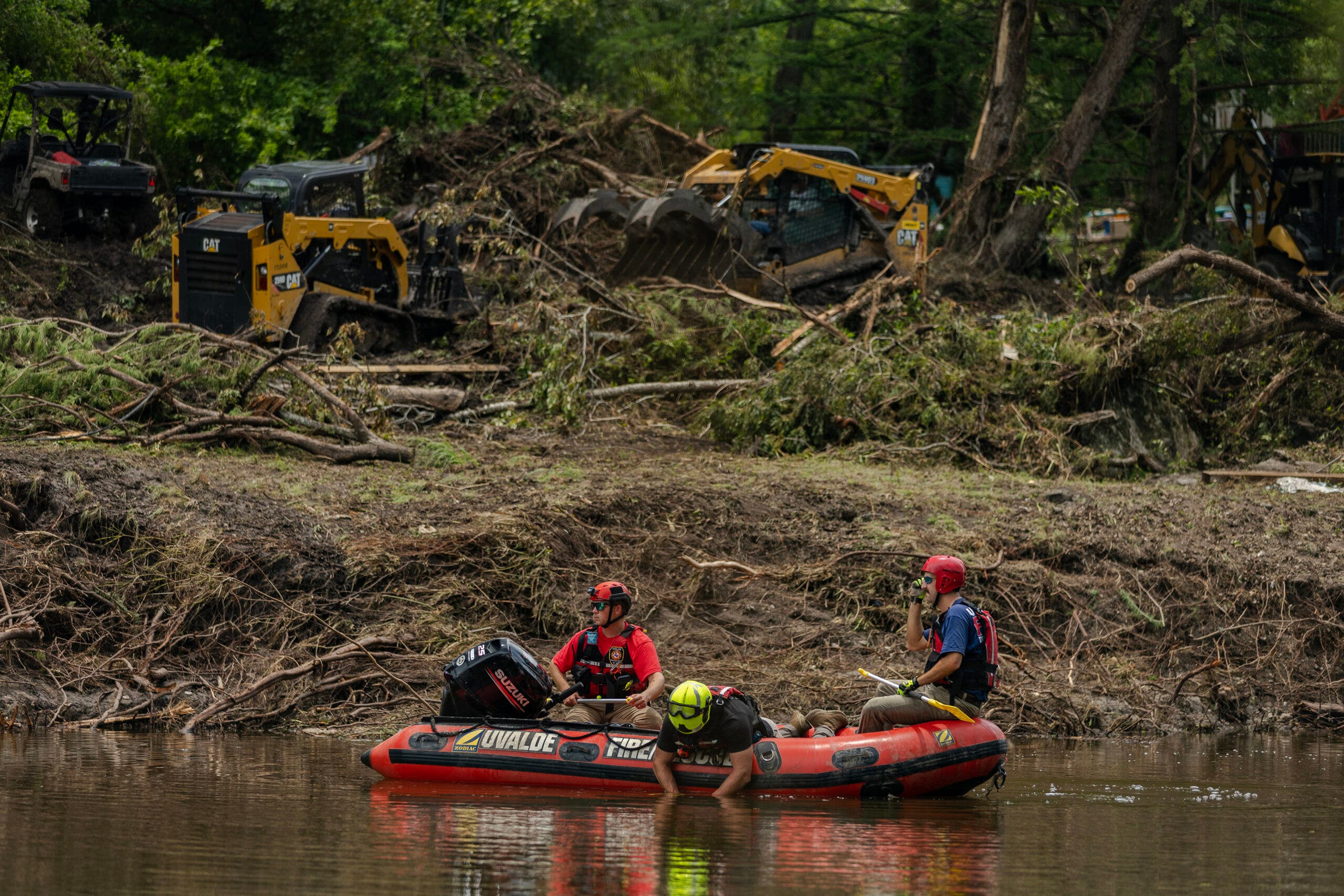
In the months after the State-sanctioned volunteer search ends, searchers from various teams coalesce under a new non-profit, Rampart Vigilance, determined to find Cile, the last Mystic camper still missing. The group is led by Aaron Tapley, a retired Army counterintelligence special agent from San Antonio. Following the flood, Aaron searched the length of the Guadalupe River multiple times, hiking from above Camp Mystic to below Center Point—up to 20 miles a day.
After the state closed off river access to volunteer teams, he began connecting directly with property owners. Rampart Vigilance divers outfitted in scuba gear remove dangerous river debris for property owners—trailer loads of sheet metal and other sharp objects—while simultaneously searching for Cile. “How can you call an area clear until you’ve actually looked under every rock,” says Kerri Peacock, who leads the group’s day-to-day operations.
A few days before Thanksgiving, the Rampart Vigilance team is cautiously excavating a riverside landing where a search dog from Ohio alerted to potential human remains. The deep, straight section of river is about three miles downstream from Camp Mystic. The dog handler, Dylan Dudley of First In Last Out Ministries, says he couldn’t sleep, knowing Cile was still out there. He’s traveled back twice in the months following the flood and spent weeks searching the river.
A diver from the Houston area, Jack Goodroe, comes to the surface with a Camp Mystic T-shirt. When the team finds personal items from the flood, they take them to Dondi Persyn, who reunites items with their owners or the owners’ families. Aaron reads a name tag still stuck to the shirt collar, “Lucy Dillon,” an eight-year-old girl from the Houston area who had long brown hair and glasses, a gifted student and passionate basketball player. After they’re done searching for the day, Aaron brings personal items they pulled from the river to Dondi, Lucy’s shirt, and the broken remnants of Camp Mystic bunk beds, bearing the playful wood carvings of the campers who slept in them.
Dondi started as a searcher near Monkey Island. After assisting in the recovery of a flood victim’s body, she realized, “This isn’t why you were called to the river.” Within an active disaster zone, searchers rarely break their focus to collect personal items. (Though some things cut through: a little girl’s pink jewelry box, for example, placed on a bluff above the river, like a shrine.) Seeing the need to return personal belongings, Dondi began collecting them from the banks of the river and posting them on a Facebook group, Found on the Guadalupe. The Facebook page went viral.
When she receives Lucy’s shirt, Dondi first steeps the shirt in vinegar. Then she lets the shirt sit in OxiClean and Dawn dish soap. After laying the shirt flat and power-washing it at a car wash, she takes it to a laundromat. “That’s the system we’ve found works best for getting all of the river out of the clothing,” she says.
Dondi works out of an old jewelry shop near the Guadalupe River in Ingram. She keeps the restored Camp Mystic clothing, jewelry, and stuffed animals behind a closed door, in a separate room with white walls and individual bins marked with the name of each camper.
Lucy’s freshly cleaned Camp Mystic shirt is folded and placed in a small wicker basket, then wrapped with a green bow. The families of the flood victims often come on scheduled “reunification days” to receive their child’s items in person. “Some families want everything, some families just want some things,” Dondi says. Oddly, the searchers haven’t found any of Cile Steward’s belongings.
But the belongings aren’t a priority. Dondi says, “They want her body.”
