

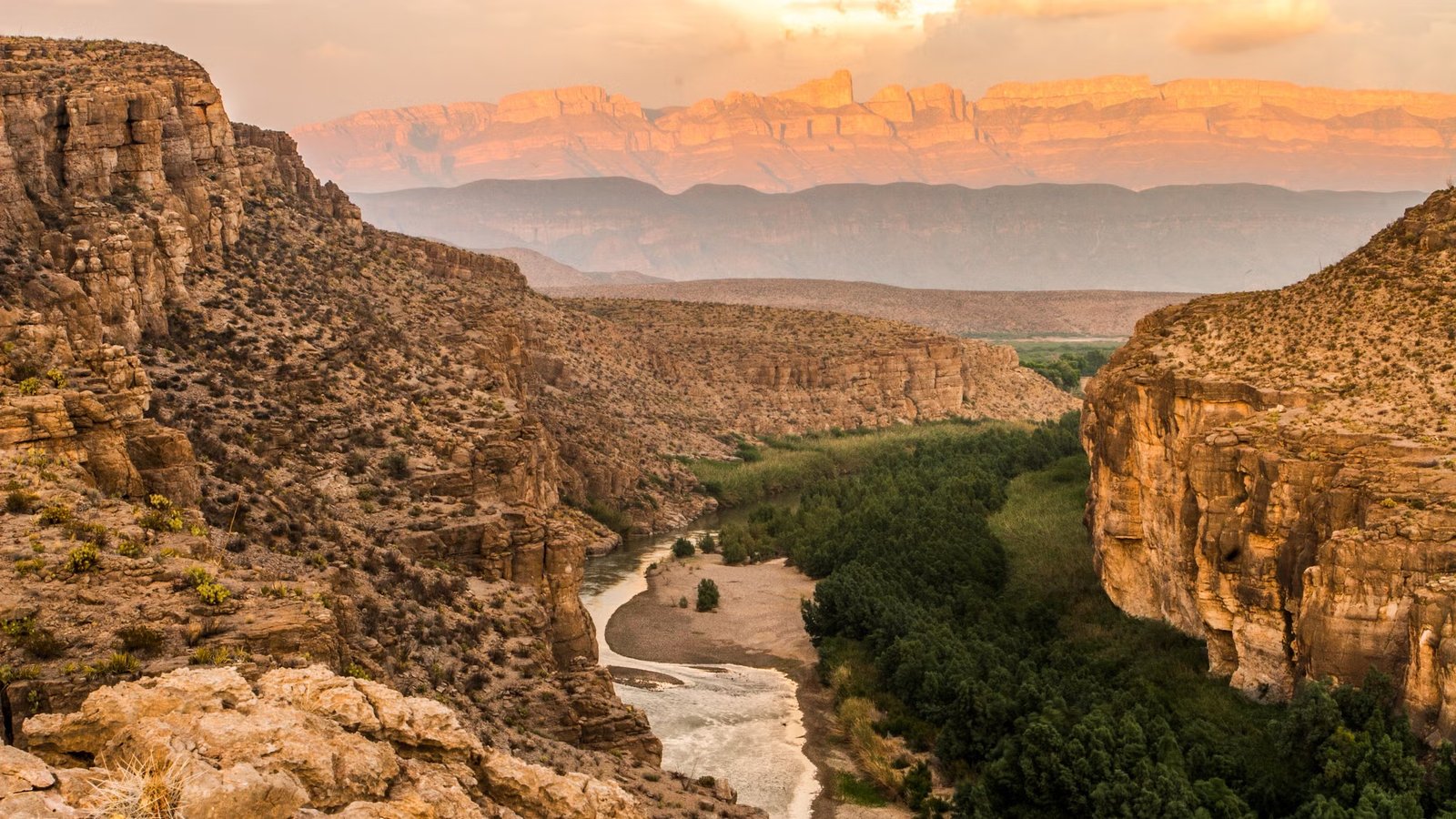
In the most remote corners of the Chihuahuan Desert, federal officials say they are now betting that vertical limestone walls and cutting-edge surveillance will be more effective—and sustainable—than a physical fence.
Planning for the wall began in January 2025, after Trump signed a proclamation to build a “Smart Wall” along the U.S-Mexico (Photo: David Goodell/500px via Getty Images)
Published May 11, 2026 03:34PM
Following bipartisan backlash over a proposed border wall through Big Bend National Park in Texas, Customs and Border Patrol (CBP) is reportedly scrapping plans for a physical barrier. Instead, the agency says it will rely on natural terrain and smart technology to guard the U.S.-Mexico border.
According to a report by The Washington Examiner, CBP Commissioner Rodney Scott said the remote Texas landscape is better protected by natural barriers and surveillance technology than a physical wall. The report comes amid confusion about the future of the proposed wall. The Trump administration previously waived 28 environmental laws for its construction, and maps detailing its location have been published, erased, and then updated. Neither the Department of the Interior nor the Trump administration has released a statement confirming the decision.
In an email to Outside, the CBP said the agency instead plans to “leverage advanced technology and the area’s natural terrain” to secure the border in the Big Bend region, in lieu of a wall.
“By deploying cameras, sensors, and barriers in strategic areas, CBP is restricting unlawful vehicle access while utilizing the natural barriers that already exist in the area,” a spokesperson told Outside. “In locations where minimal barriers may be adjacent to parks, we are actively coordinating with park officials to ensure the alignment does not impede recreational access or activities.”
Additionally, CBP says it will also use and improve existing public and park roads to provide agents with continued access along the border.
In January 2025, Trump signed a proclamation to build a smart wall along the U.S-Mexico border using funds from his One Big, Beautiful Bill Act. The barrier through the 800,000-acre Big Bend National Park, which shares a 118-mile border with Mexico, is just one portion of a project that will eventually span nearly 2,000 miles. The CBP said that this section, covering around a quarter of the U.S.-Mexico border, some 535 miles, won’t have a traditional wall due to the rugged, remote terrain. The agency will instead monitor these areas using “detection technology,” such as cameras and spotlights.
On February 17, the Department of Homeland Security waived 28 laws—including parts of the Endangered Species Act, Clean Water Act, and Clean Air Act—to move forward with plans to build portions of the border wall through Big Bend. An interactive map on the CBP website then began to show portions of the planned Smart Wall through parts of the park.
These plans quickly met with widespread bipartisan backlash. Advocacy groups, like the National Park Conservation Association (NPCA), also pushed back, arguing that the wall could both disturb archaeological sites and harm local wildlife by cutting them off from the Rio Grande.
“Building a wall here makes no logistical sense and only serves to harm the region’s wild scenery and thriving community-based tourism economy,” said NPCA Texas Regional Director Cary Dupuy in a statement published February 18.
In early March, a group of Texas sheriffs from five counties bordering the wall wrote to federal and state officials arguing against its construction. In April, local residents and nonprofits, aided by the Center for Biological Diversity, sued the Trump administration, arguing that it had illegally waived laws to build the wall.
The CBP quietly took down the interactive map of their planned wall in late April. Now, judging from Scott’s comments, it appears that the border wall will no longer exist as a traditional wall at all, at least inside Big Bend National Park.
