

Published May 21, 2026 03:30AM
On Saturday, May 2, I was walking through Camp 4 overflow parking lot in Yosemite National Park when my phone rang. “I just got ice cream, and I’m heading to El Cap Meadow to hang,” my friend Katy said. “Want to meet me there?”
I told her yes, but I’d be taking the bus. There was no chance in hell I’d drive my car and risk losing my parking spot.
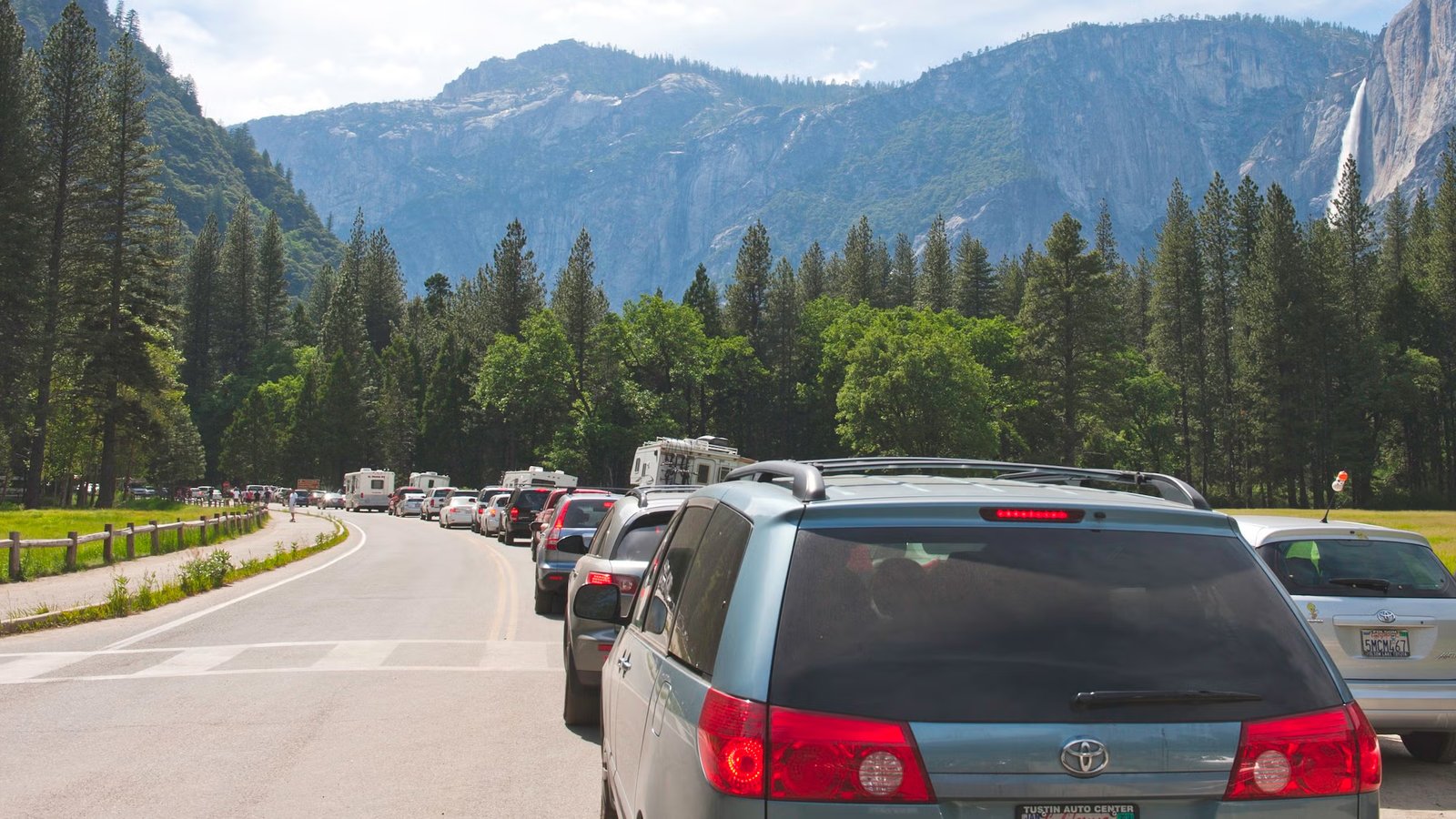
Yosemite’s parking lots that day, the first major weekend of a nervously anticipated season with no entry limits, could reasonably be described as apocalyptic. Cars squeezed between trees and rocks, onto curbs, and into the dirt on both sides of the road. On my 500-foot walk to the Lodge shuttle stop, five separate drivers flagged me down to ask if I was leaving the lot.
“Sorry!” I replied.
As I moved through the lot, the situation only got worse. The shuttle itself was trapped by an illegally parked car, which was being loaded onto a tow truck by the time I got in line. I counted two more tow trucks in the same lot, removing cars that were parked at odd angles. When I finally stepped onto the bus, I took a window seat and gaped at the line of cars parked along the roadside. It extended for the entire 1.8-mile stretch from Camp 4 to the El Cap picnic area.
Parking along this road is illegal, and every single driver was breaking the rules.
“This is crazy,” I told my partner. I couldn’t help but pity the hundreds of tourists who were getting ticketed, towed, or trapped on the road. What’s the point of driving all the way here if you can’t even get out of your car?
Ditching Reservations Opens the Door for Crowds
For the past five years, Yosemite officials have conducted a careful set of experiments with a timed-entry reservation system, only to find its conclusions overridden by a federal order. Back in 2019, the park experienced 4.42 million visitors, its highest number since records began in 1906. In 2020, after the park shut down for three months, administrators introduced the first iteration of the reservation system in order to contain the spread of COVID-19. Day-use reservations were required for the majority of visitors. Anyone who didn’t book lodging in advance, enter via public transit, or have a wilderness or Half Dome permit needed a reservation. This continued throughout 2020 and 2021, shifting in 2022 to a “peak hours” reservation system for entrants between 6 A.M. and 4 P.M. each day.
Then, in 2023, Yosemite temporarily halted reservations, with an exception for the last three weekends of February, when the park usually gets slammed for Firefall. But doing away with the system had consequences. According to a 224-page NPS report on park visitation, the 2023 season saw “long lines at entrance stations and increased strain on the park’s employees, resources, and infrastructure.”
“I was here in 2023, and it was a shit show,” said one employee of the concessionaire Aramark, which oversees hospitality and food service in the park. The employee requested anonymity because they were not authorized to speak to the media. A survey conducted in 2023 found that 51 percent of visitors said they were negatively affected by parking shortages. An additional 26 percent said that crowding at restrooms and visitor centers negatively impacted their visit.
Having presumably learned their lesson in 2023, NPS officials brought back entry limits in 2024 and 2025 in a more limited, precise form: reservations would be required every day in the busy summer period, but only on weekends in the spring and fall. In August 2024, the park released a 224-page draft management plan that outlined and compared four different reservation systems, concluding that a parkwide reservation requirement during peak hours (5 A.M to 4 P.M.) would be the best option for managing the crowds. Already, the numbers were ticking up; 2025 saw 4.27 million visitors for Yosemite, nearly as many as before COVID-19.
In 2024, I worked in Yosemite as a Climber Steward, a position managed by the park’s nonprofit, Yosemite Conservancy, that offers advice and guidance to climbers. I came back to visit in June 2025, and both times, often drove between the park’s most crowded areas: Yosemite Village, Yosemite Lodge, Camp 4, and El Cap Meadow. Although lines were sometimes long, and I occasionally had trouble finding parking, I was never seriously delayed or hampered by the crowds. It seemed that Yosemite finally had its ideal rules to manage visitation capacity.
However, on April 3, 2025, Interior Secretary Doug Burgam ordered all national parks to remain “open and accessible.” Following that, on February 18, 2026, Yosemite Superintendent Ray McPadden announced that the NPS would do away with reservations in 2026. A March 2026 survey by the Yosemite Union showed that 85 percent of the 135 verified employee responses did not approve of Superintendent McPadden’s decision, predicting that no entry limit would lead to angry, disappointed, and exasperated guests who take out their frustrations on frontline workers. As of now, more than 300 staff members have publicly called for this decision to be reversed.
What to Expect
This spring, I returned to Yosemite to report on climbing for Outside’s sister publication, Climbing. Since the season’s opening, on Saturdays, I have seen the same clogged parking lots, miles-long entrance lines, and illegally parked cars that I saw on May 2. However, as summer approaches—and as monthly visitation nearly doubles between May and July—employees are steeling themselves for an unwinnable battle. In early May, one staff member in concessions told me that they predict the traditional Saturday crowding to become an everyday situation in June.
“Really?” I asked the worker, astounded. “Every single day?”
They nodded with a grim expression, the same I’d seen on every other Yosemite worker I’d asked about this topic: on guard and tired already.
Tourists are also feeling the impact of an unrestricted entrance policy. One visiting rock climber told me that the few restaurants in the park are overwhelmed by the crowds. During a recent trip to Curry Village, a collection of shops, lodges, and eateries near Half Dome, he saw hundreds of people waiting in line to get into the two restaurants. “I just got off Half Dome and went to Curry [Village] for a chill pizza moment,” he told me. “There were lines out the door everywhere; it was a total junk show. I had never seen this many people in my life.”
How to Visit Yosemite and Beat the Crowds
Amid the crowding and congestion, many readers may be planning to visit Yosemite National Park this summer. The good news is that, with some careful planning, you can sidestep the congestion. Here are four tips to hopefully save you some headaches during your visit.
1. Avoid Weekends, Especially Saturdays
Currently, Saturday is the only day when parking in Yosemite feels downright impossible. However, this will likely expand to Sunday, Friday, and beyond as the summer crowds draw nearer. For now, scheduling your visit from Monday to Thursday will give you the best chance of avoiding long entrance lines and full parking lots.
If you absolutely have to visit on a busy day, such as a Saturday or the upcoming Memorial Day weekend, it’s ideal to get to the entrance station in the early mornings (before 5 A.M.) or evenings (after 7 P.M.). You’re much better off getting an early start, entering without fuss, and finding a cool spot to nap by the river than being stuck for miles in a never-ending line.
2. Ditch Your Car for Public Transit
YARTS runs a bus service that splits from Yosemite Village in all directions: north to Sonora, west to Merced, south to Fresno, and east to Mammoth Lakes. Tickets run around $20 per person, and guess what? You won’t have to worry about parking at all.
Once you’re in the park, the Yosemite shuttle is free, although it only runs until 10 P.M. If you plan to be out after that, plan for a nice summer walk back to your camp spot.
3. Bring or Rent a Bike
If you have to put yourself through Yosemite’s parking hell, don’t make yourself do it more than once. Bring your own bike—I bought mine for $98 at Walmart, and you can get secondhand bikes for half that price on Facebook Marketplace—and get ready to hit all of Yosemite’s best tourist spots within just 10 to 15 minutes. Most of the Valley, especially the east side, features paved bike paths that pass under gorgeous redwood canopies. Honestly, biking is the most thrilling way to travel around Yosemite, even when it’s not crowded.
No bike, and no time to buy one? Yosemite offers daily bike rentals and helmets at the Lodge, Curry Village, and next to the Village Store, but beware: These can sell out within the first hour of the day, especially on weekends. A full day can cost up to $48, and all bikes must be returned by 6:45 P.M. Still, this beats spending most of your day looking for parking.
4. Pack Your Own Food
Some of the longest lines are at Yosemite’s few restaurants, especially during midday and after 5 P.M. To avoid this, it’s best to plan ahead and eat at camp or around the park. Instead of standing in line with a pager at Curry’s Pizza Deck, head to the Village Store early to grab your snacks. If they’re pre-cooked, stuff some utensils and blankets into your backpack and bike over to a lovely meadow or riverbank to enjoy it. If they need a proper grill, head back to your campsite and enjoy a group meal under the redwoods. Just make sure to observe proper Yosemite food storage, keeping it always in a bear box when you’re not around.
