

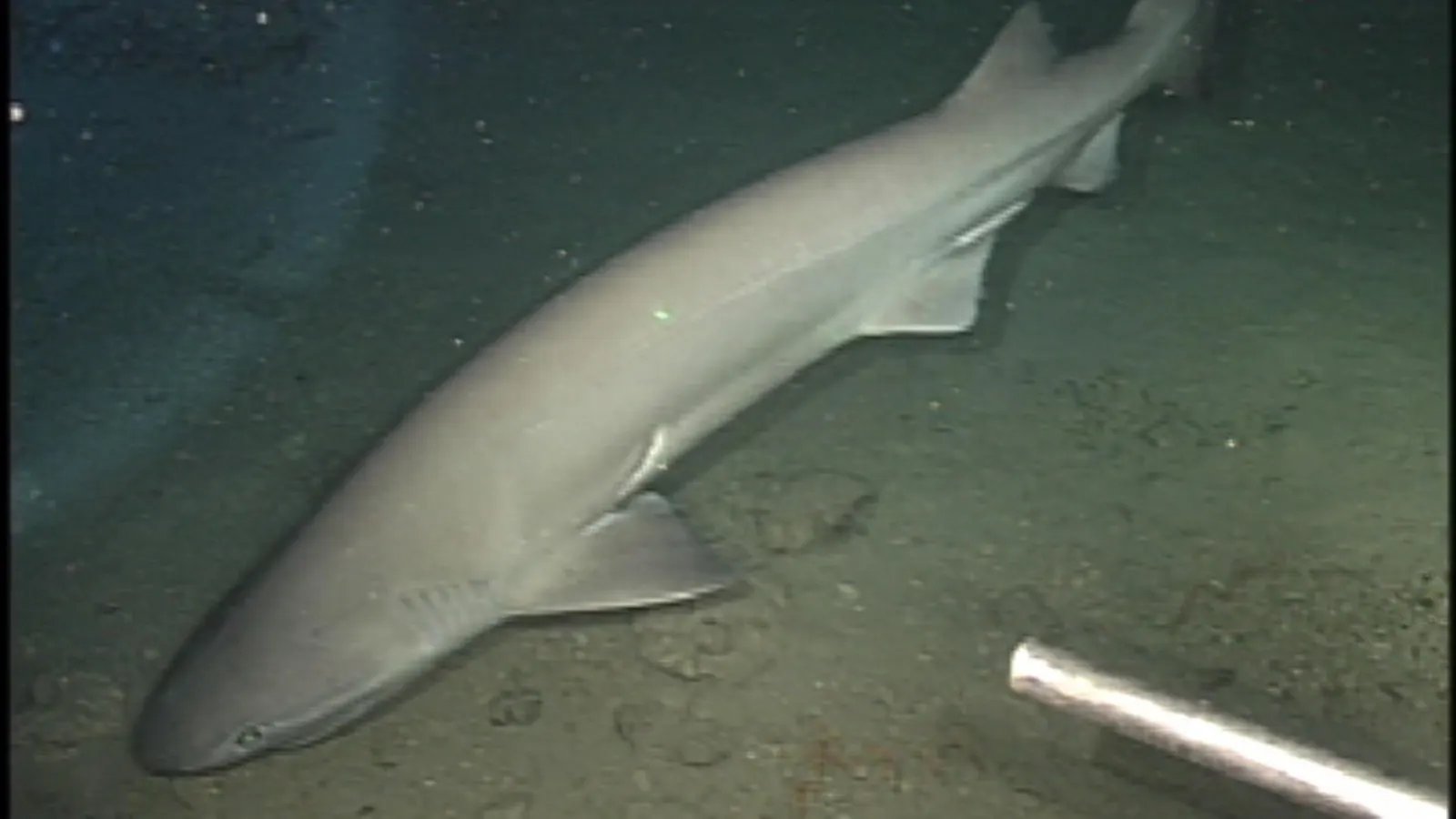
Six-gill shark swimming in for an inspection of the Eye-in-the-Sea (Photo by: Universal History Archive/Universal Images Group via Getty Images)
Universal Images Group via Getty Images
There are sharks — like the sleek reef sharks people plaster on beach warning signs or the torpedo-shaped great whites of documentaries — and then… there are sharks. Sharks like the frilled shark (Chlamydoselachus anguineus), that look less like an animal and more like a fossil that had accidentally wandered into the modern world with its eel-like body and rows of needle-like teeth that sit exposed in a permanent grin. Those do not look like the general picture people pull up in their minds when you say the word “shark.” Instead, they look like something evolution forgot to update. Now, new research suggests that impression may not be far from the truth.
Scientists have long grouped sharks together as a natural evolutionary unit, meaning every shark species shares a common ancestor that rays and skates do not. It is one of those assumptions that became foundational in biology classrooms, museum exhibits and conservation discussions. Sharks are sharks. Rays are rays. Simple, right? Except a new genetic analysis posted to the preprint server bioRxiv challenges that long-standing “simple” view. The study, led by evolutionary biologist and PhD Candidate Chase Doran Brownstein and American evolutionary ichthyologist Dr. Thomas J. Near at Yale University, examined the genomes of 48 cartilaginous fish species (including sharks, rays, skates and chimaeras) to reconstruct the evolutionary family tree of one of Earth’s oldest vertebrate groups.
What they found instead was a scientific headache because depending on which parts of the genome they analyzed, the evolutionary tree changed shape. Protein-coding genes, the stretches of DNA that contain instructions for building proteins, supported the traditional idea that sharks form their own exclusive branch on the tree of life. But another type of genomic data, called ultraconserved elements, told a different story; those sequences suggested that Hexanchiformes, the group that includes frilled sharks and cow sharks, split away early and may actually represent a sister lineage to all other sharks, rays and skates. In other words: some sharks might be less closely related to other sharks than previously thought.
That sounds like an obscure taxonomic fun fact you can only whip out during trivia night in a pub until you realize how deeply it cuts into our understanding of vertebrate evolution because cartilaginous fishes, known collectively as Chondrichthyes, have existed for at least 439 million years. They evolved before trees colonized land.
Before dinosaurs.
Before flowers.
They are one of the oldest surviving branches of jawed vertebrates alive today. And jaws matter because the evolution of jaws transformed life on Earth. It allowed animals to grab, crush, slice and manipulate food in entirely new ways. The ancestors of sharks and rays were among the first vertebrates experimenting with these innovations so if scientists have misunderstood how these animals are related, it could fundamentally change how researchers interpret the evolution of jaws, body plans, reproductive strategies and even genome size itself!
Frilled sharks specimen in a museum.
getty
Hexanchiformes as a whole are an especially intriguing group of animals to begin with, as they retain anatomical traits considered “ancient.” For example, most sharks possess five gill slits while frilled sharks and cow sharks have six or seven. Their jaw suspension also resembles older vertebrate conditions seen in fossil species. For decades, scientists debated whether these characteristics were primitive leftovers or later evolutionary reversals and this new research leans toward the first explanation. These sharks may genuinely represent a very old branch of the elasmobranch family tree! That possibility reframes these sharks entirely so they stop being evolutionary oddities and instead become actual living time portals into our planet’s distant past.
But not everyone is convinced that is the case. Some evolutionary biologists caution against treating genomic data as the ultimate authority, and Dr. Gavin Naylor of the Florida Museum of Natural History (who was not involved in this study) told Nature’s Ewen Callaway, “People revere sequence information more than they should.” Relying too heavily on sequence data can create blind spots, especially when studying lineages separated by hundreds of millions of years as DNA changes accumulate, disappear and sometimes converge independently. So, yes, the study does not provide a neat answer, but it does expose an uncertainty in the storyline we’ve been telling for quite some time now. While we might imagine science as a process of gradually replacing wrong ideas with correct ones, the real scientific method is usually messier. New technologies open doors that older methods could not, sure, but that means they also introduce fresh contradictions. Even the researchers involved in this new work acknowledge that the root of the shark family tree remains a “hard phylogenetic problem.” Translation: evolution happened a very long time ago and the evidence is frustratingly incomplete.
Humans love categories. We crave clean boundaries around things. Shark. Ray. Fish. Mammal. Yet evolution likes to sometimes branch out, overlap and leave behind some… weird… survivors from the ancient experiments it used to do back in the day. And that’s exciting, because as Brownstein told Nature, “Sharks hold more evolutionary history than any other vertebrate lineage. We need a good tree to understand what we stand to lose.” If ancient lineages like Hexanchiformes truly sit near the base of the shark family tree, losing them to overfishing or habitat destruction would erase disproportionately deep evolutionary heritage. Although the cartilaginous fish have survived the last five extinctions our planet has faces, more than a third of shark and ray species are threatened with extinction due to overfishing, habitat loss and climate change. And many deep-sea species, including sixgill sharks and frilled sharks, remain poorly studied despite their potential evolutionary importance.
So what happens if future research confirms that some sharks are not really “true sharks” in the way scientists once thought? Honestly, probably not much in everyday life. It’s not like aquariums will tear down exhibits overnight or your average person will refer to some species as “false sharks.” But in biology, redefining relationships reshapes the questions scientists ask around anatomy, genetics and ecology. It will impact how we interpret fossils and reconstruct ancient ecosystems. Somewhere in our deep ocean, a frilled shark is unaware that it may have just complicated 439 million years of evolutionary assumptions. Oops.
