

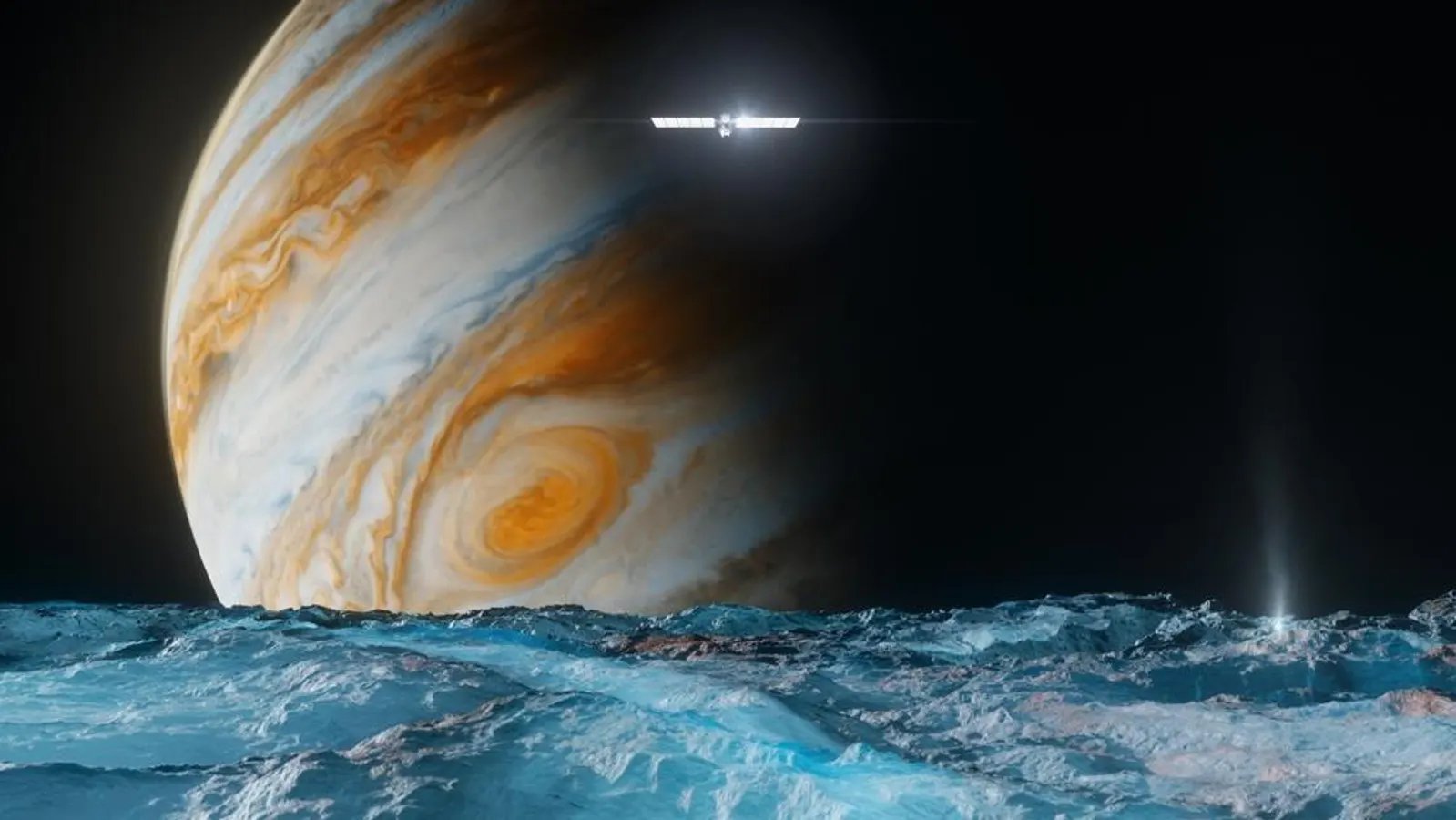
This artist’s concept depicts NASA’s Europa Clipper spacecraft as it orbits Jupiter and passes over the gas giant’s ice-covered moon Europa.
NASA/JPL-Caltech
A new analysis of more than a decade of Hubble Space Telescope observations challenges earlier claims that Jupiter’s icy moon Europa periodically ejects water vapor plumes into space.
Researchers from Southwest Research Institute have re-examined 14 years of ultraviolet data, which significantly weakens the evidence for the plumes. The new findings, published in the journal Astronomy and Astrophysics, suggest that earlier observations may have been influenced by statistical uncertainty rather than definitive signs of erupting water vapor.
It doesn’t mean plumes on Europa are impossible — just that the new analysis lowers confidence in the original conclusions.
Revisiting A Landmark Discovery
Europa has long fascinated scientists because beneath its geologically active yet frozen “chaos terrain” of ridges and valleys lies what is believed to be a vast saltwater ocean. If water vapor plumes exist, they could provide a rare opportunity to study material from the moon’s hidden ocean without drilling through miles of ice — though that would still require a spacecraft flyby.
In 2014, astronomers analyzing Hubble observations reported evidence of faint plumes detected through Lyman-alpha emissions, a specific ultraviolet wavelength associated with hydrogen atoms. The data hinted that water vapor escaping from Europa’s surface could be breaking apart into hydrogen and oxygen in space.
NASA’s Europa Clipper, depicted in this illustration that was updated in December 2020, will swoop around Jupiter on an elliptical path, dipping close to its moon Europa on each flyby to collect data.
NASA/JPL-Caltech
Evidence Weakens
However, researchers now say the original data analysis pushed the Hubble telescope to the limits of its capabilities. “The evidence for water vapor plumes on Europa isn’t as strong as we first understood it,” said Dr. Kurt Retherford of Southwest Research Institute, a co-author of both the original 2014 study and the new reanalysis paper.
What was thought may be evidence of a water vapor plume could just be statistical noise.
“Our reanalysis took our original 99.9% confidence in the plumes’ existence and reduced it to less than 90% confidence,” said Dr. Lorenz Roth , Saturn, Enceladus, Jupiter, Juno, at the KTH Royal Institute of Technology, Sweden, the paper’s lead author. “That’s simply not enough evidence to support the certainty of claims we made at the time.”
Europa Clipper May Provide Answers
Despite the revised findings, scientists remain optimistic that Europa could still harbor active plumes similar to those observed on Enceladus, where water vapor jets have been directly confirmed. Jupiter’s moon Io also produces dramatic volcanic plumes composed of sulfur dioxide.
Although its plumes of water vapor are less certain, Europa’s fractured icy crust could still provide pathways for water from the subsurface ocean to escape into space. Scientists hope future missions will settle the question once and for all — including NASA’s Europa Clipper mission, which is scheduled to arrive in the Jupiter system in 2030 and will closely study Europa’s icy shell, atmosphere, and possible subsurface ocean. Meanwhile, the European Space Agency’s JUpiter ICy moons Explorer (JUICE) will arrive in 2029 and take three and a half years to examine Europa as well as two of Jupiter’s other Galilean moons, Ganymede and Callisto.
Wishing you clear skies and wide eyes.
