

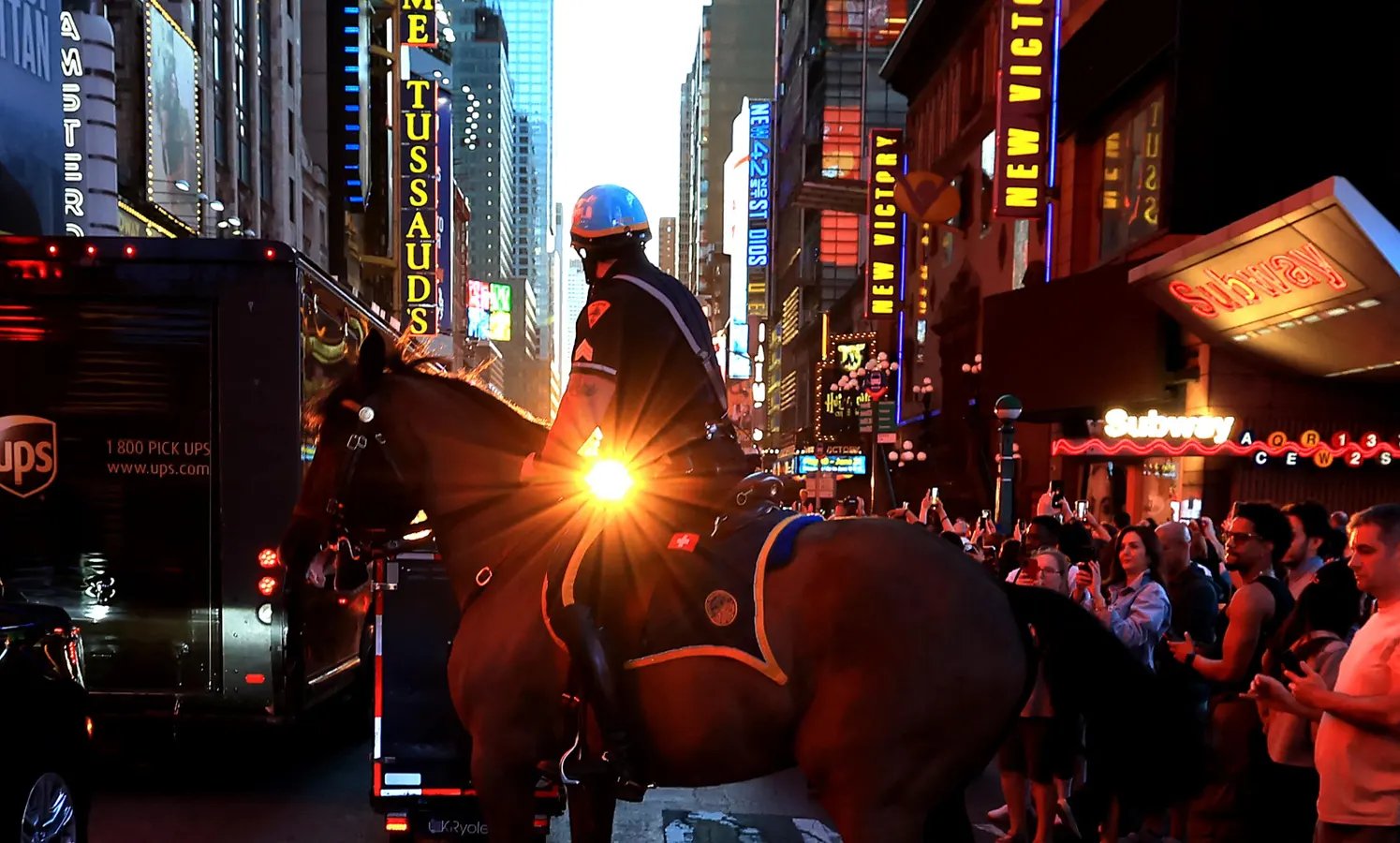
People stand in the middle of 42nd Street in Times Square for the first Manhattanhenge of 2026 in New York City, on May 28, 2026. “Manhattanhenge,” coined by astrophysicist Neil deGrasse Tyson, is a phenomenon where the sun perfectly aligns with Manhattan’s street grid, allowing it to be seen directly between the city’s skyscrapers. (Photo by TIMOTHY A. CLARY / AFP via Getty Images)
AFP via Getty Images
The so-called “Manhattanhenge” may be grabbing headlines across New York City on Thursday and Friday this week, but the famous sunset alignment is not really a two-night event.
Although the precise moment when the sun appears perfectly framed by Manhattan’s grid happens on only four evenings each year, the broader “Manhattanhenge Effect” lasts for about 44 days — creating weeks of spectacular sunsets between the city’s skyscrapers.
The phenomenon begins with this weekend’s first Manhattanhenge sunsets and continues through July 12, when the final alignment of the summer occurs.
What Happens During Manhattanhenge?
Manhattanhenge occurs when the setting sun aligns exactly with Manhattan’s east-west streets, creating dramatic sunset views framed by rows of skyscrapers.
In 2026, the first event took place on Thursday, May 28 at 8:14 p.m. EDT (“half sun on the grid”) and the second will take place on Friday, May 29 at 8:13 p.m. EDT (“full sun on the grid”).
The “half sun” event is when the sun “kisses the grid,” with only the upper half of the solar disk visible above the horizon. The following evening, the entire disk appears suspended between buildings just before sunset.
The second pair of almost identical events will occur again on July 11 and July 12 — in 44 days.
New Yorkers gather on 42nd Street near Times Square to see the “Manhattanhenge” solar spectacle on May 28 2026 in New York City. (Photo by Craig T Fruchtman/Getty Images)
Getty Images
What Is The ‘Manhattanhenge Effect?’
Manhattanhenge is best thought of as a season rather than a single moment. Between May 28 and July 12, sunset viewers can watch the sun gradually shift position within the grid. Each evening, the sun appears slightly farther north until the June solstice, after which the motion reverses and the sunset point drifts south again. The result is more than six weeks of sunsets framed by Manhattan’s streets.
Why The ‘Manhattanhenge Effect’ Lasts So Long
The extended effect is caused by the slow daily change in the sunset position on the horizon. Earth’s axis is tilted by about 23.5 degrees, causing the sun’s rising and setting positions to migrate throughout the year. The sunset point reaches its northernmost extreme on the June solstice before reversing direction.
If Manhattan’s streets were aligned perfectly east-west, Manhattanhenge would happen exactly on the equinoxes. However, the borough’s grid is rotated about 30 degrees east of true north, shifting the alignments into late May and July.
According to the American Museum of Natural History, the sun sets due west only twice per year — on the spring and autumn equinoxes. Every other sunset occurs somewhere north or south of west.
Where To See The Best Views
The best viewing locations are Manhattan’s broad east-west streets with clear sightlines toward the Hudson River. Prime locations include 14th Street, 23rd Street, 34th Street, 42nd Street and 57th Street. The farther east you stand, the more dramatic the effect becomes. Photographers also favor the Tudor City Overpass and Hunter’s Point South Park in Queens for wider skyline compositions.
When To See The Next Major ‘Manhattanhenge’
After this weekend, the most dramatic alignments return in July:
- Saturday, July 11 — “full sun on the grid” at 8:20 p.m. EDT
- Sunday, July 12 — “half sun on the grid” at 8:21 p.m. EDT
However, clear evenings between now and then will continue to offer variations of the Manhattanhenge Effect as the sunset shifts slowly through Manhattan’s urban canyons.
Wishing you clear skies and wide eyes.
