

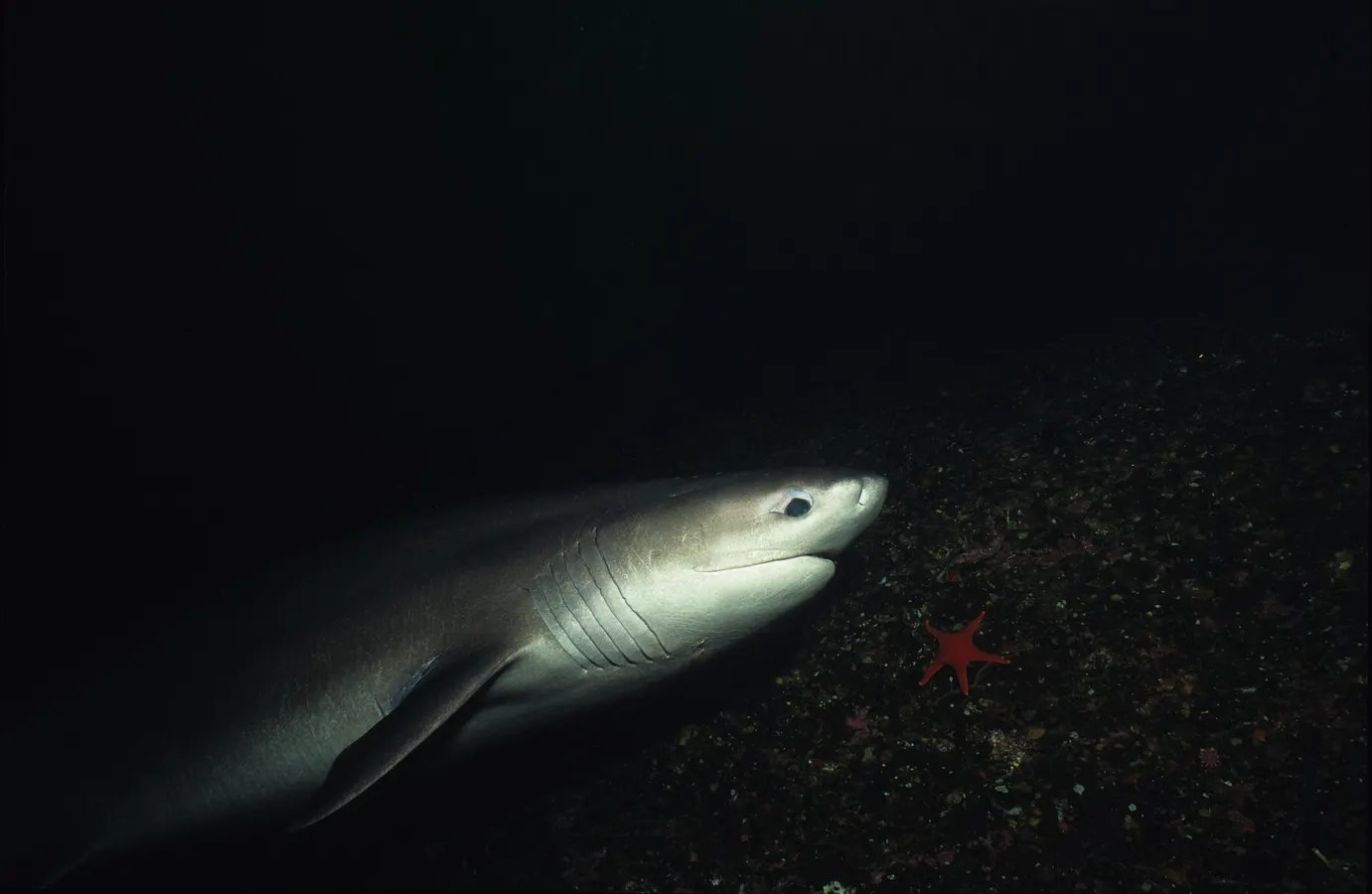
The Sixgill shark (Hexanchus griseus) belongs to a group of sharks that, according to the Florida Museum of Natural History and other studies, closely resembles fossil forms from the Triassic period, roughly 200 million years ago.
getty
This story begins not in the open ocean, but in a dockyard. Decades ago, fossil hunters working along the busy port of Antwerp (a historic Belgian port city which you might know as the world’s diamond capital) uncovered something unusual buried in sediment millions of years old. Not a diamond, mind you, but what at first glance looked like just another whale skull. But hidden within it was a clue that would take years to fully understand: a shark tooth lodged in the bone.
The single tooth fragment — now studied by researchers including Bournemouth University Professor of Evolutionary Palaeoecology John Stewart and Royal Belgian Institute of Natural Sciences Researcher in Vertebrate Palaeontology Olivier Lambert — offers a window into a very different North Sea that existed roughly 4 to 5 million years ago during the early Pliocene. Back then, this region was not the relatively low-diversity marine environment we know today. Instead, it was home to a rich community of marine life that included small baleen whales, dolphins, seals and, importantly, large predatory sharks. While it may seem like a futile effort to study how organisms interacted in the past, scientists can actually begin to understand how ecosystems might respond to the changes happening today by doing just that. “If you want information about how animals and other organisms might respond to the kind of climate changes our planet is experiencing right now, you need evidence of former responses to such changes,” the Stewart and Lambert say in a Conversation piece they published about their new study featuring this shark tooth.
The fossil record rarely preserves direct evidence of predator-prey interactions. Bite marks on bones are one thing (and quite common), but they often leave room for interpretation, so a tooth fragment embedded in a skull is something else entirely because it directly ties predator and prey together in a single, undeniable moment. In one case, the skull belonged to a small, now-extinct right whale species called Balaenella brachyrhynus. Analysis using microCT scanning revealed that the embedded tooth fragment came from a bluntnose sixgill shark (Hexanchus griseus), a deep-water species that still exists today! The placement of the bite suggests the whale was likely scavenged after death, its body drifting belly-up through ancient seas. But a second fossil tells a slightly different story; this skull came from a relative of the modern beluga whale, Casatia thermophila. And while here, too, a shark tooth fragment was found embedded in bone, the evidence suggests a more active attack. The shark, likely an extinct mako species related to today’s great white, appears to have targeted the whale’s head, possibly attempting to access the fat-rich tissues used in echolocation.
These are small details in isolation. Together, however, “these fossils represent direct evidence that relatives of sharks today fed on these whales. Even if the fossil evidence is limited to two pairs of animals, they are tangible examples of such behaviour,” as the co-authors ste. But they also hint at something else: the presence of predators depends on the presence of prey. When the community of whales and dolphins changed, so too did the sharks that fed on them. During the transition from the Pliocene to the Pleistocene, the North Sea experienced significant climatic shifts tied to the onset of ice ages. Many small baleen whales disappeared, and other cetaceans moved elsewhere. As these prey species vanished, the large sharks that relied on them also disappeared from the region. Fast forward to today, and we are watching another major shift unfold as ocean temperatures are rising. Species distributions are once again changing. In fact, in the North Sea, scientists have already documented fluctuations in porpoise strandings and the establishment of new seal colonies along the coast.
This raises an intriguing possibility that if warming seas begin to support larger populations of dolphins and seals, could they once again attract large marine predators, allowing for sharks to be in an area they have not occupied for millions of years? Yet it is not as simple as history repeating itself. Modern ecosystems are shaped by additional pressures including overfishing, habitat degradation and pollution, all of which are currently threatening most species of sharks to the brink of extinction. Still, the fossil record offers a baseline that ecosystems are dynamic and that dramatic shifts are not new. Climate change is often discussed in terms of models and projections, making it feel abstract or distant. But a fossil with a shark tooth embedded in it is physical evidence of a world that existed under different environmental conditions. So what does this mean for the future of the North Sea and similar ecosystems around the world? Right now, we just don’t know. Will warming waters bring back lost ecological interactions, or will modern human impacts push systems in entirely new directions? And if large predators do return, how will that reshape the balance of these marine environments?
The North Sea of today may seem familiar and stable, but its history tells a different story. It has been warmer, richer and filled with predators that are now absent. As our planet continues to warm, it is worth asking if we are prepared for what might return.
