

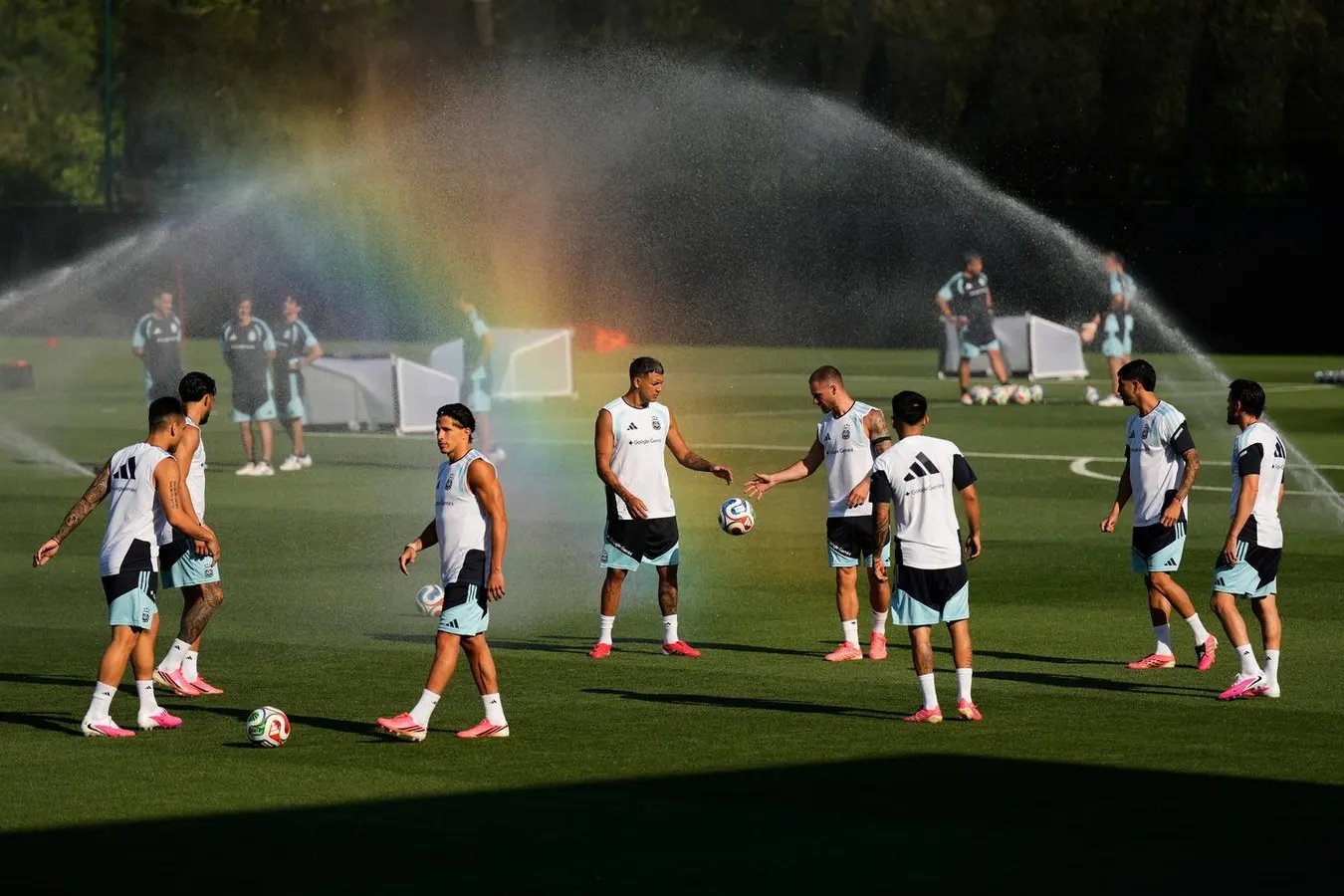
Argentina national team members work out during practice for the FIFA World Cup soccer Wednesday, June 3, 2026, in Kansas City, Kan.. (AP Photo/Charlie Riedel)
Copyright 2026 The Associated Press. All rights reserved.
The FIFA World Cup starts in a matter of days. The biggest sporting spectacle in the world will be watched for its soccer competition, economic impact to host cities, and potential to produce national bragging rights. I am watching from my perspective as an atmospheric scientist. Parts of Asia, Europe, and the U.S. have dealt with unprecedented heat since May. Players struggled through the first week of the French Open, and parts of the U.S. hit 90 degrees Fahrenheit weeks before the typical first date. From my lens, FIFA and the World Cup games face four big heat challenges now and going forward.
The Players
The most obvious impact of heat on the World Cup is for the players. A 2025 study published in the International Journal of Biometeorology examined potential heat risks associated with the 17 FIFA World Cup locations in North America. They examined something called Wet Bulb Globe Temperature. What’s that? “The WetBulb Globe Temperature (WBGT) is a measure of the heat stress in direct sunlight, which takes into account: temperature, humidity, wind speed, sun angle and cloud cover (solar radiation),” according to the National Oceanic and Atmospheric Administration. Experts believe WBGT is better at assessing potential heat impacts than the commonly-cited heat index, which simply accounts for how it feels because of temperature and humidity. “If you work or exercise in direct sunlight, this is a good element to monitor….. Military agencies, OSHA and many nations use the WBGT as a guide to managing workload in direct sunlight,” NOAA website went on to say.
Though WGBT is likely better for excessing heat risk, I am always concerned that people may see numbers like 72 or 80 and confuse those with actual temperature values. As we shift to WGBT, education campaigns will be required to orient the public as well as decision-makers. The table below describes threshold levels for different regions of the U.S.
Thresholds for Wet Bulb Globe Temperature by region.
NWS
The 2025 study found 14 of the 16 locations regularly exceed WBGTs of 82.4 degrees Fahrenheit (28 degrees Celsius) during afternoon hours of an average “hot” year. Nine of them surpassed that critical threshold more than 50% of the time. The cities that exceeded the threshold the most during June and July were Miami, Dallas, and Houston, according to the study. Monterrey (Mexico), Kansas City, Atlanta, and Philadelphia, New York, and Boston were in a second tier of cities. Seattle, Guadalajara, San Francisco, Los Angeles, and Toronto could also exceed this threshold but not as frequently. Mexico City did not exceed the threshold during the study. “Guidance from the global players’ union (FIFPRO) recommends that when Wet Bulb Globe Temperature (WBGT) reaches 26°C or higher, heat strain becomes a real risk and therefore matches must include cooling breaks,” according to the World Weather Attribution website. “At 28°C WBGT and above, conditions are considered unsafe for play and postponement is advised,” it continued.
EAST RUTHERFORD, NEW JERSEY – JULY 8: A general interior view of MetLife Stadium, host venue for the FIFA World Cup 2026 final during the FIFA Club World Cup 2025 semi-final match between Fluminense FC and Chelsea FC at MetLife Stadium on July 8, 2025 in East Rutherford, United States. (Photo by Robbie Jay Barratt – AMA/Getty Images)
Getty Images
In a recent study WWA also found, they found that 2026 FIFA World Cup games were substantially more likely to surpass dangerous WBGT thresholds than during the the 1994 event hosted in the U.S. Of additional concern, the study found that Atlanta, Kansas City, Houston, Dallas, Boston and Philadelphia can occasionally breach the 89.6 degree Fahrenheit (32 degrees Celsius) WBGT threshold occasionally. Many of these locations can hit those marks by late morning to early afternoon.
Observed and projected temperature changes in North America.
IPCC
Eleven of the sixteen locations feature open-air stadiums. They include New Jersey, Miami, Philadelphia, Boston, Santa Clara, Kansas City, Seattle, Toronto, Mexico City, Monterrey, and Guadalajara. The other five locations are enclosed or have retractable roof options. “A spokesperson for FIFA, the governing body for international soccer, wrote that the organization ‘is committed to protecting the health and safety of players, referees, fans, volunteers and staff,” wrote NPR’s Rebecca Hersher and Rahul Mukherjee. In an email to the journalists, FIFA noted that many contingency plans are in place including scheduling adjustments, additional water breaks, and air conditioning on the sidelines.
The Fans, Workers And Referees
However, players are not the only problem. Referees are equally exposed to the heat. Many measures designed for the players will also apply to the referees. However, the fans present a potential problem too. People underestimate heat, but it kills more people in the U.S. annually than any other weather event. Heat warnings are not consumed with the same sense of urgency as tornado or hurricane warnings. During excessive WBGT conditions, people will still mow the lawn or run a 10K.
Of particular concern, World Cup matches are likely to feature excessive alcohol consumption, which further elevates risk during extreme heat. Irrespective of whether the venue is enclosed, “Dangerous conditions will remain for public viewing, outdoor gatherings, celebrations, and other forms of social participation associated with major football tournaments,” wrote WWA.
Weather Fatalities in 2024 and over the past few decades.
NWS
Another overlooked group at risk is workers. “The soccer players are the stars of this event,” noted University of Georgia climatologist Andrew Grundstein. “The workers are essential for these events to run smoothly and effectively,” he added. Grundstein and colleagues examined this aspect of the problem in a 2026 paper. “Our study looked at 30 years of climate data at each of the FIFA host cities and considered the heat hazards to workers who support and staff the events,” he told me by email.
“We found a variety of heat hazards depending on the city…. The risk is not only dependent on the climate but also on the nature of work (light, moderate, heavy), the number of rest breaks, and if the worker is used to the local climate (acclimatized),” Grundstein explained. As with players and officials, he recommended proper rest breaks, hydration, and shading. ”Workers from cooler climates should be given time to adjust to local conditions,” he noted.
Florida, Woman carrying bags waiting to board bus. (Photo by: Jeffrey Greenberg/Education Images/Universal Images Group via Getty Images)
Jeffrey Greenberg/Universal Images Group via Getty Images
Urban Heat Islands
Most World Cup venues are located in major cities. As our research has shown, cities typically hold additional heat compared to surrounding rural locations because of the urban heat island. The UHI is caused by heat-absorbing materials, lack of vegetation, and waste heat found within cities. With cities swelling in population during the World Cup, that likely means additional transit, HVAC, and computational activities. A recent study by David Sailor at Arizona State University and colleagues found that emerging data center farms contribute to waste heat.
In 2022, I documented how less waste heat from traffic during the COVID-19 shutdown caused a reduction in urban heat. World Cup cities will probably experience the opposite effect with increased production of waste heat. The graphic below shows where some of the most extreme heat islands are located in the U.S.
Urban heat islands in the U.S.
Climate Central
The Future
WWA’s study concluded, based on statistical attribution methods, that all 2026 World Cup games would likely happen in conditions of at least 78.8 degrees Fahrenheit (26 degrees Celsius) WBGT, and nine are in locations without cooling. In 1994, only 21 games would have been played under such conditions. “While air-conditioned stadiums may reduce heat exposure within match venues, ensuring that football can continue to be enjoyed safely during northern hemisphere summers therefore depends not only on adaptation measures, but also on rapid mitigation efforts to transition away from burning fossil fuels,” argued WWA.
As I wrote previously, climate change has limited the number of viable venues for the Winter Olympics. A similar argument can be made for the FIFA World Cup. The current NOAA outlook over the next few weeks calls for above normal temperature conditions.
Temperature outlook from June 20 to July 3, 2026.
NOAA
