

Published June 26, 2026 11:33AM
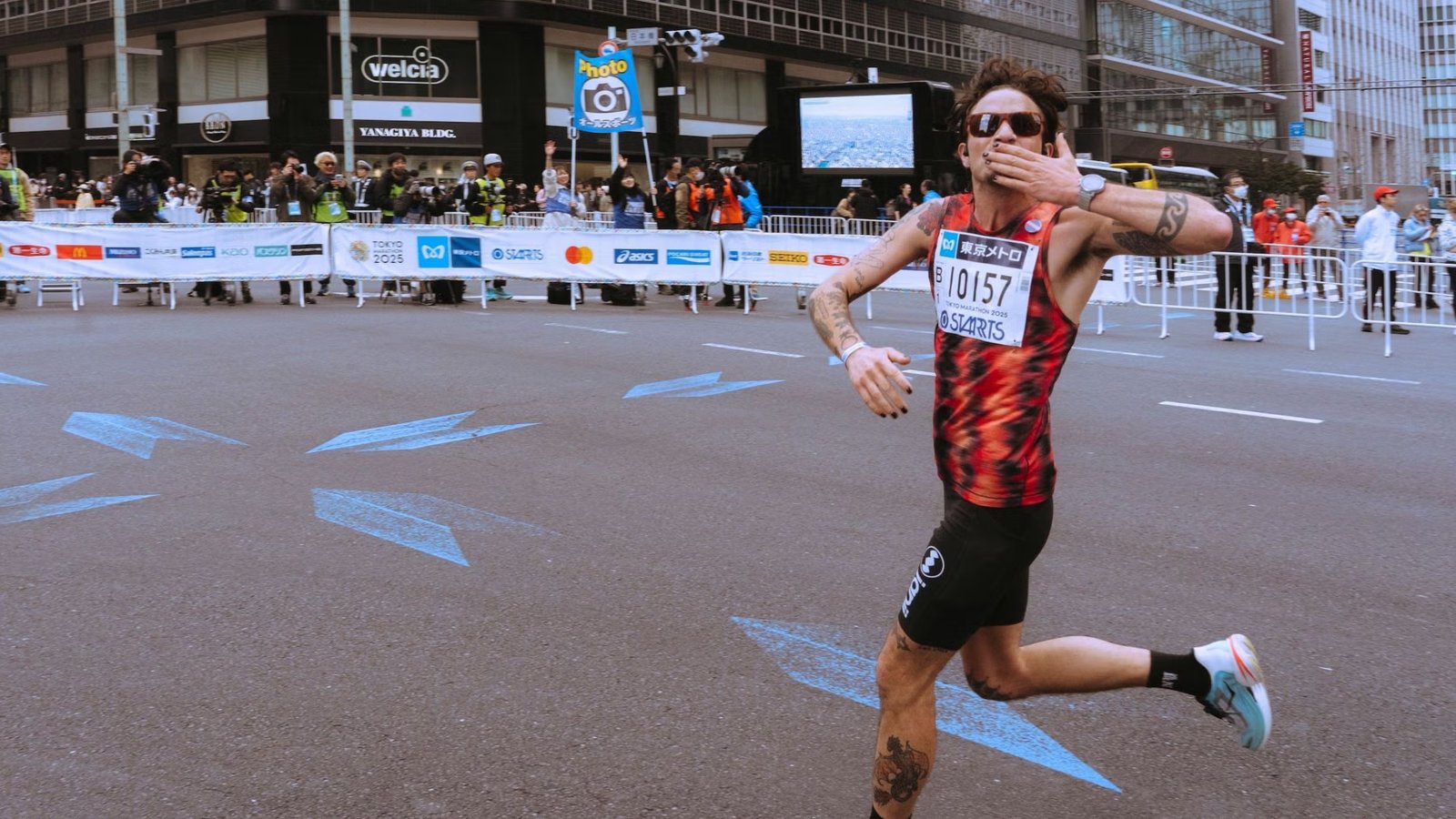
When Cal Calamia stepped up to the start line of the Tokyo Marathon last March, they already had a win at the New York Marathon and second-place finishes at Chicago, Boston, and Berlin under their belt. So the goal was clear: add another win, and take another step towards the six-star medal given to runners who finish all the World Major Marathons. As they looked around at the other anxious runners, hopping around and getting some final stretches in before the race, they kept their eyes on the competition, the other nonbinary athletes at the front of the pack.
By the time the gun went off and runners flooded out into the Tokyo streets, though, Calamia—who uses they and he pronouns—had lost them. The start of the race was stressful, as they wondered if they were in the right position for their goal. That is, until an out-and-back course provided a glimpse of their main competitor.
“I was like, at this point in the race, all of my time goals are kind of going to take a backseat, and I have one mission right now, and that’s to be this person to win this race,” Calamia says. “I found a way to run by them really confidently, and to continue with that confidence and poise for as long as I possibly could, so that when they saw me, they were like, ‘There’s just no way that I’m gonna catch Cal.’ And it worked.”
At the end of 26.2 miles, Calamia took the win, crossing the line in a time of 2:43:28. Just eight weeks later, they won the nonbinary division at the London Marathon, earning their six-star medal and getting one step closer to their goal of winning the nonbinary division at every World Major.
With their London performance, Calamia became the first person to compete in the nonbinary division at all six World Major races. Now that Sydney and Cape Town have become World Majors, Calamia has their eyes on those two races, as well. They’re currently training to race the Sydney Marathon in August.
Calamia’s advocacy is a big reason these divisions exist at all. Their work since 2022 has helped lead to the addition of a nonbinary division to every World Major, as well as to trail races like last weekend’s Broken Arrow Skyrace. And while they’re proud of the work they’ve done to allow trans and nonbinary athletes to compete as their authentic selves, their real focus goes beyond just the start line.
“I want to show up and make the sport a more inclusive place, but I also really want to show up and compete,” Calamia says. “It’s not more inclusive if, ultimately, we’re just celebrating being invited to be there. I’ve definitely made a pivot and a shift in the last two years from focusing on trans and nonbinary inclusion to trans and nonbinary excellence.”
The 29-year-old runner moved to San Francisco in 2018 to work as a high school teacher and began transitioning soon after. Going through the process of transition helped Calamia, who competed in cross-country for Saint Louis University, find a new relationship with running. And when they saw that nonbinary divisions were beginning to pop up at races like Bay to Breakers in their adopted hometown, their competitive side reignited.
“I struggled a lot with identity and gender and running in college, feeling like I don’t really know if there’s a way for me to compete and be my authentic self at the same time, so maybe this sport just can’t be for me,” Calamia says. “Once there was this little door that cracked open, that let in the light of possibility that I could sign up as myself and still have a chance to get out there and compete against myself and eventually against a larger and growing field.”
So, they returned to training. VO2 max workouts during the week, long runs on the weekend. Their first goal, when San Francisco streets were quiet during the pandemic, was to run a mile stretch in their neighborhood in under five minutes. On their first attempt, they sprinted down the residential streets, coming up to the mile mark in… 5:01.
“Failing was a key part of that moment, because it sort of served as this reminder of how much work I have put in athletically, emotionally, socially, in all these different ways to be the athlete and the person that I want to be,” Calamia says. “And how good it feels to move toward the goals that I create for myself.”
That solo effort marked a shift in both their running and their mindset around it. Returning to competitive running meant changing their lifestyle: getting more sleep, abstaining from alcohol, eating plant-based meals, and working with a coach to develop a training plan. The following summer, Calamia ran a 4:46 mile around the park near their home and was ready for the next goal.
In July 2022, Calamia stepped up to the start line of the San Francisco Marathon to compete for the first time as a nonbinary marathoner. After three hours and three seconds of running, they became the first-ever winner of the race’s nonbinary division, getting achingly close to the sub-three barrier.
In the two years to follow, Calamia dropped their personal best marathon by nearly 20 minutes, running a 2:41:59 at the 2024 Berlin Marathon. Competing as a nonbinary runner, and receiving a therapeutic use exemption from the U.S. Anti-Doping Agency (USADA) for the testosterone they take as gender-affirming care, has paved the way for other trans and nonbinary athletes to not just show up but to challenge their own personal limits.
“If none of this had happened, there very well could have been a chance that I would have turned away from the sport,” Calamia says. “And if I had that experience, certainly there are tons of other people who would have had those experiences.”
These days, you can find Calamia training hard to lower their personal best and win the remaining World Majors. But when they’re not running intervals in Golden Gate Park or recovering on a Tuesday morning run with the running group they founded, non-binary run club (NBRC), Calamia takes to the trails.
Instead of focusing on pacing and heart rate, they focus on the scenery. A 20-mile run is less an intimidating obligation and more a chance to eat snacks in the woods with friends. Plus, in a political climate that has become more and more hostile to trans athletes, trail running is a much-needed escape.
“There’s so much chatter and there’s so much conversation about who trans people are, who belongs where,” Calamia says. “When I’m out on the trails, I’m just on this mountain with this tree. I am just breathing in this fresh air under this beautiful blue sky. I don’t even know what y’all are talking about. I can’t hear you. I don’t have service.”
On top of the healing that comes with time out in nature, Calamia has proven to be a fierce competitor in ultramarathon-distance trail races. At last October’s Javelina Jundred 100K, Calamia took fourth overall, just 22 minutes back from the race leader. This coming October, they plan to return to the race, this time taking on the 100-mile distance.
“In my experience, my fastest performances have come from a long runway of concentration on what exact race I want to compete in and what outcomes I’m hoping for,” Calamia says, “and really building my life around my own athletic goals.”
In Calamia’s ever-evolving relationship with running, curiosity sits side-by-side with competition. The desire to PR in the marathon exists in tandem with the desire to explore a new trail. Their identity as a runner died and has been reborn, and still shifts every time they lace up their running shoes.
“It’s, on one hand, pushing the envelope of what I know I’m capable of for myself and being curious to learn more about that,” Calamia says. “And then on the other hand, knowing that me exploring that is opening up new pathways for other people to not have to feel the way that I felt when I was like, ‘I guess I don’t have my sport anymore.’”
