

Published July 1, 2026 03:51AM
In one of the most economically depressed neighborhoods of Washington, D.C., on a warm fall afternoon, woodsmoke rises from a vacant lot. That tells me I am headed in the right direction. Exiting the Anacostia Metro station, on a bright afternoon, I chart a course toward the smoke. In less than five minutes, I arrive at an unlikely scene for this part of town: a bustling pop-up village consisting of six mobile saunas arranged in a loose circle around a patch of astroturf.
Dozens of people wait for their turn in the saunas; in the biggest one, a refitted shipping container with one side entirely made of glass, a lithe blonde woman runs a sound bath class for a full house of about 25 people. In the smaller sauna next door, a friendly yoga instructor from Tampa leads the quirkiest breathwork class I’ve ever experienced: first she asks us to quack like ducks, then buzz like bees. We comply until our buzzing bursts into laughter. “Laughing is breath work!” insists the instructor, Annette Scott.
Over to one side of the village, well-steamed saunagoers line up to dip in a large, wood-sided tub of clear, cold water. Just past that, in a big white tent, more bodies are bending, twisting, and sweating on stretchy mats; the yoga and Pilates classes are packed all day long. There’s also locally-blended herbal tea on tap, a stocked bar, and a barbecue truck offering half-smokes, a D.C. delicacy that is like a chili dog but indescribably better. (If you know, you know.)
A pop-up sauna village is a common sight in hipster havens like Minneapolis, Seattle, and Burning Man. A large and splashy sauna festival, with 16 wood-burning saunas in a park beside the Williamsburg Bridge in Brooklyn, wrapped up in March. The one in D.C., held last October, took place in a far less hipster-friendly spot: Anacostia, the historically poorest part of town, across the Anacostia River (a tributary of the Potomac) and worlds away from the monuments and government buildings that we see on the news.
Every afternoon, commuters zoom right past this spot without stopping, on freeways whisking them to greener suburbs. They’re missing out: Anacostia is also known for Cedar Hill, the historic home of Frederick Douglass, as well as the former St. Elizabeth’s mental institution, acres of forested parklands, and the occasional pair of nesting bald eagles.
Today, however, this little corner of Anacostia is jammed—with neighborhood residents, who make up about 30 percent of the attendees, but also with people from the suburbs. I sit next to one father-son duo who drove 45 minutes from Virginia.
Most people are in shorts or bathing suits—which are available to rent—but not everyone is dressed for the occasion. I pop into one of the smaller saunas to find a tall, elegant-looking woman, dressed in voluminous linen pants and a tailored top, both of which are completely soaked—from sweat, or from a trip to the cold plunge, I can’t tell. Maybe both. She hopped into the sauna village on the spur of the moment, as she was headed somewhere else, and now she seems in no hurry at all to leave. Leaning back, eyes closed, she murmurs, “We need this all the time.”
Her wish might come true.
This two-day event—along with this winter’s better-publicized sauna pop-up in Williamsburg, Brooklyn—is a kind of stalking horse for a much bigger project. Both events were staged by a mysterious European company called the Therme Group, which recently announced plans to build a massive bathing complex—with multiple saunas, huge soaking pools, several waterslides, and an indoor botanical garden—just a few yards away, on a vacant tract of federal parkland beside the Anacostia River. The approximate price tag of the project: $500 million.
Therme DC is just one of seven such projects that the Therme Group is planning for cities around the world, including Manchester, UK (which just began construction), Toronto, Singapore, Frankfurt, Incheon (near Seoul), Dubai, Dallas, and right here in Anacostia. That’s only a beginning: the company says it eventually plans to build no fewer than ten Therme complexes, or Thermes, in North America alone.
While most Americans have never heard of Therme, it is better known in Europe, where the company owns and operates five massive and popular bathing parks. Four are in Germany, but the newest one—and the template for future expansion—is located just outside Bucharest, Romania.
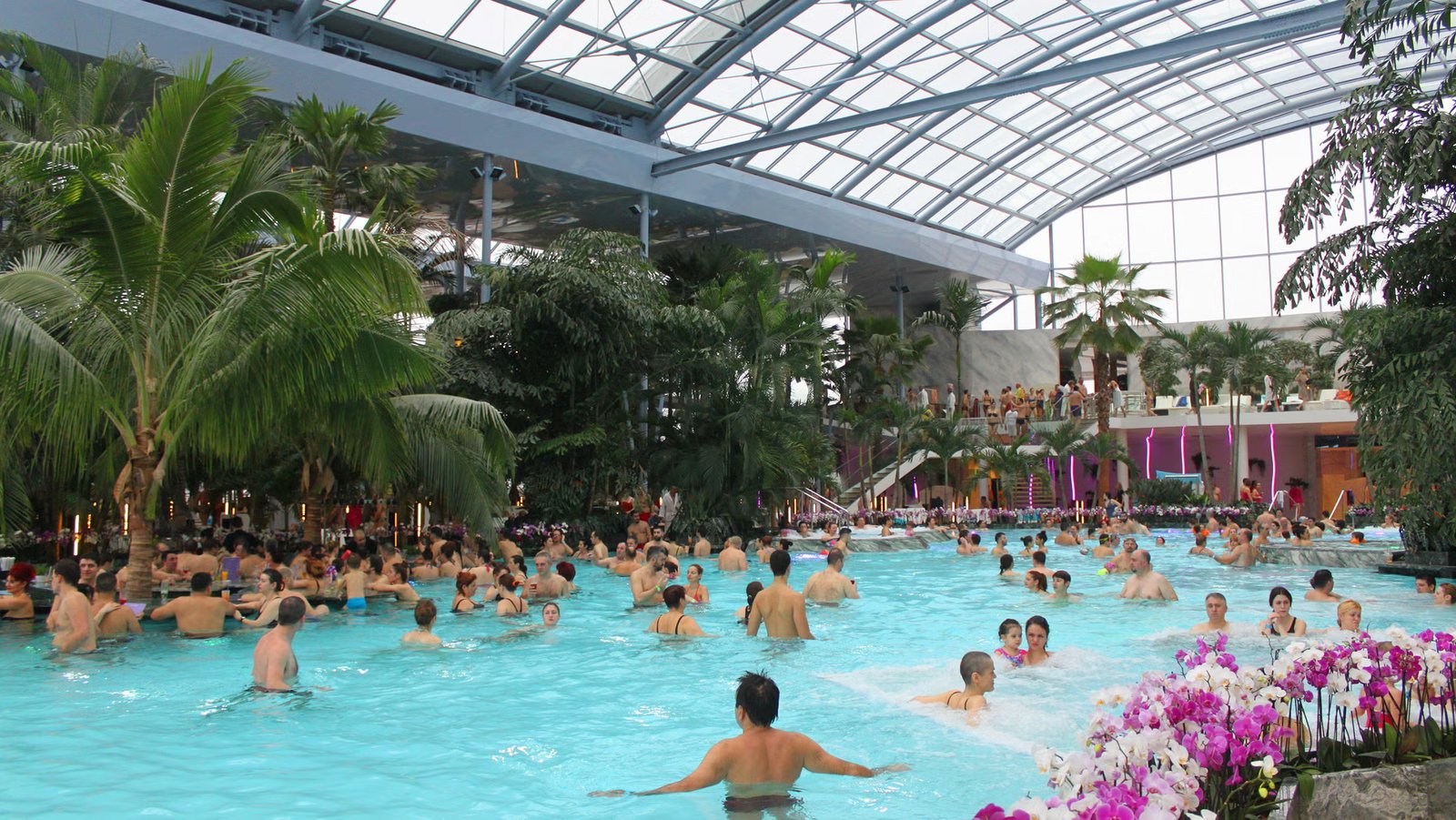
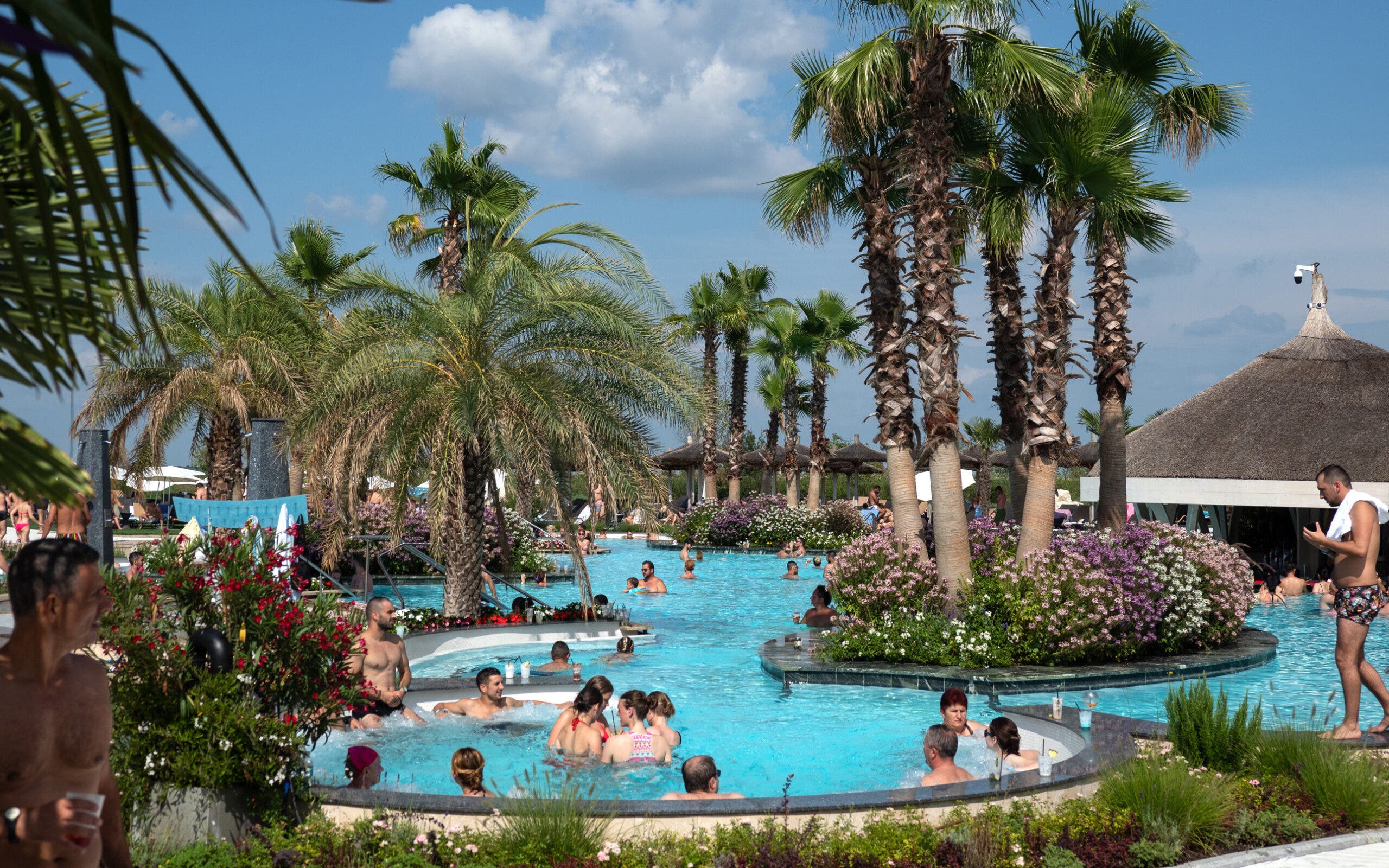
Despite its out-of-the-way location, Therme Bucharest has grown into a global tourist destination and Instagram hotspot, a sprawling 470,000-square-foot structure with ten soaking pools, 16 water slides, and 16 saunas under its vast roof—plenty to entertain its 1.7 million annual visitors.
Therme Manchester, set to open in 2028, will be twice the size of Therme Bucharest. Therme DC will rival the scale of Nationals Park, the baseball stadium just across the river. When finished, it will dwarf the three shiny new ten-story apartment buildings that have sprung up just across the road from the vacant lot where the sauna village sits, the vanguard of the neighborhood’s redevelopment.
Plans are not yet final, but Therme DC will occupy 17 acres of former federal land beside the Anacostia River, with a soaring steel and glass roof that will be visible for miles around, including from planes landing at Reagan National Airport, just across the Potomac. Therme and the city of Washington D.C. estimate that the project will employ 5,000 construction workers and more than 700 permanent employees.
These grand plans make the head spin. But while Therme and similar spa complexes are familiar in Europe, especially Germany, they are definitely not a thing in North America. After Therme DC was announced last spring, I had a difficult time grasping what, exactly, it might look like, let alone how to describe it to people. Other North Americans seem similarly confused. In Toronto, opposition to the Therme construction has been particularly sharp, as locals protested the decision to award Therme development rights to part of a treasured yet neglected lakefront park.
The skeptical Conspirituality health podcast slagged the project as a “MAHA wellness scam.”
What actually was this thing? Nobody seemed to know for sure.
So I flew to Bucharest to see for myself.
Moments after stumbling off my stuffy Romanian Airlines flight, I run into the president of Therme U.S., Robbie Hammond. He is easy to spot, in his custom-tailored pink button-down shirt with the letters SOAK stitched across the middle. Also, he is the only person in the Bucharest airport who is smiling.
As a young advertising executive in the late nineties, Hammond had co-founded Friends of the High Line, the fundraising and advocacy group that transformed an abandoned elevated railway line on the fringes of Manhattan’s west side into a thriving neighborhood park and global tourist attraction. That blockbuster success is why Therme Group hired him to help realize its two U.S. projects, the one in Washington D.C. and the other in Dallas.
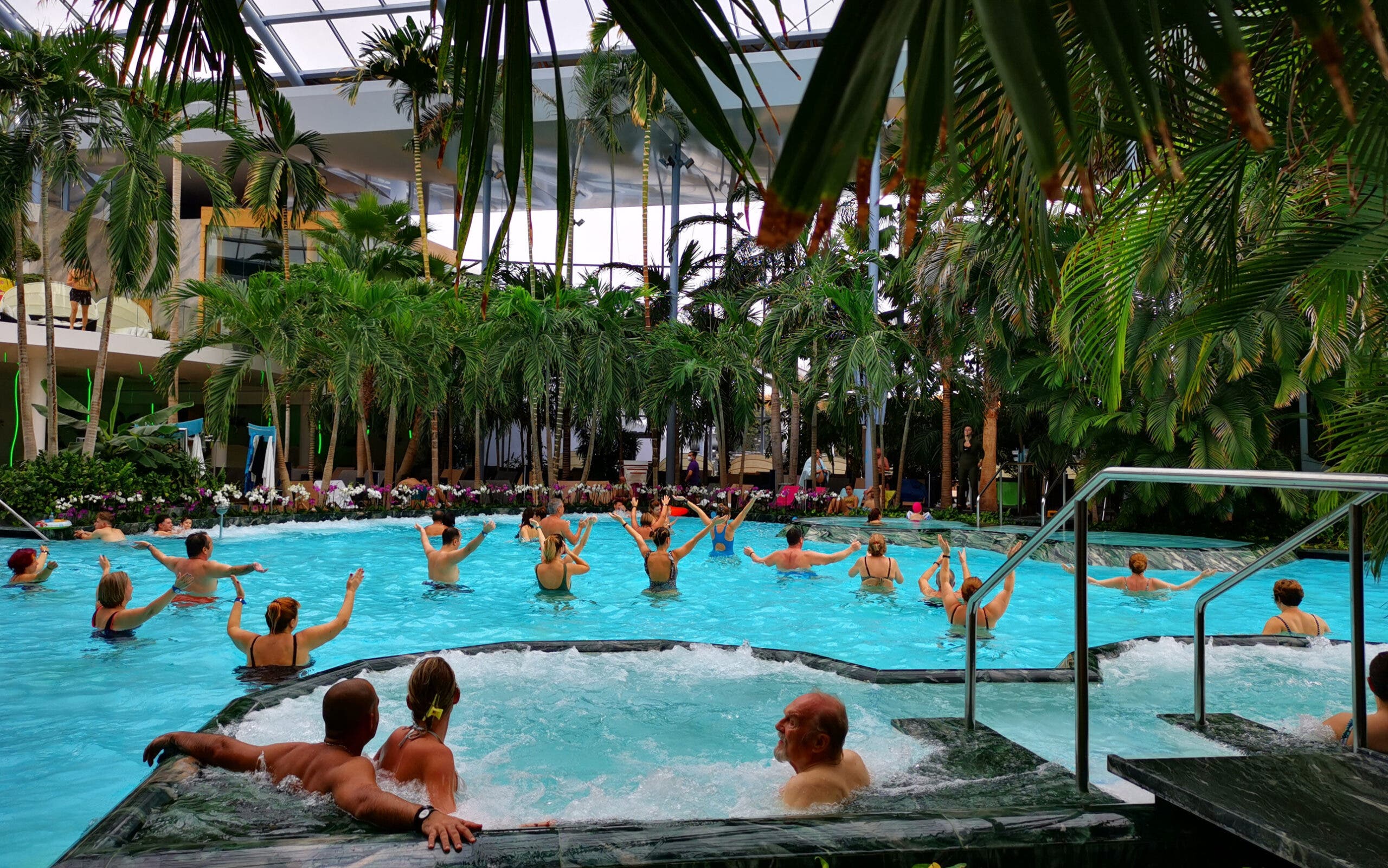
Despite his outsized ambition, Hammond is friendly and easygoing in person, which makes sense. Therme’s primary product is relaxation, as I’m about to learn. An hour after landing, we are floating in an enormous warm pool, gazing up at palm trees, a glass roof, and the late-afternoon sky above as our jet lag melts away.
Therme Bucharest styles itself as a wellness oasis, a place where guests can do healthyish things like water aerobics, soaking in mineral baths, or sweating in saunas—followed by a cocktail or a glass of wine, if they choose. It’s like Wellness Lite.
“It’s not like a gym,” Hammond had told me. “It’s like a wellness Disney World.”
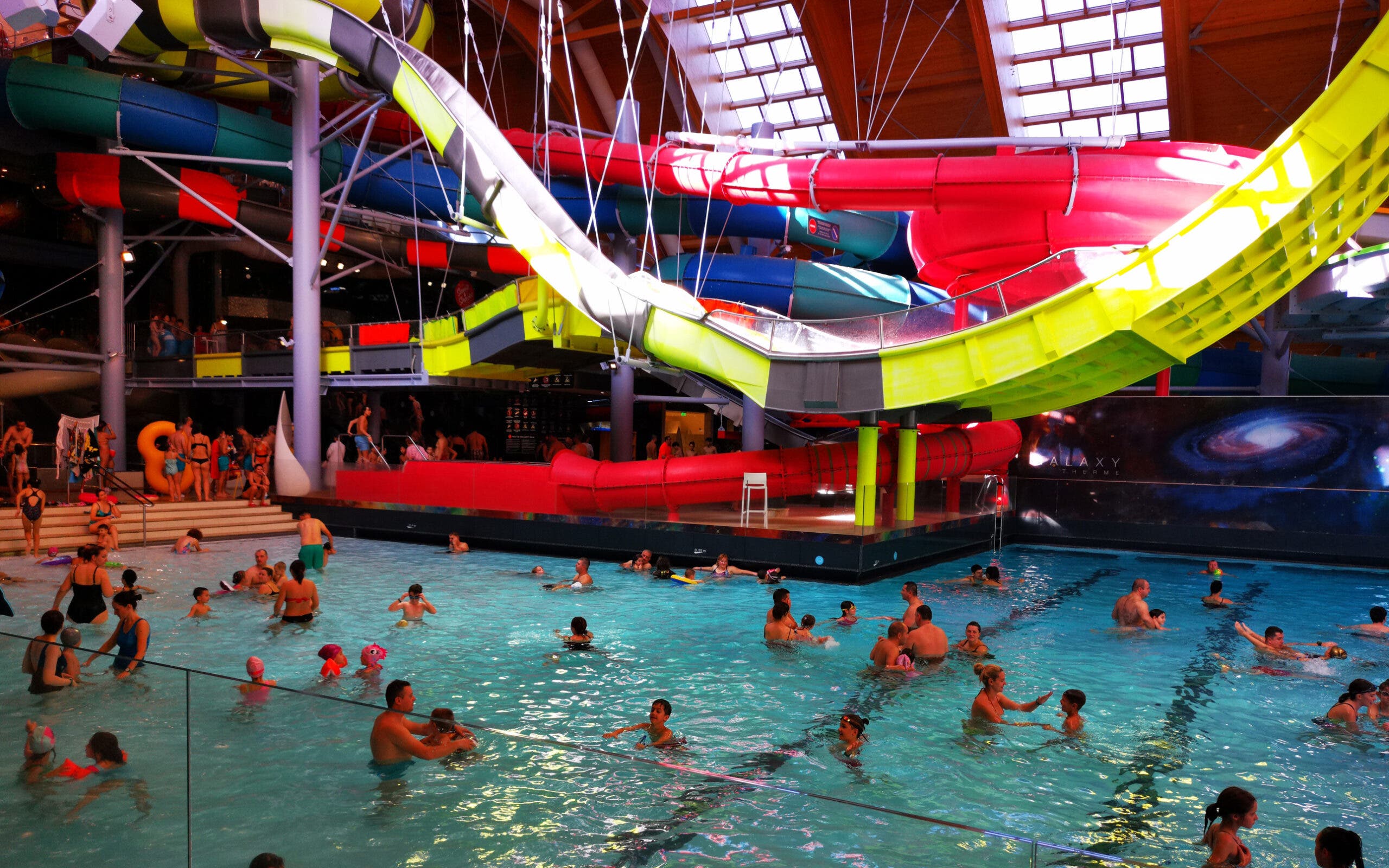
There are three zones at Therme Bucharest: The Palm, the main area with a sprawling, quarter-acre indoor/outdoor pool, kept at a comfortable 91 degrees Fahrenheit. There are also a dozen or so mineral and soaking pools; Elysium, featuring 16 saunas and steam baths, each with a different ambiance (and heat level), plus treatment rooms for massages, and an outdoor patio for relaxing and sipping drinks. Kids are only allowed in a separate, family-friendly area called Galaxy, which has some pretty thrilling waterslides.
It feels like a spa married to a tropical resort, next to a Great Wolf Lodge-style water park, all beneath a soaring steel-and-glass canopy that rises from the surrounding plain like a fancy new airport terminal.
Bucharest seems an unlikely spot for a wellness mecca. Pinned between Bulgaria, Serbia, and Ukraine, the former Communist nation of Romania has an average life expectancy of 76.6 years, even lower than that of the U.S.—a dubious achievement for a European nation. (Most EU members way outperform the U.S. average lifespan of 79.6.) Fully one-third of the male population of Romania smokes, and another third admits to binge drinking.
One of Therme’s stated goals is to try to solve this problem, in Romania and beyond. Which seems ambitious, to say the least, but in its proposals and public statements, Therme says it doesn’t just want to build flashy waterparks and resorts, but to make wellness—physical, but also social—accessible to the masses.
Their business model? The ancient Roman baths.
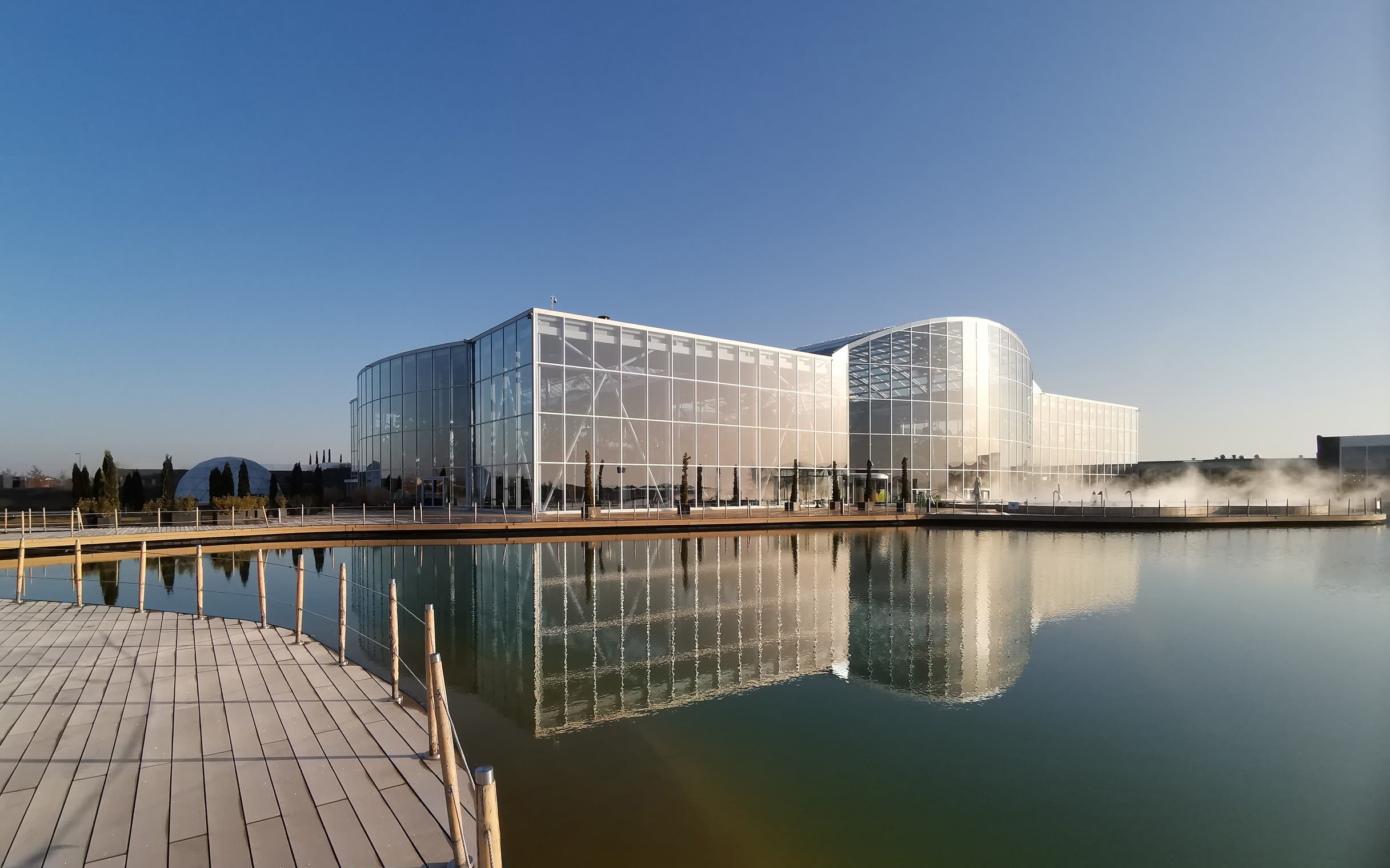
Therme Bucharest is not actually located in the city of Bucharest; instead, it sits on its own in a kind of no-man’s-land between the suburbs and farmland. The nearest hotel is a Hilton Garden Inn, a couple of miles away. Funny spot for a recreation of the ancient Roman baths. While driving out from the center of Bucharest the next morning, battling traffic every inch of the way, I wonder, Why is this here?
Free heat is why. The massive complex happens to stand atop a deep geothermal spring, explains Robert Hanea, Therme’s colorful CEO and founder, at a conference table in Therme’s corporate offices, a set of modular buildings across the road from the spa. Hanea had come into possession of this land about 25 years ago, and had thought about building something practical on the site, like a geothermal power plant—his other business is industrial engineering and HVAC—but he decided to build this fantasmal bathing complex instead.
Why not?
He was inspired, he says, by a similar and highly successful facility in Germany called Therme Erding, which opened in 1999 outside Munich and remains the largest thermal spa in the world. Some context: many cities and towns in Germany, Austria, and Switzerland have public baths, known as “thermes,” with pools and often saunas. Most are utilitarian facilities that are subsidized by local governments, like public swimming pools. Therme Erding was huge, spectacular, and profitable.
Hanea wanted to create something just as grand in his home country. He befriended Joseph Wund, the German architect who had built Therme Erding, and borrowed from his template to create Therme Bucharest, which is smaller but similar. The two main differences: Therme Erding has a “textile free” (i.e., nude) zone, while Therme Bucharest requires swimsuits; also, Therme Bucharest is heated by geothermal water—which required workers to drill two miles into the earth in order to access the 175-degree-Fahrenheit underground spring, which heats the place. (Some of the water is filtered, treated, and allowed to cool before being used in the pools).
It worked: Despite its off-the-beaten-path location, Therme Bucharest quickly became a popular European destination, drawing some 1.7 million annual visitors last year—on a par with some U.S. National Parks.
Wund died in a private jet crash in 2017. Last December, Hanea’s Therme acquired the German Therme, bringing all the Thermes under one corporate umbrella—and accelerating its global expansion, as Hanea sought to replicate Therme’s success around the world. He envisions creating dozens of Thermes in city centers around the world.
On my second day, I tagged along on a group visit by community and business leaders from Dallas, where the first U.S. Therme will likely be built. After a friendly chat with Hanea, we trooped across the street to the Therme complex for a behind-the-scenes tour, guided by VP of operations Robert Solomon, a former banker in his fifties who loved bathing at Therme so much that he quit his job and went to work for the company. The pool was nearly empty at 9 A.M., as we filed through a discreet metal door and followed Solomon down two flights of stairs to the bowels of the building, where a massive battery of pumps and fans whined and whirred, keeping air and water moving around as many as 8,000 daily bathers.
Almost as tricky: Keeping palm trees alive indoors, in a climate where winters routinely dip below zero degrees Fahrenheit. Solomon showed us how each of the 1,500-odd palm trees had its own dedicated air and water lines, like a little life-support system for each individual plant. It seems to be working: one palm in particular reached exuberantly toward the 100-foot-high glass roof, which unfortunately means that the tree’s days are likely numbered. “It will break right through the glass,” Solomon told us, so it will need to be removed.
The most striking thing I noticed during our tour was the smell of the water in the pools. I had braced myself for the usual odor of chlorine, the olfactory signature of North American pools and waterparks (and hot tubs). But there wasn’t one. Deep in the bowels of the facility, Therme officials showed us the complex treatment and filtration system that first puts the required amount of germ-killing chemicals into the water (about ¼ the concentration required in the U.S.)—and then pulls it back out via a complicated ozonation process that I can’t begin to explain.
All I can say is that it works, and the primary scent in the main pool area comes not from a bleach jug, but from tropical flowers.
Tour over, it was time to hit the pool again.
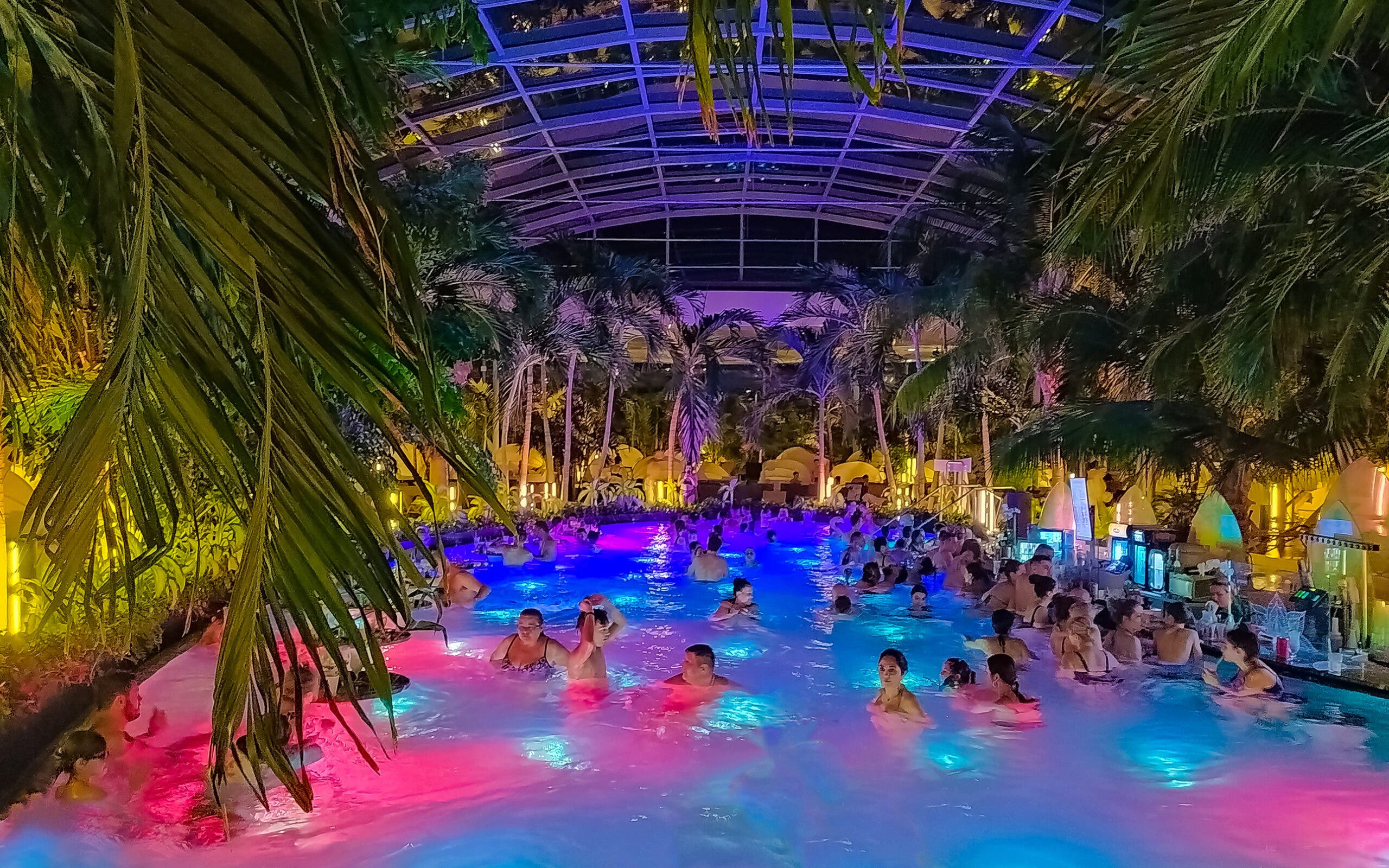
After sunset the night before, the vibe of the place had shifted on a dime—as the sky darkened, moody blue and purple lights came on, illuminating the palm trees and giving the main pool the feeling of a nightclub. Instagrammers Instagrammed on the steps leading into the water, and couples floated around entwined with each other (the pool is adults-only; kids are limited to the “Galaxy” waterslide zone). The music throbbed quietly. The bars got busy. The water was, as always, invitingly warm.
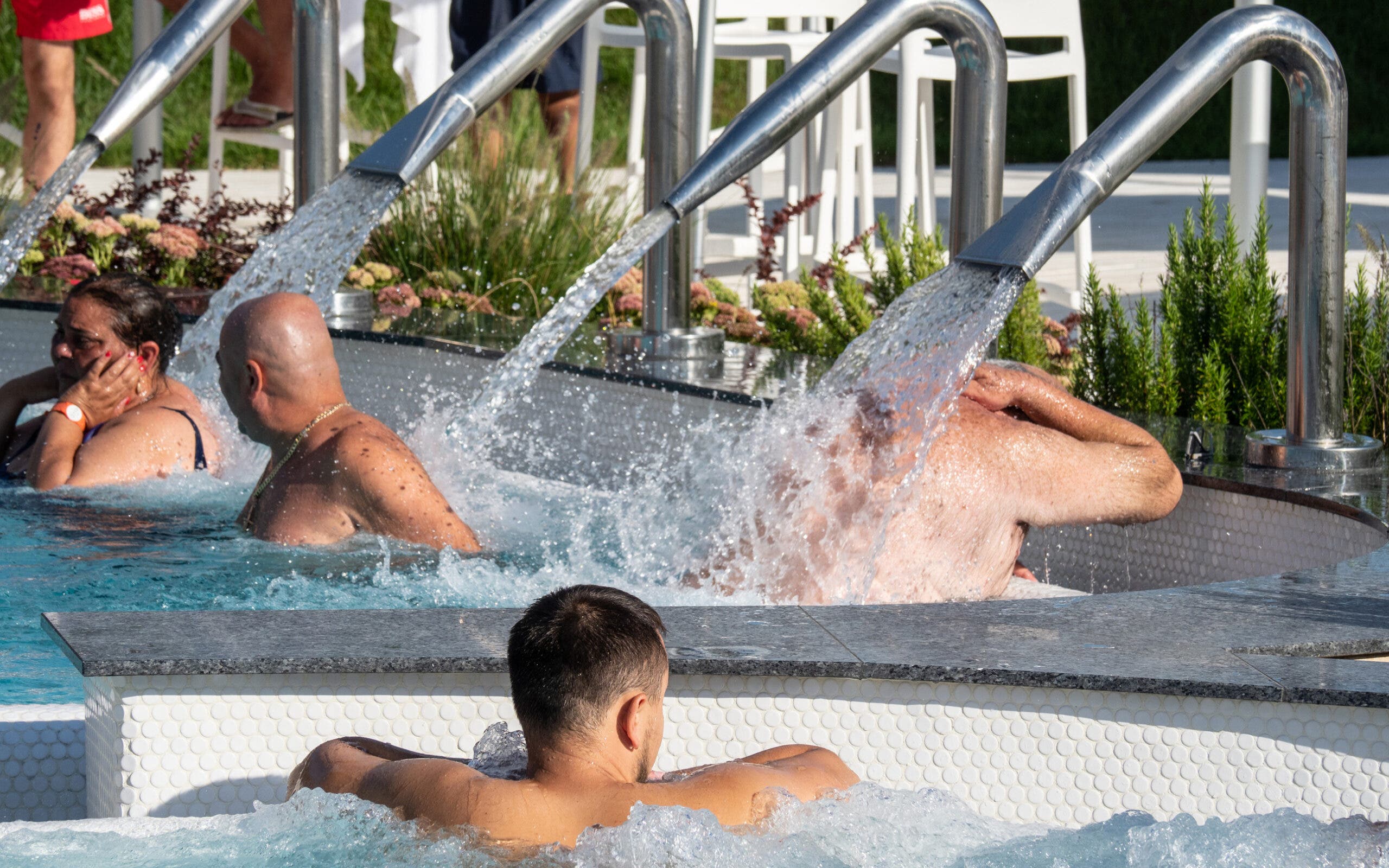
The following morning is completely different: bright, airy, wholesome. I join Hammond and about a hundred women in a water aerobics class led by an energetic young instructor who makes us put our pool noodles through their paces. Relaxed and invigorated, I wander around, sampling the soaking pools infused with magnesium, zinc, and Dead Sea salt, among other minerals—each said to convey specific health benefits. I loll in the lithium-infused pool, which is supposed to improve my mood.
Maybe it does. The sound system plays cheery spa music, which also helps.
As the day progresses, the main pool area gradually fills up with guests from all over Europe and beyond—girls’ trips from Italy, guys’ trips from Berlin. I drift over to the swim-up bar and drink a beer with some working-class Brits, right beside a group of Black American ladies from Atlanta downing fruity cocktails, then repair to the lounging area, where I chat with an Italian architect on a solo getaway. Seeking an adrenaline fix, I dip into the “Galaxy” zone and ride a couple of dizzying waterslides, then return to grab some Mediterranean lunch at the café.
Later, I asked Hammond what this project has in common with the High Line. Three things, he says: high-level design, top-quality plantings (the coddled palm trees), and most of all, the people.
“Part of the experience is the people-watching,” he says. “And it’s everybody. You see everybody, you see all kinds of bodies, and that’s both at the High Line and at Therme. But it only works when it’s busy.”
Therme is crowded in winter (with Germans wanting to look at palm trees) and summer (with guests from all over wanting a vaguely exotic beach-resort-ish experience, minus the hassle and cost of traveling to an actual beach resort). More than that, I got the sense that it was a place that people go because it’s a place that other people go. The people are part of the attraction, and Instagram keeps them coming, to take selfies against the soaring glass roof, the seductive blue pools, the lush indoor jungle, the sense of scale and space. Which is also part of the attraction.
Therme’s business is based on the German Thermes, but its true inspiration, according to Hanea, is the Roman Baths.
Specifically, the colossal baths of Caracalla, the ruins of which still stand in central Rome. Finished in 216 A.D., the baths of Caracalla rivaled Yankee Stadium in size, drawing an estimated 6,000 visitors a day. The entire system covered 27 acres, and its soaring grandeur has inspired generations of Western architects—such as the builders of the original Pennsylvania Station, for example.
Fabulous and lavish as they were, however, the ancient baths were not only intended for the elite but for everyone. Every city of any size had a bathing complex, with sauna-like warm rooms, steam chambers, bathing pools, and usually a cold room called the frigidarium. The activities were not limited to bathing, either; the larger complexes had sports facilities, food and drink, libraries, even theaters for musical and dramatic performances. Despite their spectacular and obviously expensive architecture, the Roman baths were cheap and often free of charge to use; common people and even slaves were welcome.
“The luxurious and pleasurable world of baths afforded the greater urban populations a welcome opportunity to escape their overcrowded and cramped living conditions and the dusty streets for a few hours a day and bathe in style,” writes Fikret Yegül, a scholar of classical bathing at the University of California in Santa Barbara. “Moreover, for many, it was their only opportunity to bathe at all.”
Ew, but also, great. More to the point, the baths served as a nexus for urban social and political life; they were the one place where everyone met up. As Yegül writes, the baths represented “the epitome of democratic ideals in Roman society.”
This, Hanea insists, is what he wants to re-create — a wellness space that includes rather than excludes, and that is affordable to the masses.
“This needs to be in the downtown core of cities, and it needs to be one of the most useful things in the city,” Hanea declares at our morning meeting. “It’s not a ‘nice’ thing to have; it’s a must thing to have — a space where people can have positive human interaction, because they want to be together.”
Even VIPs who land at the site’s modest helipad must wait in line; there is no FastPass to skip the queue. “We have Uber drivers that are coming every day,” he humblebrags.
Walking back from the café, I’m accosted by an attractive couple in matching white logoed polo shirts, wielding iPads. They want to know if I would like to have my body scanned. Okayyy?
They guide me to stand on a circular platform while an expensive-looking camera device whirls around me, capturing my entire body in 3D. This scan, by a company called Phy, then spits a report to my phone with insights about my health based on my posture and stance. Turns out I’d better watch out for my neck and upper spine, which are bowed from decades of riding bikes and sitting at desks writing stories like this one.
Unsure of what to do with this probably useful but somewhat dispiriting knowledge, I decide to go and get a massage. That, in turn, leads me into Elysium, the sauna area, the busiest place in the resort. When Therme Bucharest opened in 2016, it had no saunas at all. Those in place now were built in response to overwhelming demand—plus a new addition, a “sustainable” wood-burning sauna on the roof deck, designed by architecture students from Norway.
This week, they are especially busy thanks to Therme’s annual spring “Herbarium” festival, an eclectic gathering of healers and herbalists and performers from across Europe and beyond.
The main attraction is a full slate of “aufguss” shows, brief performances held inside the saunas. In its most basic form, aufguss features one or more very athletic performers, dancing around the sauna stove and waving towels to blast spectators with hot air; typically, they will mash ice balls into the hot sauna rocks, often infused with scented oils—mint, evergreen, lemongrass, sage, and more exotic flavors such as moss and Japanese herbs.
Aufguss can be a lot—one doesn’t always want to be smacked in the face with broiling steam—but it does help prevent people from getting bored while slow-roasting in a 180-degree sauna. And, as I learn, at times it can be brilliant.
I squeeze into a few shows, including a “salt ritual” that leaves me sneezing and somewhat confused, a peaceful sound therapy session, and a woodsy but vague “forest bathing” experience accented with mushrooms and piney scents. The most powerful is an “operatic catharsis” by a fit, intense Norwegian man whose rendition of “E lucevan le stelle” from Tosca has half the house sobbing as we file out.
Outside the sauna, I spot a sweaty, shirtless Hanea, who’d snuck in incognito.
Flying home, I felt like I’d been on a mini-vacation rather than a whirlwind 48-hour visit. But I wondered: Is the U.S. really ready for its own version of the Roman baths? More concretely, will Therme’s grandiose plans even be realized?
The math is daunting. If each Therme costs $500 million to build, multiplied by seven planned Thermes across three continents, that starts adding up to some serious money, although of course each will be built and financed over a period of many years. According to John Alschuler, chairman of Therme US, Dallas will likely open first, possibly as soon as 2030, on a downtown-adjacent site by the Trinity River. Next up is Toronto (provided the political opposition fades), then Washington D.C. Financing is already in place for Manchester Therme, which is under construction and scheduled to open in 2028, but the others remain a question mark.
“Financing’s never easy,” Alschuler admits, “but I have no doubt, given the dynamism of the D.C. region and the beauty of the site, its location and its access by both mass transit and automobile, we’ll get the financing.”
But before this cluster of saunas on a patch of Anacostia dirt can be replaced by a glassy bathing palace a hundred yards away, before any financing can be put in place, there’s also a bureaucratic gauntlet to be run. Land must be swapped, designs approved, and the new Washington Commanders’ NFL football stadium must be built first, just up the Anacostia River from the proposed Therme site. Alschuler, a former New York real estate developer who built Brooklyn Bridge Park, admits that the ultimate opening date is likely in 2031 or 2032, he says.
Therme is betting that these places will serve as “urban oases,” quick getaways for city dwellers and visitors, at an accessible price. An all-day pass to Therme Bucharest costs about $50, plus food ($9-12 for most entrees) and drink ($7 margaritas) and whatever else you want. Those are Romanian prices, but a bargain compared with those of an upscale New York bathhouse. A two-hour session at Bathhouse Flatiron, which is much smaller—and has no palm trees or lithium pools, let alone water slides—costs more than $110 at peak hours.
Hammond says the North American Thermes will be more affordable, at a similar price point to Bucharest, in order to maximize visitation. “This only works at scale,” he says. Indeed: If each guest spends, say, $125 per-visit, and each Therme costs $500 million to build, that works out to 4 million visits just to cover the construction costs, not counting operating expenses. That is … a lot of visitors. But Therme Bucharest, in a small out-of-the-way European city, sees 2.8 million visitors per year. At that rate, Therme DC could pay for itself within 18 months or so.
Where will those visitors come from? This is one of the questions that the pop-up was intended to help answer. Is there demand for this? Will thousands of tourists and locals cross the Anacostia River to float around in pools and sweat in saunas and rip down water slides?
One factor in Therme’s favor is that there’s not much else to do in Washington that’s fun, besides going to museums and monuments, and perhaps catching a ballgame. Some of the 27.2 million tourists who visit the city every year might welcome the chance to send their kids to play on waterslides while they lounge in a quasi-tropical pool sipping rosé.
Then there is the question of scale. Sauna is trendy now; bathhouses are popping up in cities around the country, from New York to Austin to Salt Lake City, where I live. But the industry is still nascent, like coffee bars and yoga studios back in the day. Most commercial sauna bathhouses are so small that Therme Bucharest could swallow them like an amuse-bouche. Even Othership, one of the largest New York City bathing establishments, fits only 64 guests or so at a time. Therme’s 16 saunas could handle many times that. Large-scale bathing simply doesn’t exist in the U.S.
But it used to — even if present generations have forgotten. Decades ago, people would flock by train to destinations like Saratoga Springs, New York, Glenwood Springs, Colorado, and Hot Springs, Arkansas. George Washington used to travel two days by carriage to Berkeley Springs, West Virginia, in order to bathe. These places are all preserved as relics from an earlier time. But back in the day, they were major tourist destinations. Hot Springs, Arkansas, is still thriving, drawing 10 million annual tourists to its National Park and its eight private thermal bathing spas.
Therme wants to bring that experience to big cities—and to attract similar large-scale visitation. Its goal is not to cannibalize the existing $32 billion-ish American spa market, but to create something wholly different — not a spa, not a water park, not a Disney-style resort, but in between those three poles, only more relaxed, and cheaper. And with palm trees. “I think one of the reasons people have such a good experience at Therme is because they are surrounded by live plants,” says Hammond.
But what surprised me the most about the Anacostia sauna pop-up, especially as someone who grew up in DC and lived there into my late 20s, was who showed up. Places like saunas, spas, and beach resorts tend to be exclusive and expensive. Therme aims to be affordable, and is intentionally located in one of the city’s least affluent neighborhoods.
Admission to the pop-up was free, and more than 3,000 curious bathers stepped through the gates over two days, according to the organizers. Eighty percent had never been in a sauna before. In fact, at the time D.C. had no public sauna establishments at all. As Alschuler put it, “There’s no data like actually having real people show up.”
This wasn’t the usual spa/sauna crowd, either. While the “wellness” world is overwhelmingly white and luxury-focused, this was different. About one-third of the visitors came from the Anacostia neighborhood itself, while 30 percent came in from the suburbs, with the rest from other parts of D.C. proper. That didn’t happen very often in the past.
The Washington D.C. that I grew up in, decades after the civil rights movement, was still de facto segregated, for the most part—schools, neighborhoods, politics, recreation. Ethnicities were not entirely separate, but largely so. White flight was still a thing, and the Anacostia River marked a demarcation line dividing the city by color and especially class. But the sauna village was like a different place from a different time, with Black folks and white folks sitting next to each other on the sauna benches, sweating happily together.
