

Updated August 14, 2026 12:35PM
As dusk settled over the Mara Triangle, a section of Kenya’s famed Maasai Mara National Reserve, Oloimina, an elderly male lion with an epic mane and a limp sustained from a tussle with buffaloes, started roaring. Calling into the approaching darkness, the massive cat’s calls carried for miles, his roars intended to communicate with one of the other males in his two families, the Rongai and Fig Tree prides.
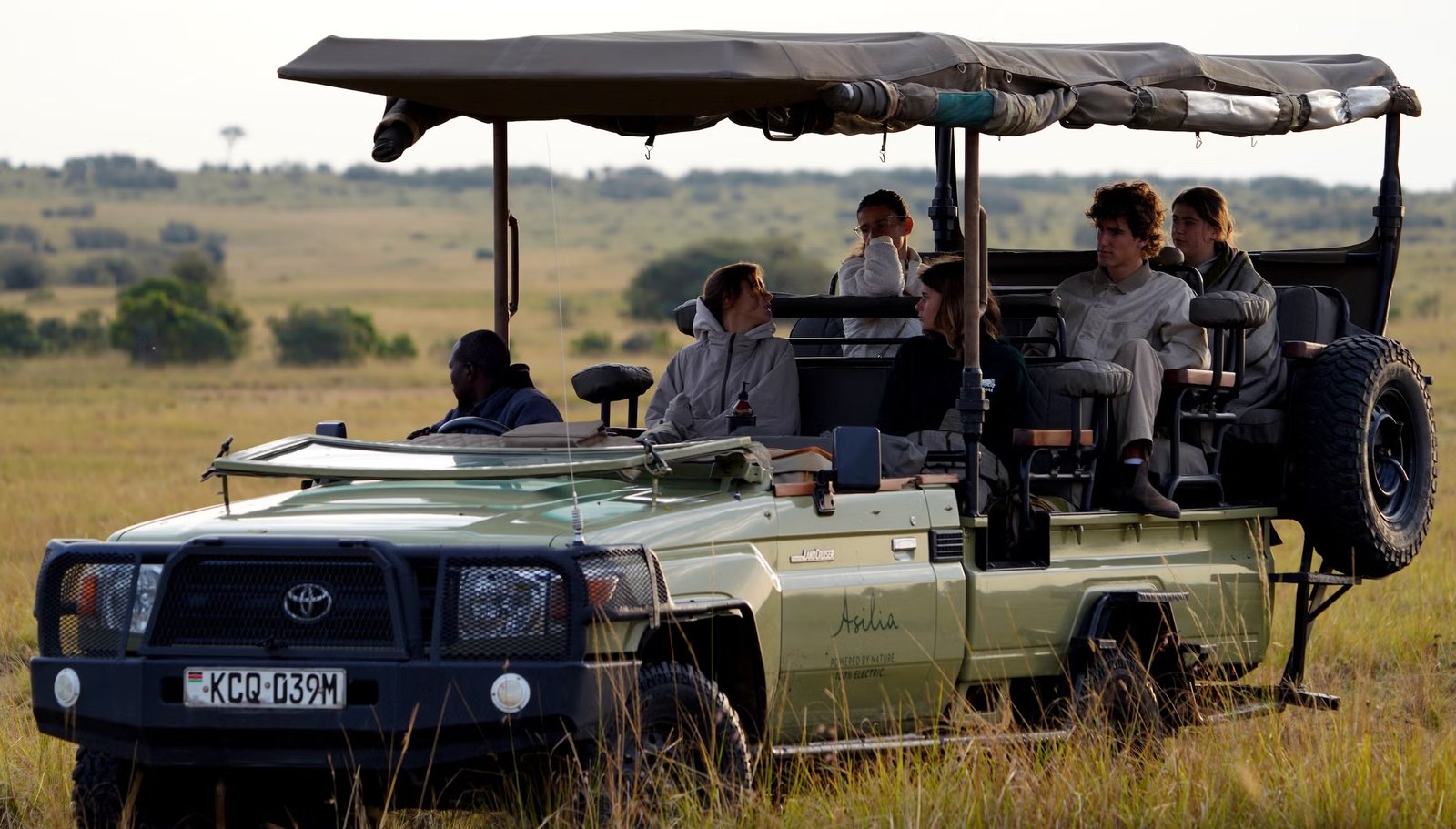
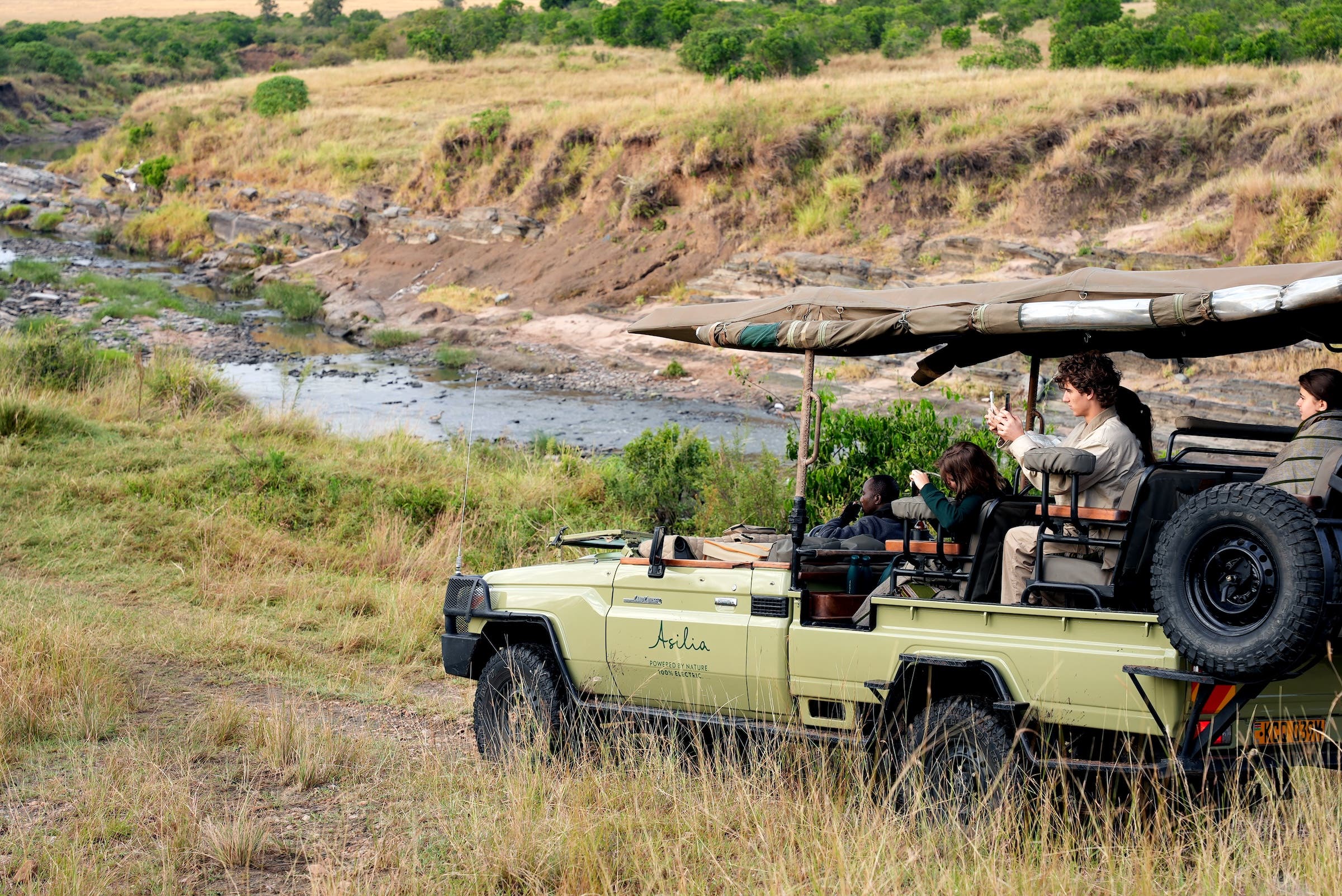
Usually at a scene like this, you’d hear the chug-chug-chug of diesel engines. But in the Toyota Land Cruiser where I sat, quietly adjusting two cameras to film and photograph the scene, there was no engine noise interrupting Oloimina’s thunderous calls. The car wasn’t off. It was electric. Its motor let out a tiny whine—kind of like a Power Wheels—but the lion didn’t seem to notice. And he felt it was quiet enough to call out to his pride-mate over and over.
But you already know that electric vehicles are quiet. And there have been a smattering of electric vehicles in safari destinations for almost a decade. What makes this quiet vehicle significant, and potentially revolutionary for wildlife lovers here and in the Western hemisphere, is that its batteries are charged by the sun.
“You’ve got a fantastic amount of solar [power] on this continent,” says Henry Fairey, chief technology officer of Silent Savannah, the company that built the electric vehicle I was riding in, but the solar array and battery bank that juiced it up for the game drive. And that “fantastic” amount of solar isn’t just equatorial sunshine. It’s solar panels: in just the first quarter of 2026, 15 African countries imported more than $400 million of solar panels, just a year after the import of panels had jumped 60 percent in a single calendar year. Some of that solar bonanza has to do with energy shocks from the Iran War, but it’s also just that solar’s become so inexpensive: it’s now the cheapest way to produce energy on the planet.
The “cheapest” marker includes making electricity in the United States and Canada, where wildlife tourism companies and regular adventurers can learn lessons from what’s working, and what’s challenging, when powering safari on solar.
Solar Makes Electric Safaris More Viable
Cheap or not, quiet, solar-powered EVs are still not the norm on safari in 2026. Quite the opposite: Over the past decade, the number of visitors to safari parks has skyrocketed, according to industry group Go2Africa—safari travel increased by 14 percent in 2023, 12 percent in 2024, and then by 7 percent in 2025. More visitors means more vehicles. And almost all of those vehicles are diesel-powered.
“The nature of the [savannah] is very open,” says Gerard Beaton, a resident of the Mara for 50 years, and strategic director at Asilia Africa, a tourism company that operates lodges in Kenya, Tanzania, and Uganda. Asilia Africa also operates the electric vehicle I was riding in while observing Oloimina. “So it’s quite easy to see when vehicles have pulled up to look at a lion, for instance. So that tends to be a magnet for other vehicles.”
When some lion cubs (or cheetahs, or a leopard) are spotted, other guides see the first spotting vehicle stop, and rush to join them, hoping to get their clients up close. Once they arrive, they’ll move their vehicle around, starting and cutting the engine, choking the air with fumes and filling the soundscape with the noise of the diesel firing up over and over, in an effort to get the perfect angle for Instagram.
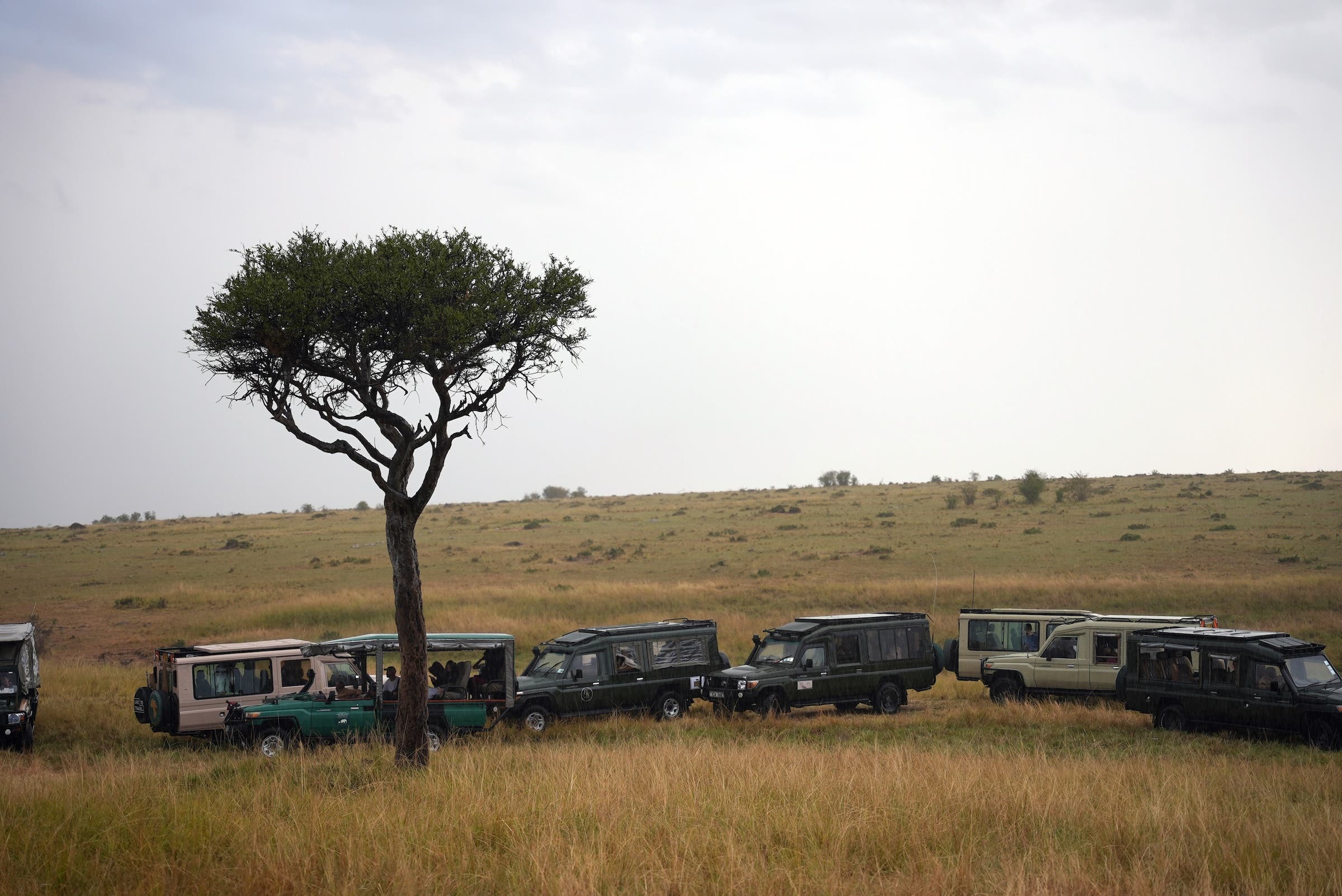
“A lot of these vehicles, they aren’t checked for emissions,” says Ashley Revay, who is studying the impact of electric vehicles on wildlife as part of her master’s program at Miami University in Ohio. “They turn them on, and there’s this big puff of smoke that goes into the air, and that also affects wildlife smelling for prey, smelling for each other, and marking territory.”
For the past decade, there has been a sprinkling of electric vehicles among that diesel horde. When Beaton was working at Ol Pejeta Conservancy, a rhino-laden haven about three hours from Nairobi, he helped introduce the area’s first battery-powered safari vehicle, built by Roam, a Kenyan company that now specializes in electric motorcycles.
“Many of those early adopters, I think there were eight or nine of us that bought one vehicle each, pretty much everybody gave up,” Beaton says. Having just a single electric vehicle meant having a completely separate system for charging and maintenance. And because solar panels weren’t as plentiful or cheap, charging the vehicles was expensive. Non-solar electricity in East Africa (and the global South in general) tends to cost more than it does in the U.S. and Europe, and the grid’s not as reliable. Blackouts happen regularly.
A number of those factors are shifting, reducing the price and increasing the feasibility of scaling up solar-powered safari. At Asilia’s Emboo Camp, Beaton says, the reduced price of panels and batteries has made it possible to add a lot more charging capability and battery capacity. The camp has amped up its power capabilities with an $85,000 investment, adding 120 kWh of battery storage capacity and a six-bay charging station. Instead of having just one electric vehicle, as he did when working at Ol Pejeta a decade ago, the camp has an all-electric fleet of ten, streamlining maintenance.
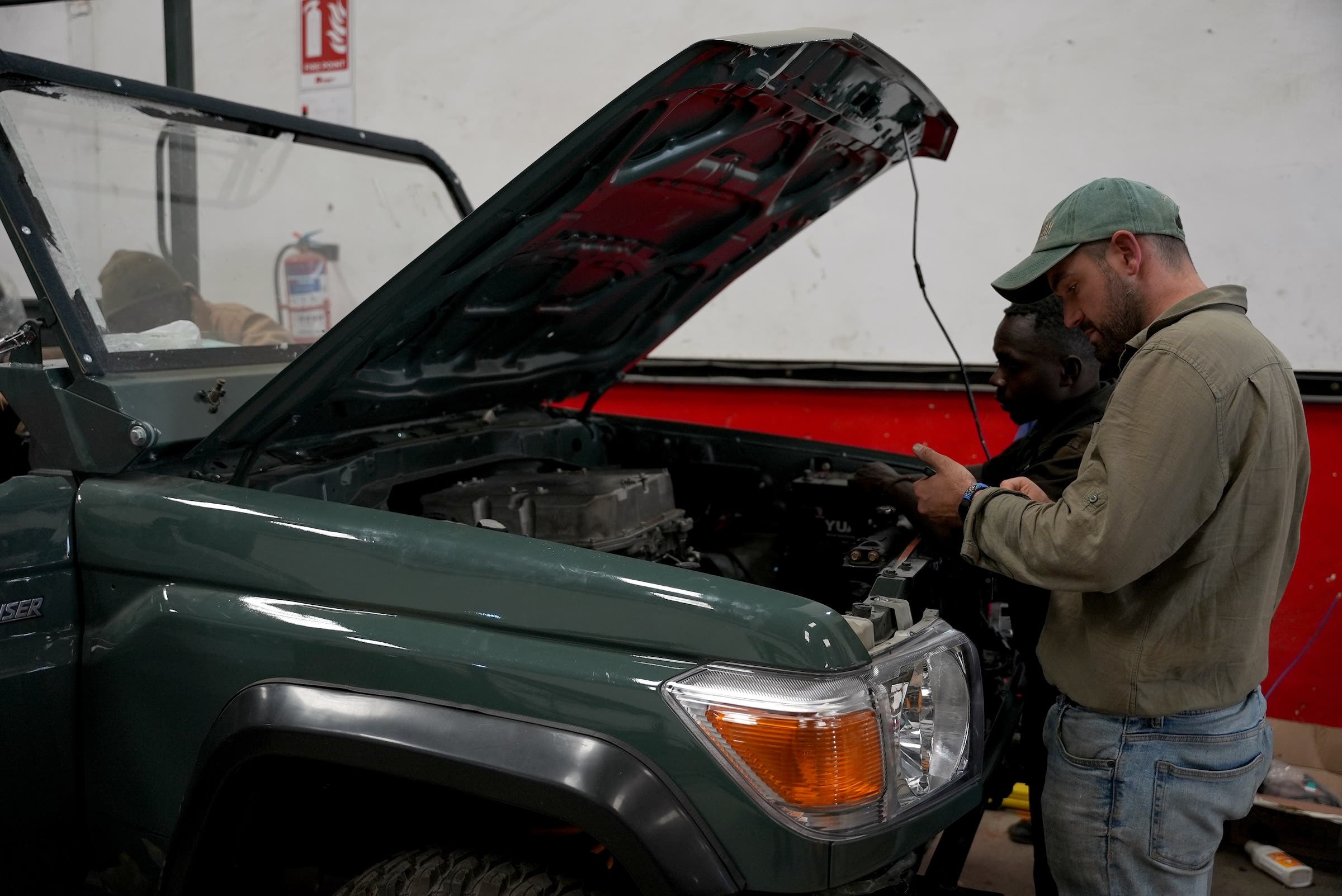
That’s possible to do because of EV conversion companies like Silent Savannah, and because of cheaper, secondhand electric vehicle components.
“We take batteries out of a variety of EVs. They may come from the West, may come from China. [The vehicles] have come to the end of their life prematurely, but the batteries and the drivetrains are still in fantastic condition,” Fairey says. These batteries, from MGs, Nissans, Lexuses, BMWs, and others, are installed in Toyota Land Cruisers, often with a motor from a much smaller vehicle—a Nissan Leaf. This motor, Fairey says, turns the already-powerful Toyotas into “rocket ships.”
Daniel Mopel, my guide and driver at Asilia’s camp, was eager to show me the Silent Savannah vehicle’s power, popping in and out of muddy ditches, and speeding towards a sighting with a grin, the engine barely emitting a whine as we whipped towards a pride of lions.
Other companies, like Electric Classic Cars in Wales and Reviver in South Africa, are doing similar conversions. And here and there, there are new vehicles creeping in: Thula, a South African company, is building their own custom electric safari vehicles and tourism boats. At Luca Safaris’ Chyulu Lodge in Chyulu Hills National Park in Eastern Kenya, there are a few Rivians that have been outfitted with the open sides and high roof of a safari vehicle. At Rob’s Magic, a body shop outside Nairobi that turns regular cars into safari-ready bodies, I saw another Rivian being kitted out next to a Silent Savannah Toyota conversion.
The real game changer, though, is the solar charging, Fairey says. Charging infrastructure is more sparse in Africa than in the U.S.; outside the parks, most of the electric vehicles you’ll see are motorcycles, which swap their batteries at small charging stations when they run dry. But for Silent Savannah, building a system that combines panels and electric-swapped EVs is their plan to increase demand.
“We started off concentrating just on electric vehicles … but the electricity grid is not quite up to what the camps and the vehicles need,” he says. “So to facilitate that, we started developing solar containers, and they’ve started to gain interest. They play a critical part in most camps—they run the camps, they charge the vehicles.”
How Quiet, Close Encounters Impact Animals
Increased attendance in safari parks isn’t inherently negative. More people getting to enjoy and appreciate these animals may bolster people’s appetite for conservation. And in places like the Maasai Mara, where the reserve is run by the local community, these spaces can increase economic activity and reduce human-wildlife conflict between herders and predators. But the influx of vehicles, and drivers’ pressure to get the perfect shot for Instagram, can put pressure on endangered and threatened wildlife.
Last year, Revay was riding in a safari vehicle in Botswana when her group came upon a leopard cub. The six-week-old cat had been left in a tree by its mother, which had gone out in search of food.
“The guide continued to reposition the vehicle for photos as the sun was setting. And every time the ignition started, the cub would startle quite significantly,” she says. “On the fourth ignition, the cub jumped down from the tree. Mom was nowhere to be found.”
On the ground, the cub was now a target for predators and scavengers. Revay, who had worked in the electric vehicle industry, was inspired to study the impact these vehicles could have on animal well-being.
Partnering with Asilia, the Kenya Wildlife Trust, and the Mara Predator Conservation Programme, she spent weeks on safari in the Maasai Mara and Botswana, observing how animals interacted when approached by electric vehicles and diesel vehicles. She measured the distance at which they’d react, observed the changes exhibited in their behavior, and how long after the vehicles departed that the animals resumed the behavior they’d been doing before the vehicles had shown up and interrupted them.
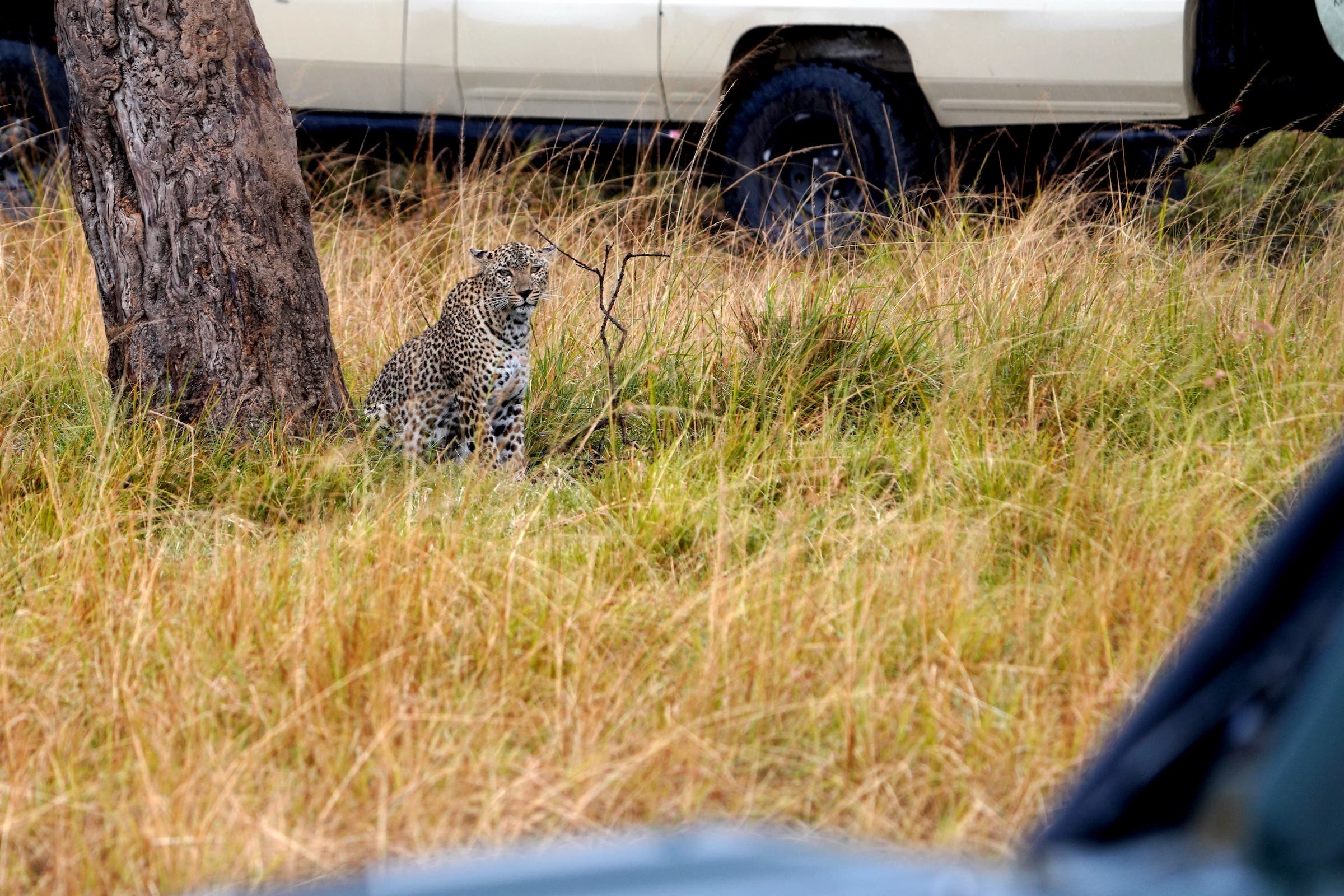
For most species she studied, the animals took longer to react to electric vehicles, waiting until the cars were closer before changing their behavior. And they went back to “normal” sooner after the EV left than they did with diesels.
This data confirms guides’ experience with the EVs.
“If there is hunting going on, you just stop. You don’t have to turn the car off, turn the engine off. You just wait for the action,” says Felix Ololoso, a guide and driver at Asilia’s Emboo Camp. “If you decide to leave, you leave quietly and peacefully, without turning any noise on. It’s amazing. The animals will continue with their behavior that they were doing, without disturbing it at all.”
It also agrees with a previous study conducted in India, published in the European Journal of Wildlife Research in 2021. Reuven Yosef, a professor at Ben Gurion University in Israel, drove electric and diesel vehicles toward leopards and other animals in Jhalana Leopard Reserve in northwest India. They approached the animals at the same speeds at similar times of day. And their observations were similar to Revay’s: the animals reacted to the electric vehicles later and fled when the vehicles were closer than they did with the fossil fuel-powered cars.
When I rode in an Asilia electric vehicle in July, we silently rolled toward a group of banded mongooses in some thick grass. On hundreds of safari drives, I’ve never been able to hear these animals, which have a complex series of calls and sounds that scientists liken to the syllables in human language. But in the electric vehicle, I could even hear the babies vocalizing to their parents.
As we watched them, I imagined being able to do the same in the U.S. Years ago, I was lucky to catch a glimpse of a lynx on a Colorado road. But as our car approached, the cat quickly ducked into high grass on the side of the road and melted into the trees. In an EV, I daydreamed, I might have caught a longer look—or even a photo—of the large-pawed feline.
In that imagined scenario, I may also have caught the creature by surprise. That was the real-life case with the mongooses: Though we could hear them, the striped animals couldn’t hear us. As the vehicle approached, the group reacted much later than they normally would, popping up on their hind legs to check out the car, and calling to each other to start a flurry of action away from the wheels.
This aspect worries Yosef about his study on electric vehicles’ impact on animals.
“If that animal is startled at such a short distance, it could take evasive behavior which could be harmful to itself, or to the tourists. Because if it’s a dead end, it could come back to the vehicle,” he says. A small animal like a mongoose could wind up in the vehicle’s tires. And a larger, more dangerous animal like a leopard could go into fight-or-flight. And if they choose flight and don’t have an escape route planned, they could get injured. “If they’re at a cliff face, of which we have quite a few in Jhalana, we don’t know if they would go off it. We know of several leopards that have fallen off cliffs and been killed by that. But was it because of humans, because of an inappropriate approach? We don’t know.”
In Revay’s study, the electric vehicles caused distress with one particularly dangerous species: elephants. The giant animals sometimes trumpeted, performed mock charges at the vehicles, or fled when electric vehicles approached. It could be, she says, that the animals are hearing something from the engine that we can’t, or that they’re feeling something from the ground through their feet, which they use when communicating at low frequencies. More research is needed to understand these reactions.
To keep visitors safe in encounters with both elephants and rhinos, which rely on hearing more than sight to react to threats, Beaton says Asilia drivers are being trained to guide differently in EVs. When possible, they don’t approach these large animals from behind, for example.
Yosef would like EVs in wildlife settings to be equipped with something that warns animals of their approach sooner. Similar to how EVs in cities are equipped with that angelic, sci-fi humming sound to warn pedestrians, the scientist says he’d like safari electrics to have a small bell to avoid animals being trampled in high grass, and to give them more time to plan their escape as the cars approach.
Solar Sustainability Draws Tourists, and Is a Point of Pride for Locals
The environmental impact of removing a few diesels from these parks may not be huge when it comes to air quality; as Yosef is quick to point out, even when a leopard is surrounded by diesels, there are fewer vehicles in the vicinity than you’d find on a typical city block.
But these more sustainable options can be a draw for visitors. When Lindsay Hergott, a Canadian leadership coach who now lives in Costa Rica, was booking her safari trip with her four children, she chose the Asilia lodge group because of its sustainable practices, including the inclusion of solar power and electric vehicles.
“Anytime you’re witnessing nature, you’re in some way impacting it,” Hergott said. “But we specifically asked to have a regenerative experience with the safaris … I wanted minimal exploitation.”
The guides at the camps, who are Maasai, the tribe the reserve is named for, embrace the solar and electric solution as protecting their home country.
“I’m born and raised here. And so it’s sad to see it going in a wrong way, with lots of fumes, all the smoke,” Ololoso says. “Now that I have a chance [to drive them] and see that the electric cars work, it’s really important for me and the entire Maasai Mara, and the people who are in this ecosystem, that the electric cars are the best to protect the nature.”
Mopel agrees: “In the future, this is what we need to have in the Mara.”
Can It Work in the U.S.?
When one of Asilia’s electric vehicles goes out for a drive, it’s been charged overnight, Beaton says.
“They set off in the morning, and then come back in from the game drive around 11 a.m. They’ll be down to around 65 percent,” he says. While guests eat a late breakfast or lunch, the vehicles are hooked up to the solar charging station. There, they can wind up back around 100 percent (or near it) before the evening game drive, which kicks off around 4 p.m. Afterward, “they may be back down to 70 percent, and then we top them up overnight.”
To provide enough power for this cycle, Silent Savannah budgets for about 12 panels per vehicle, each providing 600 watts of charging.
For operators in the U.S. who might take tourists out to see buffaloes, bears, or bison, this model of morning and evening drives with a charging session in between can be tough to replicate. But most EVs have enough range for day trips in places like Yellowstone, Zion, and Yosemite, says Court Whelan, PhD, chief sustainability officer with Natural Habitat Adventures (NatHab). The wildlife tour company has electric vehicle projects at Ol Pejeta Conservancy in Kenya, but also in Botswana, Tanzania, Nepal, Borneo, at Machu Picchu in Peru, and in the Galapagos Islands. In U.S. National Parks, the company has Rivians that act as support vehicles, transporting guests’ luggage and supplies, but not guests themselves on tours.
Natural Habitat’s Botswana vehicle is charged by a solar array—one of the first vehicle-solar hookups of its kind in Africa—but in the U.S., these systems haven’t been set up yet. For most trips, Whelan says, range shouldn’t be an issue. But for truly wild, remote, multi-day adventures, having enough power in a vehicle could pose a problem.
One way these technologies could be deployed in the U.S. in those situations could be at a mobile, solar-powered, off-grid camp, suggests David Ferriss, a veteran electric vehicle journalist and author of the upcoming book, Shift: How Your Next Car Will Shape the World.
“If I was designing an off-grid resort in the U.S. that was meant to look at wildlife, I’d want stationary batteries on site, which creates this huge flexibility to be able to soak up electrons and use it to power the building or the car,” he says. When the car is topped up, he says, it could even be used to power the building, versus the building charging the car. “There are even solar trailers that will pack up into a neat little trailer, and then unfold into an array.”
That type of array is exactly what Natural Habitat has deployed in Kenya. At Ol Pejeta Conservancy, where Beaton first used an electric safari vehicle nine years ago, NatHab has partnered with Silent Savannah to build a foldable solar trailer that powers a mobile camp with eight tents. The luxury camp, with upholstered couches, hardwood tables, and a Sodastream for sparkling water at meals, can be moved around the conservancy seasonally. The trailer also has a hookup to charge electric vehicles, once one’s deployed to the mobile camp.
Silent Savannah was able to test the trailer by towing it to the Rhino Charge, an annual event where vehicles try to traverse near-impossible routes through the Kenyan bush—they winch themselves over cliffs, climb over boulders, and try to get from point A to point B in the least amount of mileage, in a type of automotive parkour. The solar trailer was able to charge Silent Savannah’s Frankenstein-looking entrant into this contest and give it enough juice to finish. Fossil fuel–powered cars in the same event have to refuel before finishing.
Whelan envisions a future where trailers like these can be used on less insane, but still remote, terrain: American adventurers could tow small, folding trailers the size of teardrop trailers into the forest, desert, or other wild, and have sustainable solar power for days of fishing, bike-riding, birdwatching, or other adventures.
Right now, anything of this type is custom- and purpose-built. Eventually, he hopes that products will exist that cover 80 percent of use cases. But we’re not there yet.
That doesn’t mean that an electric car can’t fit into adventure plans right now, he says. Ferriss agrees, based on his family’s own use of their electric car, a Kia Niro.
“The car and the charging has been one of the biggest sources of adventure in our lives with our kids,” he says. “I’m not joking there. Having the electric car has changed our patterns such that we actually go to different places because we’re charging, and spend more time in those places because we’re charging.”
On family trips to the Cascades, for example, Ferriss has now found a favorite restaurant in Ellensburg, Washington, where he and his family stop for truly excellent sandwiches. Not exactly an encounter with a lion or bear, but it’s proof that charging can mean more newness instead of just more stopping.
He also thinks that American adventure companies could wind up taking solar charging as inspiration for smaller vehicles that need less range: think of a snowmobile outfitter in Bozeman switching from gas-powered machines to Polaris’ upcoming all-electric snowmobiles, and charging them with a portable array.
Whelan believes that for adventurers and wildlife lovers in the U.S., Africa, and everywhere else, a future with solar-powered vehicles isn’t just possible—it’s inevitable.
“There’s no doubt this is going to be the future,” he says. “So why not jump on this now? Learn more. Do some cost savings. Have better experiences. And help us get to the future that is more sustainable a little bit quicker, and a little bit better?”
Greg Presto is an American journalist and filmmaker currently based in Nairobi, Kenya. He was formerly based in Kampala, Uganda, and has covered nature and wildlife events in the region since 2016, interspersed with work on health, fitness, and sports. He is an enthusiastic lover of cats, big and small. You can view some of his other wildlife work on his personal YouTube channel, Presto Wildlife.
