

Published July 22, 2026 12:34PM
This article has been medically reviewed by Rachel MacPherson.
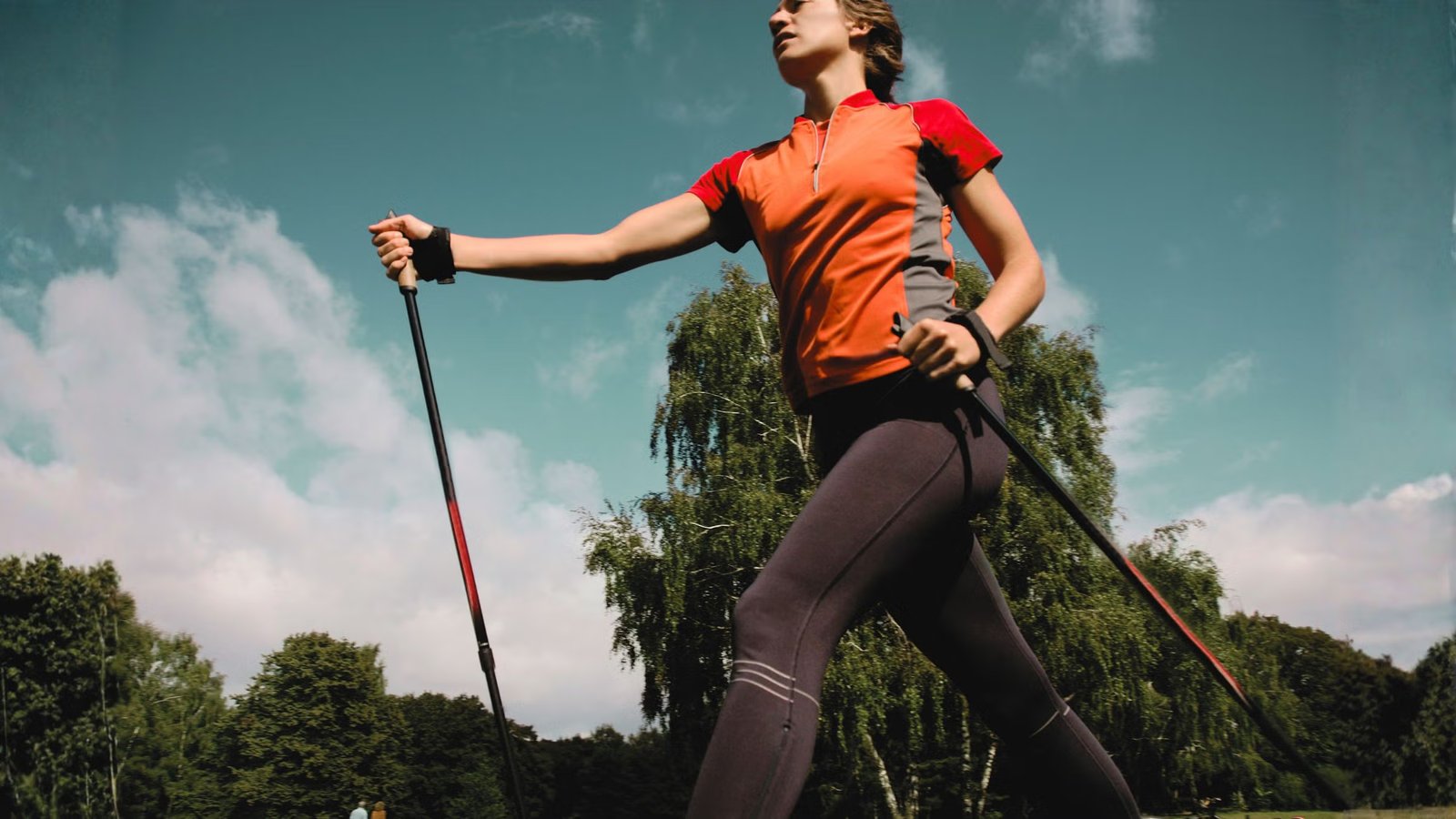
Nordic walking is cool again. While many Baby Boomers have long been into this type of walking, it’s now embraced by younger generations in search of a low-impact workout that’s still challenging.
But Nordic walking is more than a way to get your heart rate up. Research suggests there are plenty of perks to Nordic walking, such as improved mood, balance, and a reduced risk of cardiovascular diseases.
Since social media is abuzz with the trend, Outside asked doctors and sports physiologists, and a Nordic walking master about the benefits of this form of walking. Here’s what experts want you to know about.
What’s the Difference Between Nordic Walking and Regular Walking?
Despite its name, Nordic walking actually started in Finland in the early 1990s. “Cross-country skiers used poles during the snow-free months to maintain their conditioning,” Dr. Caitlyn Mooney, told Outside. Mooney is an orthopedic surgeon and assistant professor in the department of orthopedic surgery at Vanderbilt University Medical Center in Nashville, Tennessee.
A major difference between Nordic walking and standard walking is the use of specially designed poles, according to Dr. Bert Mandelbaum, a sports medicine doctor and orthopedic surgeon in Santa Monica, California. “Nordic walking uses the core and upper body more,” he said. “Rather than simply carrying poles for balance, participants use them to propel themselves forward, making walking into a full-body exercise,” Mooney added.
Nordic Walking Versus Hiking
Nordic walking is different from hiking with hiking poles, too, Barb Gormley, a Nordic walking master trainer and author of the Urban Poling Ultimate Guide to Nordic Walking, told Outside. “Hiking with hiking poles minimizes effort and makes your hike easier, while Nordic walking maximizes effort, making your walk more challenging,” Gormley said.
What Are the Benefits of Nordic Walking?
Nordic walking “uses almost all the muscles of the body,” Gormley said. As a result, you can get a lot out of it. These are the biggest perks, according to research and experts.
Better Balance
Nordic walking supports coordination and balance because the arms and legs move in opposite patterns in a rhythmic, reciprocal motion, Mooney said. “This reinforces normal gait mechanics while engaging the upper and lower body together,” she said.
Research published in the journal Clinical Rehabilitation studied 80 men who experienced acute coronary syndrome (ACS)—a group of conditions that reduce blood flow to the heart, such as heart attacks and angina. The men included in the study had suffered an ACS event two to three weeks prior to their inclusion. They were divided into three groups participating in different workouts: cardiac rehab and Nordic walking; cardiac rehab and regular walking; and cardiac rehab only. The walking and rehab protocols lasted for three weeks.
At the end of the three weeks, the researchers found that men in the Nordic walking group showed greater improvement in both lower-body endurance and balance than those in the other two groups.
Improved Mental Health
A regular Nordic walking habit may boost your mood and ease symptoms associated with mental health disorders. For example, a 2026 study found that over ten weeks, people who participated in Nordic Walking twice a week felt less depressed than those who didn’t incorporate it into their workout routines.
In that study, 64 adults with moderate to severe symptoms of depression were assigned to a ten-week supervised program. One group did Nordic walking twice a week and the others did not exercise at all. The researchers assessed all participants’ depression symptoms at the start of the study, after five weeks, and after ten weeks. The Nordic walking group showed greater improvements in depressive symptoms than the group that didn’t change their exercise routine, especially within the first five weeks. People with severe depression at the start had the biggest and fastest improvements.
Other research suggests that Nordic walking can improve mood in people with anxiety and post-traumatic stress disorder.
It Works Several Areas of the Body at Once
“Nordic walking is a whole-body activity that engages the arms, shoulders, trunk, and legs,” Jennifer Reed, a researcher who studies exercise physiology and cardiovascular health at the University of Ottawa Heart Institute, told Outside. “Because more muscle mass is active, it increases cardiovascular demand and energy expenditure compared with regular walking.”
Mooney calls Nordic walking an attractive option for people who want a more challenging workout but have limitations that make high-impact activities like running uncomfortable.
It May Lower the Risk of Cardiovascular Disease
Several studies have linked Nordic walking to improved cardiovascular health, including research that Reed authored. In 2022, Reed conducted a study, published in The Canadian Journal of Cardiology, in which patients with coronary artery disease performed high-intensity interval training, moderate-to-vigorous-intensity continuous training, or Nordic walking for 12 weeks. At the end of the study period, people in the Nordic walking group had the greatest improvements in functional capacity, an important predictor of future cardiovascular issues, Reed said.
A 2025 scientific review of 22 studies that included 1,271 people found that Nordic walking helped to improve oxygen consumption and reduced systolic blood pressure (which measures the degree to which blood presses against the arteries when your heart beats; it’s the top number in a blood pressure reading). Nordic walking also improved diastolic blood pressure (measures how hard the heart pushes against the arteries between heartbeats; the bottom number in a reading).
It’s Linked to Less Chronic Pain and Fatigue
An analysis of 14 studies published in the journal Healthcare found that regular Nordic walking may ease pain and fatigue in people with chronic conditions, but the workout is not necessarily better at reducing pain and fatigue than regular walking or other types of exercise.
“Nordic walking provides a low-impact form of aerobic exercise while offering additional support and stability through the poles,” Reed said. “For people living with chronic conditions, this can make physical activity feel more manageable and may remove barriers to the cycle of inactivity, deconditioning, and fatigue.”
Regular exercise also helps people stay active while distributing effort across several muscle groups, which may be more comfortable, Mooney said. All of this can reduce chronic pain and fatigue. “It’s important to recognize that Nordic walking is not a cure for chronic pain or fatigue,” Mooney adds. “The benefits are most likely when it is introduced gradually as part of a comprehensive treatment plan tailored to the individual’s condition.”
How to Incorporate Nordic Walking Into Your Life
Ready to add Nordic walking to your life? Gormley advises people to start by investing in a good pair of walking poles. “Be sure you buy real Nordic walking poles, not hiking poles,” she said.
Then, Gormley suggests taking at least one lesson to learn the proper technique from a certified instructor. “Nordic walking isn’t difficult to learn, but it isn’t easy or intuitive either,” she said. “Without a lesson, many people unconsciously shift into a comfortable hiking mode—bent elbows and short steps—instead of Nordic walking mode, with arms like long levers and long steps.”
Mooney says you don’t need to replace all of your walks with Nordic walking to reap the benefits. “Even incorporating one or two Nordic walking sessions each week can add variety and increase exercise intensity without substantially increasing impact on the joints,” she said. “For people who already enjoy walking, Nordic walking can be a simple way to progress their workouts while maintaining the accessibility and convenience that make walking such a sustainable lifelong exercise.”
About the medical reviewer: Rachel MacPherson is a certified strength and conditioning specialist, an ACE-certified personal trainer, and a PN1-certified nutrition coach. MacPherson has spent over a decade helping lifters trade bro science for actual results. She’s happily turned an obsession with evidence-based health into a full-time writing and strategy career, helping publications, wellness brands, and supplement companies tell smarter stories that people trust. She’s a stickler for science-backed training advice that respects the reader’s intelligence, with the ultimate goal of getting you under the bar with total confidence (or moving in whatever way feels best).
Want more Outside health stories? Sign up for the Bodywork newsletter.
