

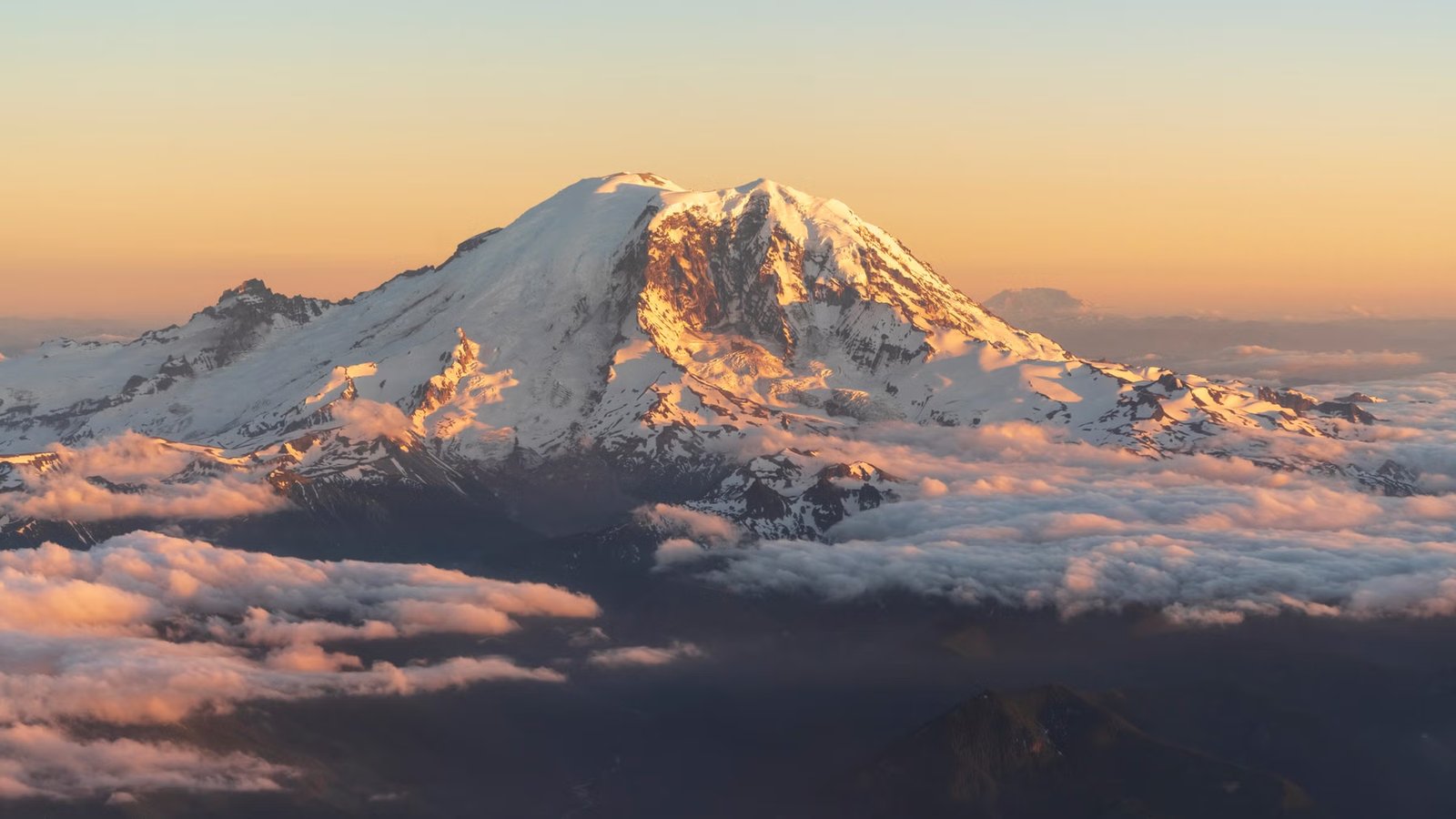
Daihong Chen, 44, died after two unguided parties were struck by rockfall near 11,600 feet on the Disappointment Cleaver. RMI guide Peter Whittaker weighs in on the unavoidable dangers of Rainier’s most popular summit trail.
Disappointment Cleaver is Mount Rainier’s most popular summit route, carrying roughly two-thirds of all climbers attempting the mountain (Photo: aaaaimages/Getty Images)
Published July 27, 2026 05:28PM
Falling rocks killed a Washington climber and injured three others on July 19 along Mount Rainier‘s Disappointment Cleaver route, the 15-mile round-trip trail that most climbers take to the summit.
The Pierce County Medical Examiner’s Office identified the deceased as Daihong Chen, 44, of Bellevue, Washington. She suffered multiple blunt-force injuries, officials said in a report. Three other people in her group were also injured, one of whom was hospitalized.
Veteran climbing guide Peter Whittaker told Outside that Disappointment Cleaver is the standard route that guides use to bring clients up Mount Rainier because it avoids crevasse-prone terrain and provides a semi-direct route to the summit.
“There’s dangers involved with the route as well,” Whittaker said. “Overhead danger, rockfall, icefall. So, even the most climbed routes on Rainier have an element of danger that you can manage, but you can’t eliminate.”
According to an incident report, the accident occurred around 3:30 A.M. at approximately 11,600 feet, as two unguided climbing groups totaling six climbers were ascending toward the summit. Rangers brought the injured climbers to the Camp Muir ranger station at 10,080 feet, where helicopters transported them for medical treatment.
Whittaker is the co-owner of Washington-based RMI Expeditions, the guide company founded by his father, Lou Whittaker. He has been guiding climbers in the region for more than 50 years and has summited Mount Rainier 256 times. Disappointment Cleaver is Mount Rainier’s most popular summit route, and approximately two-thirds of all climbers attempting the mountain follow it to the top, Whittaker said.
Despite its popularity, Disappointment Cleaver is still a technical alpine climb that requires climbers to wear specialized mountaineering gear. It is also exposed to hazards like crevasses, avalanches, falling ice, rockfall, and altitude illness, according to the American Alpine Club (AAC). The route climbs roughly nine miles one way with about 9,000 feet of elevation gain, and most climbers spend a night at Camp Muir at 10,080 feet above sea level before beginning the summit push by 1 A.M.
The route’s popularity also means more climbers face those objective hazards each season, according to the AAC.
Disappointment Cleaver Has a Long History of Accidents
A cleaver is a rock ridge that separates two glaciers, and Disappointment Cleaver separates the park’s Ingraham and Emmons glaciers. Climbers have been killed or injured along the route by falling debris and avalanches, while others have suffered accidents, falls into crevasses, or sickness from the altitude.
In 1991, one climber died of exposure after falling into a crevasse at approximately 12,500 feet, and in 2002, a falling rock struck and killed one climber in a four-person rope team on the way up the Cleaver.
Disappointment Cleaver was also the site of Rainier’s deadliest climbing accident. In 1981, an avalanche on the Ingraham Glacier killed ten climbers and one guide from RMI Expeditions. The slide swept their bodies into a deep crevasse, and rescuers never found their remains.
Warmer Temperatures Mean Shifting Conditions
Guides try to minimize the amount of time climbers spend beneath unstable rock and ice, but conditions evolve throughout the summer, Whittaker added. Winter snow acts as a protective “second skin” over the mountain in late spring, covering crevasses and creating a smoother hiking surface. But as the season progresses, that cover melts, and glacial ice and movement can expose new risks. On the Cleaver itself, the surface is usually mostly or entirely rock by August or September.
Glacier movement is the primary cause for icefalls, Whittaker adds, but rockfall is less seasonal. Whittaker says he’s seen long-term changes to Mount Rainier during his five decades of mountaineering, including the disappearance of one glacier and the retreat of most others.
“Rainier is a volcano,” Whittaker told Outside. “The rock is rotten. It’s really loose rock. Most things are crumbling.”
Loose volcanic rock makes rockfall a persistent hazard on the mountain regardless of the season, Whittaker added.
“The overall theme, those glaciers are thinning out,” he said. “Not only are the glaciers shortening in length, but there are areas where I can see changes where the glaciers actually dropped. It’s made access more challenging.”
Those changes can lead to unreliable guiding seasons. In previous years, RMI ended the season early as conditions became too hazardous. This year, he says, the conditions are unusually favorable despite the warm winter, thanks to heavy snowfall above 10,000 feet. Whittaker said guiding on Rainier requires constant reassessment because mountain conditions can change daily, even on the most traversed route.
“People hire us to make life and death decisions in dangerous places,” Whittaker said.
As of this publication, the Disappointment Cleaver route remains open. Investigators have not yet stated what caused the July 19 rockfall.
