

Published August 5, 2026 03:03AM
The outdoor industry gets a lot right. Its commitment to public lands is fierce. Sustainability initiatives are woven into brand DNA. Conservation efforts are backed by real dollars and advocacy. The industry has rallied around climate action and built a culture that genuinely cares about the planet and the wild places we all cherish.
But here’s what’s glaringly absent from that picture: women over 50.
Flip through any outdoor brand’s Instagram feed. Walk into any brick-and-mortar store and study the larger-than-life images on the walls. Scan the ambassador rosters of major gear companies. You’ll see diverse faces, different body types, a range of abilities, all positive steps forward. But you will struggle to find women over 50 years old celebrated for their strength, endurance, and decades of hard-won expertise in the mountains, on the trails, or in the backcountry.
In an industry that prides itself on celebrating human achievement in wild places, we have systematically excluded an entire demographic of accomplished, powerful, trailblazing women. And it’s time to reckon with that.
The Invisibility Feels Intentional
I’m a woman over 50 who hikes, explores, and pushes my limits in the outdoors. I’m not slowing down; I’m getting stronger, more intentional, and more confident in my abilities. And yet, when I look at outdoor marketing, I don’t see myself. I don’t see my peers. I don’t see the women I meet on trails who are summiting peaks, bikepacking across states, guiding others through wilderness with decades of knowledge.
The absence feels intentional. Not malicious, perhaps, but certainly systematic. It’s as if the industry has collectively decided that women’s outdoor achievements have an expiration date, that once we cross some invisible threshold, our stories stop mattering, our bodies stop being “aspirational,” and our accomplishments stop being worth celebrating.
I watch younger women in their twenties and thirties get the spotlight they deserve. I cheer for them; I cheer for all women because visibility matters, and I’m not interested in a zero-sum game where one generation’s recognition comes at another’s expense. But here’s the thing: the outdoor industry has made it a zero-sum game. They’ve chosen to elevate one group while erasing another.
The Double Standard Is Stark
Let’s talk about the men. Reinhold Messner is 80 and still revered as a mountaineering legend. His face graces magazine covers. His opinions shape industry conversations. Conrad Anker, now in his early sixties, remains a celebrated figure in climbing media. And who hasn’t heard of the amazing Jimmy Chin, in his fifties and consistently on magazine covers? These men, and many others like them, are praised for their longevity, their wisdom, their continued presence in the outdoor world.
Now name a woman over 50 who gets the same treatment. I’ll wait. The silence is deafening. It’s not because these women don’t exist. Lynn Hill revolutionized climbing and is now in her sixties. Steph Davis, one of the most accomplished climbers and BASE jumpers in the world, is in her fifties. There are ultrarunners, mountaineers, guides, and adventurers who are women over 50 doing extraordinary things right now. But the industry has decided their stories aren’t worth telling.
This isn’t just unfair; it’s erasure. It sends a clear message that women’s achievements have a shelf life. Our strength matters until it doesn’t. Our bodies are worth celebrating until they age. Our decades of experience are valuable until they come with gray hair and laugh lines.
And the impact of that message reverberates far beyond marketing. It tells younger women that their future in the outdoors has a countdown clock. It tells women my age that we should quietly step aside. It tells the world that women’s worth is tied to youth in a way that men’s simply isn’t.
But there’s no shortage of space on Instagram grids, no limit to ambassador budgets, no cap on whose story gets told.
How to Bring Visibility to Women Over 50
So, what now? The outdoor industry should do more than acknowledge this gap; it needs to actively correct it. That means:
Hire women over 50 as brand ambassadors. Not as tokens. Not as one-offs. As central figures in campaigns, with the same prominence given to younger athletes and male counterparts.
Feature accomplished women over 50 in advertising and in-store imagery. Show us on magazine covers. Celebrate our achievements with the same enthusiasm given to men our age.
Diversify decision-making teams. If the people greenlighting campaigns and choosing ambassadors don’t include women over 50, the blind spot will persist.
Examine the default. Ask why invisibility became the norm for aging women. Interrogate the assumptions baked into marketing strategies. Challenge the idea that only certain bodies and ages are “aspirational.”
Representation shapes reality. When women over 50 are erased from outdoor narratives, it doesn’t just hurt us, it limits what all women believe is possible as they age. It reinforces a culture that devalues women the moment we stop looking like the narrow ideal the industry has decided to sell.
The outdoor industry has built a reputation on celebrating the wild, the difficult, the enduring. It’s time to apply those values to the women who embody them—at every age. Our achievements don’t expire. Our stories don’t stop mattering. And our visibility shouldn’t be conditional on staying young.
Women over 50 are still here, being kick-ass in the outdoors. When will the outdoor industry start to consistently acknowledge our athleticism, as they do the twenty- and thirty-year crowd?
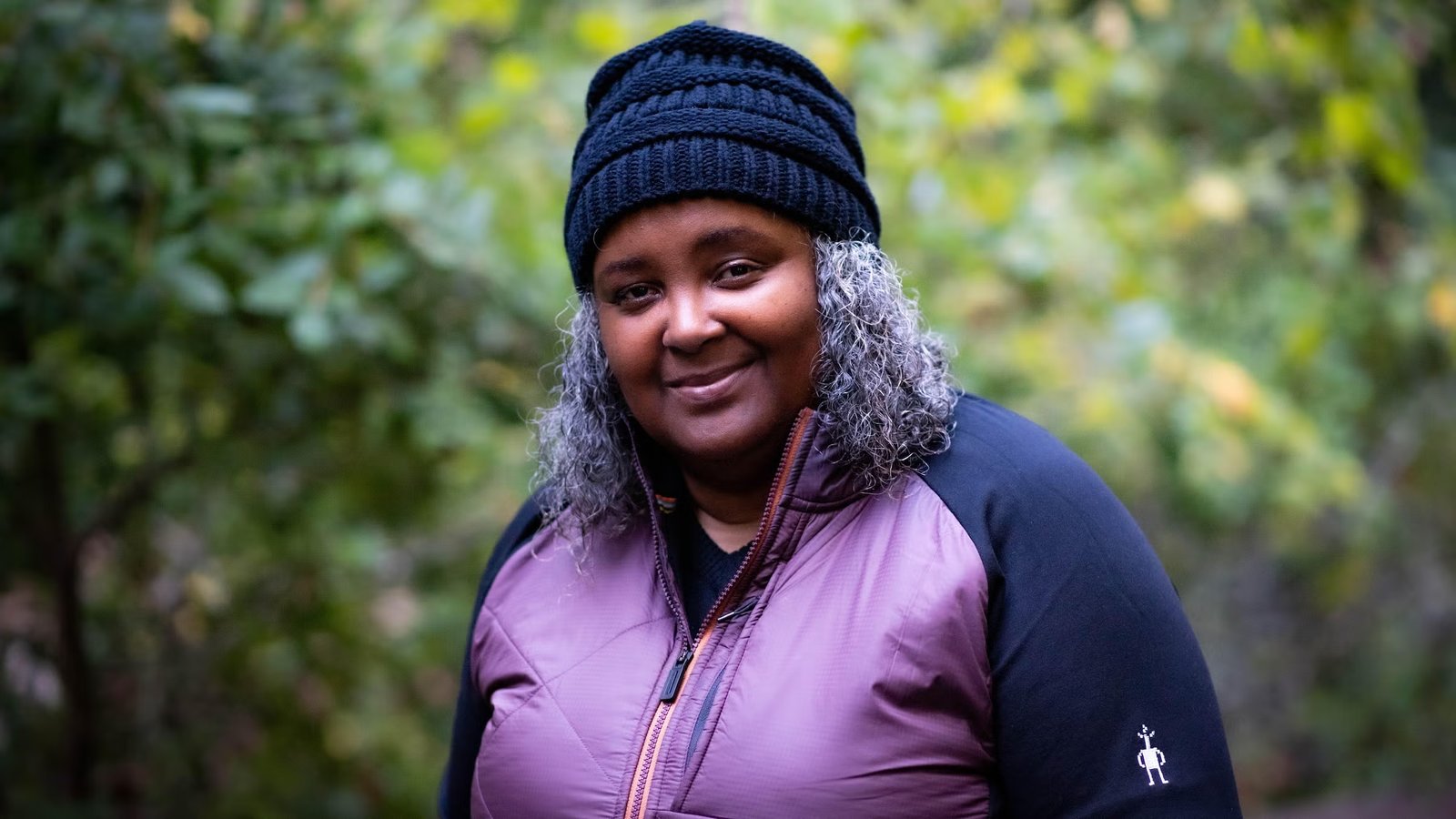
Teresa Baker is a 50-something hiker who embodies a quiet revolution in outdoor recreation. On most days, you’ll find her on California trails ( the redwoods being her favorite place to explore ), moving slowly and deliberately, never covering more than five miles, but taking up the better part of the day. She’s not collecting mileage; she’s collecting moments. Her camera, ever present, captures the images that define her day. She seeks solitude on the trails, not out of rudeness, but out of necessity, a deliberate choice to move at her own pace and on her own terms.
This autonomy is rooted in her upbringing. The only girl among eight brothers, Teresa spent her childhood navigating outdoor landscapes, most prominently, a horse ranch in Salinas where her family often gathered, and the Berkeley hills where she hiked and explored often. She was constantly challenged to keep up with “the guys” or risk being left behind. That pressure, to move faster, go harder, prove herself, ultimately shaped her early relationship with the outdoors. But as an adult, she rejected competitiveness. Today, her slow pace and solitude-seeking aren’t about falling behind. They’re about choosing her own way. Through her advocacy, she seeks to show there is room for kick-ass women in the outdoors, as they age.
