

Published August 11, 2026 03:20AM
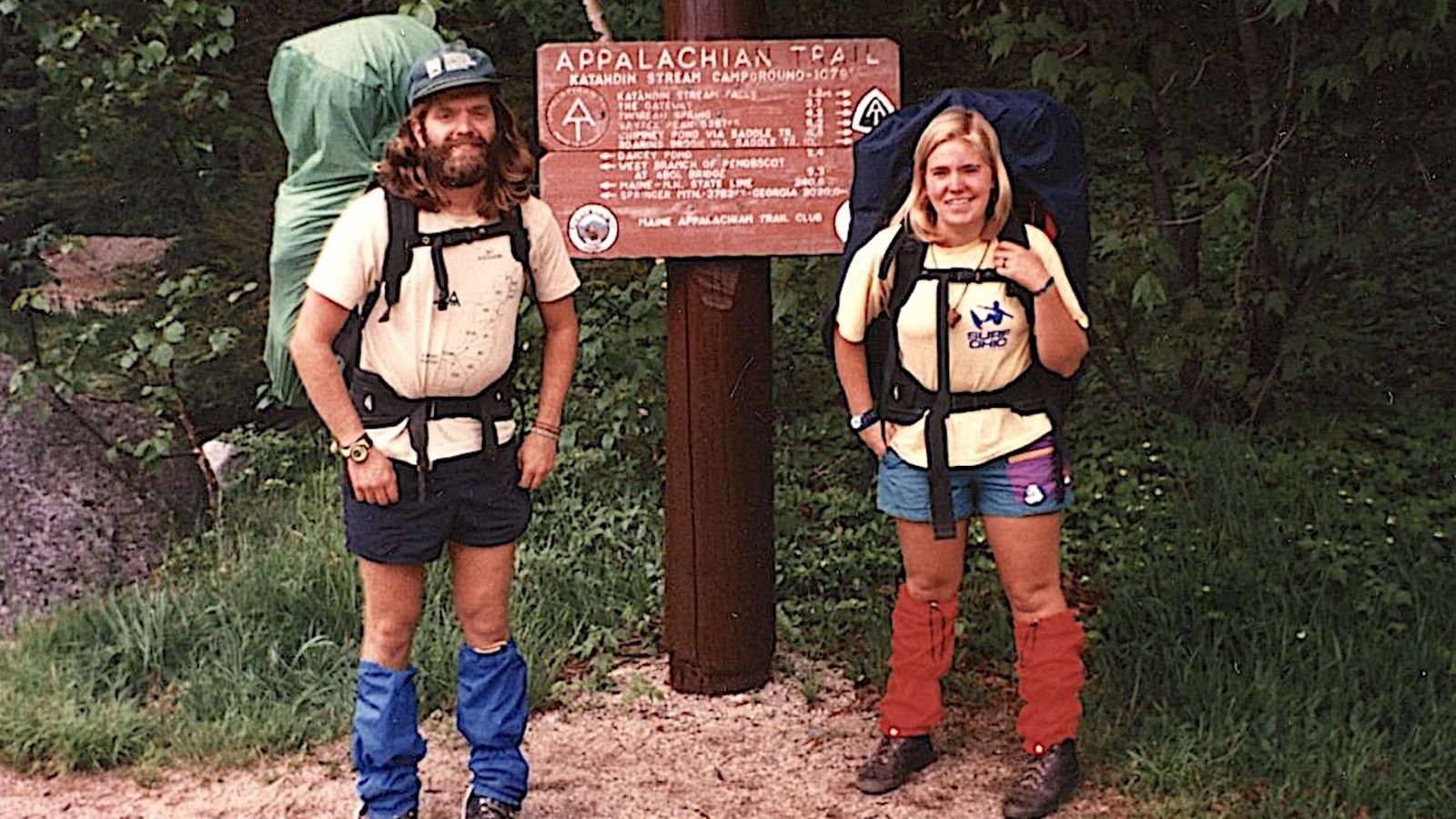
In 1990, a youthful Earl Swift hiked the Appalachian Trail (AT) from Maine to Georgia. Along the way, the Virginia journalist met a young couple he’d followed south from Mount Katahdin and through the high, wild White Mountains of New Hampshire, and whom he had come to know through their entries in the registers, or logbooks, kept in the AT’s trailside shelters.
Molly LaRue and Geoff Hood turned out to be just as he expected them to be: friendly, capable, and doing everything right. His hike overlapped with theirs for three days and two nights before the faster-hiking Swift pulled ahead. Weeks later, the couple was murdered in a campsite outside Duncannon, Pennsylvania, in a fit of violence the killer never explained.
A haunted Swift wrote a celebrated Outside account of the tragedy in September 2015, its 25th anniversary. Then, in late 2023, he embarked on a second end-to-end hike of the AT, seeking answers to questions that continued to nag him: What had happened in that campsite to turn two smart, bighearted people into prey? Why had fate chosen them, when others—Swift among them—seemed more likely candidates? And how could such a grisly episode have unfolded in the backcountry’s sylvan loveliness, not to mention one of the safest places around?
The result is Up on Cove Mountain: Adventure, Tragedy, and a Quest for Meaning on the Appalachian Trail, coming from Mariner Books on August 18. In the following excerpt, Swift and his hiking partner, fellow Virginian Greg “Animal” Hammer, catch up with LaRue and Hood after surviving a close call themselves. That 1990 account is braided with his travels over the same ground, half a lifetime later, with German section hiker Timothy Goodman.
A day’s hike south of Lakes of the Clouds, the trail leaves the ridgetop to descend the sheer, two-thousand-foot Webster Cliffs. In 1990, Greg and I picked our way down this dizzying rock face into Crawford Notch. It took an entire afternoon. At the bottom stood a lovely glade watered by a meandering, sandy-bottomed stream. It was illegal to camp there, but too exhausted to care, we set up next to the stream and within earshot of US Route 302. As usual, we were asleep at dusk, me in my tent and Greg in a bivy sack—a waterproof sleeve that pulled over his sleeping bag, enabling him to cowboy camp without getting wet. We lay so that his feet rested about five feet from the door of my tent, which in turn was about six inches from the top of my head. I was twelve days shy of my thirty-second birthday, an age at which I did not habitually wake in the middle of the night. I slept hard, and was lost in a dream when, at 12:35 A.M., I was jolted awake by the loudest sound I have ever heard—a boom that blotted out all my senses at once, a concussive thud so powerful that the ground spasmed beneath me, and for an instant sent me airborne. I sat up, blind in the dark, screaming, “What the hell? What the hell?” Outside, I heard Greg emit a startled gasp.
My first thought was that a bear was responsible—which, unless the bears in Crawford Notch deployed hand grenades, made no sense. Still, that’s what I thought as I fumbled for the tent’s zipper and braved a look outside. My view of the world was blocked by an immense object just outside the door. I flicked on my flashlight as Greg did the same, and in their yellow beams we saw a tree lying on its side, its trunk split and its rotted guts exposed as a bright orange mash.
We both scrambled out of our bags and tried to make sense of the scene. The tree had toppled with surgical precision, somehow threading the space between us so that it missed Greg’s legs and my head by no more than a foot. It had actually landed on one of the tent’s front stakes and driven it deep underground. My stove, which I had left just outside, was smashed flat. “Look at that,” I murmured, unable to summon a more insightful response.
Greg was shining his light past the tent to the tree’s jagged stump.
“I don’t see how that didn’t fall right on the tent,” he said. “It should have, it looks like.”
Sure enough, when we examined the stump in the light of day, we saw that, had the tree dropped straight down, it could not have missed me. But it spun a quarter turn as it tore away from its base, and that rotation shifted its downward path just a hair toward Greg. Had it spun the slightest bit more, its crushing weight would have landed on his legs. Had it spun any less, it would have killed me. As we stood transfixed by this realization, a red fox trotted into the campsite and stopped between us. It looked up at each of us in turn, making eye contact, then gazed at the fallen tree, then looked back to us. It seemed completely at ease in our company until Greg reached for his camera. He had time for one picture before the fox trotted away.
Crawford Notch seemed, at that moment, too otherworldly for comfort, a place unbeholden to the laws of nature. We hurried through packing, then crossed the road and climbed out of the notch and back into the mountains. I couldn’t shake the image of that tree as we hiked. It brought to mind old cartoon tropes in which characters just miss being flattened by falling safes.
Only I couldn’t find much humor in our close call. I was unnerved, and deeply so, that life or death could turn on such blind, stupid, unimaginable luck.
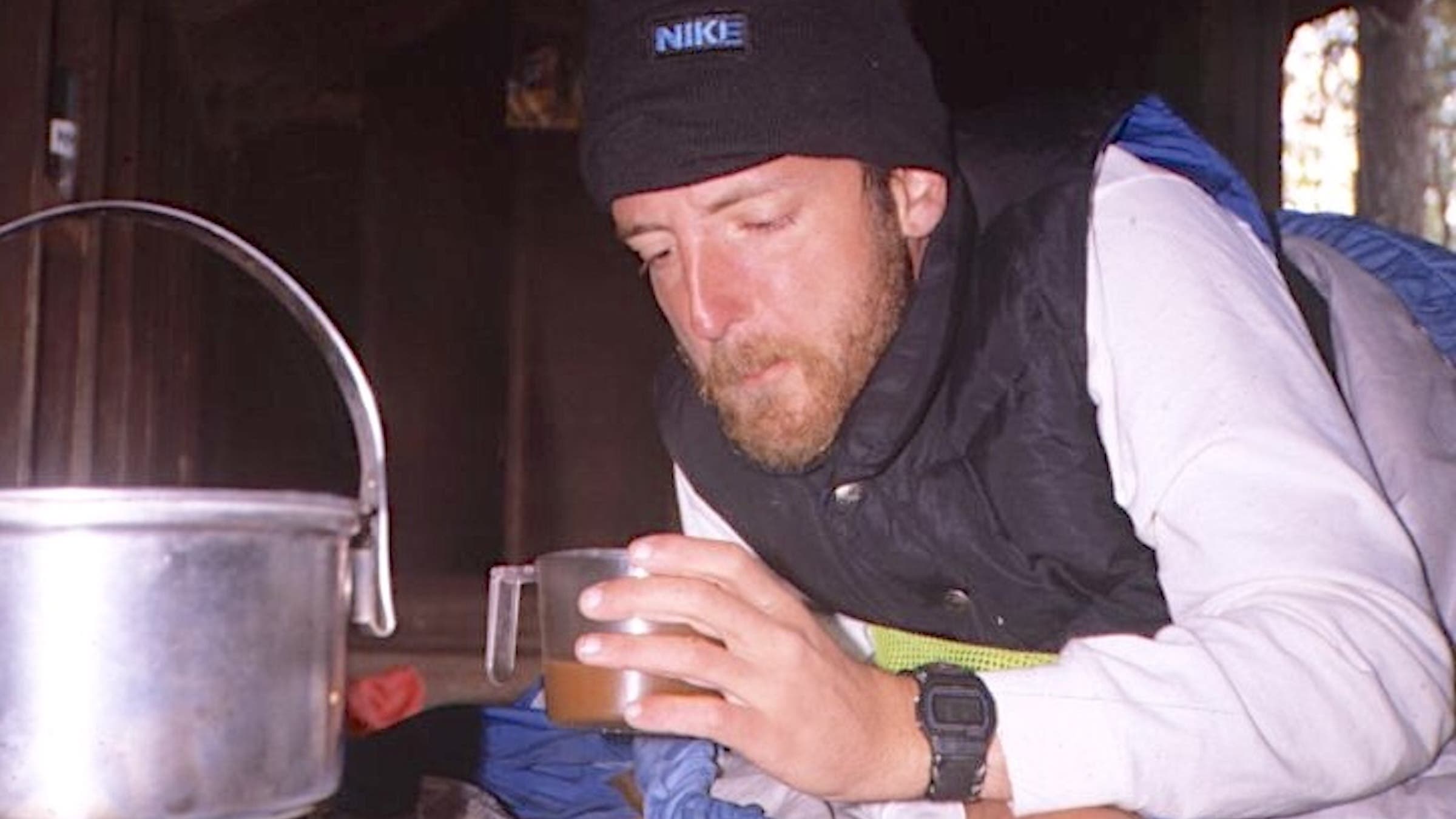
After our near-death experience in Crawford Notch, Greg and I hiked eighteen miles to a campsite high on the flank of Mount Garfield—a distance all the more impressive for the 4,600-odd feet of climbing involved, which took us above tree line in the rugged southern Whites. But then, we were motivated not only by a desire to get the hell away from the scene of our near destruction, but by our hope to catch up with Molly and Geoff. The couple’s register entries suggested they were no longer traveling as a pair, but as the de facto parents of what they called a “Southbound family” in the registers. Back at Maine’s Full Goose Shelter, they’d met a couple of young women who had hiked with them on and off ever since. Muskratt, too, had been their regular companion, though it seemed he had pulled ahead on Mount Washington.
Since entering New Hampshire, we had steadily closed the distance between us. Greg and I left Gorham four days behind them. At Lakes of the Clouds, we lagged by half that much. We arrived at Garfield the same day they left. Their slow pace was no accident: Their register entries made plain that they were concentrating on having fun, rather than setting records. They stopped to take pictures, to bake bread, and to study plants, turtles, and salamanders—to devote their full attention to the woods. “It appears, from reading the register, that our long days since Gorham have put us only a handful of hours behind a whole slew of other southbounders,” I wrote in my journal. “We may catch up with some of them tomorrow.”
The passage of three decades has slowed me down. This time around, it takes me two days, not one, to reach Garfield. Timothy is not feeling well as we climb out of Crawford Notch, and falls behind. I push on to a campsite on Mount Guyot, after a long but spectacular climb over the mountain’s treeless summit as the sun hangs low and red in the sky. The next day, I hike to Garfield, keeping my progress intentionally short so that Timothy can catch up. I’m unaware that he’s right on my tail. He blows past my campsite as I’m getting settled, and hikes miles farther into the night. I promptly fall a half day behind him.
From Garfield, the trail leads me five hundred feet uphill to the Franconia Ridge, a chain of windswept, craggy peaks high above treeline. The first, Mount Lafayette, requires a further fourteen-hundred-foot climb over rock, boulder, ledge, and stairs—not the hardest approach the Whites have offered up, but a long, tiring effort. Up top, all that fades. The sun is out, visibility is virtually unlimited, and views are stunning in every direction: Mount Washington is plain in the distance, along with every peak I’ve summited since.
Lafayette is crowded with day and weekend hikers. As I sit with them, catching my breath, a dense cloudbank blows in from the west. It reaches the ridge’s centerline as I descend Lafayette and start up the second peak, Mount Lincoln, and there it stops. For a good thirty minutes, an opaque wall of clouds hangs motionless, its leading edge directly over the trail, so that the view to the west extends only a few feet and ends at a solid white wall, while that to the east stretches for mile on sunny mile.
I catch up with Timothy the next day. We convene at a pub in North Woodstock for an evening beer. He’s staying put for another day, maybe two. I’m moving on in the morning. He thinks he’ll be able to catch up. I tell him I hope that will happen, and I mean it—he’s been wonderful company, smart and easygoing and funny as hell. But we both recognize that we might be parting for good. His visa leaves him only a week or two to continue hiking in New England if he wants to travel south for the sightseeing he’s mapped out, not least the visit to the USS New Jersey. And so, we celebrate our adventures together with a toast and a hug, and I continue southward alone.
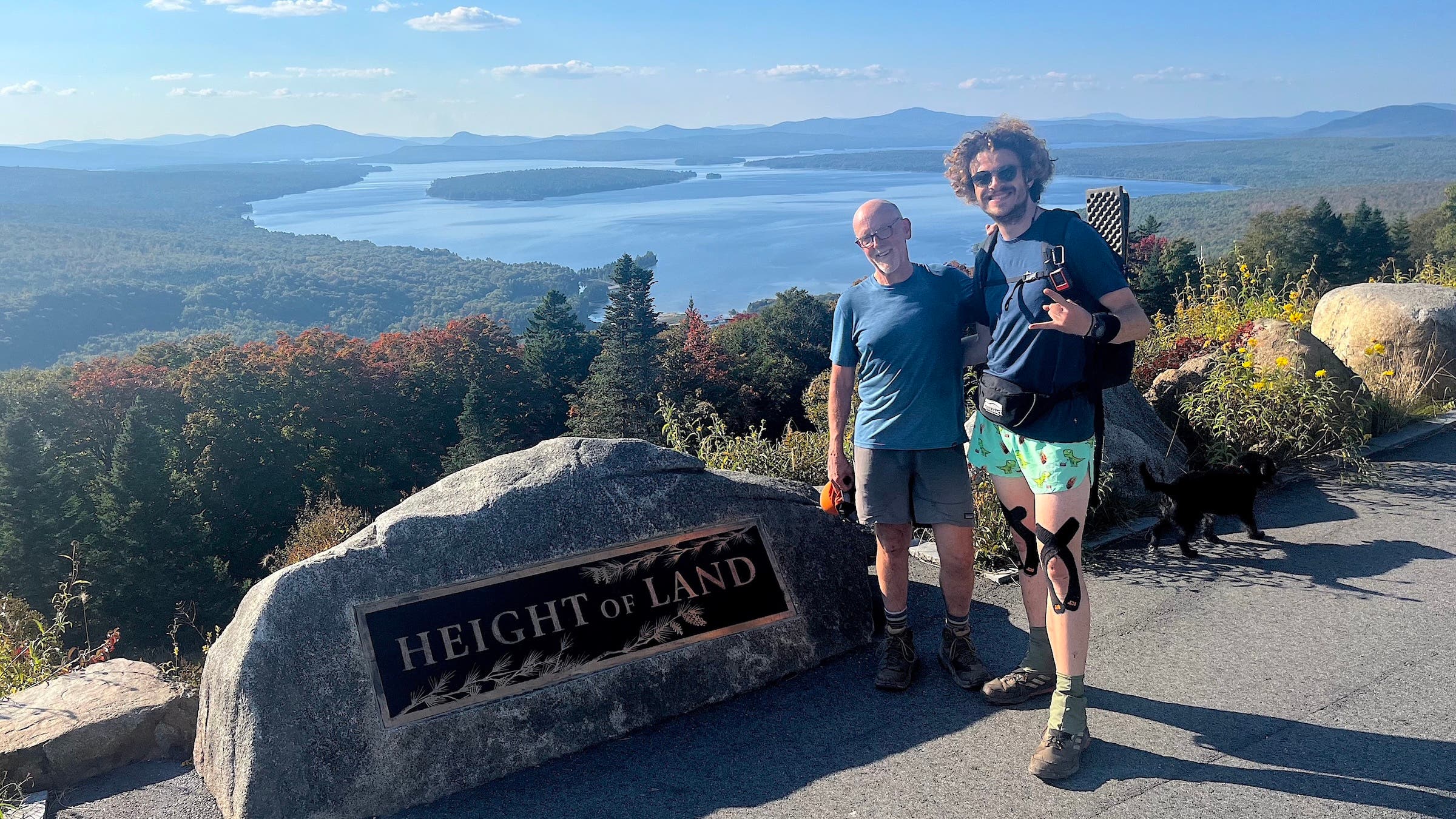
I pull out of North Woodstock aiming to pick up a mail drop in Glencliff, New Hampshire, in two days. A lot of climbing stands in the way. The most memorable stretch comes on Mount Moosilauke, the southernmost mountain in the Whites. Reaching its broad crown requires hauling myself up steep rock that shadows a cascading brook for hundreds of feet. The falls are gorgeous, their splashing chatter lovely. But their spray leaves the rock slime-slick and perilous, and I’m relieved to reach the lunar desolation of the summit. Alone up there, among cairns piled high, I can see nothing through a cold, swirling fog of the giant mountains behind me, the smaller ones ahead.
I didn’t see much of Moosilauke the first time I climbed it, either. On a Friday in mid-July 1990 I trailed Greg to the mountain’s base and pulled into the Beaver Brook Shelter, about halfway up, just as he prepared to leave. He had news: He had met Clevis and Nalgene just minutes before. They had been finishing a long break at the shelter when he arrived, and were now making their way uphill, maybe twenty minutes ahead of us. He enjoyed talking with them, he said. They were just as we expected.
Greg left as the woods darkened under a ceiling of black cloud.
I reached the tree line a short while later, just as a hard rain swept over the mountain. Lightning bolts struck the summit with ground-shaking force. The air crackled with electricity. I reversed course, back into the trees, and sat out the storm for nearly an hour. Then, as the rain eased to a light shower, I crossed Moosilauke’s domed peak and hurried down its wet, slick, and very steep far side. At the bottom, in an open forest of tall pines, I reached the Jeffers Brook Shelter, and there stood Molly and Geoff. We exchanged handshakes, and I told them that after reading their register entries for more than a month, I felt we’d already met. Molly chuckled and allowed that they had heard that before.
First impressions: Molly was blond and dimpled, quick to smile, solidly built but obviously fit. Fun. Funny. A blue-haired troll doll dangled from her pack. Geoff was bearded, long-haired, and whippet thin, with a smoky, high-pitched Tennessee drawl, a calm and contemplative manner, and a wry sense of humor. “Nice people,” I wrote in my journal. “Kind of Appalachian clogger types.” With them were the two young women they met back in Maine. Elizabeth was a graduate student in evolutionary biology at the University of California-Berkeley. Chris was a biology undergrad at Oberlin.
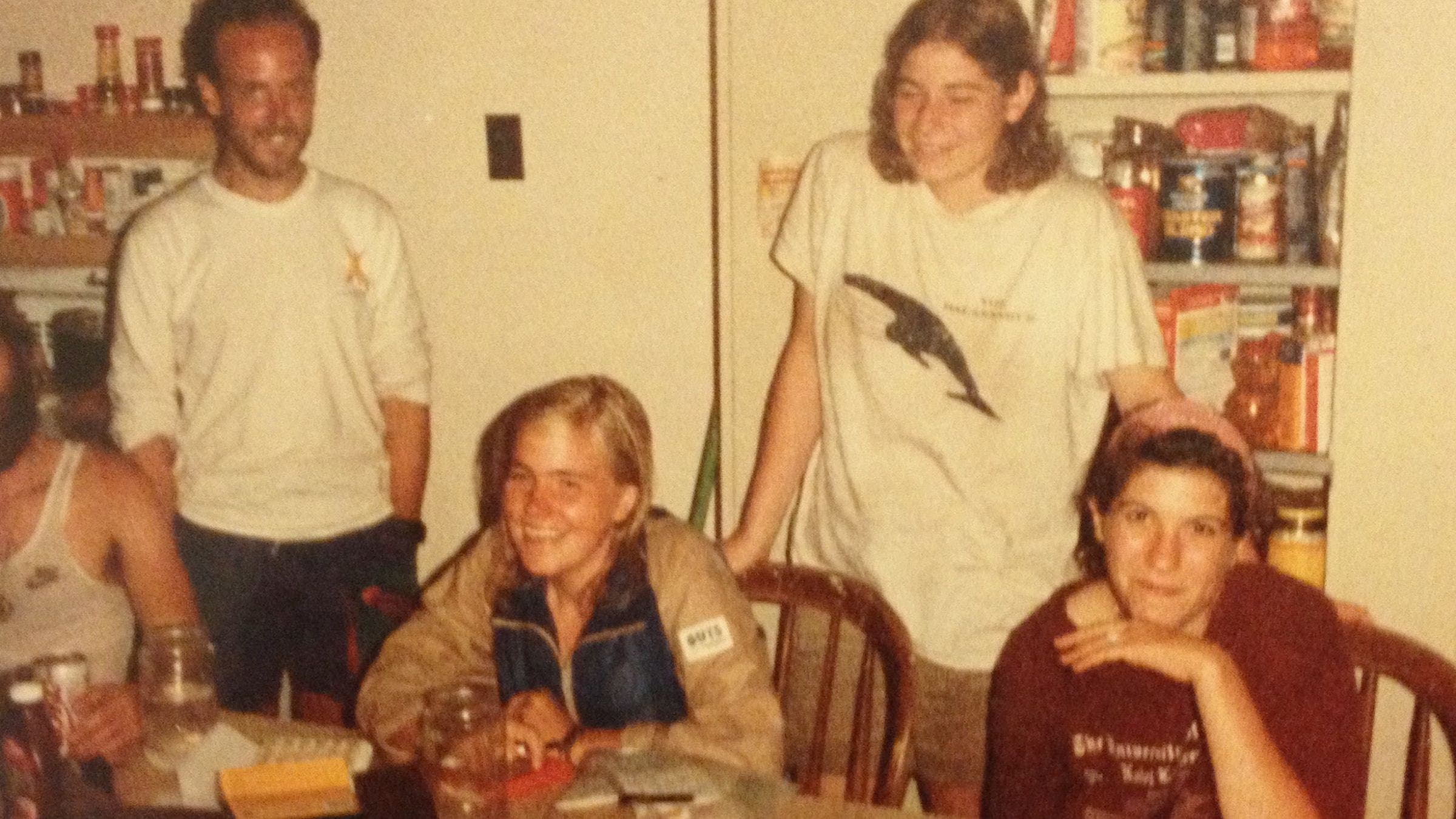
Raindrops plinked on the shelter’s metal roof as we talked. Molly mentioned that she and Geoff had started hiking after being laid off from their jobs in Salina. I interviewed for a job there once, so we discussed the charms and limitations of central Kansas while Greg spoke with Elizabeth and Chris—until everyone fell silent at once, because now the evening took an unexpected turn. A short, bearded man trudged toward the lean-to, bent under the most absurdly oversized backpack I had ever seen. It towered three feet over his head. Just as remarkable was his clothing. He wore a formal black suit, an untucked white dress shirt, and a black, round-topped, wide-brimmed hat covered in plastic.
Behold Rubin, the world’s worst camping companion. Without so much as a hello, he announced that he had to have the shelter’s east wall, where Greg had already set up his gear. He took off his pack and huffed, impatient, when Greg didn’t jump to clear the space. For a long moment we all just stared, stunned by his brusqueness. “If it were up to me,” I finally said, turning to Greg, “I’d stay right where you are.”
Greg nodded slowly. “I’m thinking the same thing.” He turned to the newcomer. “Sorry, man. You’ll have to find space in the middle.” Rubin seemed incredulous that Greg would refuse him. Greg stayed firm. Piqued, Rubin dumped his pack in the shelter’s center, next to where I’d lain my stuff, and rummaged. The rest of us broke out our stoves and started cooking supper. Our conversations resumed.
Rubin interrupted. Why had I chosen my model of backpack, he wanted to know.
I did a lot of research, I replied, and this is the one that rose to the top of the heap.
But why, when it was the wrong kind?
The wrong kind? It was the pack I wanted.
But it was the wrong kind, wasn’t it?
No, I said. I don’t think so.
But I understand that it’s a bad pack.
I’d have to disagree. It’s done well for me. I like it.
Oh, you think it’s fine?
Yes, I said, I think it’s fine.
You really think it’s fine?
Yes.
Well, if you think it’s fine, why have I heard it’s a bad pack?
And so on, every time he opened his mouth. Which he did a lot. To my everlasting regret, I devoted far more space in my journal to Rubin than I did to my exchanges with Molly and Geoff. But then, they did the same, and understandably so—because, with the sun setting, Rubin yanked a six-pack of Old Milwaukee tallboys from his massive pack and chugged the lot in quick succession. He crunched the empties into makeshift candleholders. And as darkness fell over Jeffers Brook and we others crawled into our bags, he began to celebrate the Sabbath.
In what seemed a trance, he chanted, wailed, and danced in the middle of the lean-to (“bouncing the shit out of the whole place,” as I wrote in my journal) for one hour, then two. Then beyond two. Hiker Midnight was not part of trail culture in 1990, at least by name, but its basic tenets certainly were—and here were one guy’s First Amendment rights running smack into the rights of six very tired people.
Nearly three hours in, Greg stopped him: “Are you almost through?”
Rubin nodded, then went right back to it—if anything, he grew more frenetic. A half hour later, when he paused to wolf down some bread, I told him he’d have to stop. “These people are trying to sleep,” I said, nodding toward the Southbound Family. “I’ve got no problem with religious ceremony, but there’s got to be a way you can pray to yourself.”
Rubin brushed me off. “They’re probably sleeping right through it.”
From the darkness of the shelter’s west wall, Molly yelled: “I’m not sleeping through it!” A chorus immediately backed her up.
“He’s been quiet for five minutes now, save for loud belching and rustling,” I journaled. “If he goes back to chanting, the shit’s gonna fly.”
Morning came all too quickly. I woke to find Geoff up and preparing to cook breakfast. He set up his white-gas WhisperLite inches from Rubin’s sleeping head, and, treating me to a wicked grin, fired it up with a whoosh. Rubin jerked awake. He rose to find six sleep-deprived hikers giving him the stink eye, which he evidently mistook for an invitation to bare his soul. His wife, influenced by her parents, had sued him for divorce, he told us. He was “hiding out” on the trail because his in-laws had allegedly taken out a $75,000 contract to have him kidnapped and tortured by “the Mafia” until he agreed to part ways with their daughter.
“Why not just let her divorce you?” we asked.
“She doesn’t really want a divorce,” he replied. “It’s her parents’ doing. Why would she want to divorce me?”
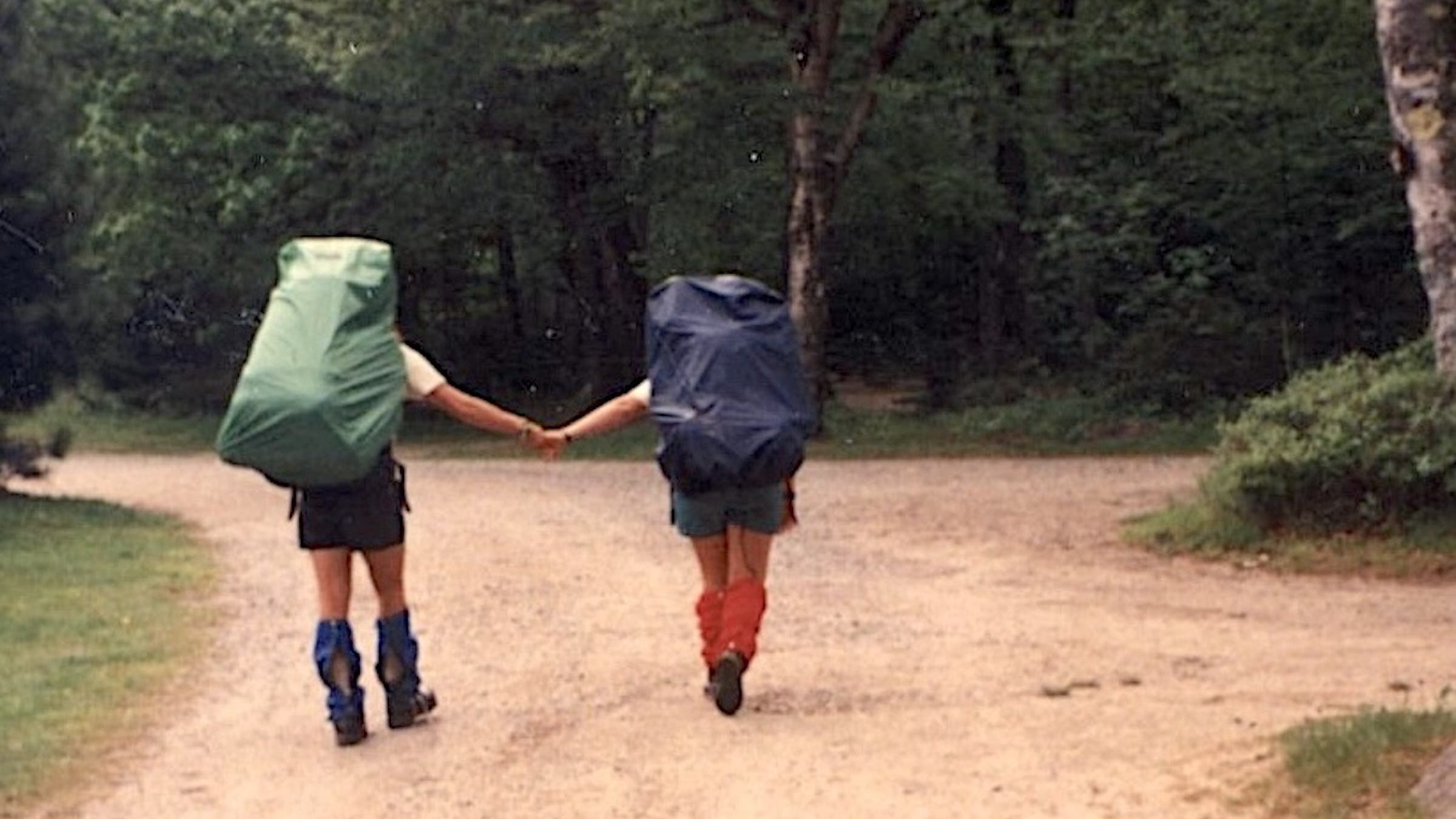
I could not wait to get away from the guy, and made no attempt to hide it. In contrast, Molly and Geoff, who journaled that they “had a very poor night’s sleep due to the noise pollution,” treated him with quiet tolerance, never interrupting his babble, just letting him be. Still, they beat us out of camp. Greg and I walked into tiny Glencliff, picked up mail drops at the post office, then rejoined the trail. We caught up with Molly and Geoff in the early afternoon as they took a break at a road crossing, and sat chatting for twenty minutes about the strange night we’d shared. All agreed it was the most memorable evening any of us had experienced since starting our hikes, and that we pitied anyone heading north in the coming days. Greg and I pushed ahead, with plans to rendezvous with the others at the “Atwell Hilton,” a decrepit old house that the Dartmouth Outing Club used to bunk its trail maintenance crews and made available to thru-hikers.
They beat us there. Greg and I were waylaid by two hard-partying locals, who gave us beer and drove us to a nearby lake for a swim. We arrived at the Atwell Hilton to find that Geoff had caught a ride to a convenience store for munchies and more beer, and the six of us sat around the dining table for hours, talking and laughing. Elizabeth and Chris told us they would be leaving the trail in a couple of weeks, as both had classes starting. Molly and Geoff described their layoffs and their evolving plans to return to school themselves: After their hike they would apply for graduate programs, most likely in Ohio. Until then, they proposed to continue their pilgrimage as they’d started it—with a constant eye for the beauty around them, rather than a penchant for miles. They might pick up the pace a little, but to hurry seemed counterproductive. When would they get another chance to do something like this?
We all endured another night of elusive sleep. The Atwell Hilton was light on amenities, including window screens, and the old house was too hot and airless to shutter up tight. We were tormented by mosquitoes until morning. Dawn brought the promise of better times, however. Greg and I bolted from the Hilton and, at the next road crossing, hoofed it two miles on the shoulder of Maine Route 25-A to the Mount Cube Sugar House, a maple syrup farm owned by a former governor—and, on weekends, a restaurant serving up pancake breakfasts. The Southbound Family hitchhiked to the place, arriving just as we did.
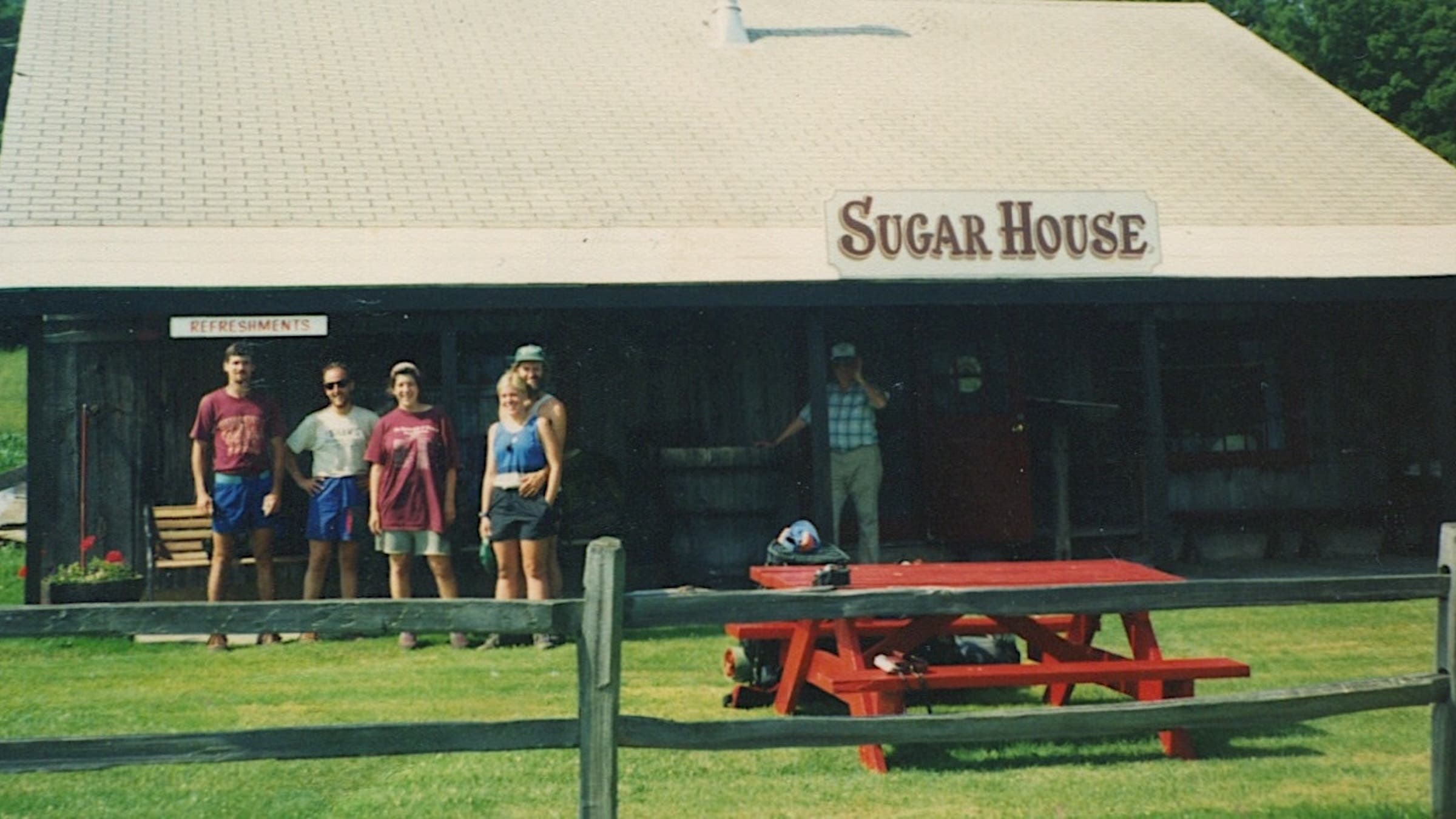
Everyone ordered the hiker’s five-dollar special—six pancakes, four pieces of sausage, coffee, juice, and all the maple syrup we could force down. Molly and Geoff didn’t want their sausage, so Greg and I took it off their hands as we passed around copies of a recent USA Today story about thru-hiking that the restaurant had on hand. We howled over its claim that we averaged up to forty miles a day. We lingered at the table long after gorging ourselves, talking about Rubin, how far we’d come, and how much easier the trail ahead promised to be, then walked outside to our packs. Elizabeth snapped pictures of us lined up on the lawn in front of the Sugar House’s front porch.
Greg and I had decided to blue blaze an old section of the AT, while the others backtracked to the relocated trail. We watched as they hitchhiked and a pickup pulled to the shoulder. Waving from its bed, they motored off for the trailhead. We expected to reunite with them that night. But Greg and I covered close to sixteen miles that day, far more than they did. We did not see them again.
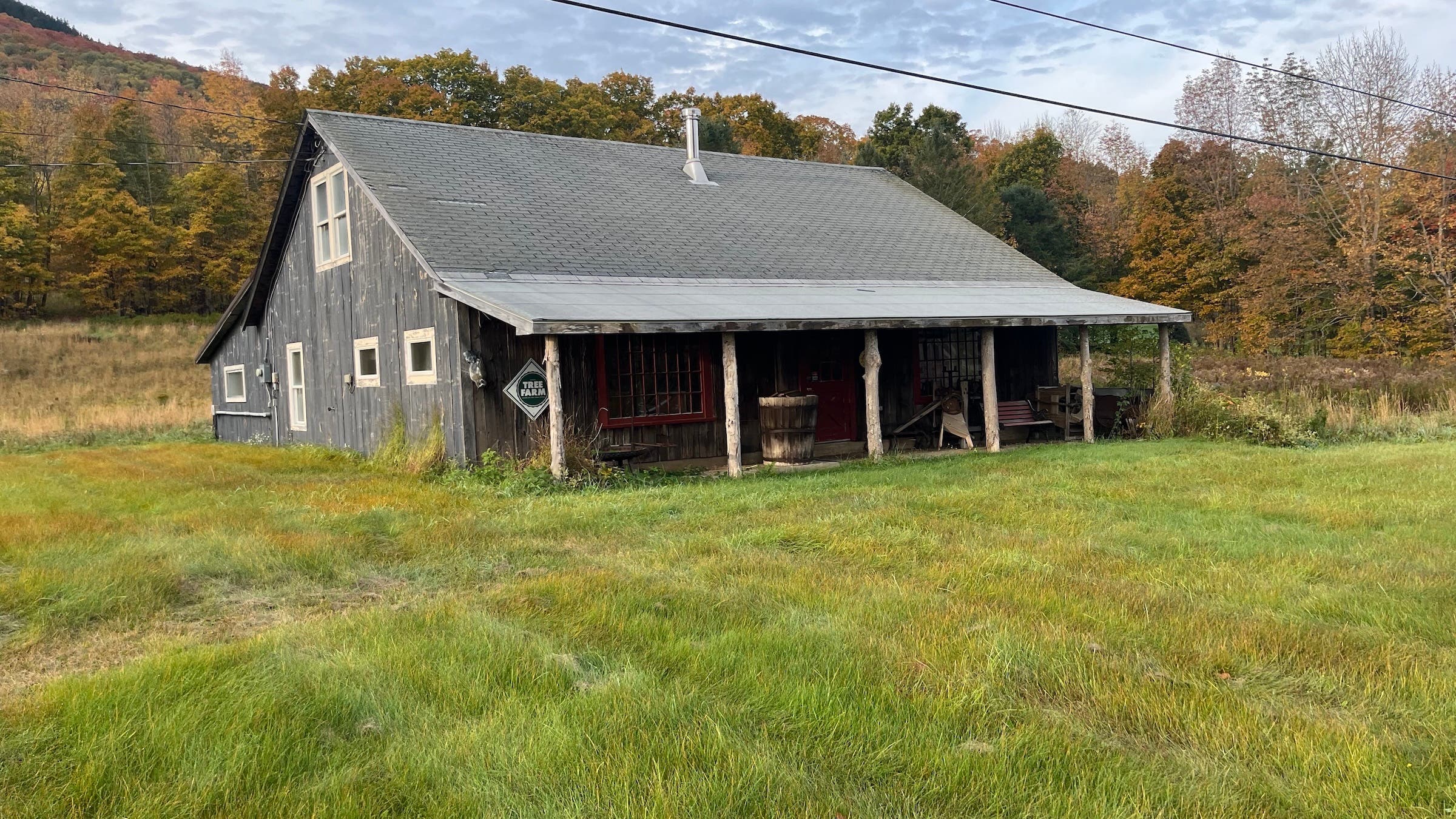
I next stand outside the Mount Cube Sugar House on an early October morning in 2024. Though a faded billboard on Route 25-A still advertises its weekend pancake feasts, the restaurant closed many years ago. All of its signage is gone. Weeds grow knee-high at its edges. The flowerpots of cheery red blossoms that once decorated the front porch have been replaced by rusted gear for collecting maple sap. I peer into the windows. Nothing about the cluttered interior looks familiar.
But a few pieces of the past endure. A Visa credit card decal on a window. A bench of the sort I remember propping my pack on before going inside. And, in particular, an immense wood-slat barrel beside the front door. As we stood outside after our meal, the former governor, Meldrim Thomson Jr., stepped onto the porch and rested his hand on that barrel, an action preserved in Elizabeth’s photos.
I linger on the lawn out front, struggling to square this forlorn relic with that long-ago Sunday morning, and the prominent place the company I kept occupies in my memories. Three days, two nights. A brief acquaintance by any measure. Had Molly and Geoff finished their hike, I wonder whether I’d recall anything about our time at the Sugar House.
After a few minutes I catch a ride back to the trailhead, and hike south toward Hanover.
