

Published August 17, 2026 03:49AM
Had you braved the bumper-to-bumper traffic on any one of the four bridges leading to Ocean City, an island-town on New Jersey’s coast with eight miles of sandy beach, muscled your way through a phalanx of umbrellas, bikinis, and bros to claim your spot by the Atlantic, and spread out your towels and blankets for a day in the sun, you’d be forgiven for thinking the hard work was over. But then, in all likelihood, you’d look up and notice the seagulls. Legions of them. Flocking together in formations so thick they’d block out the clouds.
This, Angelina Caselli tells me, is what the beachgoing experience used to be like at Ocean City, where the number of people balloons to almost 150,000 every summer.
“You’d throw pizza crust in the air and it would bounce off a seagull,” she says.
How many gulls were there? It’s tough to say for certain. But Caselli, who has called Ocean City her place of employment since 2019, says there were thousands. Maybe 3,000, she guesses. Maybe four. Enough that grabbing a slice at the popular pizza joint Manco & Manco up on the boardwalk was akin to taking your life into your hands. All right, maybe not your life. But until recently, pizza, fries, cotton candy, and caramel corn were not treats to be savored, but valuables to be guarded against swarms of winged pickpockets. Take your eyes off your pizza for a second, and chances were good a dive-bombing seagull would snatch it right off your plate.
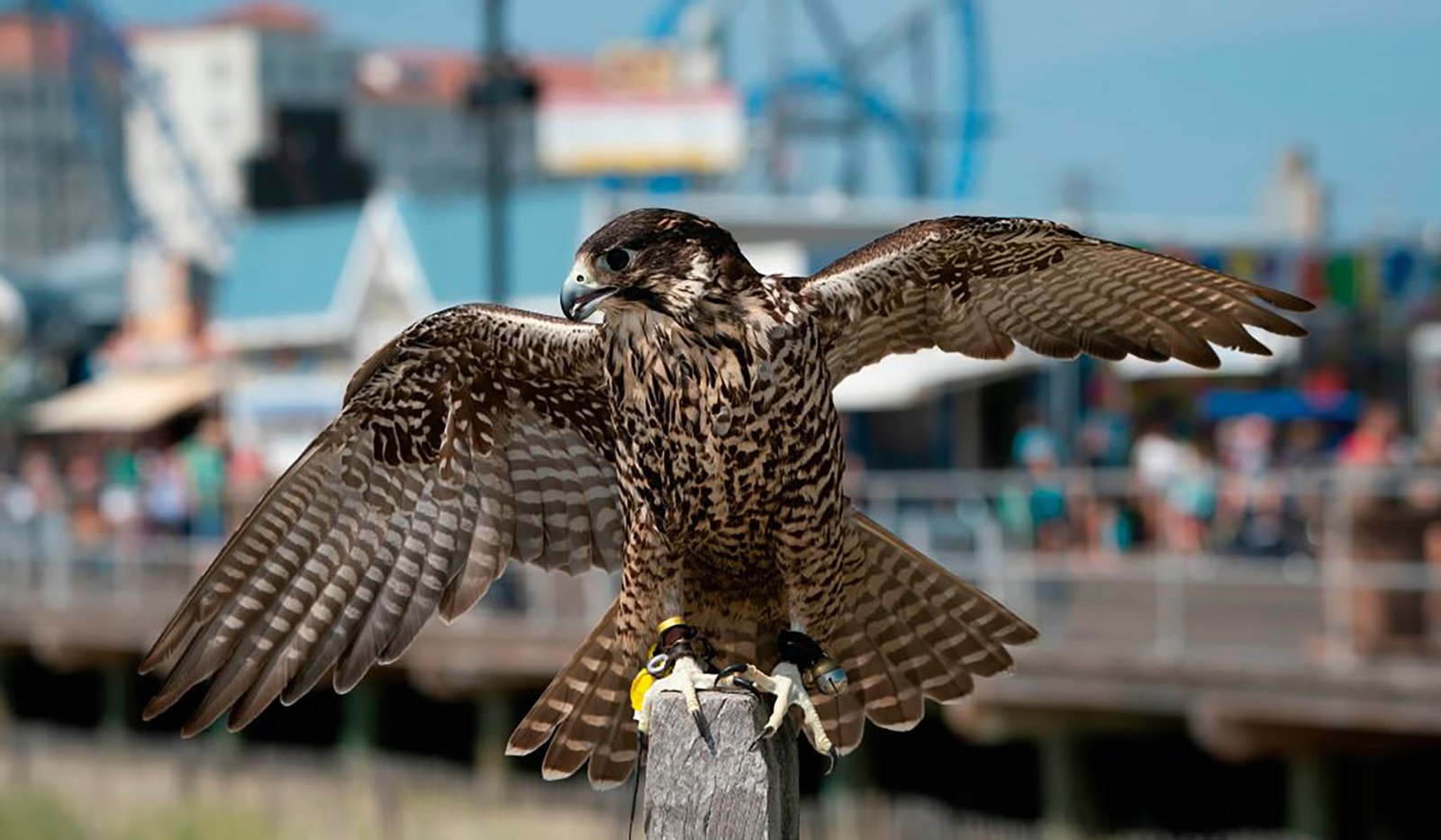
So I was warned. But on a Friday in mid-July, the salty air my only reprieve from a scorching summer sun, I barely count three-dozen seagulls above me. And as I approach my destination not far from the city’s famed boardwalk, I soon discover why. Inside a building that resembles a backyard toolshed are 13 birds: a pair of dark-feathered hawks, brothers Marco and Polo, one owl who’s an absolute unit, and ten falcons. Three rows of predators with sharp talons. There would be a 14th bird here, too, another hawk called Karen, named for her impeccable ability to never shut up, but she’s off in Atlantic City guarding a bunch of high-rollers at the Hard Rock Hotel and Casino.
Quickly, the purpose of these birds comes into focus. The small shed is a mews, a place for resting raptors, and Caselli and the handful of staff inside, clad in green caps and shirts, are trained falconers with East Coast Falcons, an outfit in North Jersey. Their mission? To walk Ocean City’s boardwalk and protect tourists against the hordes of seagulls—with birds of prey.
“This is the original bow and arrow, the original gun to go hunt with,” Caselli tells me as we walk around the mews.
After years of waging battle on the gulls, Ocean City turned to a thousands-year-old remedy to defend the boards and the tourists who visit every year. Handled carefully by Caselli and crew, these birds patrol every day, from Memorial Day to Labor Day. Not to kill, mind you, but to scare. To frighten a population of bold gulls, and to keep a summer ecosystem of people and prey living in relative harmony—even when pizza is involved.
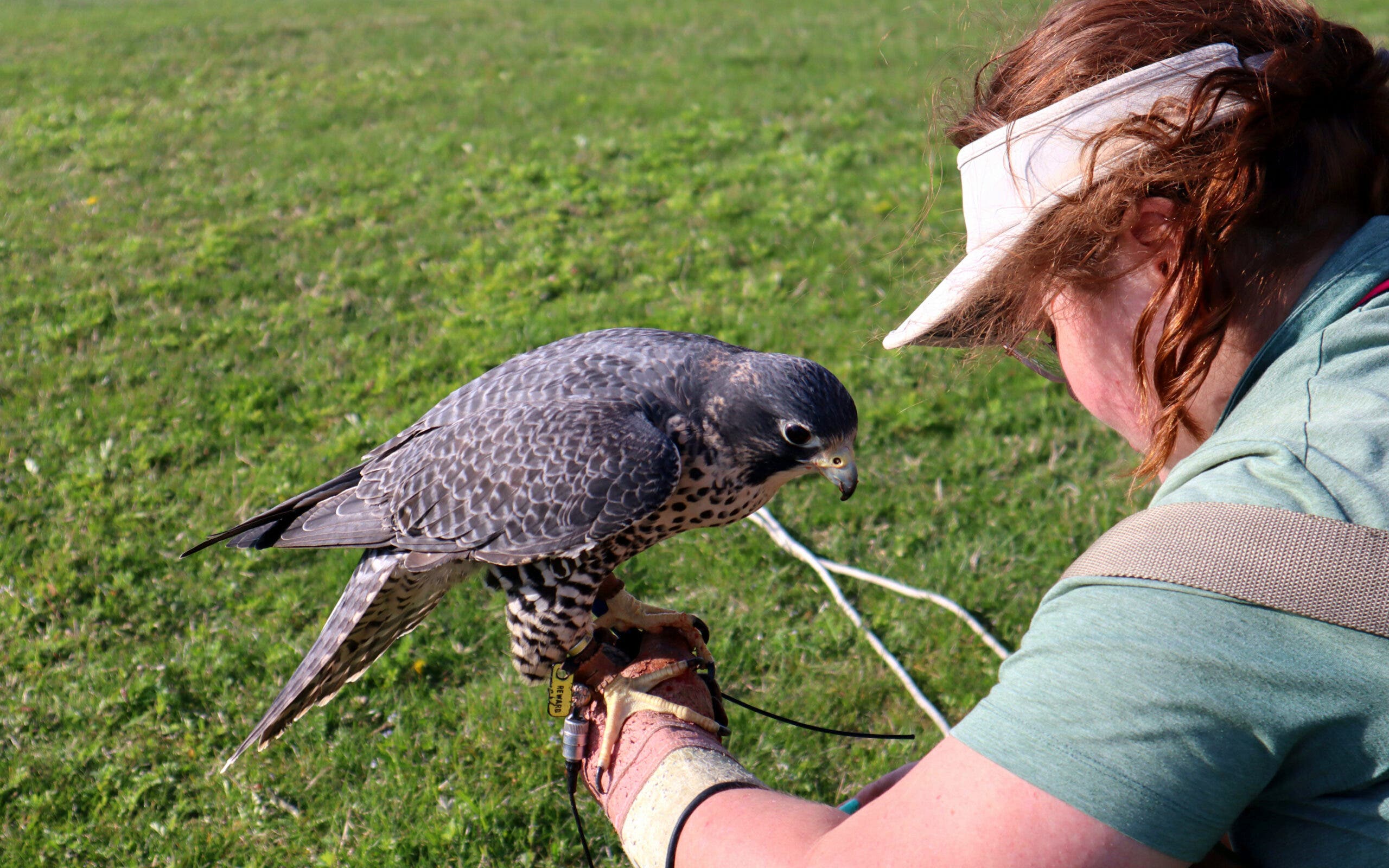
Just before 1 P.M. I meet up with Caselli, who’s the manager of the abatement program. As we exit the mews, she’s wearing a gloved, thick leather gauntlet on her left arm with a two-pound falcon, Cookie, sitting atop. Right now Cookie’s in pre-game mode: A hood, which looks like a tiny version of an old-timey football leather helmet, covers her head so she can’t see. Falcons, as Caselli tells me, are visual predators. Keep them literally in the dark, and they know it’s not go-time.
Caselli is a 22-year-old with a maturity that belies her years and a knack for the dad joke. Later that afternoon when Cookie does what birds do—you know, shit in public—Caselli describes it as “dropping ballast.” She got her start back in 2019, when Ocean City was putting East Coast Falcons through a trial run. Caselli, then in her late teens, and her family were in town for Father’s Day, and after she saw a person with a hawk strolling the boards, she was hooked. That night she went home and emailed the guy who would become her boss, Erik Swanson, who pulls up just as Caselli is telling me her origin story.
If the dictionary came in picture form, you’d see Swanson under the entry for “oxymoron.” Sporting a grizzled gray beard, specs, and a ponytail, he’s soft-spoken in person; it was difficult for me to hear him over the engine of his massive, lifted Ford F-150. Swanson is a master falconer, someone who’s been training raptors since the early 1990s. Before then, he taught police and narcotics dogs, but switched to birds after learning to work with eagles at the Turtleback Zoo in West Orange, New Jersey.
Falconry, he says, is very much its own club, one where you have to expect the occasional nips, nicks, and cuts that accompany working with predators. “Everybody that works here, we bleed every day. It’s just the way it is,” Swanson tells me.
They usually fly birds just one at a time. Most fly for a half-hour; some fly for several hours. Marco, Polo, and Karen are Harris’s Hawks, a breed with brown feathers on their bodies and red plumage on their wings. Ozzy is the group’s Eurasian eagle owl. The falcons, whose shift goes from noon until dark, are a variety: Some are pure breeds, like saker and Barbary falcons, two species that perform well in hot weather. Others are cross-breeds: Strawberry, the oldest of the bunch at 22, is a cross between a gyrfalcon—the largest and most powerful falcon—and a Barbary falcon. And while falcons can fly as high as 10,000 feet, they’re usually only flying to 400 feet for patrols.
To join this archaic practice, per the federal laws in place, one must first pass a 200-question multiple-choice test on raptor biology and ecology, and then complete a two-year apprenticeship. One element to note is that raptors, the ones used by falconers and companies like East Coast Falcons, are always captive-bred birds. (Swanson carries a regulatory permit to do this work; his employees are covered by that same document.) Falcons and other raptors used for abatement must acclimate, to some extent, to human interaction. Raptors that hatch make their imprints on humans, and begin to view a person as a parent. But it just so happens that hawks, falcons, and owls thrive with human companionship.
“Raptors in the wild, they’re not always successful at hunting. The reality is a lot of hunts are going to end in failure,” says Julie Cotton, co-manager of operations at the California Raptor Center inside the UC Davis School of Veterinary Medicine. Many wild raptors might not eat for several days. And although they don’t display affection like that of a dog or a cat, they are excellent students. Adds Cotton, “They do have the ability to observe and to learn that their actions can produce consequences.”
Which is why one of the core components of the apprenticeship is to catch and train your own wild, red-tailed hawk. Taking it under your wing as an apprentice is a way to learn how to communicate with birds of prey. It’s a relationship built on a foundation of respect.
“It’s entirely voluntary,” says Caselli when I ask her why the raptors return to her after a seagull-frightening sortie over Ocean City’s boardwalk. “They trust you to not lie or cheat them out of a meal, that you’re going to be a good partner to them.”
Just an hour later I get a sense of what she means. We’re walking the boards near Manco & Manco when we spot a tourist who’s dropped a bucket of caramel corn. Overhead several wily gulls start flying circles, obviously eying a meal. Caselli raises her left arm high, and Cookie—still hooded, by the way—unfurls her dark brown wings as if she’s giving the air a wraparound hug. Right at that moment, Caselli blows a whistle she’s carrying, and the gulls overhead scatter. Then she removes Cookie’s hood, unhooks her from the leash, and watches as she sails into the sky, pumping her wings until she reaches the top of a nearby pavilion.
When Cookie’s time is up, Caselli heads to a nearby dune. She pulls out a lure from the messenger bag slung across her body and begins spinning it in great circles, blowing her whistle at the same time. Cookie, sensing her cue, comes flying back, and when she arrives, Caselli has some dried quail meat—a raptor favorite—in her hand, which Cookie happily takes. Then she re-leashes her falcon and puts the hood back on. And we walk back and forth between the boardwalk’s intersections with 6th Street to 15th Street, for another hour, a pair of beat cops searching for gulls—with a falcon on hand ready to fly if any get a little too close.
Dispatching raptors to scare off seagulls may appear bird-brained, yet the notion of employing the animals to thwart unwanted creatures isn’t a foreign concept. Disneyland sics feral cats on unwitting rats who scurry onto park grounds. And while Ocean City never originally set out to hire East Coast Falcons or anyone else to use birds to fight birds, the problem with its seagulls got so bad by the late 2010s that city officials were willing to look anywhere for a solution.
“We were having a number of issues and complaints of aggressive seagull activity: swooping down and stealing an ice cream cone from a three-year-old or a kid riding their bike with a piece of pizza,” says Daniel Kelchner, director of community services with the city government. “Quite frankly, the seagull problem had really started to negatively impact some of the perception of us as a safe community.”
The city has tried other methods to chase the gulls away. Loud noises. Fishing line. Plastic owls. The occasional public service announcement still blares over the loudspeakers along the boardwalk: “As per city ordinance, it is prohibited to feed the seagulls and other wildlife.” Nothing had worked, and other abatement methods—scattering poison or bringing in shotgun-wielding hunters—were deemed too inhumane. The connection with East Coast Falcons was forged by city business administrator and municipal engineer George Savastano. Savastano reached out to Swanson through his website. When the two of them met, Swanson says, Savastano was incredulous. “Can this really work?” Swanson remembers him asking. The pilot program was such a success that the city handed Swanson a contract, renewed in 2023, and again in 2025. The current contract runs through 2029, and, according to Kelchner, the city paid East Coast Falcons $369,996 to patrol its boardwalk this year.
While the predators’ job is strictly to scare away gulls, the occasional seagull ends up as a meal. When I arrived, I was already informed that two seagulls had been killed by East Coast Falcons’ birds this summer. They are predators, after all, and even captive-bred birds can’t buck nature. To get in between that natural inclination, handlers fly the birds about 10 percent above a bird’s “hunting weight” in grams. (The outfit’s falcons weigh anywhere between 600 and 1,600 grams.) Doing so is enough to engage their hunting instinct: The falcon is at peak condition, which means it doesn’t need to kill for food, although it will still give chase to pesky gulls. And, by this point, the bird knows its falconer will be there at the end to dish out some quail.
“Their bodies still function by these natural laws, which is what we harness to keep them moving,” Caselli says. “But they don’t want to chase the seagulls, really, because they know that chasing the seagulls is a waste of energy when there’s a piece of food waiting for them.”
To keep track of its birds, East Coast Falcons uses an app-controlled GPS monitor that allows falconers to view a bird’s exact position, as well as a radio-telemetry unit attached just above each bird’s claw. Caselli calls it the “bread and butter” of every falconer. It sends out a ping that interacts with an antenna to home in on a bird’s position. Then there’s the medieval: a small jingling bell.
Again, the aim isn’t to kill gulls. Seagulls are usually thought of as nuisances. Caselli likened them to “coyotes of the air.” The typical description is a comparison to rats with wings. Yet gulls are important pieces of coastal ecosystems. They dine on crustaceans and insects. They like trash. But they’re also smart scavengers, and well-suited to habituating with crowds of people. That means they don’t scare easily around humans. Some studies even show gulls tracking our eye movements. If we see fries, they see fries. Seagulls are so smart, apparently, that Swanson even says gulls in Ocean City have come to recognize his falconers.
“They know my falconers by face. They know their cars. They know their trucks,” he says. “If they walk across a parking lot, the gulls start alarms, screaming at them.”
I thought Swanson’s description was a little incredulous, until I started walking the boardwalk with Caselli. Almost once every couple of hours, the same seagull would swoop low above our heads and release a loud, aerial, taunting squawk.
After one low pass, Caselli pointed out the gull, rolled her eyes, then turned my way. “They brave my presence,” she says, “for that last almighty french fry.”
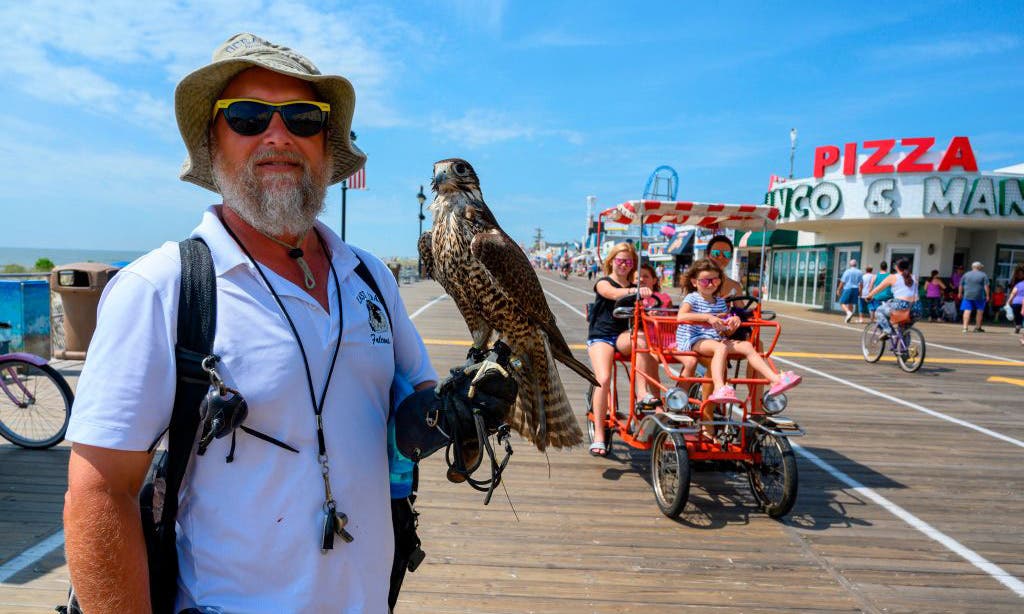
We patrol all afternoon, and at 6 P.M., Caselli heads to the mews to bring out the big gun, Strawberry. I had been told about this bird by Swanson. “She runs the show, and knows which places to go and where to sit and what’s the highest peak and where to look,” he says. “We kind of just let her do whatever she wants.” Caselli calls her “turbo grandmother.” She got her name from her previous job as a protector of blueberry fields. Whenever she scored a kill, the blood would drip down from her beak onto her plumage, dotting her chest with red droplets.
Back up on the boards, Caselli frees Strawberry from her harness right away, and off she soars above the ferris wheel and to a corner on the nearby Flanders Hotel. After a few minutes, Caselli heads to a dune to try to coax her back down. “You can’t call her back until she knows her 30 minutes are up,” she tells me, re-packing her lure and keeping her eye on her watch. Eventually Strawberry flies back to Caselli, and after a quick snack of quail, she’s sent up again for the last half of her hour-long patrol.
This time, however, she doesn’t come back—which is, I’m told, one of her behaviors. She was once gone from the mews for 24 hours and 34 minutes. “She had caught a seagull, eaten said seagull, and just decided that she was not hungry enough to return to me,” says Caselli.
A strong sense of déjà vu washes over Caselli as she begins leading me away from the boardwalk, consulting her GPS tracker on her phone. We find Strawberry at a condominium complex a few blocks north of the boardwalk. After a resident lets us inside, we spot her on the fifth floor. A waterfall of floating white feathers drops from above. “Look,” Caselli says. “She’s got a gull.”
There’s no lure strong enough to capture the falcon’s attention. We watch, somewhat helpless, as Strawberry holds the gull in her claws and flies over to the roof of a three-story vacation house, perches herself, and continues plucking feathers. One of Caselli’s co-workers brings her an entire frozen quail, which she connects to the lure, only to see Strawberry soar away again, back to a corner of the Flanders Hotel. It’s 7:45 P.M. now, and we watch as Strawberry, belly full of gull meat, gives herself a bath in the gutter water.
Make that three seagulls this summer. Strawberry doesn’t come back to Caselli until her feathers are dry.
