

Apparel companies are moving beyond advanced footwear to design suits that stabilize joints and save energy. The latest technology suggests the future of physical performance involves what you wear from head to toe.
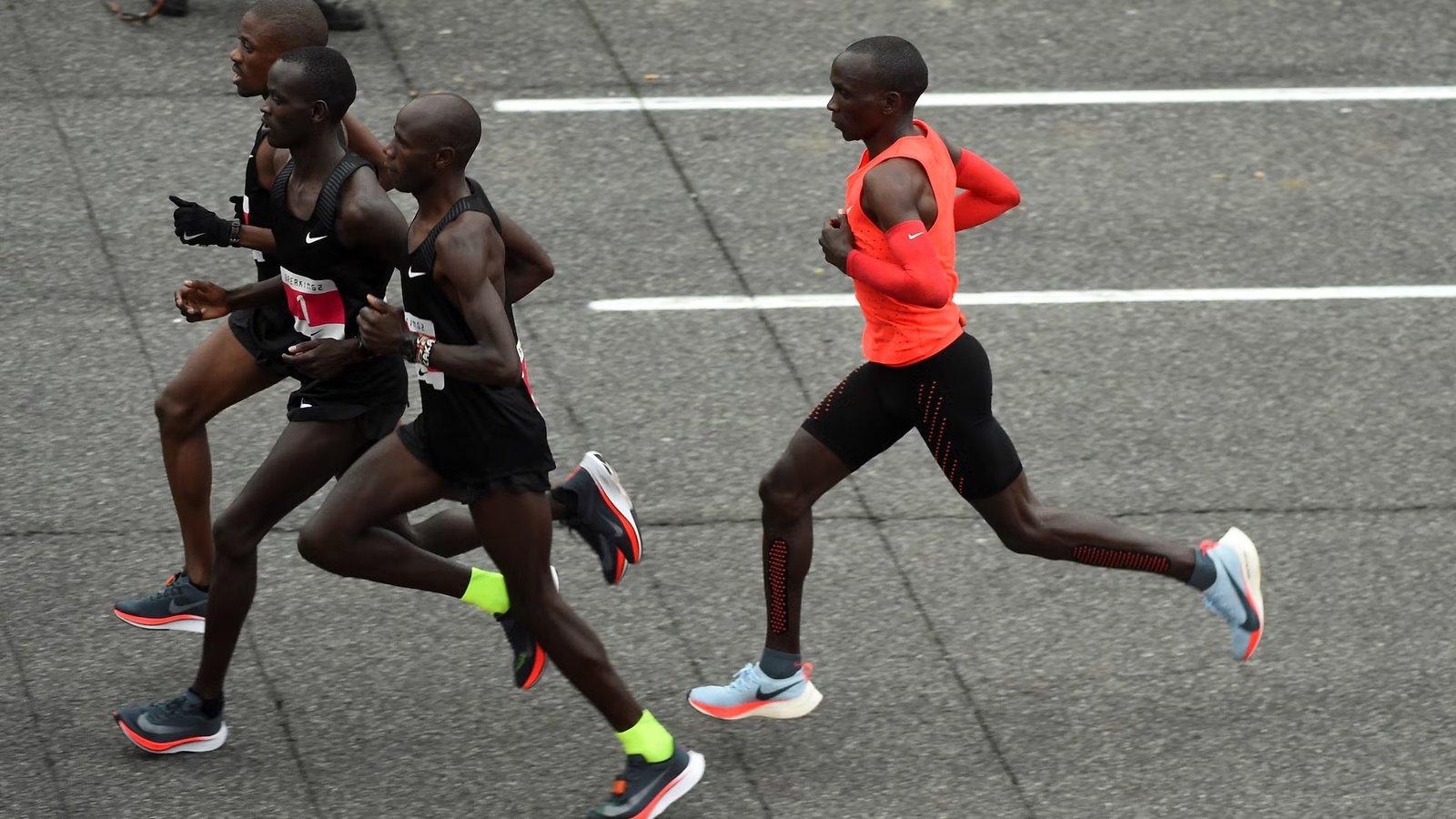
Eliud Kipchoge runs during the Nike Breaking2: Sub-Two Marathon Attempt at Autodromo di Monza on May 6, 2017. (Photo: Pier Marco Tacca / Stringer / Getty)
Published September 22, 2026 03:23AM
At first everyone thought it was all about the shoes. When Kenyan runner Sabastian Sawe and his Ethiopian rival Yomif Kejelcha broke the two-hour barrier at the London Marathon in April, they were wearing Adidas’s latest and greatest super shoe, a $500 foam-and-carbon-plate creation hyped as the fastest running shoe ever. It wasn’t until a week later that a senior exec with Adidas’s innovation team dropped an unexpected nugget in a LinkedIn post. Kejelcha’s high-tech speedsuit, the exec claimed, was itself worth a one percent boost in running economy—an unprecedented claim for clothing, and bigger than the margin by which the two men had broken two hours.
Sweat Science 101
Sign up for a ten-part email series from Alex Hutchinson on how to train, fuel, and recover. Each week, Alex covers a new topic, including strength training, supplements, and more!
Sports apparel has always ridden the boundary between fashion and function, with a bigger emphasis on the former. Sure, today’s lightweight, breathable, sweat-wicking garments are more functional than the baggy cotton-and-wool monstrosities from a century ago. But for the most part, the performance edge provided by even the most cutting-edge clothing was thought to be mostly about comfort. As the fashion-forward 1980s sprinter Florence “FloJo” Griffith-Joyner put it: “Dress good to look good. Look good to feel good. And feel good to run fast!”
FloJo famously experimented with all sorts of fabrics and uniform designs, from one-legged tights to a hooded speedskating suit that she wore at the 1987 World Championships. Speedskaters, like cyclists, had figured out by then that aerodynamics make a big difference at high speeds. But at lower speeds, the benefits are less clear, even for sprinters. For longer distance runners and recreational athletes, the prevailing advice has long been to simply stick with whatever feels comfortable.
That started to change a decade ago, when Nike launched its multimillion-dollar Breaking2 project in pursuit of a sub-two-hour marathon. Among the innovations they rolled out for Kenyan superstar Eliud Kipchoge and his teammates was a wholesale rethink of their uniforms: arm sleeves, a tighter-than-usual sleeveless tank top, half-tights with aerodynamic patterning and targeted bands of compression for muscle support, and even textured aerodynamic tape on the inner calves to reduce drag as the ankles whip back and forth.
The centerpiece of Nike’s Breaking2 initiative was the first carbon-plated super shoe, which they boasted would improve running economy by four percent, meaning that it takes four percent less energy to run at a given pace. But they didn’t make any similar claims about the clothing. When I tried to pin down one of the company’s apparel designers in 2017 about the new uniform’s benefits, he downplayed expectations. The potential benefit would be measured in seconds over the course of a marathon, he said. “But even if it was just one second, that would be significant,” he added. “We would feel really bad if we didn’t try everything and they ran 2:00:01.”
Others were feeling more ambitious, though. Around the same time, research groups from around the world began publishing data on “unpowered exoskeletons”—basically mechanized pants that make it easier to walk or run. Initial designs looked more like Robocop suits, but over the years they’ve gotten simpler and less obtrusive. A Korean design published in 2021 showed a 2.5-percent improvement in running economy with what amounts to a pair of half-tights with an elasticized band running up the quads and connected to suspenders. Super shoes had already transformed running; now it looked to be only a matter of time before super pants followed.
In London this spring, Sawe and Kejelcha both broke two hours, and were both sponsored by Adidas—but were wearing conspicuously different uniforms. Sawe wore a singlet in Adidas’s Climacool+ line, with an array of embossed 3D dimples patterned across the chest. These dimples enhance airflow and prevent the fabric from clinging to the chest when it gets wet, according to Margherita Raccuglia, the director of Adidas’s apparel innovation team. Wet cling isn’t just an aesthetic issue: it interferes with the cooling effect of sweat evaporation. As a result, Raccuglia says, lab tests have shown the design helps keep body temperature lower, though she didn’t give a number on how much.
Kejelcha, in contrast, wore a one-piece bodysuit in the company’s Techfit+ line. Normally you associate bodysuits with aerodynamics, or perhaps with compression—a feature that has long been touted to boost performance, but has mostly failed to live up to the hype in lab tests. In this case, the suit’s primary purpose is “targeted muscle support and joint stabilization,” according to Raccuglia. As athletes fatigue, their posture and alignment degrade; strategically placed stiffening bands made of thermoplastic polyurethane run along the quadriceps and hamstrings, stabilizing the hips and pelvis. This is the effect that, according to Adidas’s internal testing, boosts running economy by one percent.
Will super pants sweep the endurance world in the same way that super shoes have? Before that happens, we’ll need to see the purported benefits replicated in third-party testing. For elite runners, a one-percent improvement in running economy translates into a gain of two-thirds of a percent in race speed. At two-hour marathon pace, that’s 48 seconds; Sawe ran 1:59:30 and Kejelcha ran 1:59:41, so this is a meaningful margin. Does it matter to the rest of us? The runaway success of super shoes, along with growing interest in the marginal benefits of products like carbohydrate gels and baking soda, suggest that the answer for many people is “yes.”
Admittedly, I have a hard time envisioning myself in a tight one-piece bodysuit. Sawe apparently has similar feelings. Adidas’s scientists hoped until the last moment that he was going to wear it in London, but he opted instead for the Climacool+ singlet along with Techfit+ half-tights, which are equipped with some of the same stiffening elements as the full bodysuit but don’t provide quite as much support. When I asked Raccuglia whether that meant Sawe had left some time on the table, she diplomatically dodged the question. His choice “represented the optimal apparel combination for Sabastian Sawe at that specific moment and for the demands of that particular race,” she said.
In other words, FloJo was right: to run fast, you have to feel good. And feeling good will always depend on more than lab results, which is why the tension between fashion and function in athletic apparel will never entirely disappear. Still, if the positive results keep piling up, expect to see to more tight-fitting, dimpled, stiffened looks—because free speed never goes out of style.
This article is from the Fall 2026 issue of Outside magazine. To receive the print magazine, become an Outside+ member here.
