

Published October 1, 2026 03:02AM
In honor of spooky season, Outside editors are sharing their personal encounters while in the backcountry, hiking, camping, or otherwise enjoying the outdoors. In October of 2024, Outside social media strategist Nicole Facchina drove down to Zion in the dark. Here’s what it was like to feel watched by something you can’t see.
The night is thick in the middle-of-nowhere, southern Utah. It’s fall 2024, and the autumn leaves are just beginning to turn. My boyfriend, Marshall, is sleeping in the passenger seat as I drive us from Salt Lake City to Zion National Park. It’s our first trip to this landscape of narrow slot canyons and red rock.
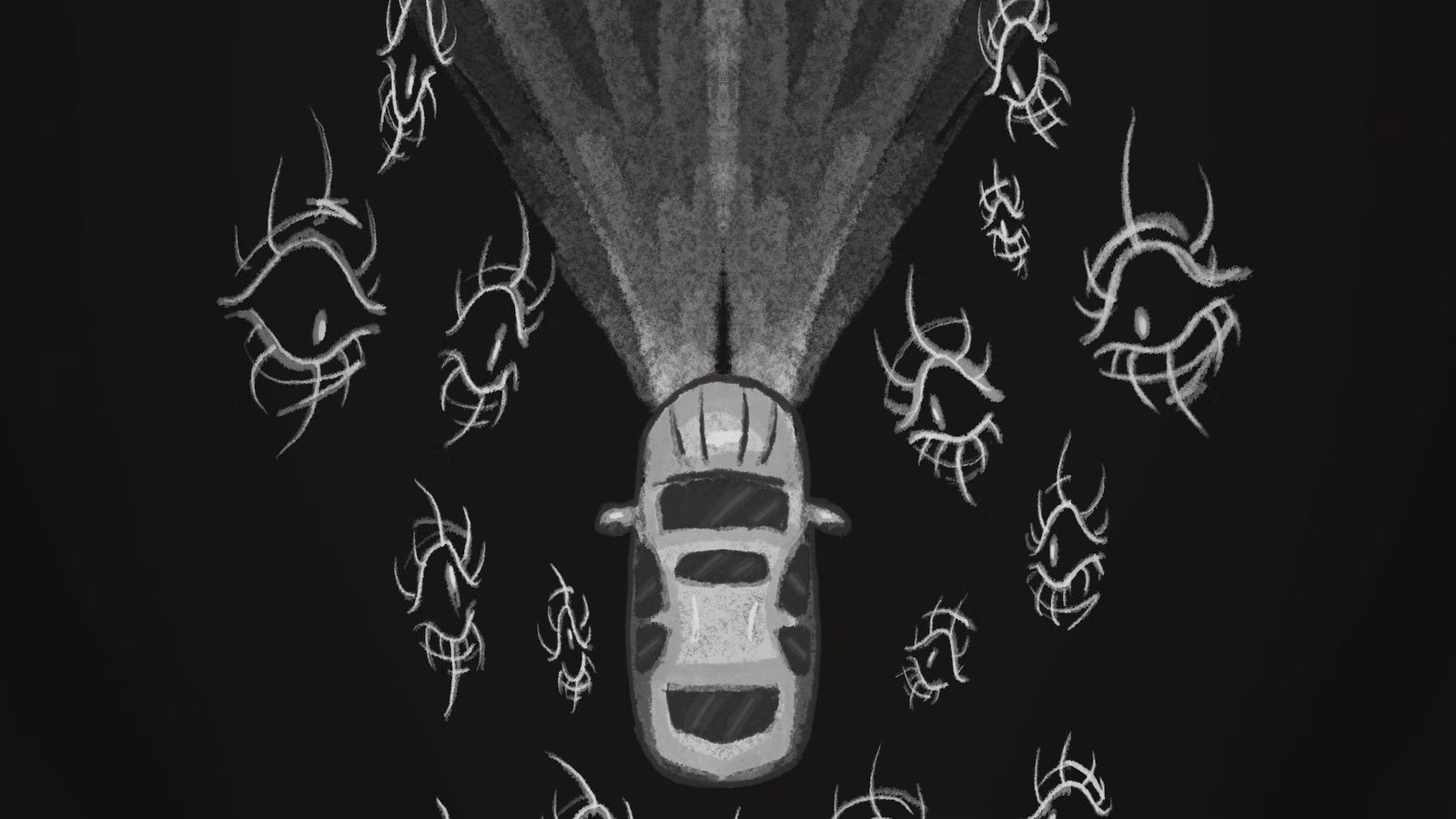
Suddenly, I jerk the steering wheel right, and the car glides around a sharp 90-degree corner on the dark road; it’s as if a switch flips inside me. My heartbeat quickens, and goosebumps rise on my arms. The temperature in the car drops ten degrees in a second, and my skin goes ice-cold everywhere except the back of my neck, which is unsettlingly warm.
I look into the rearview mirror. Inky blackness meets my gaze. Nothing there—at least, not that I can see. But that doesn’t matter.
I feel like I’m being watched.
Growing up a day-trip away from Virginia’s section of deep-woods Appalachia, I’m no stranger to this kind of abyss. It’s so dark it’s impossible to know whether anyone, or anything, is outside of the thin sliver of headlights.
This was different.
The Science of Feeling Watched
There’s a name for that feeling of being watched: scopaesthesia, also known as the psychic staring effect.
In 1913, American psychologist John Edgar Coover reported that between 68 and 86 percent of students he surveyed intuitively knew when they knew when someone was staring at them. Nearly a century later, biologist Rupert Sheldrake similarly found in 2000 that people could sense when they were being watched, writing that the reason was, at present, unknown to science. A quick scan through Google Scholar, a database of academic literature and scholarly research, returns 149 studies that include the term.
Our bodies have an in-house detection system to ensure our survival. That means our eyes may notice subtle movements even when our brains don’t consciously register them. We hear tiny sounds, and our skin can detect changes in temperature or pressure.
Whether this phenomenon is a psychic sense or our evolutionary hyper-vigilant ability to quickly process shifts in sound or temperature remains debated. Nonetheless, it’s an eerie feeling for those who have experienced it.
The Drive into the Shadows
At the time, Marshall and I were new to the state. Marshall’s favorite national park was Zion, and to celebrate our new proximity to it, I booked a one-room cabin just outside the East Entrance.
We left on a Friday at around 5:30 P.M. It wasn’t long before the sun slipped below the horizon, leaving me to drive in total darkness. Marshall had worked the graveyard shift at the Lodges at Deer Valley the night prior, and I let him sleep while I drove the first leg of our six-hour drive.
To his credit, I think he looks pretty cute when he sleeps.
Up until this point, the drive was almost painfully uneventful. But everything changed the moment the car charged through that dark corner. It felt as though every move I made, every twitch and shake of my body, was being studied by the oppressive gaze of an unseen watcher.
Then, Marshall, who’d previously been dead asleep through every sharp turn before, snapped awake. His eyes darted open, and he spun around in his seat, as if startled by something behind him.
When did it get dark? I remember him asking. Why didn’t you wake me up to drive?
I swallowed my unease, not wanting to spook him further.
Didn’t need to, I said.
I wondered if he felt it too, but kept quiet. As the miles passed, I couldn’t shake the heavy feeling in my chest.
Unpacking at the Edge of Zion
Forty-five minutes after that eerie turn, we pulled onto a dirt road leading to our cabin. The air was cold and dry, as the desert nights tend to be. Our weekend cabin sat at the very end of the road, barely illuminated by the dim ground lights poking out of the red desert earth.
I rushed Marshall out of the car and told him to unlock the cabin while I fumbled with our bags.
I’ve never moved so fast. I snatched up the bags, locked the doors, scampered through the pitch-black night onto the dimly lit porch, and practically dove inside. I locked the door behind us, checked the lock, and checked it again.
The rest of the night blurred by. Marshall fell asleep quickly. I, on the other hand, stared at a thin-paned window next to the bed, searching for whatever could be on the other side.
I never saw anything. At around 3 A.M., I finally forced my eyes shut. By sunrise, as daylight flooded the room, the oppressive feeling evaporated. For the first time in hours, I felt at ease.
“It Wasn’t Just You”
We had a full day of hiking ahead, and I wasn’t going to let a night of paranoia ruin our trip.
And it didn’t. We spent the weekend exploring red-rock cliffs, eating whatever gluten-free treats we could find, and hiking the Narrows—Zion’s famed trek through a river surrounded by canyon walls.
I dismissed the night until a year later, over dinner with friends, when the topic of weird wilderness encounters came up. As I shared my story, I expected laughs. Instead, everyone looked at Marshall. His face had gone pale as if he’d seen a ghost.
It wasn’t just you, Marshall said. I felt it too.
My comfortable denial vanished.
I woke up in the car because something felt wrong, he told me. When we got to the cabin, I felt like we were being watched. Then I woke up in the middle of the night—and I swear I saw two glowing eyes looking at us through the window.
My mouth fell open. Why didn’t you say anything? I asked.
Marshall shook his head. I don’t know. I guess I didn’t want to believe it.
Always Trust Your Instincts
Neither of us can explain what happened that night. I may never understand if that feeling was just paranoia brought on by driving fatigue or something actually lurking in the desert shadows.
What I do know is that our instincts pick up on cues long before our minds process them. The next time you feel that hot prickle on the back of your neck in the backcountry, don’t write it off. Trust your instincts—they exist for a reason.
