

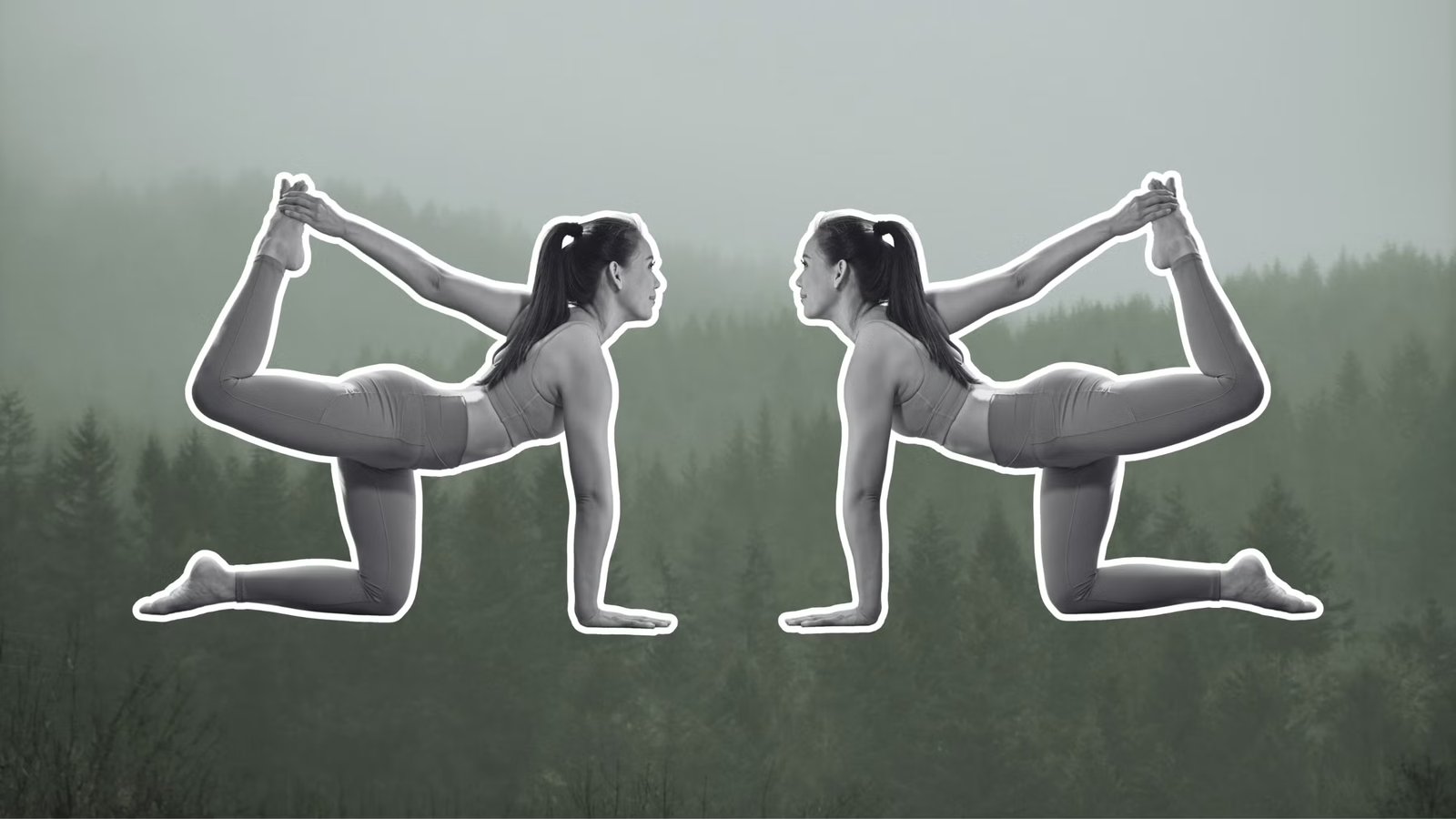
Though this move is challenging, you’re literally balancing on one side of your body, it can provide a boost to your glutes, core, and hamstrings, which can help you power through your next trek.
(Photo: BongkarnThanyakij/Getty; Design: Ayana Underwood)
Published October 1, 2026 11:59AM
Reporting Note: Jenny McCoy, a NASM-certified personal trainer, explains why the B.O.D.Y. Challenge targets the muscles that can make you a stronger outdoor athlete.
In exercise, sometimes the most challenging moves involve no movement at all. That’s the idea behind the B.O.D.Y. balance challenge (which does not appear to be an acronym), a buzzy social media core-strengthening exercise that looks elegantly easy, but is really tough to pull off.
This pose starts on all fours, then you place your right forearm on the ground and lift your left leg. Then lift your left arm and rest it on the IT band of your left leg. (The IT band sits on the outside of your thigh). Then place your right foot on top of your left quad, while keeping your left leg lifted in the air. Lastly, prop your chin up using your right hand.
The end result? You’re balancing on your right elbow and right knee, and the goal is to hold as still as possible in this position. Then you switch sides and repeat.
Because those directions are, admittedly, a mouthful, it may be easier to just take a look at a visual of the move here.)
I’m a certified personal trainer, and I was wobbling all over the place when I tried this move. But a strong core improves both balance and posture, and can make hiking, backpacking, and running much easier. Here’s what you should know.
What Makes The B.O.D.Y Balance Move So Hard?
This exercise is essentially a super-advanced plank variation. It’s challenging because you have only two points of contact with the floor: one elbow and one knee, both on the same side of your body. This creates an asymmetrical load. (If the contact points were an elbow and knee from opposite sides, the move would be a little easier, because that diagonal line creates more stability.)
Your hips and spine naturally want to rotate towards the grounded side, and you have to really engage your core to keep them level. The move also demands shoulder stability on the arm that’s propping you up by the elbow, as well as glute and hamstring strength from the leg that’s lifted straight up. Then there’s the immense mental focus: you have to be 100 percent present and connected to your body; otherwise, you’ll likely topple over the minute your mind starts to wander.
It’s important to note that this exercise places quite a bit of pressure on your knees and elbows, so I’d suggest placing a foam pad, blanket, or pillow underneath your elbows and knees to make it more comfortable. And if you have a history of pain or injury in those joints, it’s probably wise to steer clear of this move altogether. Instead, check out these safer plank variations to challenge your core and shoulders.
How This Move Is Relevant For Outdoor Athletes
The skills that the B.O.D.Y. balance challenge trains are relevant to pretty much any outdoor athlete. Good core stability helps protect your spine from taking on excessive force as you backpack, climb, run, and ski.
Extra glute and hamstring strength can propel you on long trail runs and up steep hikes. Sharpened attention can also help you stay mindful of your movements and surroundings outdoors, which may reduce your chances of surprise trips and falls.
That said, the B.O.D.Y. balance challenge isn’t the most functional—meaning the specific position (balancing on just one elbow and knee) doesn’t closely resemble the way you’d move in daily life and outdoor sports. So while it does have legit benefits, you don’t need to add it to every workout.
But if you do get the hang of it, trying it every now and again could be a good way to benchmark your core stability and balance. Even if you can’t quite master it, in today’s instant-gratification world, there’s still something powerful about earnestly trying—and failing.
Want more Outside health stories? Sign up for the Bodywork newsletter. And for tips on how to train, fuel, and recover better, sign up for the Sweat Science 101 newsletter.
