

A newly dated 272-foot rock carving in Cabeza Prieta National Wildlife Refuge was severely damaged by border contractors, exposing a growing threat to public lands, outdoor access, and sacred Indigenous heritage.
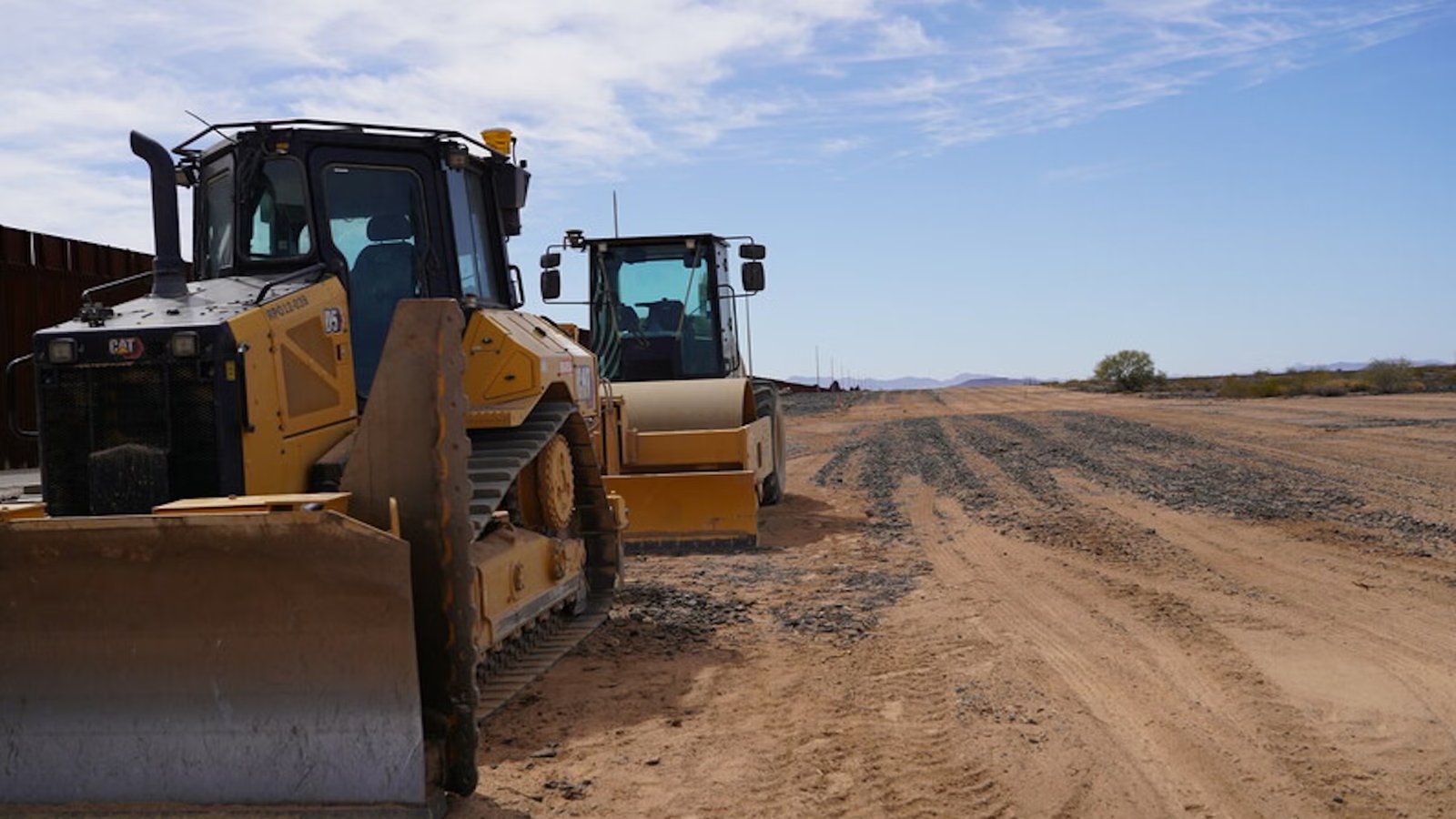
A bulldozer pictured in Cabeza Prieta National Wildlife Refuge (Photo: Courtesy of CBD)
Published October 2, 2026 01:13PM
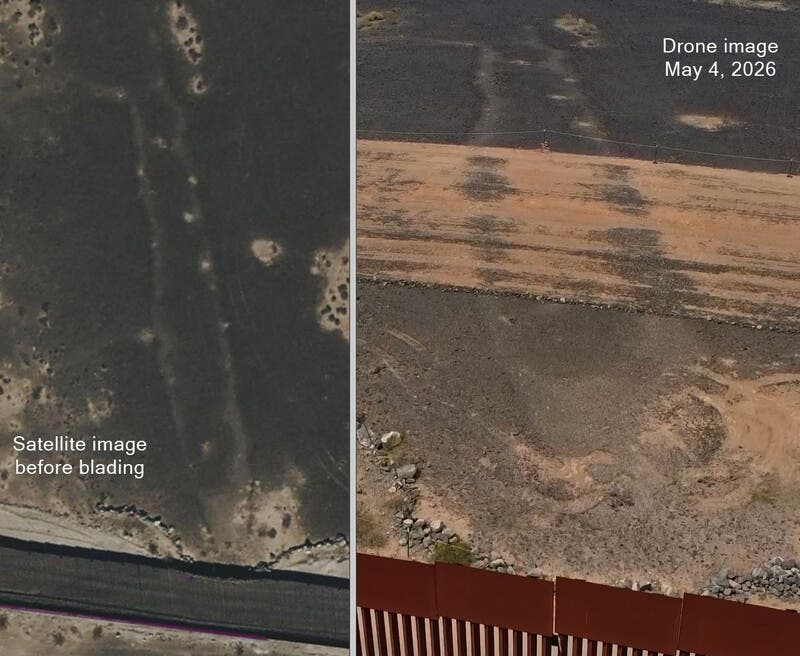
For millennia, a 272-foot-long fished etched into the rocky floor of the Sonoran Desert called Las Playas Intaglio has resided largely undisturbed along what is now the U.S.-Mexico border. But in April, construction workers near Ajo, Arizona, plowed a 50-foot scar through the ancient geoglyph to build the Trump Administration’s border wall.
Archaeologists now believe that the ancient rock carving is 6,000 years older than previously thought, according to research published in The SAA Archaeological Record in September.
That puts the ancient carving at around 7,000 years old, predating England’s Stonehenge by 1,500 years, Egypt’s ancient pyramids by around 2,000 years, and the Nazca Lines in Peru by 4,000 years.
It also makes the earthwork the oldest dated geoglyph in the Americas.
“They just ran right through the fish, basically severing its head from its body,” Russ McSpadden, southwest conservation advocate at the Center for Biological Diversity, told Outside. “About 30 percent of it was damaged. The fish was decapitated. This is a slap in the face to our shared human history.”
U.S. Customs and Border Protection told Outside that it “secured the remaining portion of the site, and it is being protected in place.” A spokesperson said the agency “continues discussions with the tribe.” The agency did not comment on the extent of the damage.
Advocates like McSpadden warn the physical destruction of the Las Playas Intaglio showcases a broader threat facing public lands, desert ecosystems, and Indigenous heritage sites.
“The circumstances with respect to the Las Playas Intaglio furthermore are especially alarming given the federal government’s plans for additional border wall enhancements,” researchers David Whitley and Ronald Dorn wrote in their study. “Their destruction, should it come to pass, will be a national tragedy and international scandal.”
“A Gem of the Sonoran Desert”
Intaglios are geoglyphs that were scraped into desert pavements, and those found in Arizona were created and used for religious rituals, according to Whitley and Dorn. Las Playas Intaglio sits in an ancient lava field along the U.S.-Mexico border. Its fins are visible from space, and its face points south to the Sea of Cortez in the Gulf of California, about 45 miles away.
The intaglio lies on the Cabeza Prieta National Wildlife Refuge in Arizona on the ancestral lands of the Tohono O’odham Tribe. The refuge encompasses more than 800,000 acres of undesignated wilderness and a winter hiking destination.
Nearby Organ Pipe Cactus National Monument is also known for its dark skies, camping, and 28 miles of established hiking trails. The area is also home to the Arizona National Scenic Trail, an 800-mile hiking route that spans from Mexico to the Arizona-Utah border.
“The wildlife refuge itself is a gem of the Sonoran Desert,” McSpadden said. “Before the border wall, it connected to this larger protected desert landscape, which is the El Pinacate and Gran Desierto de Altar Biosphere Reserve in Mexico. And that connected to the Organ Pipe Cactus National Monument.”
“Nothing is Sacred Right Now”
According to the Center for Biological Diversity, the U.S. Department of Homeland Security issued a series of waivers in 2025 that set aside dozens of environmental, cultural, and public health laws to expedite border wall construction across southern Arizona. Authorities have issued similar measures to build the border wall in Big Bend National Park.
McSpadden said the Arizona intaglio signals what might happen to other cultural sites along proposed border wall construction.
“Nothing is sacred right now for projects at the border,” McSpadden said. “The only thing that’s sacred is the wall itself, and it’s dark and lawless because, by design, they’ve waived all the laws. The victims are not just people and wildlife, but also deep history and our connection to our human past.”
In February 2020, Monument Hill, a burial ground sacred to the O’odham in Organ Pipe Cactus National Monument, was blasted. Protected Saguaro cacti have also been destroyed, according to the National Park Conservation Association, which the National Park Service says only grow in the Sonoran Desert landscape.
