

Published October 4, 2026 11:21PM
How we reported this story: We interviewed certified Gyrotonic and Gyrokinesis instructor Leslie Hubbard. Hubbard demonstrates the exercises in the videos below.
A few days into a weeklong backcountry skiing trip, a friend showed me an exercise routine unlike anything I’d done before. She led me through a sequence of rolling, stretching, and flexing movements to attend to all of the tiny, neglected, and overworked muscles in my feet and ankles. It felt amazing. My friend told me she’d learned the moves through classes in Gyrotonic and Gyrokinesis, two exercise methods that I’d never heard of. My trail-weary feet (and the rest of my body) needed to learn more.
Gyrotonic is a movement system using specialized equipment that was originally developed to help dancers rehabilitate from injury. While the equipment looks similar to that of Pilates, Gyrotonic movement principles draw inspiration from qigong and tai chi, Chinese practices that center slow movement and focused breathing. Many Gyrotonic sequences feature circular or spiraling motions that bring joints through a full range of motion. Gyrokinesis employs similar movements, but is performed off the machines and on a stool or mat.
“There’s a lot of energetic qualities to the system in the movement,” says Leslie Hubbard, a certified Gyrotonic instructor and owner of Hidden Root Studio in Maple Falls, Washington. “It’s very circular; it’s very three-dimensional. It looks at the body as a whole, and that all the systems are connected.”
The goal is to bring multiple biological systems into harmony, promoting blood flow and repairing cell damage. Just as I experienced with the relief in my feet, this type of movement can benefit hikers wanting to address stiffness and aches, rehab old injuries, or simply build full-body strength for the demands of the trail.
Hubbard says that the practice focuses on small, safe movements that start in the core to build strength from the inside out. The idea is to build stability throughout the body, not just in certain muscle groups. The holistic approach can benefit hikers carrying a loaded pack or moving through varied terrain.
By bringing awareness to the whole body, Gyrotonic and Gyrokinesis can help hikers move more fluidly and pain-free.
Hubbard says that Gyrotonic and Gyrokinesis are individualized practices, and she curates classes and sequences depending on an individual’s physical abilities and limitations. “Not everybody is the same,” she says. “And that’s one thing that’s really beautiful about this system: we look at who is in front of us. It’s not a cookie-cutter.”
When trying the sequences below, listen to your body. Focus on what feels good rather than trying to force your joints through extreme ranges of motion. “The smallest range of motion could be so satisfying for the body, especially after a long day of hiking,” says Hubbard.
Gyrotonic and Gyrokinesis for hikers
Outside of a Gyrotonic class, you can still experience the benefits of Gyrokinesis. Try out these movements at home or in camp, remembering to tune into your body and move in ways that feel good. Stop if you experience any pain.
Spine Sequence
After carrying a backpack all day, give your spine some love. This spine mobilization serves as a foundation for many Gyrokinesis movements.
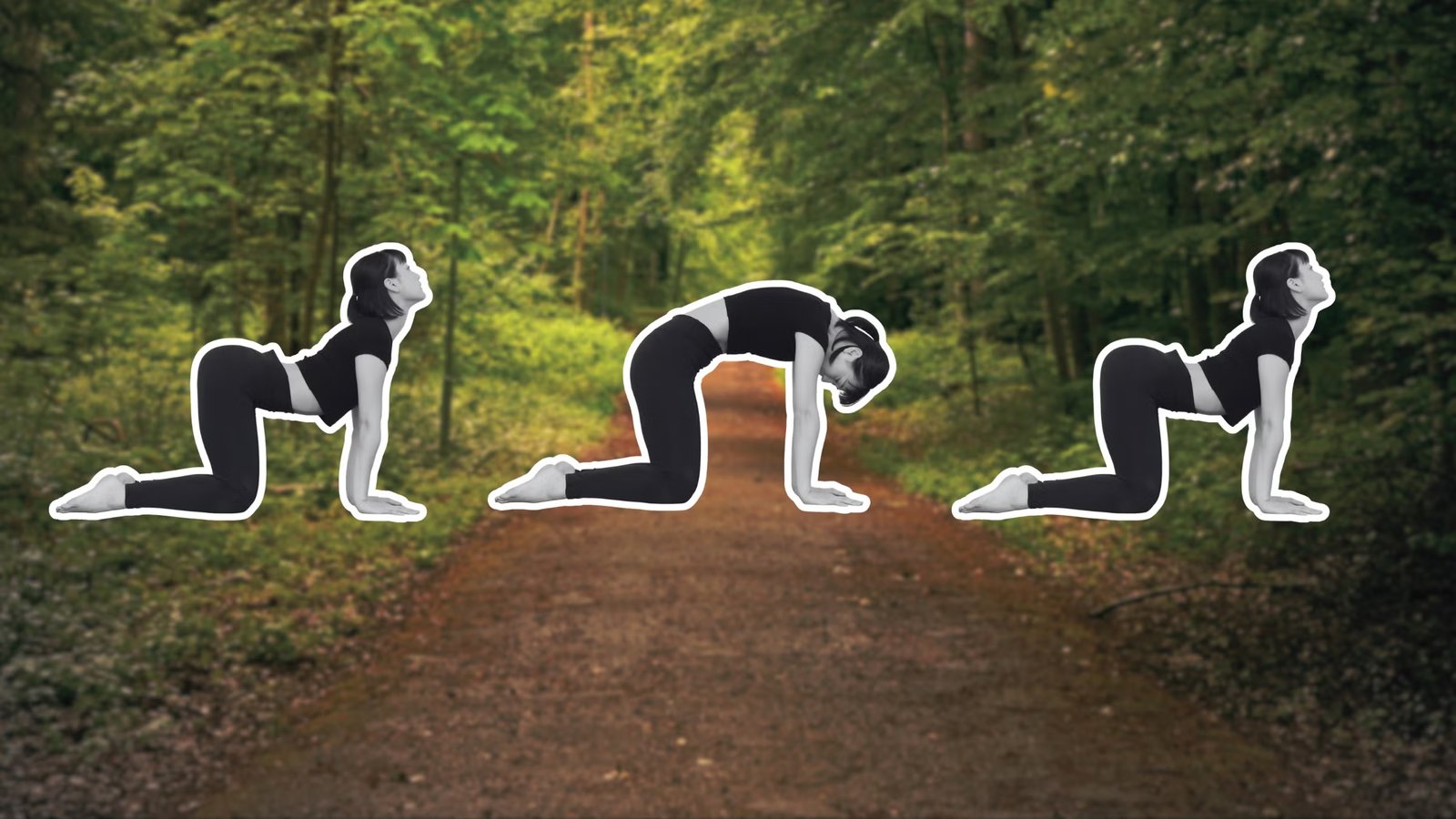
Sitting upright on a stool (or in camp, on a rock or log), gently begin to mobilize your spine. Alternate between arching and curling your spine. Drive the movement from your pelvis (not your neck) and through the entire spine. (Think of cat-cow pose in yoga, but seated.) Repeat as many times as feels good. Next, “spiral” the spine, rotating your trunk from side to side, again driving from your pelvis rather than your head. Incorporate some side arches, slowly leaning left and right to stretch your side body. Next, move your spine in a wave pattern: keeping your arms at your sides, curl and arch your spine as you draw your chest forward and back.
Foot and Ankle Sequence
Here’s the sequence that was my intro to Gyrokinesis. Remove your shoes and socks and, seated, work through the following.
Lay one ankle across the opposite knee so that you can reach your foot from a seated position. Start with what Hubbard calls foot openings, massaging your sole with your thumbs from the heel through the arch and toes with a focus on areas that feel especially tight. Don’t neglect the undersides of your toes—this will feel great after a day on trail. Next, grasp each toe one by one, stretching it forward and back as well as stretching the webbing between your toes.
Then, grasp your foot with your fingers threaded snugly in between your toes, so that the webbing between your toes meets the webbing between your fingers. With your other hand, stabilize your ankle. Use the hand grasping your foot to draw your toes in circles, first one direction, then the other. Next, move your other hand above the ankle, and, with your hand still threaded between your toes, draw larger circles with your ankle joint. “You’re creating space and strength at the same time,” says Hubbard.
Pull your fingers out from between your toes and use your hand to slap the bottom of your foot.
“This seems odd, but you’re bringing blood to the sole of the foot,” says Hubbard. Next, shake your ankle out.
“Just doing that, you’ll feel the difference,” she says. “When you put the foot down, you’ll feel the difference between the two sides.
This next sequence will feel best at home on a flat floor. Or, lay a foam pad on a level area in front of where you’re seated in camp. From sitting, place the tops of your toes on the ground to stretch the front of your ankle joint. Alternate between your left and right foot. Next, with the top of your toes still against the ground, roll your ankle joint outward from your big toe to your little toe. The idea is to get a good stretch through the front of your ankle and the entire joint.
Next, place the soles of your feet flat on the floor. Lift and spread your toes, reaching them forward as you lower them to the ground. Then pull your toes toward you as if grabbing a towel on the floor, lifting through the arch as you do so. After a few repetitions, reverse the motion. Focus on engaging the arch of your foot as you do this one.
Stand up and lean over to place your hands on the stool, rock, or log. Don’t arch your back—keep your core engaged. With your knees slightly bent and your weight in your hands, lift onto the balls of your feet and circle your ankle joints outward, rolling through the balls of your feet toward the little toes. Complete the circle by lowering your heels and rolling onto the inside of your feet. Reverse directions, rolling your ankles inward. Then roll both ankles clockwise, followed by counterclockwise. Repeat until your joints feel loosened and happy.
“You want it to feel good,” says Hubbard. “You want it to work in a way that feels like a massage.” It’s OK if your range of motion is small; listen to your body and stop if something feels uncomfortable.
