

Published October 22, 2026 03:47AM
Yeti made waves in the outdoor industry last week when the company announced its foray into apparel. This is unexpected, right? Not really. The expansion into outerwear is only surprising if you still consider Yeti “just a cooler brand.” Over the last few years, the cooler kingpin has parlayed its brand recognition and reputation for durability into other outdoor niches, like backpacks. And honestly, they’ve done so with flying colors.
Let me start by saying that I am by and large a Yeti fan. Their insulated drinkware has become my go-to for morning coffee. These overengineered insulated bowls have relegated plastic Tupperware to the recycling bin. And then there are the expedition-grade waterproof backpacks, heavy-duty gear-hauling tote bags, these killer gear storage solutions, and more that have all been tested and approved by yours truly and Outside’s team of gear nerds. Hell, this summer, I got my hands on a Yeti carbon-steel wok that can handle electric cooktops and open-flame cooking alike. I was skeptical, but upon first sizzling stir-fry, I was sold. All that to say, Yeti doesn’t just talk the talk. It walks the wok.
Cookware humor aside, it’s not remotely surprising to me that Yeti, which goes by the same four-letter ticker on the NYSE, is trying to take a bite out of the massive outdoor apparel pie. But my question is this: Will Yeti’s foray into clothing be as successful as its venture into cast-iron pans, bags and totes, or its ongoing toppling of Tupperware’s microplastic-built empire?
The short answer: who knows? Product is limited—insert grumpy emoji here—so we haven’t tested samples yet. When we do, we’ll report back. Regardless, we’ll quickly break down some eyebrow-raising specs and share a few thoughts. Because if we can’t review gear, we’d at least like to gossip about it.
The Yeti Tilloo Rain Jacket: Breaking Down The Price
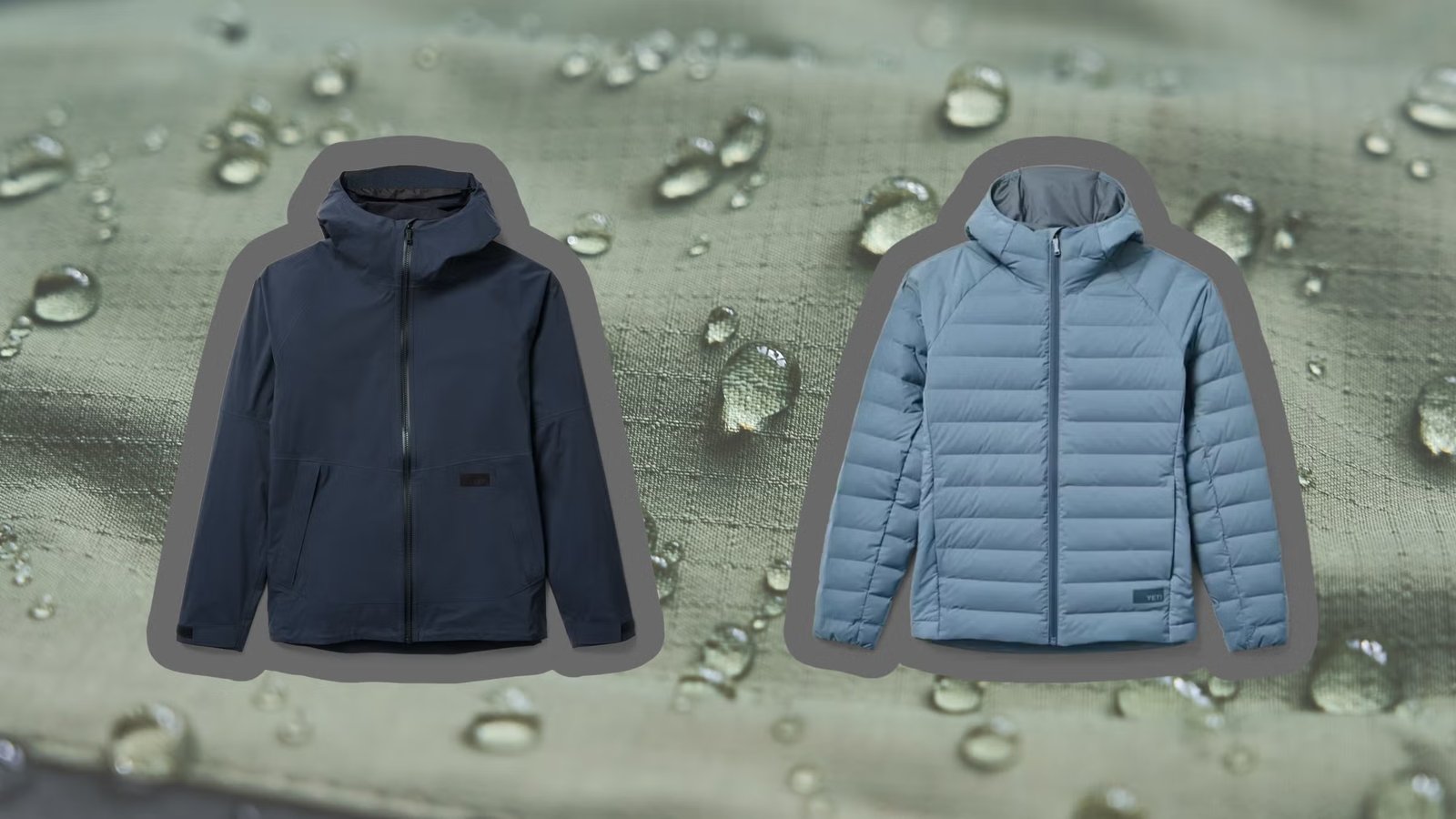
The most newsworthy piece of Yeti’s debut apparel line is the Tilloo Rain Jacket, available for $350 in both men’s and women’s versions.
But before we get into the numbers that gear nerds care about most (waterproof and breathability ratings), I’d like to quickly tackle price, since I’ve read a few comments from pitchfork-wielding shoppers saying they’d never spend three-hundred-plus bucks on a rain jacket. It’s a fair point, but misguided. Yes, $350 is a lot of money. But it’s closer to average than outrageous for a decent rain jacket these days.
Take our coverage of the best men’s rain jackets of 2026, published on Backpacker and last updated in September. When you consider the eight jackets our testers loved the most, the average price is $333. Our favorite do-it-all pick, the Helly Hansen Verglas Infinity Shell 2.0, costs $370. Granted, if you are hunting for an affordable hard shell, you can check out other tester favorites, among them the more than reasonably priced REI Co-op Rainier for a hundred dollars, or the tried-and-true, ultra-durable Patagonia Torrentshell 3L for $189, our top value pick, which gives shoppers the most bang for their buck. Whatever you choose, the $350 price point on the Yeti Tilloo rain jackets is reasonable when stacked up against current competitors.
How Waterproof is the Yeti Tilloo Rain Jacket?
Price notwithstanding, Yeti describes the Tilloo as crafted from a three-layer waterproof, breathable, stretchy nylon fabric. The site doesn’t list a specific waterproof and breathable membrane, like Gore-Tex, suggesting the tech is proprietary. The waterproof rating is listed at 40K millimeters, while the breathability rating is listed at 45K grams per square meter of fabric over a 24-hour period (this rating will often appear as a 40K/45K denotation in product specs). This is where things get interesting.
Now, if you pay attention to waterproof and breathability ratings, you already know that these numbers are higher than I was at Golden Gate Park on 4:20 PM, April 20th, during my senior year of high school. (I was violently high.)
If you are unfamiliar with these numbers, or you are currently violently high, a quick refresher. The first number references a hydrostatic head test. The exact protocols for these tests vary, but the best way to conceptualize it is to imagine a section of fabric placed beneath a cylinder that’s full of water. You increase the water pressure by raising the water level in the cylinder, and the waterproof rating is determined when the fabric leaks and fails. If the fabric isn’t waterproof, it leaks quickly, resulting in a lower rating. If the fabric is very waterproof, more water pressure is needed, so the rating is higher.
The second number refers to a breathability rating that measures the weight of water vapor that can permeate a square meter of fabric in a 24-hour period. The more grams of water that can pass through the fabric, the more breathable the fabric is, and the score is higher.
To put this in perspective, we wouldn’t trust a jacket with a 5K waterproof rating in a storm, nor would we do a high-output activity like ski touring in a shell with a 5K breathability rating. In general, the sweet spot is 20K/20K if you’re looking for an extremely waterproof and breathable jacket for a weather-prone sport like skiing. Gore-Tex Pro, for instance, often considered the gold standard waterproof and breathable membrane and the backbone of the Montane Alta XT, our favorite heavy-duty shell, comes in at 28K/25K. With that in mind, Tilloo’s rating of 40K/45K is extremely high.
So, Should You Drop Everything and Buy the Yeti Tilloo Rain Jacket?
Given what we know so far about this new jacket, are we still curious? Yes. Are we excited? Yes. Are we skeptical? Also yes. These data points are helpful beta, and we always consider them when purchasing a rain jacket. But living and dying by numbers is a fool’s errand. First off, it’s hard to know whether the findings are verified by a third party or provided by the manufacturer. This explains why we test jackets in the field and also send them to the Outside Lab for further side-by-side analysis.
What’s more, the fabric itself isn’t always the source of failure for a rain jacket. A rain jacket can score well, only for the taped seams to peel like sunburned skin, the stitching to unravel, or the waterproof zipper to be not-so-waterproof.
Additionally, a couple of key numbers are absent from the specs of the Tilloo. First off, we don’t see the fabric’s denier, which quantifies fabric thickness and weight and correlates to durability. We expect Yeti to produce durable gear, but without this data point, that faith is somewhat blind. Even more egregious, weight is missing from the specs entirely. If you’re a discerning outdoor enthusiast using a shell for anything beyond casual, daily wear, that number is critical for your decision-making.
Nitpicking and sleuthing aside, the Tilloo does have several features that suggest we will inevitably enjoy it, among them fully taped seams, a waterproof Aquaguard YKK zipper, and a touch of stretch in the fabric itself. One feature that’s missing is pit zips, which we can do without if the Tilloo is as breathable as Yeti claims.
Our Thoughts on the Tensleep Hooded Jacket and More
After the Tilloo, nothing stands out to me as particularly noteworthy. There’s the Tensleep Hooded Jacket (men’s/women’s), which is Yeti’s take on a classic puffy. It purportedly blends the lightweight, lofty properties of down and the moisture-wicking, anti-odor properties of wool fibers for a hybrid insulator that can handle high-output activities. Again, this sounds intriguing, but with no down fill-power listed (a measure of loftiness that influences a puffy’s warmth-to-weight ratio), no total weight listed, and no opportunity to test, we’re flying blind here.
Additional pieces include a variety of mid-layers. There’s a PrimaLoft fleece, plus a full-zip and quarter-zip crafted from NuYarn merino. These are materials that we’ve tested and loved over the years, so we have no reason to believe these Yeti iterations will be anything other than solid.
Final Thoughts on Yeti’s New Apparel
If you’ve stuck with this gear nerd’s meanderings this far, I thank you. I’m also sorry I don’t have more to report. But until we get our hands on this apparel and test it both in the field and at the Outside Lab, it’s tough to say if this is a flop or a triumph. Granted, if I were a betting man, I’d lean toward the latter given Yeti’s track record.
If you’re curious or a diehard Yeti loyalist, it certainly could be worth purchasing the new rain jacket or puffy, or checking out the fleeces and merino layers. But if you need a reliable rain jacket that’s co-signed by myself and our experienced test team today, I’d head over to Backpacker to read our men’s and women’s rain jacket reviews. We won’t steer you wrong there.
One interesting point that I’ll leave you with is this: some of Yeti’s previous expansions have been made in part via acquisitions. More specifically, they bought renowned bag builder Mystery Ranch in 2024 and cast-iron connoisseur Butter Pat Industries in the same year. As of now, we’ve seen no news of an apparel brand acquisition. It seems like Yeti is breaking trail solo here. But we wouldn’t be shocked to see Yeti snap up a smaller fish sometime in the not-so-distant future. It isn’t “just a cooler brand,” after all.
