

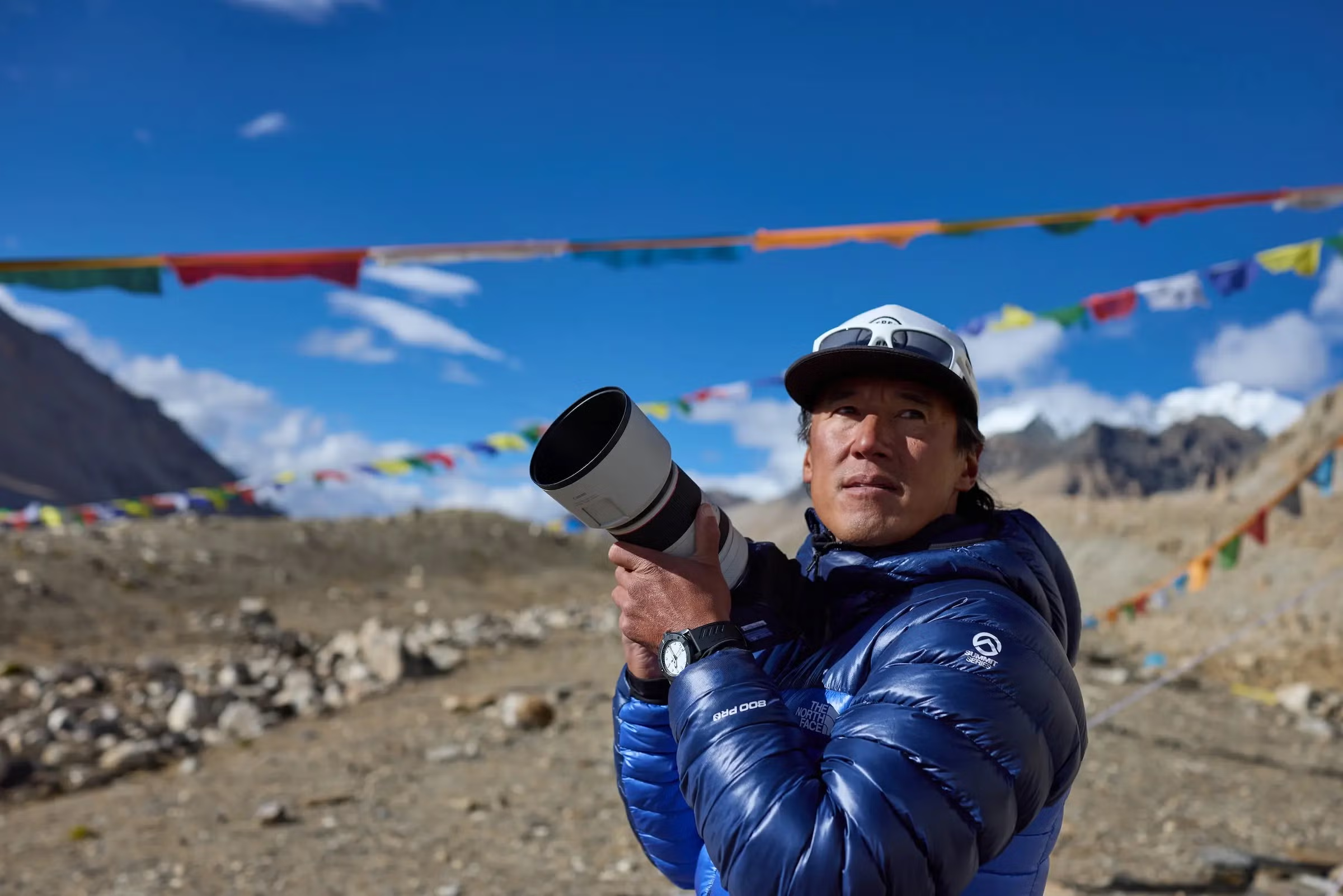
Published October 31, 2026 05:00AM
When Jimmy Chin was in his twenties, living out of a 1989 Subaru Loyale somewhere between Yosemite and the Tetons, he kept trying to explain climbing to his father. His father, a librarian at Mankato State University in Minnesota, would listen, and then say: “Our language is 5,000 years old, and there is no word for what you do.”
Chin has spent the decades since building a vocabulary for it anyway, as a climber, a photographer, and the Oscar-winning director of Free Solo featuring Alex Honnold, and his latest film, Everest: The Other Side, which documents Jim Morrison and Hilaree Nelson’s attempt to climb and ski down the North Face of the world’s tallest mountain.
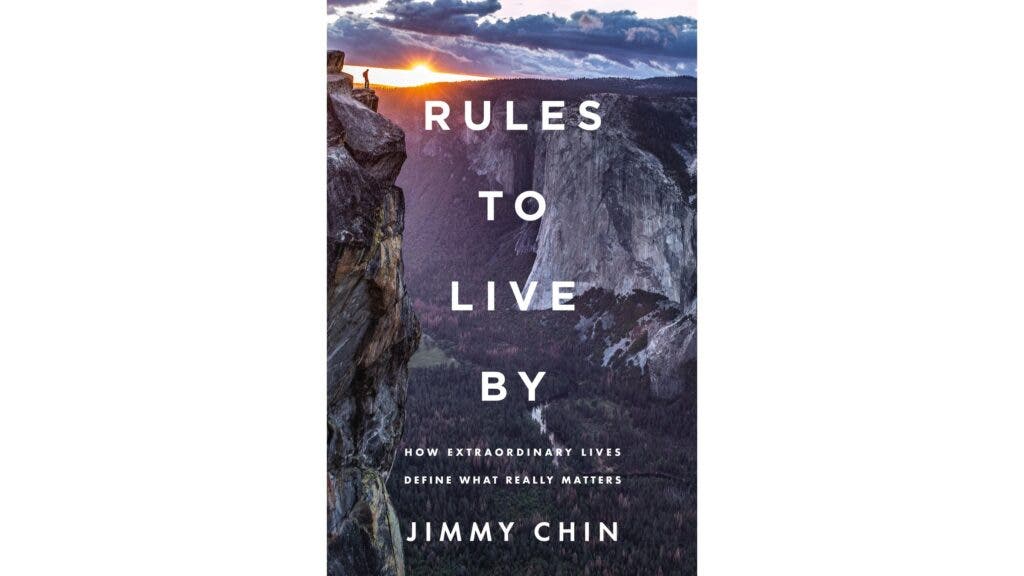
His new book, Rules to Live By (Celadon), presents other people’s words, but is also part memoir. It’s built from ten conversations with people who have lived on their own terms: Yvon Chouinard, Yo-Yo Ma, Simone Biles, Ridley Scott, Kelly Slater, Annette Bening, Lynsey Addario, Kris Tompkins, Alex Honnold, and Bill King, a retired command master chief of SEAL Team 6. He asks each of them some version of the same question: In the end, what really matters? And in the end, we learn what matters most to Jimmy Chin as well.
Earlier this month, I sat down with Chin onstage at the Bell House in Brooklyn. It was his first book event, and he confessed he hadn’t reread the book since turning it in. “There’s a reason I’m a filmmaker,” he told the crowd. “Writing is really, really difficult.” What followed covered violin practice, an undisclosed military base, and a missing sock. The conversation has been edited and condensed.
“If you’re going to do it, do it well”
OUTSIDE: You write that you’re “the only son of an only son of an only son.” That sounds like a lot of pressure.
Jimmy Chin: I started violin when I was three, and it became two hours of practice a day. Then martial arts, two hours a day. Then homework. That was my weekdays, and it was all I knew. But I learned discipline, and there was a very high expectation for excellence. My dad always said, “If you’re going to do it, you might as well do it well.” I hated that. Sometimes I still struggle with it.
There’s a scene in the book where you’re practicing violin, staring out the window at the forest. When did the forest win?
Chin: Anytime I did well in school, my reward was running off into the woods. There were no rules out there. My parents were librarians, so I always had a lot of books, and later, when they asked how I ended up doing this, I said, “It’s your fault. You gave me all these books.” I found climbing in college, and it was the first thing that felt like a calling. Growing up, I literally thought there were three jobs: lawyer, doctor, or professor. So after graduation I told my parents I’d take one year off, get it out of my system, and then pursue my real career. Which was a total lie. From 21 to 28 I lived out of my car, or in a cave in Camp 4, or in a chicken coop in Jackson.
What were those phone calls home like?
Chin: My sister, who went to Stanford and worked at Yale for 18 years, was my huge advocate. I’d ask her how Mom was doing, and she’d say, “Mom just keeps saying, ‘I raised a homeless man.” With my dad, I deeply wanted him to understand me. People see the films and photographs and ask about the greatest risk I’ve ever taken. It definitely wasn’t a mountain. It was being in my early twenties, full of doubt. There are a lot of storm days, sitting in a cave with water dripping, soaking wet, thinking, What am I doing here? Meanwhile your friends are going to grad school and starting careers.
And during this time, you were in a reggae band.
Chin: I dropped violin after high school and picked up the guitar. The furthest thing I could think of from a concerto in D minor was covering Bob Marley. The whole band was classically trained kids. Everybody was technically skilled, so we could play whatever we wanted.
Did you ever put out an album?
Chin: [Laughs.] No…we weren’t that good.
A Constellation of Answers
How did you choose the ten people in the book?
Chin: My documentaries take four, five, six, seven years. You have to bleed for them. You can only make so many films in a lifetime, and there are so many people I admire who I’ll never make a film about. I wanted the book to be a constellation: totally different backgrounds, totally different careers. After these extraordinary lives, what have you discovered really matters? What did success look like when you started, and what does it look like now? I had just turned 50, so I was looking back at my life in phases and thinking about what was to come.
An Anomaly Among Anomalies
You almost didn’t make Free Solo.
Chin: After Meru, producers kept asking what was next. I mentioned to my friend Evan Hayes, who became a producer on Free Solo, that I’d been thinking about a documentary about Alex. I hadn’t even finished his name before he said, “That’s it.” National Geographic green-lit it immediately. I hadn’t even made a pitch deck.
I’d been filming and photographing Alex for ten years. I’ve worked with some of the greatest adventure athletes of our time, people at the pinnacle of their sports. All of them were anomalies within their sport. In my mind, Alex was an anomaly among anomalies. Even athletes at that level were confounded by what he was doing.
So I called him: “Good news, the film’s green-lit.” He said, “Great, because I’m thinking about soloing El Cap.” I said, “No. Not making that film.” I literally called Evan and said, “I’m out. Done.”
Why?
Chin: Among his friends, none of us would even talk about that idea. We didn’t want to put it in the ether. We’d seen the trajectory. He soloed Moonlight Buttress, which was outrageous. Then he soloed Half Dome. We were talking about breaking speed records on Half Dome, not free soloing it. It wasn’t hard to see what came after that. We just didn’t want to say it out loud. And then he dropped it in my lap. My fear was obvious: What if filming him causes him to fall? That’s not something I could live with.
What changed your mind?
Chin: He was going to do it anyway. I knew Alex really well. I took him on his first international expedition, and we’d done so much together. And I trusted him. Alex was the most calculated person I’d ever met. He had instinct, he was extremely smart, and it was never about external validation. He’s also straightforward, to a fault. He’s been well trained by now, with all the awards. But when I first met him, he’d say things and we’d be like, “You can’t say that.” If he isn’t comfortable doing something, he’ll tell you, and tell you why it’s stupid.
So we moved forward, and I gave my crew three rules. They were almost all elite professional climbers, because that’s the only team you could have: a short list of people who are both. Number one, we’re his friends first. Second, we’re climbers; you think like a climber before you pull out the camera. Third, we’re filmmakers. The film’s needs can never supersede Alex’s needs.
People saw the brain scan in the film and decided Alex was superhuman. You write that he resents that.
Chin: Because it’s just not true. He says, “I feel fear. I’ve always felt fear.” One of the reasons he started soloing was that he was so shy he was too scared to ask people to climb with him. So he climbed by himself. His process was to step outside his comfort zone a little at a time, in a regimented, disciplined way, until the things that scared him were well within it. The film took almost four years. But he’d been training for that climb his entire career. We left the brain scan open to interpretation, but that’s his process.
Alive, and Alive Inside
In 2017 you were trying to dial down the risk in your life. Then Conrad Anker and Alex asked you to come to Antarctica, and you went. You argue in the book that children need parents who are alive, but also parents who feel alive inside. Is that an argument or a good excuse?
Chin: Those are really personal decisions. It’s impossible to justify to a child that their parent died in the mountains doing what I do. I don’t know if there’s a right answer. I’ve lost a lot of friends in the mountains, some of them parents. After my friend Hilaree Nelson died, Bill King wrote to me, and I wrote back: “The mountains give us so much life, yet they take so much life away. It never makes sense, but we understand.” He quoted that line in his retirement speech. So it’s not an excuse. I believe your kids want you alive physically, and alive as yourself. For better or worse, this is my calling.
How do you tell fear that’s protecting you from fear that’s psyching you out?
Chin: Fear can sharpen your senses or paralyze you. When things are going sideways, panic never serves you. So you break it down: How much of this is perceived risk, and how much is actual risk? That exercise alone brings you back into the present. You set the perceived risks aside, focus on what’s real, and mitigate it. Then you make a plan and execute.
The Question at the Undisclosed Location
I love how all Bill King wanted to know was why you turned around 100 meters from the summit of Meru.
Chin: I got a surprise call from SEAL Team 6 asking me to come talk at the base. They gave me a date, a time, and an airport. I got on a plane, they flew me to an undisclosed location, took my phone. I hadn’t been nervous speaking in years, but these guys roll in and size you up. Someone told me every member of Team 6 had watched Meru. When I finished, a guy in the back cut to the chase: “How did you decide to turn around 100 meters from the summit?” I knew the entire reason I was there was to answer that question. That was Bill.
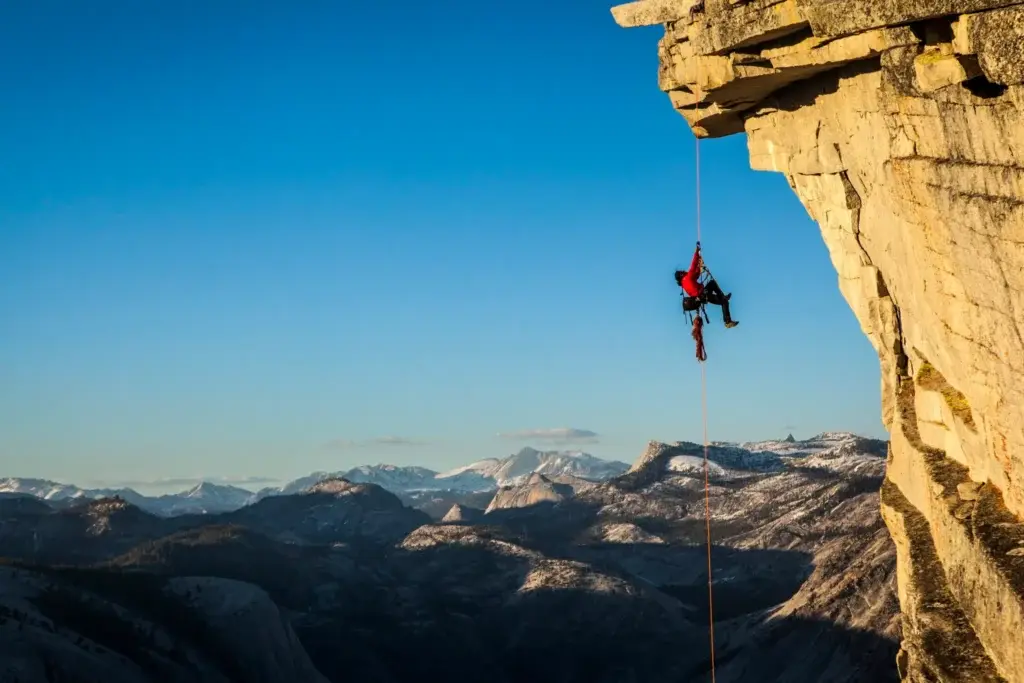
When you’ve put years into an objective and it’s within sight, and things aren’t right, it takes extraordinary discipline to walk away. On Meru we had seven days of food and were on the wall for 19. We crossed so many of our own lines, deliberately. You set a line, reach it, evaluate, set another. The more you do that, the more invested you are, and the harder it is to turn around.
You and the SEALs share a no-asshole rule. Tell me about that.
Chin: I asked Bill what trait gets people through training. He didn’t flinch: “Humor.” If a guy is getting his ass handed to him and he’s still cracking jokes, they’re not worried about him. It’s the same in the mountains. Humor changes the environment and brings you back to good, rational decisions. My selection process isn’t as serious as theirs, but these are the people holding a rope for you. You can’t have people who only think about themselves. And you can feel it. In conversation, it’s “I, I, I, me.”
Yvon’s Wisdom
Yvon Chouinard is the closest thing you have to a guru. He tells you, “It’s so easy to complicate your life. It’s so much harder to simplify it.” Have you managed it?
Chin: On expeditions, yes. That’s part of why I love them: the best version of me comes out. We’re brutal about simplifying, because every ounce counts. Everything is about efficiency, even how much stress you allow, even your heart rate. I can stay really calm in the worst situations. But if I can’t find my matching sock at home, it’s all over. In the mountains, when things are going sideways, I’m like, oh, this is casual.
You have kids. Do you worry about whether the wild places you’ve spent your life in will still be there for them?
Chin: It’s what the last pages of the book are about. I think of it with Yvon on one end and Kris Tompkins on the other. They’ve both had a tremendous impact on my life, and I’ve talked with both of them about this a lot.
Yvon always says, “Everybody has different tools. Whatever tool you have in your toolbox, whatever you’re good at, that’s what you should contribute.” It’s not only activism. His example is that if you’re an accountant, there are a ton of grassroots organizations that need accountants. So you ask: What can I contribute? Contribute what you have.
And what’s in your toolbox?
Chin: Storytelling, and a platform. That’s why I made Wild Life after Free Solo. I had the chance to finance a film about conservationists, which I probably wouldn’t have had otherwise. It’s about Doug and Kris Tompkins, who preserved something like 17 million acres over a 25-year dream of creating national parks. I’ve brought my kids down there. Those are the things I hope will make a difference: telling these stories, and putting them in a book. What Yvon and Kris have to say is so much more compelling than what I have to say about it.
