

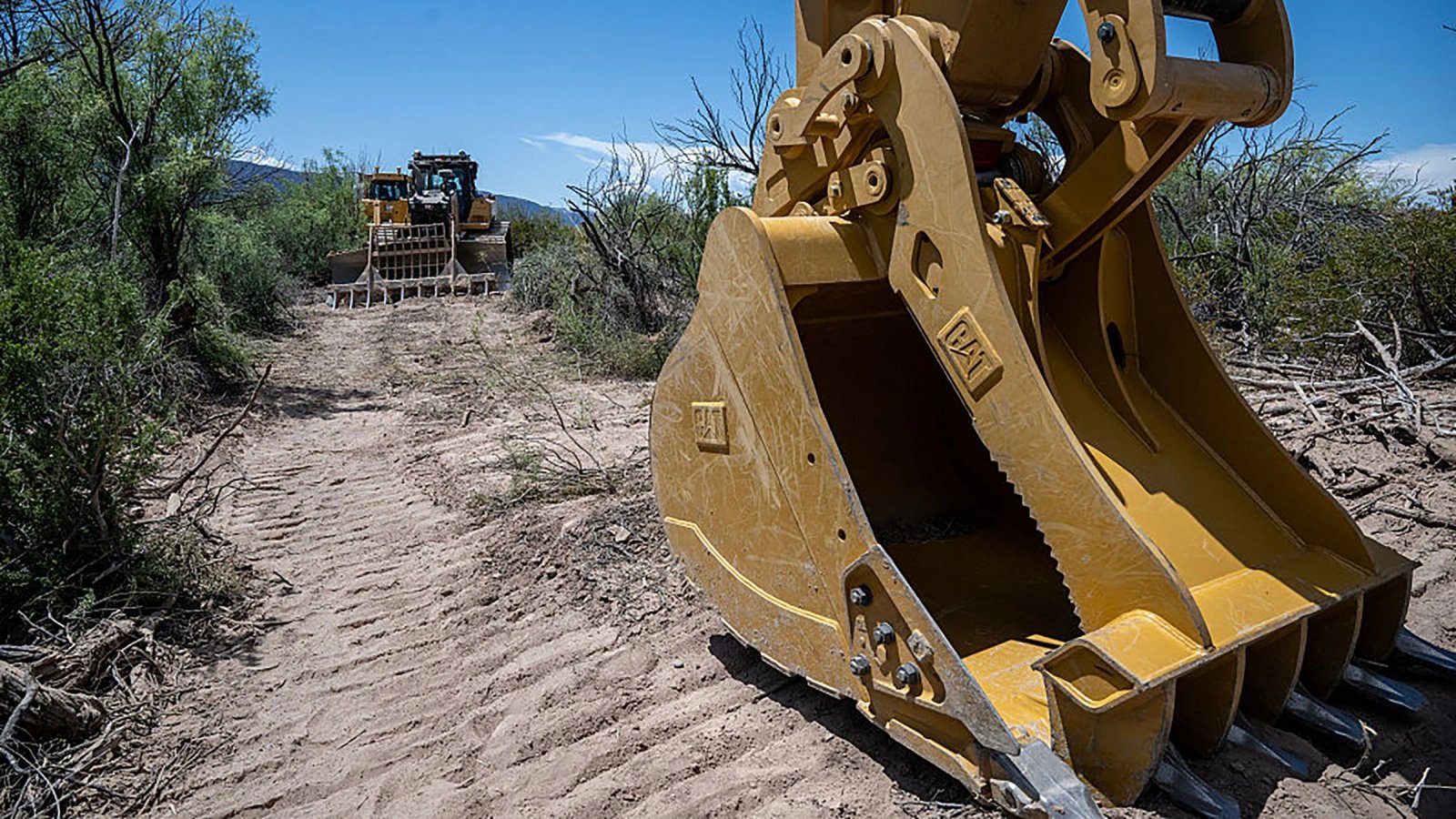
The Supreme Court ruled on November 9 that construction crews can resume the construction of barriers, fencing, and surveillance infrastructure through Big Bend National Park
Construction crews tear into Big Bend National Park to build the border wall (Photo: ONALDO SCHEMIDT / Getty Images)
Updated November 9, 2026 03:07PM
Bulldozers may soon tear into the rock cliffs and desert sand in Big Bend National Park to erect parts of the Trump Administration’s controversial border barrier.
On November 9, the U.S. Supreme Court gave the federal government the green light to resume construction on barriers, fences, and surveillance equipment along the U.S.-Mexico border in a remote corner of Texas that includes Big Bend National Park.
In an unsigned opinion, the court ruled that Congress has expressed “clear, preference for expeditious border construction.” The government’s desire to limit immigration overrules any “aesthetic, recreational, and environmental harm,” the court added.
The court ruled 8-1. Justice Ketanji Brown Jackson dissented with the decision.
The Center for Biological Diversity, one of the plaintiffs in a lawsuit that challenged the construction, blasted the decision in a statement.
“The Trump Administration and its contractors are hellbent on destroying one of America’s greatest national parks, and the Supreme Court just gave them the green light,” Laiken Jordahl, national public lands advocate at the Center for Biological Diversity, said on Facebook.
The ruling marks a groundbreaking decision in a months-long game of political football between the Trump Administration and a growing number of advocates, Texas locals, and lawmakers who opposed the construction.
Officials with the U.S. Customs and Border Protection and the Department of Homeland Security have said that the barriers along stretches of the Rio Grand and Big Bend National Park are needed to curb illegal immigrants from entering the U.S. from Mexico.
Advocates and local property owners in Texas have argued that the number of illegal crossings in the Big Bend region is negligible, and that construction would irreparably damage the pristine landscape, hurt local flora and fauna, and destroy local businesses that rely on the landscape for tourism and agriculture. In April, a coalition of opponents to the project filed suit to block the construction.
In August, construction crews arrived in the Big Bend region and began clearing swaths of desert for bollards and fencing. But construction ground to a halt after state politicians put pressure on Trump administration officials. And on October 2, a federal judge overseeing the legal case ruled that the construction should stop because it threatened to harm a group of plaintiffs who had sued to stop it.
The border wall plan drew ire from officials on both sides of the political spectrum. On November 9, Texas Senator John Cornyn, a Republican, published an op-ed in the San Antonio Express News titled “The Case Against the Big Bend Border Wall.”
“Texans should not have to bear another unnecessary financial burden caused by building a 30-foot wall atop a 1,000-foot riverbank cliff,” Cornyn wrote.
After the Supreme Court decision on November 9, environmental groups and other opponents voiced their disapproval on social media.
“We are outraged by the Supreme Court’s decision allowing Trump’s border wall construction to resume in Big Bend National Park,” the Sierra Club posted on X. “This destructive project threatens irreplaceable wildlife habitat, sacred cultural sites, and one of America’s most treasured landscapes.”
This is a developing story.
