

Updated November 12, 2026 03:08PM
As it turns out, it takes a lot to sink a 990-foot ocean liner.
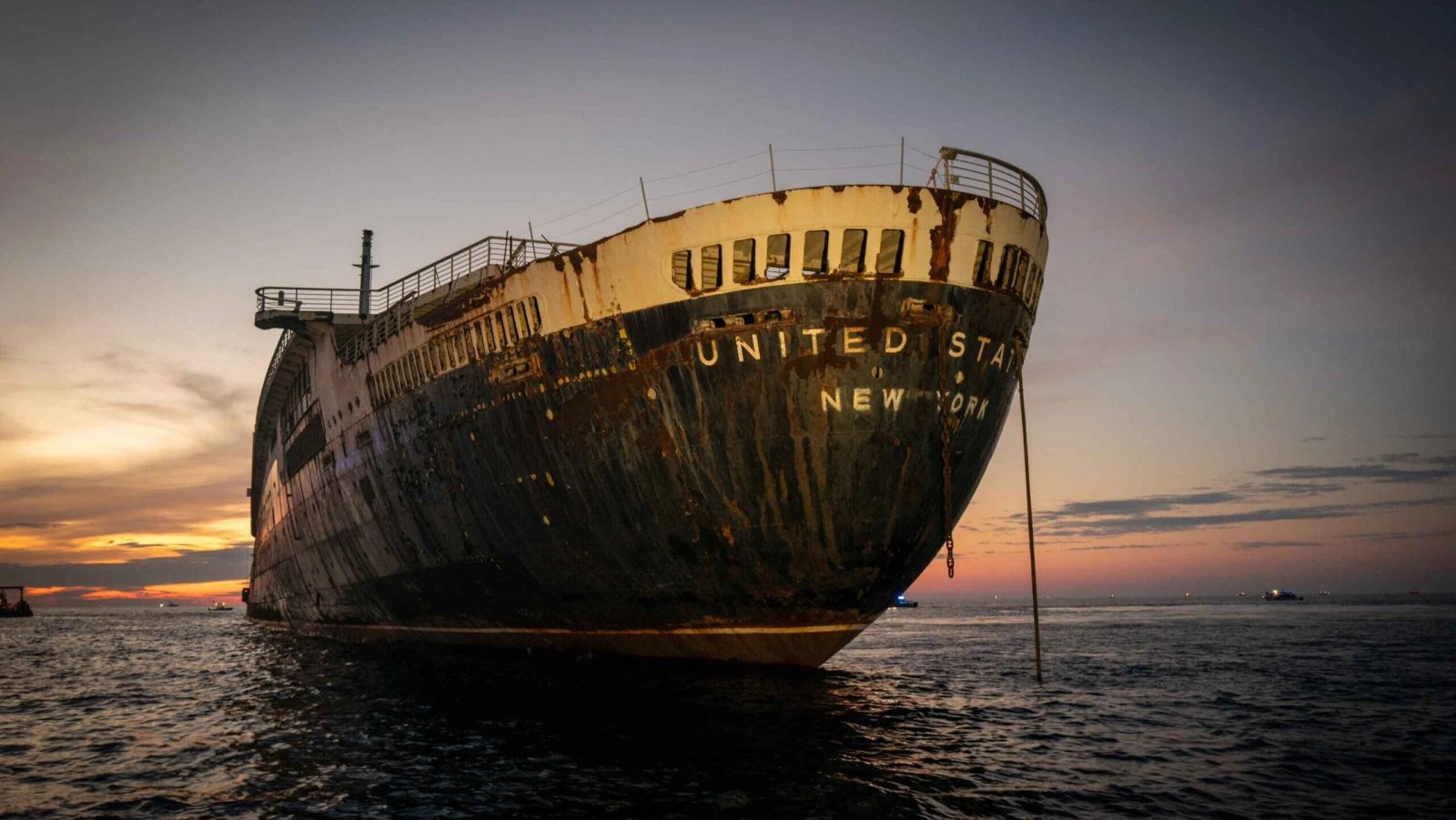
The SS United States was supposed to start going down at 1 p.m. Central Time on Wednesday, November 11. Last-minute preparations pushed that to nearly 5 p.m. By 4:45, every valve was open, and the Gulf was pouring in. Then came four more hours of watching a ship refuse to leave. She finally slipped under at 8:59 P.M., twenty-two nautical miles southwest of Destin, Florida, in the Gulf of Mexico, tilting hard to her port side.
From a nearby boat, I watched the fastest ocean liner ever built make the slowest exit imaginable. On her maiden voyage in 1952, she beat the Queen Mary’s record by about ten hours. On Veterans Day, the iconic ocean liner needed about four hours just to go under.
With this scuttling—a deliberate, controlled sinking—the SS United States becomes the world’s largest artificial reef, surpassing the USS Oriskany, which had held the title since its 2006 sinking. It’s a second life that’s part habitat project and part tourism bet, and it follows years of failed rescue plans and a last-minute court fight.
Here’s how a ship once meant to become a museum ended up on the Gulf floor, what it means for the sea around her, and what divers can expect when they finally get to explore her underwater.
The World’s Largest Artificial Reef Now Rests Off Florida
Why sink her off the Florida Panhandle? Habitat and tourism. The seafloor off Destin and Fort Walton Beach is mostly sand and shell, and natural reef is scarce. Okaloosa County’s tourism department laid out a five-year, $12 million plan to make Destin-Fort Walton Beach the dive capital of Florida, with part of the money coming from tourist-development tax revenue. Visit Pensacola and the Coastal Conservation Association’s Florida chapter signed on as partners. Part of that money funds a multiyear marketing campaign to promote the ship as a diving destination.
The SS United States is also slated to join the Florida Panhandle Shipwreck Trail. The state created the trail in 2012 to stimulate tourism, after the Deepwater Horizon oil spill. It began with twelve wrecks off Pensacola, Destin, Panama City, and Port St. Joe and has since grown to more than 20. Divers collect passport stickers at each one. These 20 ships are among 48 large vessels sunk by the county since the 1970s.
The SS United States now rests in about 180 feet of water. If she landed upright, as early sonar scanning indicates, her upper decks are roughly 50 to 60 feet down. The county says divers of all skill levels can reach the upper decks.
Why Was the SS United States Sunk Off Florida?
While there were once dreams of converting the 990-foot icon into a hotel or museum, she deteriorated to the point that the options came down to the scrapyard or an artificial reef.
The liner was abruptly withdrawn from service in 1969. She later spent nearly thirty years docked in Philadelphia, where no one managed to repurpose her.

For decades, owners kept hunting for the ship’s second act. In 2016, Crystal Cruises studied a return to sea and called the obstacles insurmountable. By the time a rent fight got the historic ship ordered off a Philadelphia pier in 2024, the nonprofit that owned the vessel says it was left with two options: scrap or “reef her”. Preservationists argue a museum ship was still possible.
The conservancy ultimately sold the liner to Okaloosa County, Florida, for $1 million. The county has spent a total of more than $13 million getting it ready to scuttle—remediation, towing, insurance, deployment—and contributing toward the yet-to-be-constructed museum dedicated to the ocean liner. The county’s tourism director calls the project an economic development opportunity and an environmental asset. Its tourism director told NPR the county expects to make back its investment in a couple of years.
A last-minute lawsuit nearly stopped the sinking. The SS United States Preservation Foundation sued the Army Corps of Engineers in federal court in Pensacola on November 3, arguing the agency failed to adequately weigh the ship’s toxic coatings under federal environmental law. Three days later, a judge denied the emergency request to halt the sinking, citing the lack of an affidavit and the cost of an injunction. An earlier suit from a separate New York group had already been dismissed in 2025.
Is Sinking a Ship Good for the Environment?
On the whole, scuttling (or initially sinking) a properly cleaned vessel can house a new ecosystem for fish and other oceanic life. Crews drained and cleaned the fuel tanks of the SS United States, and no explosives were used. The county says it removed 99 percent of the PCB-containing materials, though nobody outside the project has independently verified that number.
The open question is the old zinc-chromate primer, which contains hexavalent chromium. Those who still wanted the ship preserved topside say it will leach. The county says it converts underwater into a less toxic form. A Drexel oceanographer called the risk “a little overblown,” while saying he’d still prefer mitigation. The Oriskany, another purpose-sunk vessel off the coast of Destin, which held the title of world’s largest artificial reef until Wednesday is a cautionary precedent. It became a thriving reef, but monitoring also found elevated PCBs in some of its fish.

How Do Artificial Reefs Help Marine Life?
Algae, barnacles, and sponges settle on the steel first. Corals can follow, then small fish, then the predators that hunt them. Woods Hole Oceanographic Institution is tracking the process at about 132 tagged spots on the wreck, with a goal of acquiring ten years of data.
Scientists still argue about whether reefs create new fish or just concentrate existing ones for anglers. Gulf red snapper research leans toward creation, though it comes mostly from oil platforms and smaller reefs, not one giant ship.
One more caveat: this is new habitat, not restoration. It was sunk in an area that was mostly sand, so no existing reef habitat was disturbed or restored. This is a net-new ecosystem for the region.
What Happens Next?
The iconic ship’s two sixty-five-foot funnels, propeller, and radar mast are headed to a land-based museum near Destin. Everything else now belongs to the Gulf.
Like the other divers who attended the sinking, I was hoping to dive it within the first 24 hours. But the rough conditions forecast for today, which pushed the sinking up one day, also kept us out of the water. I’ll be back as soon as I can to skim above the deck, but the bragging rights for the vessel’s first recreational dive are still up for grabs.
How to Dive the S.S. United States
The exact date divers will have access to the new dive site is still unknown. Safety divers must clear the site before recreational divers are allowed.
Local charter operators are hoping to head out as soon as Friday. Niuhi Dive Charters says divers from all over the world have already signed up.
The county says her top deck, anticipated to be at 55 to 60 feet, is accessible to all levels of certified divers, which makes an Open Water certification the entry ticket. If you want more than a look at the top, Advanced Open Water, with its 100-foot-limit, is the better choice, and charter operators set their own requirements. Wreck and Nitrox certifications are smart additions. The lower decks belong to technical divers with decompression and trimix training.
Plan on a full day offshore. She’s about twenty-two nautical miles southwest of Destin-Fort Walton Beach, and Destin is the closest launch point. Divers can book through Niuhi Dive Charters or ScubaTech Destin, which runs daily Gulf charters aboard the Sea Cobra.
Alexandra Gillespie is the former digital editor of Scuba Diving magazine. With nearly 200 dives under her weight belt, and has covered scuba diving and marine sustainability for Outside, National Geographic, U.S. News and World, NPR, BBC, and other major publications. She’s gone diving everywhere from California’s kelp forests to Bahamian reefs to Sudan’s Red Sea.
