

Published November 17, 2026 03:09AM
“WE ARE VERY close to being able to see Carroll Crater!” Christina Koch shouts across the campground, glancing up from her moonscope.
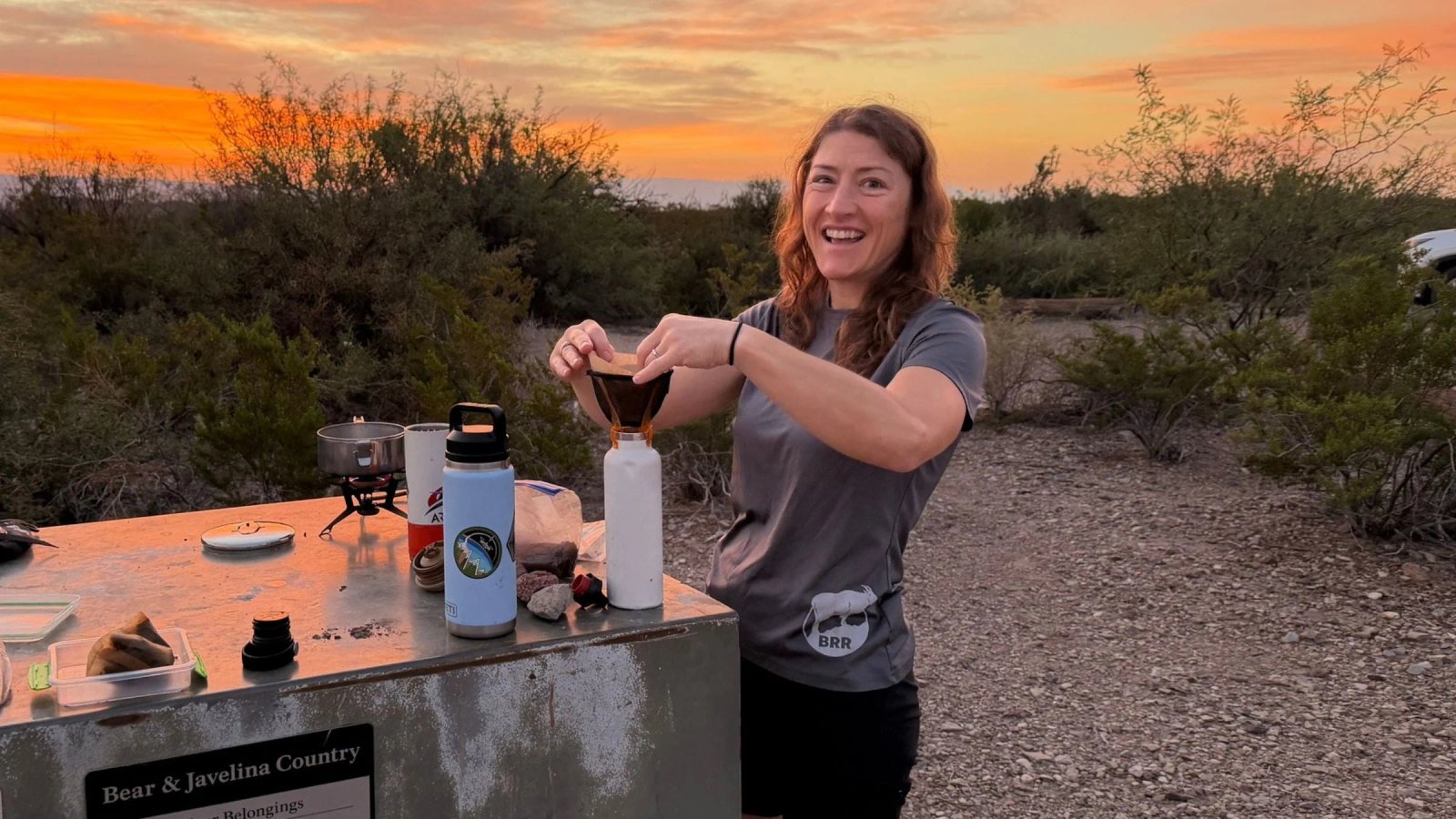
The NASA astronaut is bent over a small tube that looks like a telescope, attached to a tripod. A nearly full moon illuminates her curly hair, with her tent and a field of scraggly creosote bush behind her. The Big Bend National Park campsite is large enough to sleep eight people, but it’s just the two of us here tonight. Even at 10 P.M., the temperature hovers in the mid-70s. It’s already past my bedtime, but Koch and I came to the park to witness what happens in the sky after dark.
“If you look to the lower left, there’s a dark spot, almost like a mole. Carroll Crater is a little up to the left of that,” Koch says as I bend down to look through the lens, the dark splotches of the moon suddenly massive and detailed to my right eye.
Koch and the other three astronauts on the 2026 Artemis II mission named Carroll Crater after colleague and mission commander Reid Wiseman’s late wife. Mission specialist Koch, Wiseman, pilot Victor Glover, and mission specialist Jeremy Hansen made history in April 2026 when they completed a ten-day-long mission around the moon, traveling a record-setting 252,757 miles from Earth, livestreaming the event, and going viral along the way. It made Koch the first woman to travel around the moon, adding another record to her list, which also includes the longest spaceflight by a woman (328 days throughout 2019 and 2020), and embarking on the first all-women spacewalk on October 18, 2019.
FIVE MONTHS AFTER the Artemis II crew touched down in the Pacific Ocean, Koch and I met in Big Bend to go on our own small mission: nighttime photography. Last night, September 26, was a full moon, and it still looks massive, bright, and round above the Chihuahuan Desert tonight. The only way you can tell it’s no longer full, Koch tells me, is that you can spot a little bit of the Terminator in the upper right corner. The Terminator, the line that divides the side of the moon that’s glowing from the one going into shadow, looks like a sliver of darkness that shifts the moon’s craters into 3D.
“Imagine seeing that when it’s literally this big in your view,” Koch says, holding her hands wide.
We’ve spent the evening on a couple-mile hike and scramble up to Balanced Rock to photograph the stars and moon. Balanced Rock is a massive boulder suspended between stacks of rocks on either side so that it appears to hover above the ground. Sitting next to the boulders, Koch set up her tripod and snapped shots of the massive, orange moon rising and the stars sparkling above the syenite rock formations. She even managed to capture the shooting star we both spotted streaking above.

Photography is her hobby, she tells me. She’s been taking pictures since she did so for her college paper at North Carolina State University, from which she holds multiple degrees in physics and electrical engineering.
Her love of photography came in handy for her space missions. NASA, which features an entire photography training team, worked with Koch and the rest of the Artemis II crew ahead of their historic trip to optimize documenting photos of the moon and Earth from space. They had to learn how to use a wide lens as the Artemis II crew occupied a very small vehicle, how to use the proper f-stop and shutter speeds, and how to take more technical photography, too, to report back on anything that appeared broken and other details for the on-the-ground engineers.
Photography wasn’t the only arts-based training the Artemis II crew took on prior to their mission. The four astronauts decided to seek out and collaborate with a poet to assist them in better describing what they saw in space. Koch still trains with the poet today. “He helps me a lot with metaphors and language, but also just seeing the beauty in things,” she says.
The crew’s holistic approach is, in many ways, different from how older generations of astronauts prepared for space travel. The Apollo Generation, which included astronauts like Neil Armstrong and Buzz Aldrin, who became the first people to walk on the moon in 1969, focused on thousands of hours of moonwalk and lunar surface simulations and reduced gravity training. While practical, technical skills were vital to the Artemis II astronauts, too, they also concentrated heavily on team dynamics: the crew embarked on a National Outdoor Leadership School (NOLS) trip together, a common practice today for NASA teams. “We made so many commitments to being a crew that loved and trusted each other,” says Koch. “NOLS was one of the things that we did when we learned a lot of those actual skills to keep us in a good place and keep us friends.”
Another focal point for the Artemis II crew was learning about the meaning behind their destination. “We worked with cultural experts on the moon and tried to cultivate a deeper understanding of the many facets of where we were going, not just the scientific ones,” says Koch.
But for the differences in training approaches and communication styles throughout history, the narrative around space exploration has, in many ways, remained the same. “Beautiful concepts like love and peace, and going for all of humanity, those have always been a part of it,” says Koch. “There is almost no one who went [to space] and didn’t have beautiful things to say.”
AFTER A COUPLE of hours taking pictures near Balanced Rock, Koch and I are back at camp, eating dinner under the moonlight. She’s cooked up some simple couscous on a backpacking stove and finishes it with a handful of pine nuts.
“This is how low-key I am,” says Koch, gesturing to her pot. “It’s practically plain couscous, and I’m so excited for it because I was such a dirtbag backpacker for so long. This is very standard and kind of nostalgic.”
Over the years, Koch, who’s 47 years old, has developed an arsenal of dirtbag and outdoors skills. She’s an accomplished climber—mostly sport, trad, and ice—and skis both downhill and cross-country. Despite growing up near the ocean in North Carolina, where her dad taught Koch and her four siblings how to sail, she didn’t begin surfing until her mid-thirties; now it’s one of her favorite sports. She also loves trail running, but after struggling with hip dysplasia for years (the trip to Big Bend was a few months after she had a hip replacement), Koch took up triathlons instead to balance out the running with cycling and swimming. In order to do so, she had to learn to swim distances, which she tackled in her mid-forties. “It took me like two years to learn to swim. I’m very uncoordinated,” Koch insists.
One of Koch’s biggest adventures, outside of the Artemis II mission, took place in 2006 when she and some friends climbed Mount Kenya. The group ascended the 17,058-foot mountain, which requires technical climbing to reach the highest summits, without a porter. The first night camping on the trip, Koch opened the door of her tent after hearing a strange noise; a sea of glowing eyes reflected back at her as a herd of wild buffalo passed by. “I was like, ‘We’re going to get trampled and die,’” she says.
Luckily, the herd moved on without incident, but Koch had another problem: she quickly realized that she hadn’t packed enough food for the ascent. That same night, a ranger came by and had cut his finger very badly but didn’t have a way to sew up his wound. Koch and her friends had a first-aid kit on hand and helped patch up his injury in exchange for a can of beans.
The beans, along with the food she did pack, helped fuel her through the week-long backpacking trip, in which she and her friends carried a lot of weight, hauling their climbing gear up to the technical section of the mountain. While they didn’t make it all the way to the summit they were targeting, they did climb for a stretch of it. “We made it higher than you could walk up,” says Koch.
Coming off the mountain, though, the climbers were out of food and cash, and rather than hike another eight miles, they managed to scrounge together their very last coins to ride a bus back to town. “I must have lost so much weight,” she says. “My pants were hanging off of me, and we were very hungry.”
But they arrived at their target hotel safely and used their credit cards to book a room. “I will never forget the next morning we were eating at an all-you-can-eat breakfast buffet,” says Koch. “It was the funniest dichotomy of going from really feeling like we were at the end of our line, coasting out on fumes, to being completely OK and in the borderline lap of luxury. It was just so ridiculous.”
Professionally, Koch spent several years of her early career traveling to remote, isolated landscapes, conducting scientific research. She always wanted to be an astronaut, but wasn’t interested in pursuing the typical paths astronauts often follow, such as obtaining a degree in aerospace engineering or getting a pilot’s license. “I want to be in nature, not flying over it, so that was just never a hobby that really called my name,” she says.
So while Koch has dreamed of being an astronaut since she was a child, she wasn’t going to give up her interests to pursue some kind of checklist to become one. Instead, she followed her passions for science and nature into often harsh environments. She worked as a research associate for Raytheon Polar Services, stationed in Antarctica, where the area closes down for months at a time due to extreme cold and darkness. “There’s no mail, no fresh food, no people in or out for eight months,” Koch says. “That was something I went and did when I was 25.”
She also worked as an electronics and instrument technician in Greenland, Alaska, and again in Antarctica before traveling to American Samoa in 2012 as a station chief for the National Oceanic and Atmospheric Administration (NOAA). It was there, while stationed in American Samoa, that she met her husband, Bob Koch, who at the time was working as a GIS coordinator.
During a time before smartphones and internet access were a given, Bob quickly figured out that Koch drove by a favorite surf break of his 45 minutes east of where he lived on her way to work each morning. So Bob asked Koch to take a photo of the surf on her commute, and then send it to him over the reliable internet at her laboratory. “She was my surf report buddy, and then obviously things took off from there,“ says Bob, who now works for the Army Corps of Engineers. “We called it Peter Pan Island.”
Not long after meeting, Koch decided to apply to become an astronaut, and when she was accepted in 2013, she and Bob moved to Houston, Texas, where NASA’s Johnson Space Center is based and where the couple now lives with their dog, Sadie. “Going from a full-on dirtbag lifestyle to the most regimented, military-like astronaut training, with these requirements and proficiencies, was like whiplash for me,” says Koch, who used to view more conventional career paths as selling out or growing up. “Everything I did was towards free time and the outdoors and very minimal requirements in life.”
But her thinking soon shifted as she embraced her new job. “I used to think that all of these people working really hard don’t know what life is really about,” she says. “And then I realized, actually, maybe it’s totally OK to work really hard for something and make a difference.”

WHEN ARTEMIS II launched into space from Florida’s Kennedy Space Center on April 1, 2026, the four crewmembers had prepared themselves, each other, and their loved ones for the risks and reality of the adventure they were undertaking. In preparation, the Kochs bought a Sprinter van.
“[Bob] was trying to figure out what do you do when your wife goes to the moon?” says Koch. “You can’t go to work; you’re not going to be able to concentrate. If you’re sitting at home, you’re going to be worried. So he organized a road trip with his friends.”
Bob devised a plan: Mission Break 80, in which he and his friends would golf and surf their way from Florida, where Artemis II launched, to San Diego, where the crew was set to land. They’d camp along the way in his new van, which proudly displayed an Artemis II magnet. As a joke, Bob created Mission Break 80 patches to match. And while he only made it as far as Houston in the van, the distraction largely worked.
“Going surfing every morning took me away from my phone for two hours, or the act of setting up camp and being outside just created a calming effect,” says Bob. “That was my way of coping with the mission: actually spending time outdoors, away from devices, but just close enough in case I needed to get a call.”
Bob got two half-hour calls with Koch during the mission, one on day three and the next on day seven. He took the first call from the beach with wet hair and waves in the background.
One thing the crew and their families had not prepared for was how many people would watch the Artemis II mission worldwide. “Moon joy,” the excitement of the 2026 orbit, as it was dubbed, went viral. NASA reported more than 149.4 million views of the launch, splashdown, and lunar flyby on its own platforms alone. An estimated 400,000 people gathered in person to watch the launch in Florida, according to Smithsonian Magazine. “They kind of caught lightning in a bottle,” says Bob. “I think it was a combination of the synergy of the crew collectively and all their unique personalities and kind of how they played off each other. And I think it was just some timing where people really wanted a positive story that they could follow and all rally around.”

While #moonjoy was trending on every social platform, Koch and the rest of the Artemis II crew were oblivious to the buzz on the ground. “We never dreamed it would become what it was,” says Koch. “We actually might never know what happened on Earth while we were gone,” she continues. “Earth had a party for us, and we weren’t there.”
On the second of their two allotted calls, Bob realized he had to let Koch know how popular the mission had become. He told his wife that she and her colleagues were inspiring people down on Earth. “I told her how proud I was and how inspirational she and the crew and mission were,” he says. “I remember she teared up.”
Koch remembers the call vividly, too. “He was like, ‘Tina, I need to tell you something. Something is happening down here. You guys are having an impact. You’re moving the needle,’” she recalls.
“It’s funny because when you cry in space, your tears well up in your eyes, and they just stay there,” says Koch, explaining that the lack of gravity makes it so that tears don’t fall. “I was wiping my buoyant tears, and I was like, ‘That’s all we ever wanted…’ When we designed our mission patch, it was ‘A II;’ we made it look like the word ‘all.’ That was our goal: for all.”
IT’S NEARLY NOON and the sun is blazing in Balmorhea, Texas. Koch and I just met up to cool off in the world’s largest spring-fed swimming pool, a 1.3-acre body of brisk water in the high desert of West Texas. We’re taking a dip with the locals—kids splashing and shrieking with delight, groups of women floating on inner tubes, and a handful of scuba divers—before driving out into the 91-degree desert to hike and camp.
As we chat and tread water, I glance down to see schools of fish darting around our legs. “Sometimes they bite,” Koch told me earlier, “which is kind of fun!”
If I look long enough, with a little luck, I might even see a turtle, one frequent swimmer mentioned when I arrived. Koch says she spotted them last time she was here on a van trip.

“I’m going to go do some laps and look for turtles,” she tells me, snapping on her goggles and doing the breaststroke over toward the deep end, which reaches 25 feet.
I follow her, trailing behind, gazing into the sparkling, royal blue water. Behind me, a group of teens is taking turns launching off a diving board, and a small family is gearing up to scuba dive. We’ll need to head out soon if we want to snag a camping permit before the park’s visitor center closes. Koch knows it’s time to get going, too.
“I’m just going to jump off of the high dive one time before we go,” she announces, making her way to the opposite side of the pool. As I watch, she climbs out and walks briskly to the edge. She hesitates briefly as she eyes the water below. Then, she jumps, suspended in space for just a moment before she splashes back down to Earth.
Abigail Wise is the brand director at Outside. She’s been fascinated with space since her mom sent her to a science space camp one summer in elementary school. These days, she’s been known to drag her own kids out to watch meteor showers in the middle of December near their home in northern New Mexico—and insists it’s worth every whine.
This article is from the Winter 2026 issue of Outside magazine. To receive the print magazine, become an Outside+ member here.
