

Published November 18, 2026 05:32PM
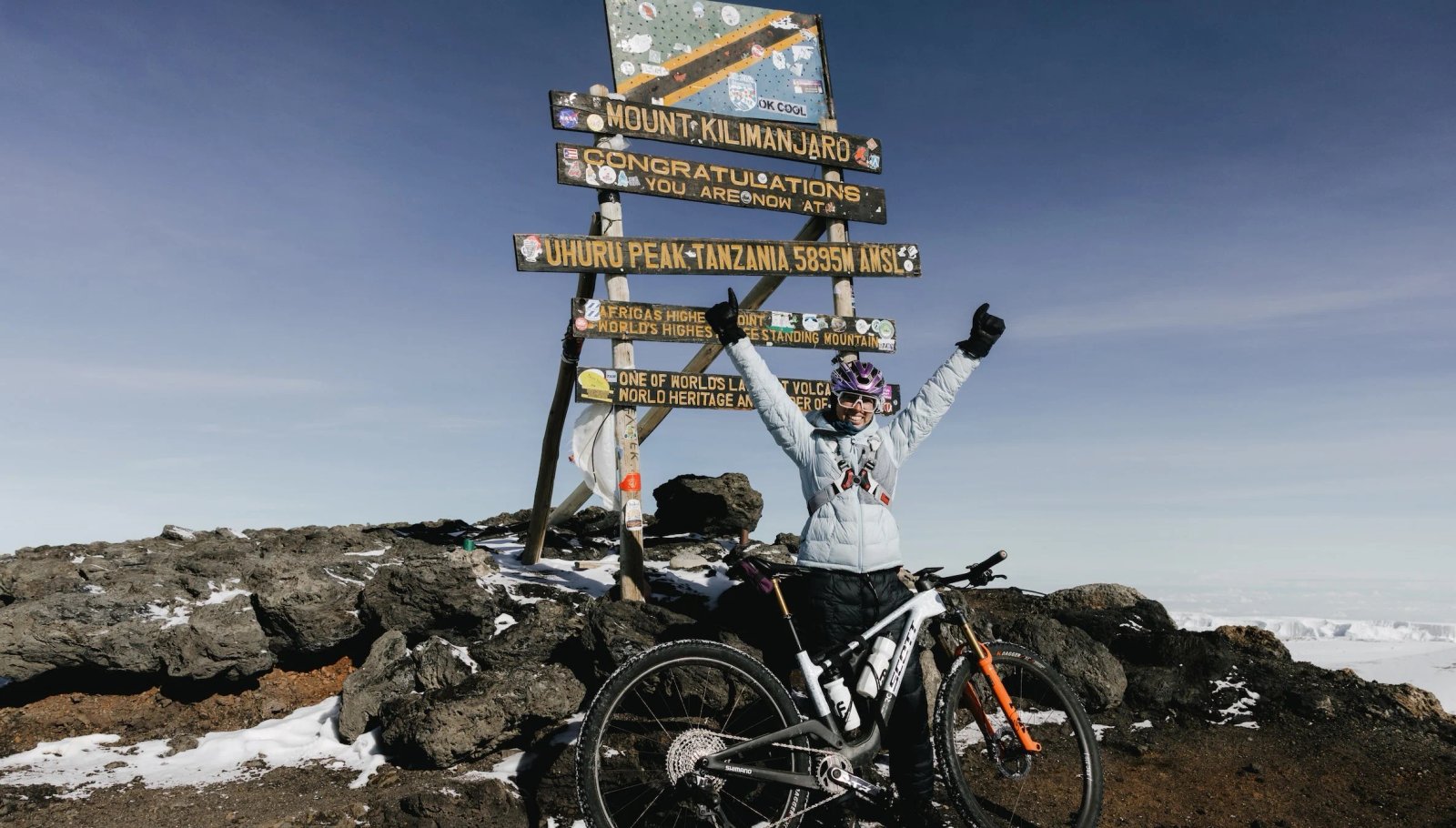
By the time professional mountain biker Hannah Otto, 30, reached the final miles of her descent from Mount Kilimanjaro, 19,341 feet, she had already navigated the mountain’s most punishing terrain. She’d hauled her bike up snowy slopes, scrambled over boulders at 18,000 feet, and ridden steep, rocky trails where softball-sized stones shifted beneath her tires. Now she was on a rainforest dirt road easy enough to ride on a gravel bike.
On November 3, Otto became the first known woman to ascend and descend Africa’s tallest mountain with a bicycle in a single day. She completed the effort in 10 hours, 18 minutes, and 51 seconds, despite breaking her leg just two miles from the finish.
“I came around a gentle bend in the trail, and the trail went from dry dirt to mud, and it was like I hit ice,” Otto told Outside. “The bike just came out from underneath me, and I was on the ground in a second.”
The fall had broken her leg. But two miles from the finish, she got back on her bike and rode out.
The attempt was also part of a fundraising campaign for World Bicycle Relief, a nonprofit that provides bicycles to improve access to education, healthcare, and employment. Otto hopes to raise $165,000 to provide 1,000 bicycles to rural African communities.
The Climb
Otto’s ride established the first known women’s time for a single-day bicycle ascent and descent of Kilimanjaro. Canadian mountain biker Cory Wallace completed an ascent and descent in 8 hours, 55 minutes in 2022, but no verified women’s time had been recorded before Otto’s attempt.
Otto, who has raced mountain bikes for 21 years, spent months preparing for the altitude and dramatic changes in terrain. Kilimanjaro rises through rainforest, heath and moorland, and alpine desert before reaching its snow-covered summit. Otto said temperatures ranged from about 70 degrees Fahrenheit near the base to 10 degrees near the top.
She trained as often as possible above 10,000 feet in Utah’s mountains, scheduled races at higher elevations, and added heat and sauna sessions to her routine. She also hiked on a steep treadmill with a sandbag on her back to train for carrying her bike.
After seven days acclimatizing on Kilimanjaro, Otto returned to the base, rested a day, and started her single-day attempt at 3 a.m. with a support team that included her husband, a film crew, and local Tanzanian guides, aiming to beat the afternoon storm
At about 15,500 feet, the terrain became too steep to pedal. Otto strapped her bike to her back and spent three and a half hours hiking three miles up snow-covered slopes approaching a 40 percent grade. Near 18,000 feet, she scrambled over large boulders with her hands, the bike still strapped to her back.
“With every 1,000 feet up the mountain, it felt like the bike gained five pounds,” she said.
Otto had planned three different ways to carry the bike, rotating between them for relief. Meanwhile, the altitude shortened her steps, raised her heart rate, and made every stumble harder to recover from.

Two Miles Out
Snow began falling just as she reached the summit. After hiking down the first steep section, she got back on her bike, thinking she’d beaten the worst of the weather. But rain had soaked the rainforest trails below.
After the crash, Otto tried twice to stand.
“I watched my leg go in two completely different directions, and it was the most painful thing I’ve ever felt in my life,” Otto told Outside. “Both times, I fell to the ground screaming.”
Her nearest guide was about 15 minutes behind her and could radio for a one-wheeled stretcher to carry her out. At first, she waited for help.
But as she lay there, supine on the muddy floor of the Tanzanian rainforest, Otto told Outside that she imagined herself at 60, explaining that she’d been physically capable of finishing but had fallen short because of an accident. At the time, the thought made her sick. Living with that disappointment, she decided, would hurt worse than whatever her injured leg might put her through on the way down.
She army-crawled through the mud to retrieve her bike, used it as a crutch to stand, lowered the dropper seatpost, and draped her chest over the saddle to shimmy into a seated position.
Most of the remaining trail was downhill, allowing her to coast. Still, every bump sent pain through her broken leg. She used one hand to lift the injured leg onto the pedal for support, then moved it out of the way to pedal uphill with her good leg.
“There was also a piece of me that was riding out of fear and survival, even though it was excruciating,” Otto said.

Across the Line
When Otto finally reached the finish, about 20 Tanzanian team members sang, danced, and clapped as she approached. They knew she’d summited, but nobody had told them about the crash. As soon as they saw her condition, the celebration stopped.
Within minutes, the team had loaded her into a vehicle for the 45-minute drive over rough roads to the nearest hospital, where X-rays confirmed the break.
Rather than undergo surgery in Tanzania, Otto made the roughly 30-hour journey home with her broken leg. Back in Salt Lake City, she underwent surgery for two tibial plateau fractures and an associated ACL injury. She expects eight to ten weeks without putting weight on her leg, but hopes to return to racing in April 2027.
Despite the injury, Otto said the experience has changed how she thinks about her own abilities.
“Now I feel like I have this story and this moment that I can always lean back on and be like, ‘You are so tough, Hannah,’” she said. “For me, that is the most reassuring thing that I could gift myself.”
