

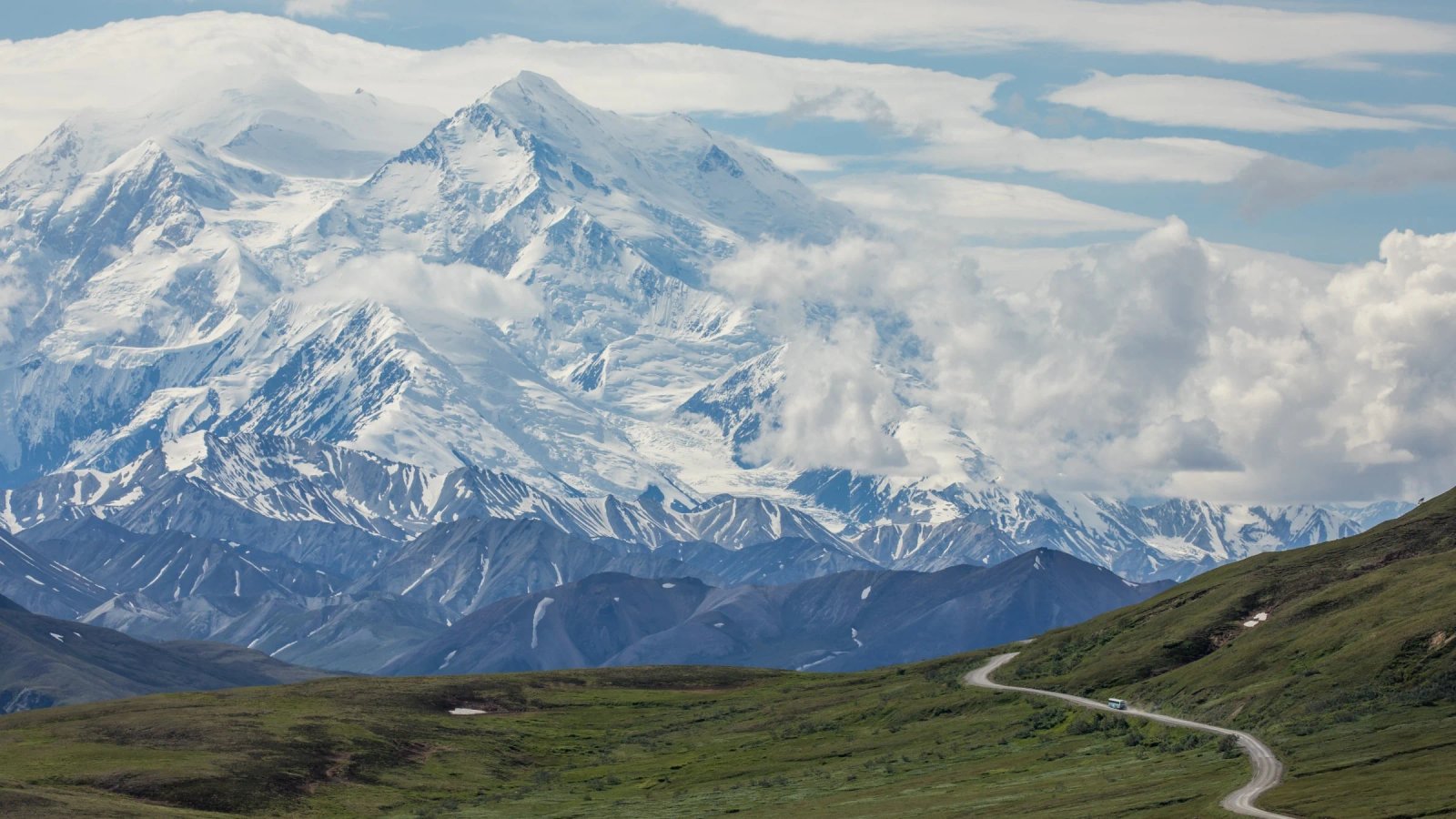
For six years, a landslide cut off the back half of Denali National Park. With the $230 million Pretty Rocks Bridge now complete, the park’s wildest stretches are back within reach. Our senior travel editor reports on what it’s like to travel the full road once again.
The single road in Denali National Park winds through the heart of the park and ends in the remote historic mining town of Kantishna. Hikers and cyclists are now able to cross the newly completed Pretty Rocks Bridge, and full public park bus service is set to resume in 2027. (Photo: Pursuit)
Published November 20, 2026 02:10PM
“Bear! On the left!” I jolt forward from the front passenger seat to find where our driver has spotted a grizzly on the open tundra. On a steep slope covered with birch trees, pops of autumn amber and rust scattered against green spruce trees, I can make out a moving boulder—then I spot its golden blonde fur. Olivia Juarez, general manager of Denali Backcountry Lodge, tells me it’s the signature coat of Denali grizzlies. Juarez is driving three of us, including her dog, on the entire 92-mile nearly unpaved stretch of the Denali Park Road, which feels precarious at times due to two-thirds of it being only one lane. But the speed limit is 35 mph, and we are the only ones on it.
For the last six years, this mostly gravel mountain corridor—the only road through Denali National Park and Preserve—has been closed after mile 43 due to a landslide. But in time for the 2027 summer season, access to the full 92 miles will reopen, allowing visitors to explore the depths of Denali’s backcountry once again.
Juarez slows the van to a stop, and we pass around binoculars. The grizzly is far in the distance, but it’s what surrounds it in every direction that catches my breath: striking volcanic cliffs in a kaleidoscope of earthy hues and gravelly, braided glacial streams stretching across an endless expanse of wild. It’s only us on the road, and this grizzly out yonder, for as far as we can see. And out there, somewhere hidden under a cloak of clouds, is Denali, or The Great One, as the peak’s traditional name translates from the Koyukon Athabascan language.

An Engineering Feat
On September 2, 2026, the long-awaited Pretty Rocks Bridge in Denali National Park was completed, an architectural marvel that bypasses the still-active landslide. At 475 feet long and 24 feet wide, the steel single-span truss bridge is just wide enough for a park bus to drive through.
This $230 million federal project includes 23 underground thermosiphons—a passive cooling technology that pulls heat out of the earth to keep the permafrost frozen year-round. Pedestrians and cyclists are currently permitted to cross, with full bus and vehicle service scheduled to resume in 2027.
I’ve spent the last four nights at Denali Backcountry Lodge, a remote all-inclusive outpost that sits at the end of the road. I flew in via a 45-mile helicopter ride, the only way guests can reach the property since the landslide. The lodge is the farthest place you can stay and still be in the park. We spent our days hiking through the spongy tundra, exploring the history of the Kantishna mining camp, and kayaking Wonder Lake with Denali in the background, a coveted sight since it was photographed by Ansel Adams on a rare cloudless day in 1947.
Since the road closure, no one other than guests staying at the three remote wilderness lodges has been able to visit these iconic areas of the park. While Denali Backcountry Lodge offers a chance to truly settle into the wild, all the excitement is found along the road. That is, nearly all our wildlife sightings (except for a grizzly sitting atop its moose kill spotted in the distance on one of our guided hikes) happened on a drive: a trio of caribou running, a moose moving through the willow marshes, a porcupine waddling across the road, a bear cub prancing out from the shrubs.
Starting in 2027, visitors will finally be able to reach the end of the road again on a Denali park bus. Guests staying at Denali Backcountry Lodge will arrive and depart via a private bus next year, and their Creekside Cabins guests will take a private bus in and fly out on a single-engine bush plane. Day guests will be able to reach the end of the road and book a guided experience at Denali Backcountry Lodge.

More travelers returning to Denali’s backcountry means there’s more opportunity to transform them into stewards of this land. “Visiting a place like this is life-changing for people,” says Alexa Donahe, vice president and general manager of Pursuit’s Alaska Collection, which includes Denali Backcountry Lodge. “Day traffic allows for more people who don’t have the time or resources to have an immersive backcountry experience like this and to experience the depths of the wilderness for a day.”
Even with more visitors coming in by bus, it will still feel remote, says Donahe. There will be strict park (and lodge) restrictions to preserve the landscape and wildlife. For comparison, more than 4 million people visit 2.2-million-acre Yellowstone yearly, with easy road access for private cars. Only 500,000 people visit Denali each year, but at 6 million acres, the park is the size of Vermont.
Sure, there are more people gathering at the park entrance, where you’ll find a visitor center and the famous Denali sled dogs, but once you reach the dirt road, it feels as remote as ever.

A Glimpse of the Great One
Only about 30 percent of visitors to Denali National Park and Preserve get a completely clear view of the peak. An even smaller subset—fewer than ten percent—experience a completely cloud-free, base-to-summit view. Visitors who stay multiple days (such as four days in Kantishna) see the mountain at much higher rates, around 85 percent. Because the massive 20,310-foot peak creates its own local weather system, heavy cloud cover frequently obscures the summit, especially during the summer tourism season.
One morning at breakfast, a group of Natural Habitat guests wait out bad weather to depart. Their expedition leader Samantha Strauss shares with me her thoughts on the fully opened Denali. “For every person who comes out and sees this place, that’s one more person that cares about public lands. Especially right now, public lands are not promised to us,” she says. “Even if that means I have less square mileage allotted just to myself, even if that means I have to share this space with more people, it is a conservation win because it helps people create a connection to the landscape and have a stake in its future.”
I flew over Denali National Park in a helicopter and left on the Denali Park Road, just days after the Pretty Rocks Bridge bypassing the landslide was completed. Both ways gave me different perspectives on this vast, 6-million-acre expanse of raw wilderness.
While it was thrilling to soar over glaciers and peaks, it was seeing Denali from the ground, my eyes scanning the landscape for wildlife, moving through the changing early autumn hues, feeling the rush of brisk air as I rolled my window down to take a photo, that made me feel I was a part of it. The road is the center line of this wilderness, and it’s not only the best way to see Denali’s untamed backcountry and wildlife, but to feel its beating heart.
This article is from the Winter 2026 issue of Outside magazine. To receive the print magazine, become an Outside+ member here.
