

Quad soreness after a day on the slopes can hit skiers of every ability. A physical therapist explains why it happens and the best ways to relieve it.
(Photo: Ayana Underwood/Canva)
Published November 21, 2026 03:04AM
Having sore quads after skiing might seem like a side effect reserved for beginners who pizza their way down the slopes. But athletes of all levels can suffer from them.
Even with good form, your quads are the dominant muscle in skiing—especially the lateral quad (vastus lateralis), which is the most active when you turn, James Spencer, a physical therapist in Aspen, Colorado, told Outside. The stronger a skier you are, the harder you can push your quads on the mountain, which means “you can find a way to make them sore, no matter your skiing level,” he explained.
The root cause behind this soreness is the same reason your legs are tender after an arduous trail run or a lower-body weightlifting workout. When you intensely and repeatedly load your quads, you create microscopic tears in the muscle fibers. That damage may sound bad, but it’s actually a good thing: it’s one of the triggers that tells your body to strengthen that muscle, Spencer said.
Still, the side effects can be unpleasant. As with any bodily injury, the microtears trigger swelling, which increases the pain you feel after exercise and causes that sore sensation, Spencer explains. Officially known as delayed onset muscle soreness (DOMS), this feeling sets in after your workout ends and can peak as late as two to three days after. So if you feel fine boarding the shuttle at the end of a long ski day, but find yourself hobbling to the toilet the next morning, DOMS is probably the culprit.
The true cure for DOMS is time. “You really just gotta wait for those [microtears] to heal,” Spencer said. But there’s also something you can do in the interim to ease your pain slightly: quad stretches.
By gently stretching your quads after a hard day on the mountain, you can decrease the intensity of your soreness by flushing out some of the inflammation in your muscles, Spencer said. It won’t be a cure-all, but it can help you move and feel better in the short term. Read on for the specific moves Spencer recommends.
Essential Quad Stretches to Reduce Soreness and Pain After Skiing
You don’t need a ton of quad stretches to find relief. In fact, Spencer says two are enough. You’ve probably seen these stretches before, and while, sure, they’re not the most exciting, they are simple and effective.
1. Standing Quad Stretch
How to Do It:
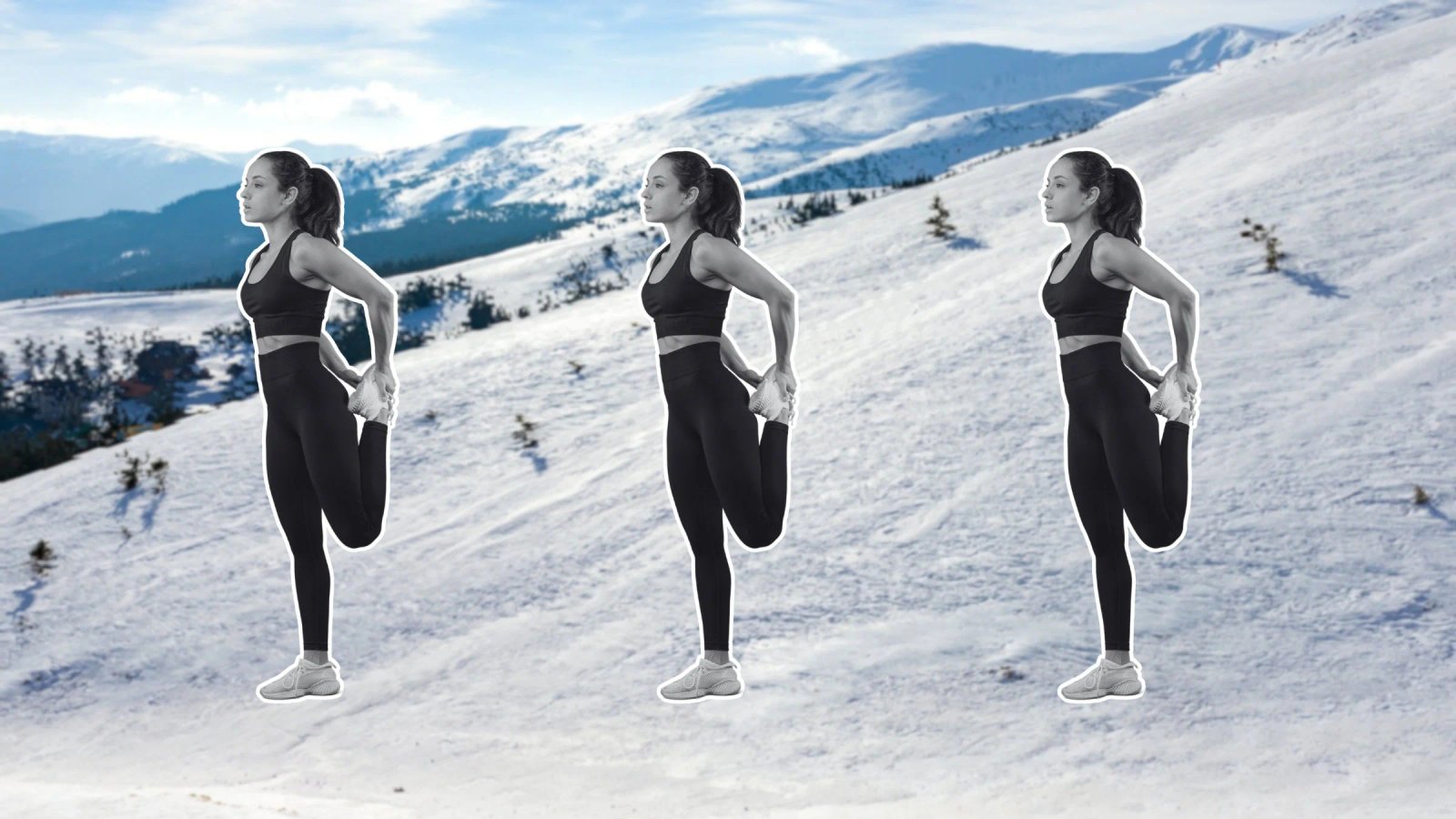
- Stand tall next to a wall or other sturdy object (like a chair or couch) and grab your right foot with your right hand and pull it towards your right glute. Make sure your right knee is pointing straight down (not twisted to the side or in front of your body). If you’re wobbly in this position, lightly rest your left fingertips on the wall or other sturdy object for balance support.
- Maintain an upright posture and feel the stretch through the front of your thigh.
- Hold for 60 seconds (or, if that’s too intense, do two 30-second rounds or three 20-second rounds).
- Switch sides and repeat.
2. Lunging Quad Stretch
How to Do It:
- Start in a half-kneeling position.
- Step your right foot forward and firmly plant it on the ground.
- Lower your left knee to the ground directly beneath your torso.
- From here, shift your body weight forward to feel a stretch in your left quad, particularly the top part of the quad.
- Hold for 60 seconds.
- Switch sides and repeat.
Optional: Do this stretch in a hot tub. The heat may also help reduce feelings of soreness.
More Ways to Ease Sore Quads After Skiing
The above stretches can be sufficient to help reduce quad soreness, but if you’re looking for more, Spencer also suggests other recovery methods.
Foam Rolling and Bike Riding
Spend a couple of minutes foam rolling your quads, including the front of your thigh (from the knee all the way up to the hip) and the sides to hit the vastus lateralis (basically where your IT band is). Similar to stretching, foam rolling can bring some relief to the quads by reducing swelling in the area.
Another option: hop on a stationary bike and gently cycle your legs for ten to 15 minutes. This easy movement can also reduce soreness by pumping out inflammation from your quads, Spencer said. Just make sure to keep the resistance and your effort level low. “It’s not meant to be a workout,” he said.
How to Prevent—or Mostly Prevent—Sore Quads in the First Place
Stretches can ease DOMS in the short term, but if you want to prevent intense soreness altogether, strengthening your quads is the ticket.
“If you just build a little strength going into the season, you’re going to be less sore,” Spencer said. And you’re also less likely to get injured, he added.
Exercises such as quad sets, wall sits, and really any squat variation like traditional squats, Bulgarian split squats, and single-leg squats can all strengthen the muscle group.
“The thing I hear all the time is the only way to get ready for skiing is by skiing, and that’s a total lie,” Spencer said. There’s a lot you can do both in the off-season and throughout the winter to prime your body for the demands of skiing, he said. In addition to quad-strengthening exercises, he recommends hamstring, glute, and core moves, plus jumping exercises that train your ability to react to the unexpected.
Want more Outside health stories? Sign up for the Bodywork newsletter. And for tips on how to train, fuel, and recover better, sign up for the Sweat Science 101 newsletter.
