

Published November 25, 2026 03:19AM
“How soon after surgery can I start surfing again?”
That was the first thing I asked my surgeon upon learning I had aggressive breast cancer that required a double mastectomy.
Fourteen months, three surgeries, and 21 rounds of chemotherapy and immunotherapy infusions later, I have paddled out more than 100 times. I’m convinced that surfing through cancer treatment saved my sanity, and possibly my life.
I grew up about as far from the ocean as you can get, in the Midwest. I moved to Northern California after college and fell in love with the Pacific Ocean. Every time I went to the beach, I was fixated on watching surfers—but never thought I could join them because I was too scared to try. And once I started a family, that dream moved further out of reach.
Fast-forward to the COVID 2020 pandemic lockdown when the public pool where I swam on a Masters swim team was shut down. I started doing laps in the San Francisco Bay with friends. I’d always been terrified of open water swimming, but after a year of braving the Bay’s chilly, choppy waters every morning, I decided it was time to try surfing. I was already wearing a (three-millimeter triathlon) wetsuit.
I was 52, the age when menopause, graying hair, and wrinkles can make women feel invisible. My kids had just left home for college. I needed something big to fill that hole in my life. I took a surf lesson, and was hooked immediately. On the drive home from the beach, I bought a hooded, five-millimeter wetsuit and booties, and started surfing several mornings a week, collecting phone numbers of women I met in the lineup and parking lot.
After decades of giving everything I had to everyone around me—work colleagues, kids, husband, dogs, parents, sisters—surfing was just for me.
Soon I had built a community of women surfers aged 25 to 75 to join me for dawn patrol sessions at our break north of San Francisco and surf trips to Mexico, Nicaragua, Costa Rica, San Diego, and Santa Cruz.
Surfing made me feel strong and beautiful. So I didn’t want to give that up four years later as I faced down cancer.
Seeking guidance on how to surf through surgery recovery and treatment, I posted a message on the Facebook “Women Who Surf” group of 39,000: “I just got diagnosed with breast cancer and am looking for other women surfers who surfed through chemo, and surfed after a double mastectomy.”
A hundred women weighed in with personal experience of cancer and surfing. Most hadn’t surfed during surgery recovery or chemotherapy due to doctors’ orders, infection risk, weak immune systems, limited mobility, fatigue, and weakness.
But one woman told me to go for it: Melanie Ezell, a 42-year-old big wave surfer, based in Oahu, who surfed through ovarian cancer. She became my role model, inspiring me to paddle out as soon as I could.
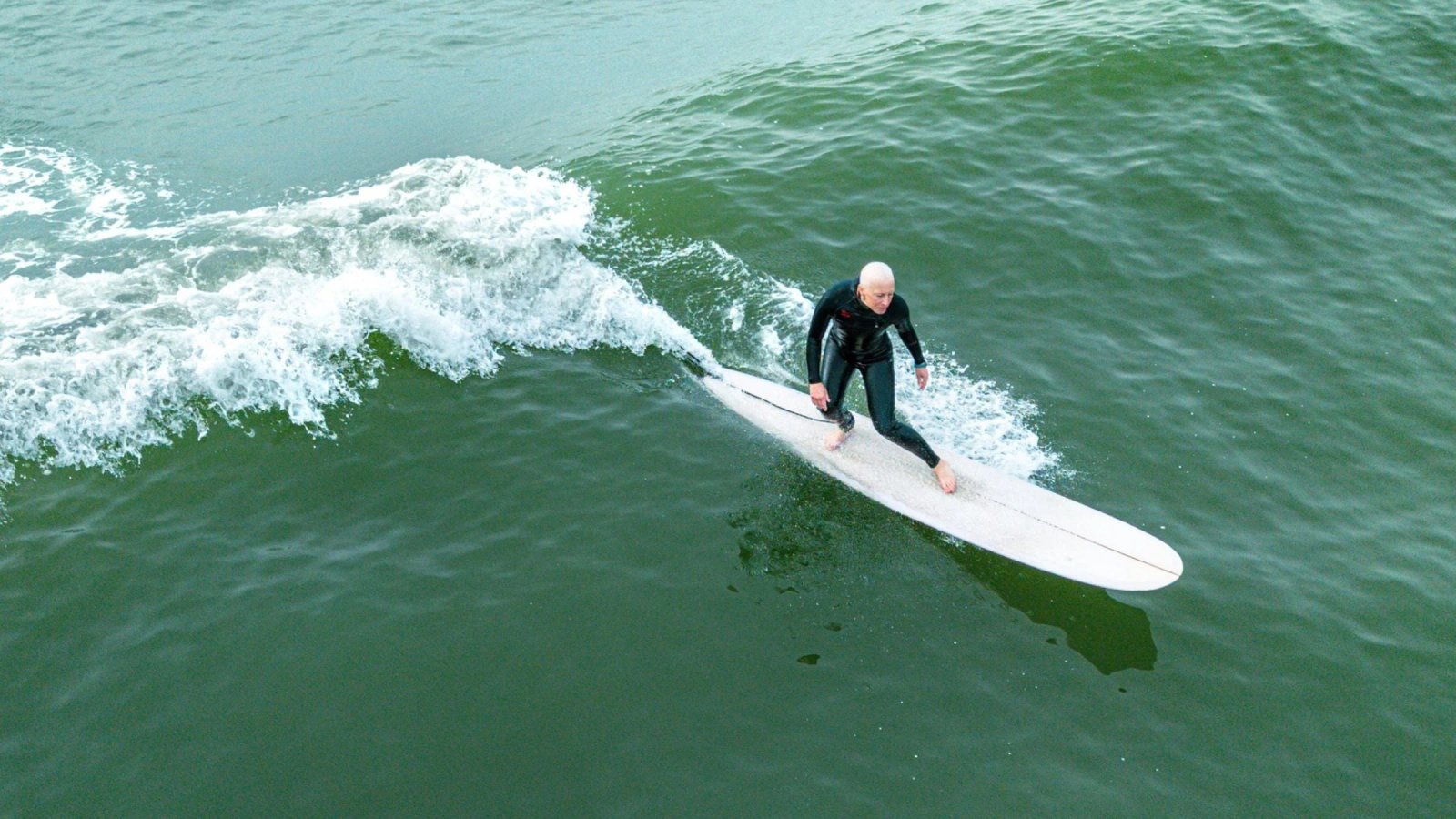
That long-awaited day came after being grounded on land for seven weeks following my double mastectomy. It was three days after my first chemotherapy infusion when my plastic surgeon declared my chest incisions adequately healed. I drove immediately to the beach, paddled out, and felt triumphant when I caught my first wave of the session.
And I kept paddling out through the remaining 11 rounds of chemotherapy.

On days when the swell was big and I was weak with fatigue, I’d claw through the impact zone after riding a wave, leaving my arms drained of power and lungs gasping for air. Once safely outside breaking waves, I’d rest on my board and let sets roll past until my breathing slowed. Still, being in the ocean felt like an antidote to the toxic drugs coursing through my veins. I loved watching the birds and seals, scanning the horizon for incoming sets, paddling into a rising wave, feeling its energy connect with my board.
Sometimes those sessions lasted only an hour because of my reduced stamina. But they always left me feeling stoked and alive, adjectives easily lost when you spend Tuesday afternoons hooked up to an IV bag pumping the sledgehammer drug Taxol into a port in your chest.
After my last chemotherapy session, I started ten rounds of targeted immunotherapy infusions (which I just concluded this month) and began posting GoPro videos on Instagram and Facebook of me surfing bald to inspire other women. I wanted them to see what it looks like when breast cancer takes your breasts and hair, but not your identity.

Women from around the world reached out to share their own stories: Ellen McLaughlin, a 54-year-old massage therapist and mom surfing through rectal cancer in the chilly waters at the Oregon-California border; 32-year-old Lottie Bakewell from Cornwall, England, surfing through breast cancer and the demands of caring for her one-year-old son and three-year-old daughter; Belen Kimble, a 48-year-old former professional longboarder, World Surf League commentator, surf performance coach, and single mom in New South Wales, Australia, surfing through breast cancer; and Caroline Wilhelm, a 55-year-old surfer and competitor from Los Angeles who took my cue to keep surfing through her breast cancer.
Backed by growing research showing that physical activity during cancer treatment offsets chemotherapy side effects and improves recovery and resilience, my little cohort of surfing cancer patients proves the ocean is not just a sanctuary, but an active prescription for healing.
But you don’t have to be a surfer to reap the benefits of physical activity during cancer. A new study of 45,530 women published in the Journal of the National Cancer Institute in September 2026 confirmed what my surf sisters and I already knew: regular exercise gives women going through breast cancer the strength to bounce back more fully and reclaim our lives after treatment. The study followed women for 15 years with data from the Women’s Health Initiative and found that keeping up physical activity and healthy habits prior to a cancer diagnosis acts as a powerful buffer against the physical toll of cancer treatments.
The trick is to start with small amounts of exercise and work with your care team on a game plan to get active.
“Even if you are not an exerciser, you can still start an exercise regimen during chemotherapy,” said my oncologist Eva Thomas, MD, from Kaiser Permanente Oakland in California, who encouraged and cheered on my surfing during chemotherapy. “It sounds counter-intuitive, but women tell me that when they push themselves to exercise, they feel better. Mood is better, sleep is better, energy is increased, and body aches are reduced.”
In 2022, the American Society of Clinical Oncology released the first-ever exercise guidelines based on more than 100 clinical trials examining the link between exercise and cancer treatment. For anyone going through cancer who wants to get active, the American College of Sports Medicine created a step-by-step guide in 2024 with research benefits and resources. It outlines a path to get started.
My own path began years before cancer, as a young woman fixated on surfing, who waited decades to act upon her dream.
Looking back, I see that my surfing community—and the strength and identity it gave me—helped me to charge forward through the scariest chapter of my life. The takeaway lesson is useful for all women and men facing challenges: Don’t delay trying something new and scary. It may end up transforming, and saving, you.
Danielle Cass lives with her husband in Northern California, where they raised their 26-year-old son, 23-year-old daughter, and dogs. When she’s not surfing with friends, she leads Responsible AI enablement at Microsoft. A two-minute short film about her midlife entry into surfing Learning to Surf at 52 screened at the 2022 San Diego Surf Festival. Follow her surfing through cancer adventures on Instagram @danielle.cass and Substack Danielle Rides the Cancer Wave.
