

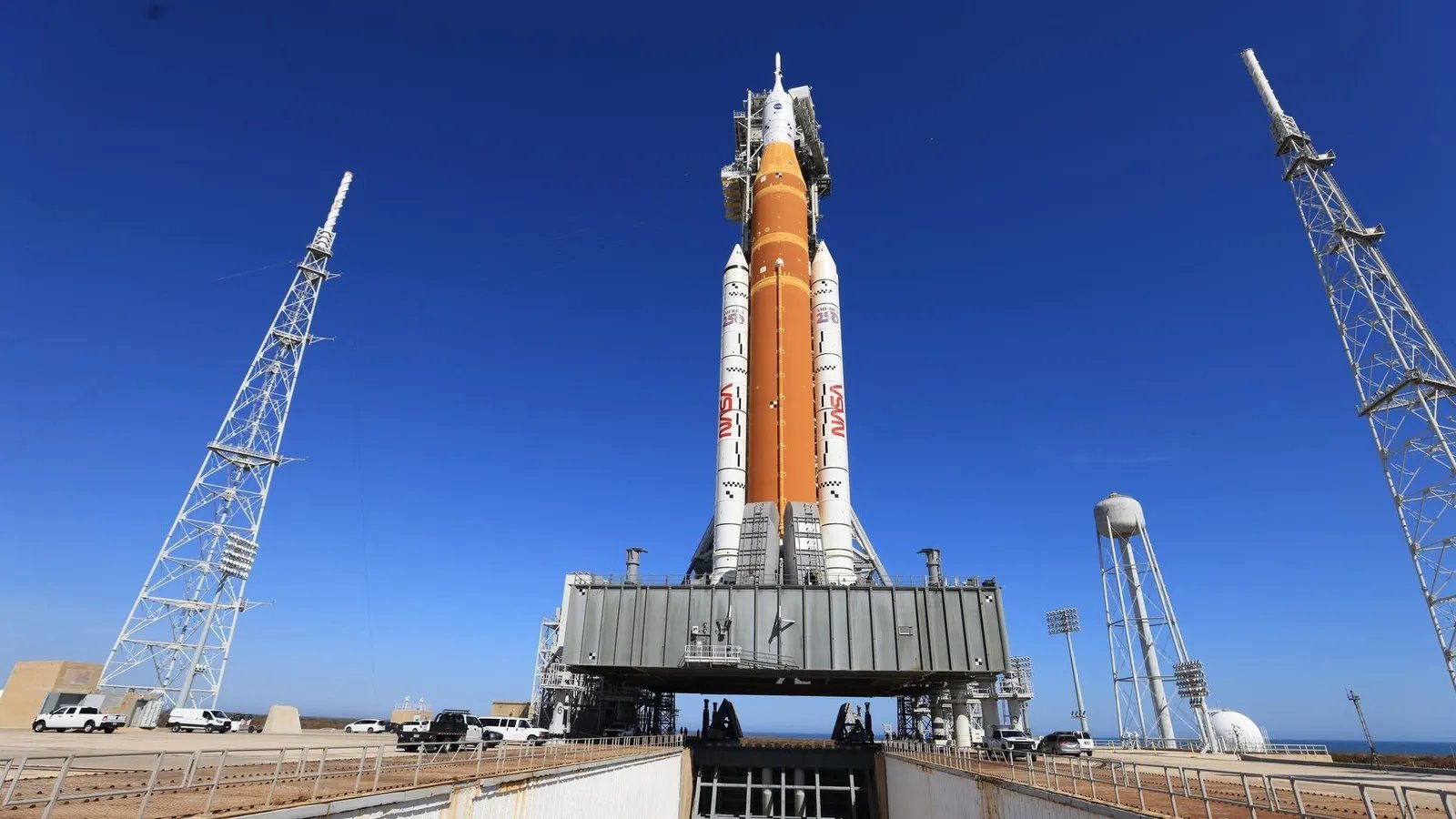
NASA’s Artemis II SLS (Space Launch System) rocket and Orion spacecraft stand vertical on mobile launcher 1 at Launch Complex 39B at NASA’s Kennedy Space Center in Florida on Tuesday, Feb. 10, 2026. The Artemis II test flight will take Commander Reid Wiseman, Pilot Victor Glover, and Mission Specialist Christina Koch from NASA, and Mission Specialist Jeremy Hansen from the CSA (Canadian Space Agency), around the Moon and back to Earth.
NASA/Ben Smegelsky
More than 50 years after humans last ventured beyond Earth orbit, NASA is preparing for a historic return to deep space. The Artemis II mission, set to launch no earlier than Wednesday, April 1, will send four astronauts on a 10-day journey around the moon, with extensive real-time coverage available online.
The launch window opens at 6:24 p.m. EDT (11:24 p.m. BST) and runs for two hours, with backup opportunities through April 6:
- 8:00 p.m. EDT on Friday, April 3 to 00:00 a.m. EDT on Saturday, April 4.
- 8:53 p.m. EDT on Saturday, April 4 to 00:53 a.m. EDT on Sunday, April 5.
- 9:40 p.m. EDT on Sunday, April 5 to 1:40 a.m. EDT on Monday, April 6.
- 10:36 p.m. EDT on Monday, April 6 to 2:36 a.m. EDT on Tuesday, April 7.
Artemis II: When And Where To Watch The Launch
NASA has confirmed comprehensive coverage of Artemis II across multiple platforms, including its YouTube channel and NASA+.
You can already watch a live stream of the rocket stack on Launch Pad 39B from NASA’s Kennedy Space Center.
NASA will hold a prelaunch news conference on Tuesday, March 31, to reveal the countdown status.
Live coverage of launch day begins at 12:50 p.m. EDT, several hours before liftoff, giving viewers a front-row seat to final preparations.
Artemis II: What To Expect After The Launch
Following liftoff, coverage will include the deployment of Orion’s solar arrays and its journey into high Earth orbit. After two orbits of Earth, Orion will move into a highly elliptical orbit, with translunar insertion sending it to the moon.
A post-launch news conference is expected roughly two-and-a-half hours after launch, as the SLS rocket’s upper stage performs a burn to send Orion and its crew to high Earth orbit.
NASA intends to provide real-time coverage throughout the mission on YouTube, possibly including a live stream of views from the Orion spacecraft, as well as live conversations with the crew.
How To See Artemis II Spacecraft In The Night Sky
The Italy-based Virtual Telescope Project will try to observe and share in real-time the Artemis II spacecraft once in space, four hours after launch. At 02:45 UTC on April 2 (10:45 p.m. EDT), astronomers using a large telescope will try to track it from Italy during a live stream.
Meanwhile, smart telescope-maker Unistellar is encouraging its 25,000 customers to observe the sky and look out for the Artemis II rocket approaching the moon — and image its silhouette crossing the moon for a few seconds. “As Artemis II approaches the moon, this event offers a unique opportunity to deepen our understanding of the mission and its trajectory,” said Franck Marchis, co-founder of Unistellar and SETI astronomer, in a press release. “By capturing this moment, amateur astronomers can play a meaningful role by contributing observations that help refine tracking, improve mission analysis, and strengthen collaboration between the public and the scientific community.” Unistellar has set up a dedicated webpage for the event.
Meet The Artemis II Crew
The mission will carry four astronauts: commander Reid Wiseman, pilot Victor Glover, mission specialist Christina Koch — all from NASA — and Jeremy Hansen from the Canadian Space Agency.
Their journey will mark several historic milestones, including the first time a woman, a Black man and a non-American astronaut travel beyond low-Earth orbit toward the moon. Over approximately 10 days, the crew will test critical systems aboard the Orion spacecraft, including life-support technology designed for deep-space missions.
NASA’s Artemis Program In Full
NASA’s Artemis program is designed as a step-by-step return to the moon, ultimately culminating in a permanent moonbase:
- Artemis I – Uncrewed test flight that successfully orbited the moon and returned to Earth (completed in 2022)
- Artemis II – First crewed mission, flying astronauts around the moon (expected 2026)
- Artemis III – Planned mission to test systems ahead of a lunar landing (expected 2027)
- Artemis IV – Expected to deliver astronauts to the moon’s surface, targeting the south pole (expected 2028–2029)
- Artemis V – A follow-up mission aimed at expanding lunar exploration capabilities (expected 2029–2030)
From Moonbase To Mars
Artemis II is only the beginning of a broader vision. NASA ultimately aims to establish a sustained human presence on the moon, including a potential lunar base near the south pole where water ice could support long-term exploration.
At the same time, the agency is already planning missions beyond the moon. Recently, NASA announced a nuclear-powered spacecraft — SR-1 Freedom — which is targeted for launch to Mars in 2028. Using nuclear electric propulsion, the mission could dramatically shorten travel times and carry heavier scientific payloads, while deploying advanced robotic helicopters to scout the Martian surface.
Wishing you clear skies and wide eyes.
