

Let’s be honest: nobody wakes up at 70 and says, “I can’t wait to hit the gym so I can get ‘shredded’ for beach season.”
Most of us just want to get off the sofa without making that “oof” sound, or reach the top shelf for the hidden biscuits without a balancing act worthy of a circus performer.
I’ve spent 15 years as a Personal Trainer, and for the last 6 years, I’ve specialised in training folks with disabilities and those who are “chronologically gifted.” If there is one thing I’ve learned, it’s that your house shouldn’t feel like an obstacle course.
The Reality Check: According to the NHS, around one in three adults over 65 will have at least one fall this year. We aren’t training for “fitness”; we’re training for survival and independence.
The “Fantastic Five” (No Spandex Required)
1. The “Toilet Prep” (The Box Squat)
-
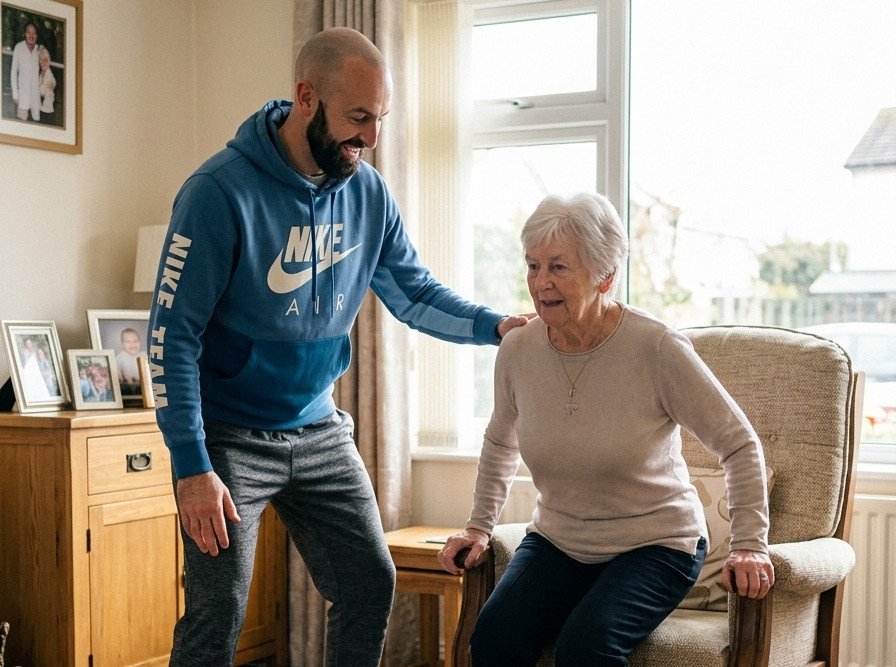
The Goal: Mastering the transition from sitting to standing—essential for chairs, cars, and the “porcelain throne.”
-
The Move: Stand in front of a sturdy chair. Keep your chest up (imagine you’re showing off a medal). Slowly lower your rear end until it grazes the seat, then drive through your heels to stand.
-
My Pro-Tip: Don’t let your knees “cave in” like they’re shy. Keep them tracking over your toes. If you’re “plopping” down like a sack of spuds, slow it down. The slow descent is where the strength is built.
2. The “Door Opener” (Wall Push-Ups)
-
The Goal: Pushing open heavy fire doors or catching yourself if you lose your balance.
-
The Move: Face a wall, hands at shoulder height. Lean in like you’re whispering a secret to the wallpaper, then push back firmly.
-
My Pro-Tip: Squeeze your glutes (your bum muscles) and tighten your core. This turns a simple chest move into a full-body stability exercise.
3. The “Rug Clearer” (Stationary Marches)
-
The Goal: Improving your “gait” so you don’t trip over rugs, pets, or your own feet.
-
The Move: Stand tall (hand on a counter for safety). Lift one knee toward your chest, then the other.
-
My Pro-Tip: Imagine you’re landing “softly like a cat.” If your feet are thudding, your core isn’t engaged.
4. The “Tightrope Act” (Tandem Stance)
-
The Goal: Navigating narrow hallways or uneven pavements with confidence.
-
The Move: Place one foot directly in front of the other, heel-to-toe. Hold for 20 seconds.
-
My Pro-Tip: Don’t look at your feet! Pick a spot on the wall at eye level. If your eyes are down, your balance goes down with them.
5. The “Top Shelf Reach” (Calf Raises)
-
The Goal: Reaching for the good plates and keeping your ankles stable.
-
The Move: Stand behind a chair for balance. Rise onto the balls of your feet, hold for a second, then slowly lower.
-
My Pro-Tip: Most people “bounce” at the bottom. Stop. Reset. Control is King.

🟢 Level Up: The Veteran’s Progression
Your body is clever—it adapts quickly. To keep getting stronger, you have to stop “going through the motions” and start challenging the system:
-
The 3-Second Rule: Count to three on the way down for every move. This “time under tension” builds serious muscle without needing a single dumbbell.
-
The “Hover” Test: On your last squat, hover an inch above the chair for 5 seconds. Warning: Your thighs will have a few choice words for me after this.
-
The “Close Your Eyes” Challenge: Once you’ve mastered the Tandem Stance, try blinking your eyes shut for 2 seconds. It forces your inner ear and feet to do the hard work of balancing.
Your 4-Week “Independence” Roadmap
|
5 Reps of each. Focus on perfect form. |
||
|
10 Reps of each. Make it a non-negotiable habit. |
||
|
10 Reps using the 3-Second Rule. |
||
|
12 Reps. Try using only “fingertip support” on the counter. |
Why This Matters (The Serious Bit)
In my 6 years of mobility and physical independence training, I’ve seen how one fall can shake someone’s confidence more than a physical injury. Strength isn’t about vanity; it’s the best insurance policy you can own.
By building these functional muscles, you’re installing a high-tech stability system in your own legs. You’re staying in the home you love, on your own terms.
Safety Check: I’ve got 15 years of experience, but I’m not your GP. Have a quick chat with your doctor before starting, especially if you’ve had a recent “unintentional floor meeting.”

A Bit About Me
I’ve spent the last 15 years in the fitness industry, but over the last 6 years, my real passion has been helping people maintain their freedom. I don’t care about your “beach body”—I care about your ability to live life without restriction. I specialise in taking complex strength movements and turning them into simple, life-saving habits you can do right in your kitchen.
Ready to get started, but want to make sure you’re doing it right?
I’ve spent 15 years helping people move better, and I know that every home and every body is different. If you want a plan tailored to you—or just the peace of mind that you’re training safely—let’s have a chat.
No strings, no “gym-bro” talk—just expert, local advice on how to stay strong and independent in the home you love.
Frequently Asked Questions (FAQs)
1. What are the best exercises for seniors to prevent falls at home?
The most effective exercises focus on functional movements like Box Squats, Wall Push-Ups, and Tandem Stances. These mimic daily activities—like getting out of a chair or opening heavy doors—building the specific muscle memory and strength needed to maintain independence.
2. How many times a week should an older adult do mobility training?
For most residents I work with in Sevenoaks, I recommend starting with 3 days a week. This allows for adequate recovery. As your strength improves, moving toward a daily “mobility snack” of 10–15 minutes is the gold standard for long-term physical independence.
3. Can I improve my balance after age 70?
Absolutely. Balance is a “use it or lose it” skill. By performing exercises like Stationary Marches and Calf Raises, you are retraining your neuromuscular system and strengthening the stabilising muscles in your ankles and hips.
4. Do I need gym equipment for mobility exercises?
No. My philosophy centres on bodyweight movements that you can do in your own kitchen or living room. A sturdy chair, a clear wall, and a kitchen counter are all the “equipment” you need to build life-saving strength.
5. Why is “functional strength” more important than lifting weights?
Functional strength is about the ability to perform daily tasks safely. While lifting weights is great, functional training—like the Box Squat—specifically prepares your body for real-world actions like getting off the toilet or in and out of a car.
6. Is it safe to exercise at home if I’ve had a fall before?
Yes, but safety is the priority. Use “fingertip support” on a heavy piece of furniture and start with fewer repetitions. If you’re in the Sevenoaks area, I recommend a Face-to-Face consultation to ensure your home environment is set up safely for your routine.
7. How long does it take to see results from mobility training?
Most of my clients report feeling “sturdier” on their feet within 2 to 4 weeks of consistent practice. Significant improvements in leg strength and balance recovery usually become noticeable around the 2-month mark.
8. What is the “3-Second Rule” in mobility training?
The 3-Second Rule refers to Time Under Tension. By counting to three as you lower yourself into a squat or push back from a wall, you force the muscles to work harder without adding heavy weights, which is safer for your joints.
9. Can these exercises help with arthritis pain?
Yes. Gentle, controlled movement helps lubricate the joints and strengthens the muscles surrounding them, which can take the pressure off the joint itself. Always move within a pain-free range of motion.
10. Do you offer mobile Personal Training in Sevenoaks?
Yes! I specialise in Face-to-Face mobility training specifically for Sevenoaks residents. I come to your home to ensure you are performing these movements correctly and safely in your home environment.
