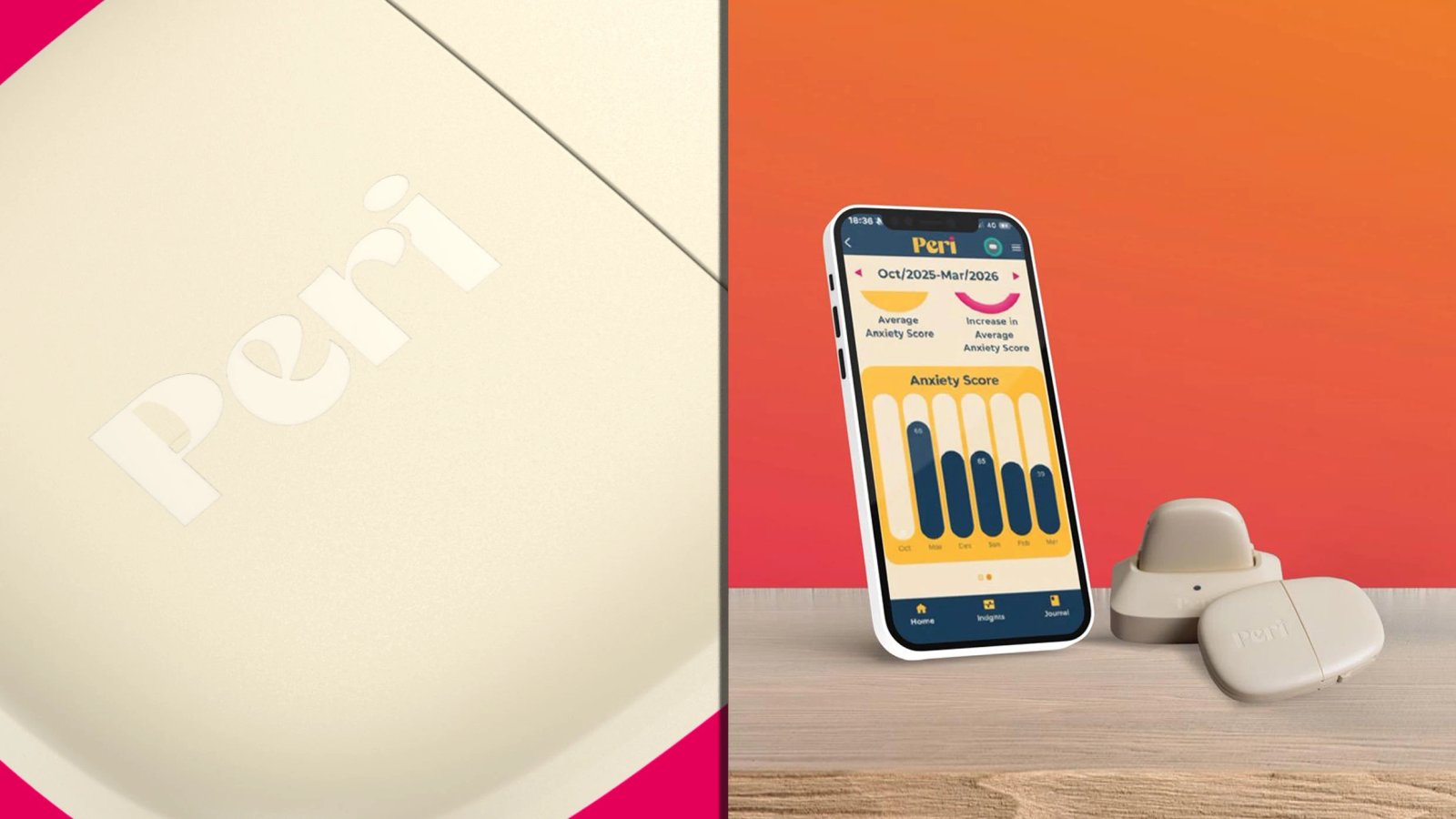
In a companion app, women can log lifestyle variables, like caffeine and alcohol consumption, as well as supplement use and medication. Over time, Peri packages this data into insights designed to help women as they progress toward menopause itself, which is defined as 12 consecutive months without a period.
“When I heard about Peri, it was a light bulb moment,” Hewson says. “Of course busy women can’t be expected to record every single anxiety attack, hot flash, or sleep disturbance accurately.” Instead of guesswork, she imagined that Peri would be able to provide individualized answers to the question of how hormones, lifestyle, and symptoms interact.
That same vision is what brought together Ireland-based Peri cofounders Heidi Davis and Donal O’Gorman, experienced scientists with a shared interest in women’s health and longevity.
“For us, it was all about getting real data for women to navigate [perimenopause] with more confidence, and to not waste their money on things that aren’t working for them,” says Davis, who is CEO.
Demand for wearables continues to grow, thanks to consumers’ interest in optimizing their health and wellness. Whoop, the wristband wearable built for fitness, raised $575 million at a $10.1 billion valuation earlier this week. Last fall, Oura, which makes a ring wearable, raised $900 million at an $11 billion valuation. Oura, like some other wearables, offers some data related to women’s health, such as period and peak fertility prediction.
Peri aims to capture a more mature consumer market: the estimated 1.3 million to 2 million women in the U.S. who enter perimenopause each year, with their symptoms lasting as long as a decade. Wearables like Whoop, endorsed by star athletes, promise performance maxxing; most women in the perimenopause demographic, in contrast, would be happy to just feel like themselves again.
New research, old problem
Once considered an afterthought, perimenopause is now believed by scientists to set the stage for risk factors later in life, with severe vasomotor symptoms like hot flashes correlated with cardiovascular and other diseases. That shift in thinking is shaping new research, but reciprocal changes to clinical practice have been slow, at best.
“Women are quite intuitive, they know something is not right, but they’re not getting the help they need,” Davis says. She and O’Gorman hypothesized that personalized data could bridge the gap between women’s experiences and their clinicians’ recommendations.
Thus far, personalization has played little role in the booming menopause market, which is expected to grow from $18 billion in 2024 to $27 billion in 2030, according to Straits Research. Much of that growth has come from menopause influencers peddling lotions, serums, lubes, and supplements.
But there are signs that women are eager for solutions that integrate with providers, particularly as interest in HRT continues to rise. In the U.S., women’s telehealth startup Midi Health raised $100 million in Series D funding at a $1 billion valuation in February.
Peri has been operating lean. To date, the startup has raised 3 million euros (roughly $3.5 million) from Hewson, other angels and strategic investors, and Ireland-based impact fund WakeUp Capital.
Davis and O’Gorman started testing an early version of Peri six years ago. “We had done the science and believed that if we had sensors in the right location, we could build algorithms for hot flashes and night sweats,” Davis says.
They approached hardware specialist Analog Devices, which sent them a sensor circuit. “It was big and clunky and really ugly,” Davis says, but the data was “really good.” A first prototype followed a month later, setting the stage for Davis and O’Gorman to partner with Ireland’s Health Innovation Hub, which helps startups run trials.
A WEARABLE FOR WOMEN
Peri contains four sensors: motion, optical, electrodermal, and temperature. The noisy data that they generate can be used to infer heart rate variability and a host of other data points, using a methodology now common to Oura rings, Apple Watches, and other devices.
To meet women’s specific needs and offer value beyond established wearables, Davis and O’Gorman decided to first isolate night sweats. Women in Peri’s trial manually logged their night sweats while wearing the prototype, and then Peri built algorithms capable of identifying the symptom’s biosignature. Crucially, Peri needed to be able to distinguish between symptoms and activities like exercise or household chores.
“People sweat, their temperature goes up, their heart rate might change: Was that exercise or not?” says O’Gorman, who serves as COO.
Initially, O’Gorman and Davis envisioned that Peri would function as a medical device delivered to patients through clinicians. But the trials changed their plans. Among the women participating, “the frustration was palpable,” O’Gorman says. They wanted a direct understanding of their own symptoms and the chance to regain a sense of control.
The data “has clinical utility,” O’Gorman says. “But it will actually have a more impactful utility if it is put in the hands of women who can then decide what they want to do with that information.”
PUTTING PERI TO THE TEST
Last month I tried Peri for myself. At 42, I’m starting to think about perimenopause and regularly hearing from friends who have started on HRT. Earlier this year I wondered if I was having a first hot flash.
At first glance, Peri is larger than wearables like a ring or the face of a watch. But once on, it’s almost invisible. The device is incredibly light and thin enough to seamlessly fit under most clothes. At bedtime one night, it nudged against my ribs when I rolled over and I realized I had forgotten about it entirely.
If my symptoms were to progress, I can imagine wearing it for long stretches of time, as Peri advises. It’s safe to wear the device while showering or bathing, and the sticker that holds it in place can last up to two weeks.
Many wearables require a subscription, but Peri is opting for a different model. The device costs a onetime fee of $449 (it’s HSA and FSA eligible), and it comes with two rechargeable batteries, a charger, and enough stickers for several months of wear.
Simple charts in the app summarize symptom incidents each day and over time. In particular, I liked a feature that would allow me to compare my symptom incidence to that of the Peri population. For example, a symptom like anxiety can be difficult to pin down and quantify. With Peri, data enters the picture: Is my anxiety low or high compared to my peers? Has it increased over time? Without that contextualized information, I might feel hesitant to seek help from a clinician.
As Peri goes live in the U.S., with Ireland and the U.K. to follow later this year, Davis is already looking ahead. She would like to make the device even smaller, in keeping with her mantra of helping women live their lives as normal while Peri works in the background. She’s also eager to refine the tailored insights that Peri plans to provide about when and why symptoms might be changing.
“We’re building a database that doesn’t exist, and this database is going to help women overall,” she says.