

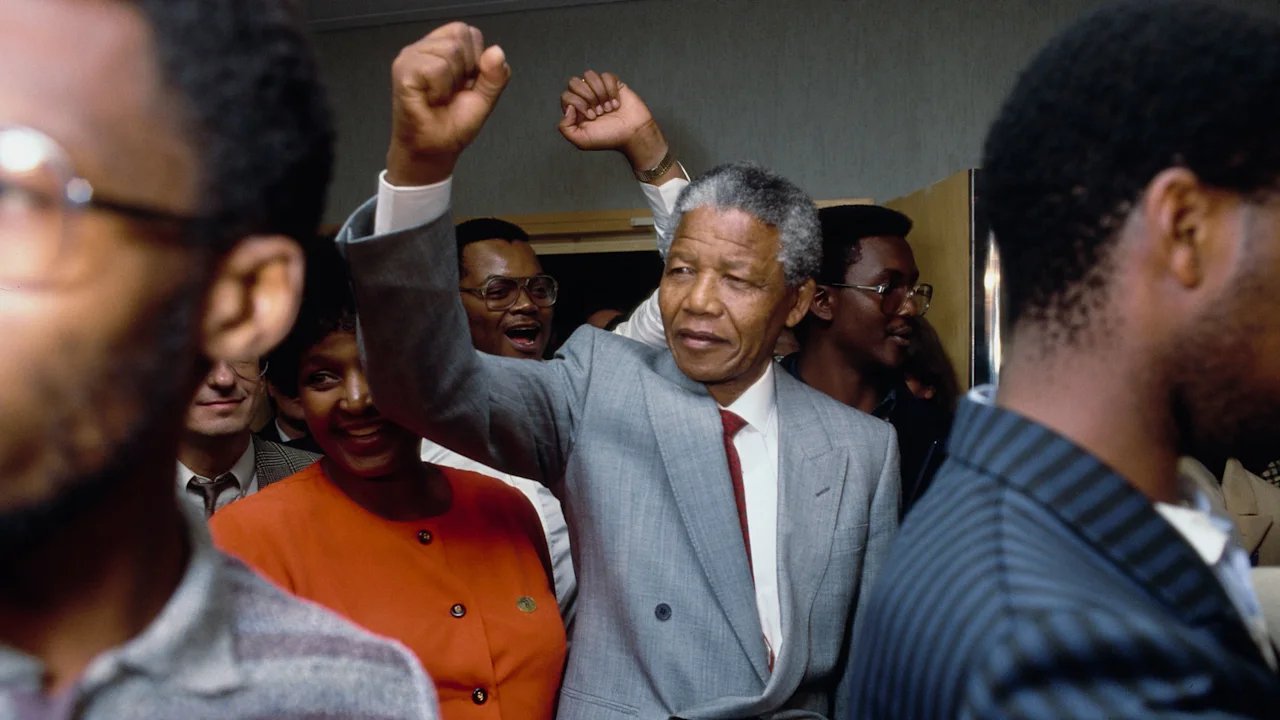
On February 10, 1985, an imprisoned 66-year-old male serving a life sentence was offered a conditional release that would have reunited him with his wife and children, from whom he had been separated for 23 years.
The prisoner turned down the offer. His name was Nelson Mandela.
In a rejection publicly delivered to the South African government by his daughter at a rally in Soweto, Mandela refused the condition that he permanently walk away from the country’s anti-apartheid movement. “I cherish my own freedom dearly, but I care even more for your freedom,” he stated, unwilling to “sell the birthright of the people to be free.”
Mandela would spend another five years in prison until his unconditional release in 1990 at age 71. While often mythologized for his otherworldly stature, this lesser-known story best represents what made him revered: his courage. His life is a visceral, powerful example proving that we can live with virtue, alongside fear, and successfully navigate an uncompromising world.
Unfortunately, tales of enduring models of courage—Abraham Lincoln, Rosa Parks, Amelia Earhart, among others—are told so reverently that courage begins to sound mystical. We tend to portray it as an innate trait possessed by dint of nature, a birthright hardwired into a rare few.
Nothing could be further from the truth.
Turning toward the fire
Courage is the ability to act intentionally in service of a virtuous core mission, despite the risks. Yes, courage is foreshadowed by dread—an emotion that triggers our instinct to flee. But courage is what happens when we act against those instincts and run toward the fire. While some muster courage faster than others, we can all develop it as a habit. Courage takes work, time, and intention.
Mandela noted that prison gave him time to think deeply, and that the rigid discipline of reflection shaped his behavior. He spent his days reading biographies and, legend has it, Marcus Aurelius’ Meditations. Aurelius’ Stoic philosophy argues that a good life depends on governing your own mind. Mandela’s worldview grew eerily similar: control yourself, manage your vanity, and temper your hunger for approval.
In my research for my book, C.O.U.R.A.G.E., this emotional independence is the fundamental underpinning of a courageous life. Mandela spent 27 years honing his. I concluded that courage is a deliberate skill, an ability developed by training seven key muscles, practiced together:
- Commit To A Purpose
- Own Your Potential
- Unmask Fear
- Reject Distracting Voices
- Act Decisively
- Grow From Failure
- Embody Resilience
Proper training
To activate this framework, professionals must adopt the mindset of an elite athlete. An athlete trains for the moment before the moment arrives, rehearsing fundamentals until execution becomes dependable under pressure. Courage works the same way. A leader doesn’t suddenly manifest it during a corporate crisis out of thin air; they rely on “muscle memory” forged through daily repetitions of micro-courage.
In my book, I share the lived experiences of “courage pilgrims”—compelling, everyday models of courage:
Ali Hassan Mohd Hassan turned a tiny startup into Malaysia’s most beloved sports retailer while keeping his purpose rooted in service to young people, not just profit. Roosevelt Giles rose from sharecropping poverty with a sense of self-worth that outgrew his circumstances. Janet King, a single mother in a deeply patriarchal setting, kept saying no to limiting assumptions and built security and dignity for her family. Gary DeStefano showed what decisive courage looks like in business by moving from debate to action and, just as importantly, by developing courage in others. Simidele Adeagbo transformed the disappointment of missing one Olympic dream into becoming Nigeria’s first winter Olympian and the first Black female Olympian in skeleton. Wendy Lea turned personal tragedy and business setbacks into a life of ecosystem building and resilient leadership.
None of them is famous. But they hit the “gym” every day, building their courage muscle by having difficult conversations, pushing past debilitating rejection, and viewing failure not as a stop sign, but as vital coaching feedback.
We desperately require this kind of athletic, conditioned courage today. Between the rapid acceleration of artificial intelligence, deepening global polarization, the collapse of trust in institutions, and unprecedented economic shifts, we stand at a crossroads. The stakes are somewhat similar to the situation South Africa faced in 1990. Mandela’s cultivated courage steered a fractured nation toward reconciliation, averting anarchy. It took immense effort to forgive, to unite, and to insist on a shared future.
Stepping into the arena
Today, business professionals and everyday citizens face a similar challenge. The moment calls for leaders willing to risk their own comfort, popularity, or purse to guide the world toward common human uplift. We cannot wait for naturally endowed saviors to emerge. We must all step into the arena, knowing that we could each be the spark needed to ignite meaningful change. After all, courage is contagious.
When Mandela was offered compromised freedom in 1985, he didn’t agonize over the decision. His response was quick because he had spent 23 years in the dark, lifting the heavy weights of reflection, purpose, and self-control. By the time the ultimate test arrived, his response was a reflex.
We owe it to ourselves to start our own training today. Because ultimately, courage is not hardwired—it must be trained like a muscle. And courage is what the world needs the most these days.
