

Published April 27, 2026 03:17AM
“Did you hear that?” Bryan Goldner asked before backtracking along the cattle road. “Road” might be a generous way to describe the path we were walking on. The prior day’s rain had turned the ground into a sticky, tacky clay. Hoof prints and footprints, deeply embedded in the earth, suctioned my feet in place one moment before sending them sliding out from under me the next. I only managed to turn my torso and watch as he peered up at the leafy canopy above us.
Gray clouds blotted out the sun, casting everything in a dull light. I was in Panama for a weeklong menopause retreat and Goldner was leading our group of 12 on an excursion near Cerro Hoya National Park. The park contains some of the last remaining primary forest in the area and its namesake three peaks rise approximately 5,000 feet above sea level before crashing down to the ocean.
The area is remote in more ways than one. It’s hard to get to: we traveled an hour by boat along a section along the Pacific coast known for its tuna fishing. It’s also geologically remote—one of the oldest parts of the country that began forming almost 90 million years ago—and ecologically isolated, making it a haven for rare species of plants and animals, some that only exist here.
“It’s like a mini-Galapagos,” Goldner told us before we set out that morning.
The sound he’d heard wasn’t just another bird. It was a great green macaw, a critically endangered species. “Right there,” he said, pointing up at the branches above us. His excitement was palpable.
The leaves shifted like a kaleidoscope. The repeating patterns of green and yellow morphed and revealed a lime green parrot perched above us. Only a hint of red on its head and bright blue flight feathers tucked down by its side set it apart from the lush vegetation. We quieted down and just stared. What were the chances of catching a glimpse of one of the estimated 1,000 remaining adult great green macaws on the planet? And while on something called a “menopause retreat,” of all things?
When I told a friend that I was going on the retreat, she asked, “What the f—— is a menopause retreat?”
“I’m not sure. I think it’s like a wellness retreat, but we talk about hormones?” I answered before adding, “Watch, I’m going to go and have a life-altering experience.” I laughed—the possibility of such a thing seemed absurd.
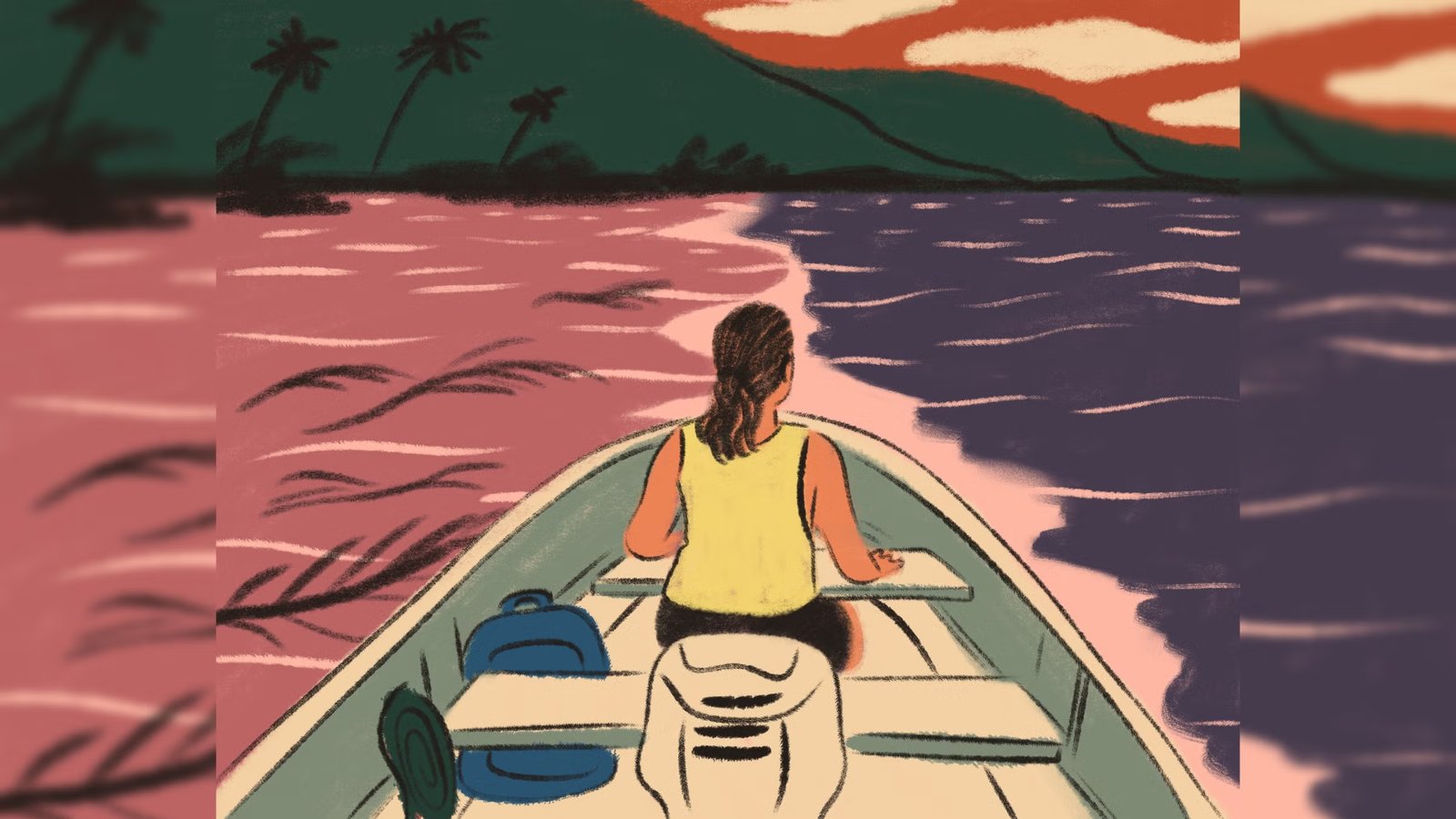
But that day did feel a little magical. Half an hour after our impromptu birdwatching stop, we swam under a waterfall, one that only appears during the rainy green season. The rest of the year, the waterfall is dry, and the swimming hole disappears. The skies threatened to release a torrential downpour, but held off until we returned to the covered shelter for lunch. Rain beat down around us as we ate tostones and pico de gallo, arroz con pollo, and stewed lentils, but stopped in time for our boat ride back to the resort. A few hundred feet from shore, branches and leaves swept downriver by the rain created a natural border between the brown, brackish water on one side and clear saltwater on the other. When our boat passed over the line in the water, it felt like we were crossing back into reality.
It sounds cliché, but I felt alive, attuned to my senses and the sensations around me. It had been a long time since I felt present, not simply trying to make my way through an endless mental checklist. And right then, I was exactly where I wanted to be—sitting on a boat, salty spray prickling my skin. I smiled.
Maybe this was the start of my life-changing experience?
As I approached my late forties, my body started changing. It was disorienting in a way I had never felt before, even during adolescence and pregnancy. I couldn’t concentrate and kept forgetting words as I was about to say them, too. I knew that my shifting hormones were the likely culprit, but there was a part of me that was loath to admit that I was getting older, like I was ashamed of it somehow.
When I first heard about menopause retreats, I admit that I rolled my eyes. From the outside, they seemed like just another iteration of a “wellness retreat,” a mash-up of educational workshops, yoga, and spa treatments set against the backdrop of a scenic locale like Costa Rica, Portugal, or Miami, that promise support with expert guidance and in community with like-minded women.
As someone who has reported on health and fitness for more than a decade, I’ve seen how the wellness industry can prey on people’s insecurities and frustrations, especially when there’s a juicy market to capitalize on. With the increased attention on women and changes in midlife and a market estimated at roughly $17.8 billion in 2024—growing to more than $24 billion by 2030—it’s not surprising that menopause is getting a glow-up.
But I’ve also seen that the industry can shine a light on taboo topics and bring them into mainstream conversations. The current enthusiasm for all things menopause is in stark contrast to its previous black-sheep reputation. Menopause, defined as a year without a menstrual cycle, is the bookend to puberty. No one used to talk about this phase of life; it was associated with images of The Golden Girls rather than women in the prime of their life and career. (Menopause occurs, on average, between the ages of 45 and 55.) Symptoms like hot flashes, night sweats, anxiety, depression, achy joints, and brain fog—caused by wildly fluctuating hormones like estrogen and progesterone, especially during the lead-up to the final period known as perimenopause—could be debilitating and embarrassing.
The biggest blow to menopause’s reputation came in the early 2000s with the publication of the Women’s Health Initiative (WHI) study, a long-term national study funded by the National Institutes of Health. The findings raised concerns that use of hormone therapy by postmenopausal women increased risks of cardiovascular disease and breast cancer.
“Everybody stopped using it, literally overnight,” Stephanie Faubion, MD, director of the Mayo Clinic Center for Women’s Health and medical director of The Menopause Society, told me. “We went from roughly a quarter of women in the United States using systemic hormone therapy down to four to six percent.” And today, she said, the number of women on hormone therapy is even lower. “We stopped teaching menopause because there wasn’t anything to do for it … no one was prescribing hormone therapy anymore. It stopped being in the educational curricula at all levels—medical school, residency training programs, continuing medical education,” she said.
Even though it has since been shown that there were flaws with the original WHI study and that hormone therapy can be a beneficial and effective treatment option for women younger than 60 years old or within 10 years of their final menstrual cycle, many doctors are still reluctant to prescribe it. “You have this 25-year gap in knowledge, when no one learned how to take care of menopausal women, a generation of doctors that has no education about menopause,” said Jen Wagner, MD, chief health and performance officer for Canyon Ranch, one of the original wellness resort companies.
Recently, there’s been a shift as more women come into menopause. An estimated two million women in the United States enter menopause each year. Globally, approximately 1.2 billion women will be postmenopausal by 2030, according to the World Health Organization. In the United States, Gen Xers are in the thick of or are post menopause while millennial women are preparing for or entering menopause age. Celebrities like Oprah, Naomi Watts, and Gwyneth Paltrow are talking about it.
Everyone wants better information, better solutions. There’s a refusal to suffer from symptoms, which affect four in five women, to grin and bear it like our mothers and grandmothers. “This age group of women is at the peak of their careers. They have money to spend, and they have a problem that hasn’t really been solved,” Dr. Faubion said.
The menopause market has exploded to fill this void, with everything from supplements and skincare treatments to menopause-specific diet and fitness plans to wearables and telehealth platforms designed specifically for midlife women. Combined with a social media algorithm that favors quick-fix, simple, short-form videos and influencers hunting for the next viral trend, it’s incredibly easy to share information—or misinformation—instantaneously, especially if it appeals to people’s needs and insecurities. With so many conflicting messages, trying to get good, science- and evidence-based advice has become a bad game of telephone.
Which is where the menopause retreat comes in. While the concept isn’t new, it’s starting to reach scale, says Beth McGroarty, vice president of research at the Global Wellness Institute (GWI). Wellness travel is one of the fastest growing segments of the wellness market. It was valued at $894 billion in 2024 and is expected to reach $1.3 trillion by 2029, according to GWI’s latest report. Interest in women’s health has exploded, particularly around longevity, leading to a greater emphasis on “gender-based programming,” McGroarty said.
So in October 2025, I attended Midlyfe Retreat, which was founded by a group of women’s health experts to help people negotiate life in perimenopause and menopause.
Everyone—five-star resorts, spas, health experts, your local fitness instructor—seems to have some version of a menopause retreat. Typically, these programs offer workshops on the hormonal and physiological changes that happen in perimenopause and menopause and how to navigate symptoms. Some—like M/Power, the retreat that Canyon Ranch launched last year—offer testing, like a DEXA scan for bone density, body composition testing, and comprehensive blood work and hormone panels; and one-on-one consultations with experts in women’s health, mental health, exercise physiology, and nutrition. All offer women social connection and group support for symptoms and a lived experience that their doctors have dismissed and no one else around them seems to understand.
“We want to empower women to be their own best advocates by having the knowledge to be able to go back to their doctor or healthcare provider and have an informed conversation,” said Jen Baker-Porazinski, MD, a menopause-certified physician and M/Power’s resident medical expert at Canyon Ranch.
Ultimately, empowerment was the inspiration behind Midlyfe. It was founded by a group of women’s health experts to help negotiate life in perimenopause and menopause.
A few years ago, Skylar Orton and Jane Hopkins both noticed that their clients (Orton is a physical therapist, Hopkins is certified Pilates and yoga instructor, and both are certified menopause coaches through Girls Gone Strong) were coming to them with questions about menopause. It coincided with changes in their own bodies. Orton and Hopkins, both based in the Denver area, had discussions about how they were managing their symptoms and resources they found. When they both read a 2023 New York Times article on menopause retreats, they texted each other. Did you read this? This looks like something we should do.
That’s when the idea for Midlyfe was born. “When you’re in the medical space, people ask you questions and all you want to do is support them and help them understand what’s happening to their body,” Orton told me over matcha lattes one morning. Orton convinced her friend Alyson Miletich to join them. Miletich is a board-certified obstetrician-gynecologist and owner of Surya Medicine, an integrative health practice in North Carolina.
“We wanted to put these pieces together so that women felt supported, gained knowledge so they know what they’re dealing with and talk about it with their doctor,” Hopkins said. “We want to help them feel more equipped to handle what’s going on now and to plan for the future.”
Two years to the day from when they first dreamed of Midlyfe, the founders boarded a plane to Panama to host their first retreat, which I attended. Our group included nine women. Most lived in the Denver area and are clients of or friends with Orton and Hopkins. Most came to the retreat in pairs.
We traveled by private bus for the six-hour drive to Sansara, a wellness/yoga/surf resort in the village of Cambutal and our home for the week. The beachfront property is luxe zen, with minimalist boho decor—textured neutrals, wooden beams and furniture, a palette of creams and neutrals, and a wall of windows that gives everything an airy, relaxed vibe. My cabana had a bathroom that’s as big as my living room in Brooklyn, a kitchenette, and a private saltwater soaking pool. I’d be lying if I said I didn’t think about moving in permanently.
Most mornings started slowly: a yoga class; breakfast of eggs, avocado toast, or a smoothie bowl at the Buddha Bar, the resort’s on-site restaurant; some people scheduled spa treatments. You could also sign up for surf lessons or an excursion, like the waterfall hike or a sunset horseback ride.
The main draw was the educational content. Every afternoon, we gathered for a deep dive on one of the troublesome areas of menopause: hormones, bone and muscle health, nutrition, injury, sleep, stress, and the pelvic floor. “Unfortunately, this isn’t really part of public knowledge. It’s not being disseminated broadly yet because it takes time to get from scientific understanding to getting it into standard of care,” Dr. Miletich said.
“We get fed all this information through social media, books, and articles, but how do you know what they’re telling you is right?” Sunny Heydorn, 51, a Midlyfe attendee, told me. “As a woman, you have to be your own advocate in this healthcare system.”
Two years ago, Heydorn was dropped into menopause after a hysterectomy. She tried to research what that meant for her, but it was so complicated. “I wanted to come here to help me make sense of the information. What am I supposed to be doing? Am I on the right track?”
For Amanda Rutenberg, the retreat was a chance to reconnect with Heydorn, a friend she met during a law school study abroad program but who she hasn’t seen in person in 20 years. Rutenberg, 51, hadn’t thought much about menopause prior to the retreat. “But I thought maybe they can give me some strategies for maximizing my energy and getting back to feeling more like I used to feel,” she told me. Another participant, Susan, told me that she appreciated Midlyfe’s mix of expertise—a medical doctor with a functional health focus, a physical therapist, a yoga instructor—because it creates the space to explore issues in a more integrated way.
Still, there were limitations. Several people wanted more specifics about hormone therapy and other treatments or what their exercise program should look like, but in a group setting, it’s impossible to tailor the content to any one person. Even though we left with many handouts, there’s a lot to sort through when you get home. To some, it might feel unsatisfactory, especially if you were hoping to walk away with an action plan rather than general guidance.
The sessions on injury prevention, posture, and the pelvic floor were more hands-on and interactive. During one, Orton and Hopkins demonstrated six functional movement patterns—push, pull, squat, hinge, lunge, and carry—before observing us individually and offering form adjustments as needed. They also demonstrated range-of-motion exercises using a resistance band, a series that addresses issues Orton frequently sees with her middle-aged clients.
I left the session motivated to recommit to strength training and incorporate what we learned into my routine at home. Building and maintaining strength not only helps keep up with an active life, it also guards against injury and falls in the future, a key to longevity. Studies have found that women who fell repeatedly were more than four times more likely to die within the next ten years compared to women who didn’t fall repeatedly.
2026 Menopause Retreats to Try
If you’re considering attending a menopause retreat, here are a few recommendations.
Midlyfe Retreats
Cambutal, Panama
In 2026, Midlyfe will return to Sansara Resort in Cambutal, Panama, from October 18 to 24, with some tweaks to their programming such as more breakout sessions and facilitated discussions. There will also be optional activities like hand-dying silks and painting in addition to outdoor excursions like surfing and hiking. Prices start at $3,400 per person for double occupancy and includes accommodations, three daily meals, transfer to and from Panama City, educational workshops, and daily movement classes.
M/Power
Lenox, Massachusetts
This four-day immersive retreat hosted by Canyon Ranch blends the best of the wellness powerhouse’s expertise and is led by physicians, exercise physiologists, nutritionists, licensed mental health professionals and spiritual wellbeing professionals. Through one-on-one consultations and assessments—including a DEXA scan to assess bone density, a comprehensive blood work panel, and hormone panel—M/Power staff help participants develop a customized game plan to navigate perimenopause and menopause. Participants can also participate in activities like rucking and hypnosis for hot flashes. In 2026, retreat will be held May 6 to 9 and August 24 to 27.
Six Senses Female Wellness
Multiple destinations
Six Senses resorts offer three-, five-, or seven-day Female Wellness programs to help participants understand the transition during perimenopause and menopause. Developed in collaboration with experts like Mindy Pelz, the program provides insights on hormonal and metabolic health, nutrition, movement, sleep, and stress. It includes personal training, spa treatments, hot and cold immersion, sound healing, and mindfulness meditation. The Female Wellness program is currently offered at Six Senses resorts in Portugal, Italy, Switzerland, and the Maldives and can be booked year-round. Prices vary.
By their nature, retreats are small group experiences, but there’s the potential for a big ripple effect. “I hope people go home and share what they’ve learned with a sister or friend who might be struggling,” Hopkins said. “We would love it to be like three degrees of Midlyfe Retreats,” Orton added.
Toward the end of our first workshop, Miletich asked us to write down our intentions for the week and for 20 years in the future. What do we want to be able to do? How do we want to feel? Calm. Spacious. Like I can think clearly, I scribbled in my notebook.
When I looked for a menopause retreat, I knew I wanted to go somewhere remote. I wanted to be far away—from New York City, from my everyday life and responsibilities, from the emotional demands of everyone around me. Life has felt relentless lately, between worrying about an aging mother, trying not to worry about a son who just started college, helping another son navigate his last two years of high school, and working a full-time job. There’s so much background noise, the static’s so loud, that I can’t hear my own thoughts.
“I wanted [the retreat] to be a destination with natural beauty and where we were traveling a distance,” Hopkins said. “It’s easier to kind of sink into that retreat mindset the further you go from home.”
At Sansara, my only responsibility for the week was to show up for a two-hour workshop every afternoon. The rest of the time was my own and I didn’t have to think much beyond whether I wanted to nap, read, or take a walk on the beach. Even my meals were easy. When we arrived, the staff took Polaroids of each member of our group, noting our allergies or dietary restrictions. As someone with an extensive list of allergies that can lead to anaphylaxis, it was the first time in a long time that dining out didn’t come with a hearty side of anxiety.
Before dinner the first night, Hopkins led us through a short yoga practice and all I wanted were heart-opening postures, like my body needed to feel more expansive, to be cracked open. I rested in supported fish pose instead of savasana. After dinner, I stared up at the inky black sky from the black sand beach, the wide expanse overhead littered with constellations I never see at home. Head tilted back, I slowly turned in circles, again and again, struck by the vastness of it all.
Each decision that day was guided by a simple question: What do I want to do? It was hard to answer at times, like an undertrained muscle—and honestly a little uncomfortable, because it felt selfish. I felt selfish. It was more tiring than I expected. When I got back to my room, I starfished on my king-sized bed and fell asleep exhausted, a good kind of tired.
When we regrouped to discuss our intentions, Orton shared a story about her mom, who’s in her early eighties. One day, she tried to hop up onto the tailgate of a truck, a move she has performed countless times. But this time, she struggled. It caught her off guard.
“I don’t want to be surprised by what I can’t do because I haven’t tried it in ten years,” Orton told our group.
I’ve been surprised by a few things recently. I can’t run as far as I used to. I’ve faltered a couple of times when lifting my carry-on to place it into the overhead compartment. It’s a little harder to get up from sitting on the floor. On the surface, I seem like the same person, but I could feel myself slowing down in incremental ways. It was easy to miss the cracks if you weren’t looking for them.
But more than that, I’ve been surprised by how I’ve retreated inward, living much smaller than I used to. It’s easier to stick with “safe” pursuits because the anxiety of doing anything else, even activities that I adore, can feel too much at times. In the process, I’ve lost a part of my identity. It’s changed how I relate to myself.
Earlier that day, Kara, another Midlyfe participant, asked if I was going to surf. I was hesitant. I tore my ACL a couple of years ago—my third ACL tear—and it’s taken me longer to recover from surgery this time around. I haven’t surfed since before my injury, because my knee felt different, and I was scared of hurting myself. If I’m ever going to surf again, I should surf here, I thought. After all, a big part of the reason why I signed up for the retreat was to stop being scared of trying things. I signed up for a lesson for the next day.
On the drive, I kept telling myself that my only goal was to get in the water and try. That’s all. When we arrived, the beach was empty, just a conveyor belt of waves rolling into the shore. Our instructor, Leah, a former pro surfer, led us into the water. When I caught my first wave, I felt that familiar rush of adrenaline. Why haven’t I been doing this more often?
Kara and I traded waves. At one point, Leah leaned over and told me I could paddle out farther if I wanted, but I was happy where I was—the lull of the waves, the bright reflection of the sun, the fact that I can’t do anything else except wait for the next good wave. Yes, I was nervous about going farther out into bigger waves, but I realized that I didn’t need to do more just to do more. Because this—reminding myself that I am still capable, trying regardless if I fall or fail—was enough.
“We just skip over this time of life,” Susan told me one morning. While there are plenty of networks and events for single adults, new parents, and retirees, there are few things aimed at people in midlife. Menopause retreats offer one way to connect with women in middle age, but it can be hard—and expensive—to take time away from family and work.
“It’s hard to justify spending money on yourself and not your whole family. For this amount of money, my whole family could have taken that trip,” Heydorn said. However, in her conversations with friends, she has noticed a shift around the age of 50. “You’re in your self-care era. I’m finally able to say I’m going to focus a little bit more on myself.”
“There’s an appeal to getting together with a group of women to reflect on this stage of life,” Susan said. Plus, there’s a beauty in doing it with a group of people you’ve never met. By virtue of signing up for the same retreat, you’re connected, and it leads you to share more openly.
The women on the retreat were curious, smart, and funny. In the evenings, we sat around a long, wooden table for a three-course farm-to-table meal. We swapped tales of mysterious symptoms—who knew that itchy ears could be due to perimenopause?—and recommendations for creatine supplements. We laughed at how our partners referred to this trip as menopause camp. We joked about having a progesterone party so that we’d all sleep through the night. We all had a story that was immediately met with a chorus of “Me too!” It was a reminder that this life stage is messy and chaotic but can also be deeply hilarious. That we’re not going through it alone.
When deciding on the retreat’s name, the founders purposefully choose “Midlyfe.” They opted not to include “menopause” in the name as, technically, menopause is a single point in time, whereas midlife and the menopause transition span a longer stretch. They added the “y” because they didn’t want people to associate their offerings with a midlife crisis.
“It’s an opening, a metamorphosis. This is a time that doesn’t have to feel icky. It can be a time of joy,” Orton said.
It’s easy to be complacent with age. At 66, Judy Strickland was the oldest member of the group. She told me that she was independent when she was younger but “then when you get married, you kind of settle in. My husband takes care of a lot.”
For her, the retreat was a chance “to prove to myself that I can do this.” She traveled alone and internationally for the first time in years. She made it to the waterfall, traversing a river and navigating slick rocks and surfaces. “You can’t see where you’re putting your foot or how deep the water is. I had no idea that my balance was that bad in the water,” she said.
“I learned that I can do this,” she said. “This has been a big adventure and I’m so thrilled.” It’s that sense of self-efficacy you get only from doing something new or hard that forces our brains and mindsets to adapt, which studies have found can improve cognitive and functional skills and a key part of healthy aging.
I realized that I had something to prove to myself, too. For the past few years, I’ve been existing, going through the motions without fully engaging with the world and life around me. The retreat was an opportunity to immerse myself in each day in a way that felt intentional. I didn’t leave Panama fully transformed, but something shifted inside of me. It felt good to be grounded in my body, to spend time with my own thoughts, to do something simply for the joy of it, to laugh harder than I have in a long time.
I also left feeling empowered. There’s a narrative in our culture that the changes women experience in midlife—the debilitating symptoms and decreased quality of life—are just normal. You shrug and move on. The retreat reminded me that I don’t just have to accept that; there are tools and strategies I can use to be more proactive about my health. Consistent strength training. Short bouts of jumping. Sneaky pelvic floor exercises while waiting in line. Nutrition tweaks.
As someone said on our final day, “It’s forward momentum that feels hopeful.” Like Strickland, I learned that I can do this.
This article is from the Spring 2026 issue of Outside magazine. To receive the print magazine, become an Outside+ member here.
