

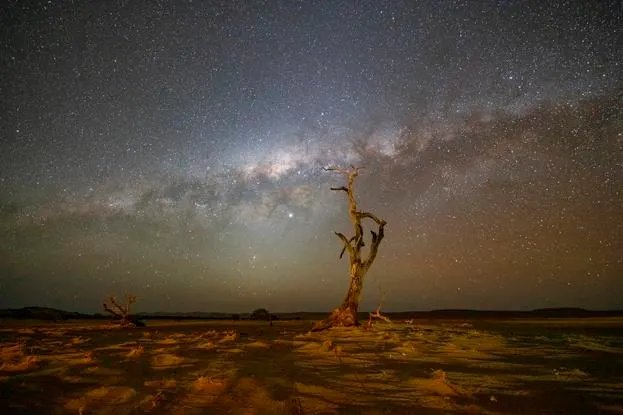
Scenic desert landscape against starry night sky
getty
The simple ritual of “dusking” — quietly watching the transition from day to night — is spreading beyond its cultural home in the Netherlands as travelers search for slower, more grounding ways to reconnect with the natural world.
What Is ‘Dusking?’
At first glance, dusking sounds similar to the classic “sundowner” popularised on African safaris and in beach resorts. While both revolve around sunset in some way, they represent very different experiences. A sundowner is golden-hour drinks, while dusking is more of a back-to-nature trend (often called “mindfulness” and “wellness” by marketing graduates). According to the BBC, dusking is a trend inspired by old Dutch twilight rituals, encouraging people to switch off screens, sit quietly and intentionally observe the fading of daylight into darkness. For stargazers, “dusking” is the act of being outside in twilight, watching the stars appear as night’s window slowly opens and the night sky is revealed in all of its glory. It can begin, of course with the sunset.
Is ‘Dusking’ A New Travel Trend?
Named a travel trend for 2026 alongside cool-cations (skiing and/or northern lights), journeying by rail and townsizing (serving busy capitals to visit quieter second-cities), dusking belongs within stargazing, astrotourism and the awkward-sounding NocTourism (nocturnal tourism). However, like all of those other travel trends for 2026, dusking is nothing new — it’s just new to a young generation.
Increasingly, dusking is being framed as a reaction against the hyper-curated “Instagram aesthetic” that dominated travel culture throughout the 2010s. Rather than chasing viral viewpoints and posting heavily edited cliche sunset photos, travelers are now seeking calmer, more reflective moments rooted in atmosphere and place.
Dusking is a trend inspired by old Dutch twilight rituals, encouraging people to switch off screens, sit quietly and intentionally observe the fading of daylight into darkness — starting with sunset.
getty
A New ‘Global Dusking Index’
According to a new Global Dusking Index from Holafly, the best place in the world to experience that transition may not be where social media has been directing tourists. The study ranked 29 destinations using NASA atmospheric data, clear-sky frequency, humidity, aerosol density and the duration of the golden hour (the period of soft, diffused light and long shadows just before sunset) to identify where the physical conditions for sunset are scientifically strongest.
The surprise standout? Namibia — a destination with only a fraction of the online visibility of some destinations, but near-perfect atmospheric conditions for golden hour. It beat popular-but-underwhelming destinations tagged for sunsets, including Bali, Santorini and Mykonos in Greece, Italy’s Amalfi Coast, Portugal’s Lisbon and the Algarve and Tenerife in Spain’s Canary Islands.
Why Namibia Outperformed The Maldives
Holafly’s research found Namibia possesses some of the strongest sunset conditions in the world, thanks to a rare combination of atmospheric factors.
The country recorded a remarkable 98% clear-sky frequency and just 12% humidity at sunset hour — among the best scores in the entire index. Its desert atmosphere also sits within the ideal Aerosol Optical Depth range needed to scatter sunlight into rich reds and oranges.
Counterintuitively, perfectly clean air actually weakens a sunset. The atmosphere needs the right amount of suspended particles to refract light effectively, creating the vivid colors associated with golden hour. Namibia’s position beside the Namib Desert places it almost perfectly within that atmospheric “Goldilocks zone.”
Meanwhile, the Maldives — despite generating 392.5 million TikTok views related to sunsets — performed surprisingly poorly scientifically, recording only 48% clear-sky frequency and 78% humidity at sunset. Researchers described it as the clearest example in the study of “social dominance over atmospheric reality.”
Rock arch and granite mountains at sunset in Spitzkoppe, Namib Desert, Namibia, Africa.
getty
‘Dusking:’ The Reality In Namibia
The growing popularity of dusking may reflect a rejection of fast, algorithm-driven tourism, the beginning of the end of people, for some reason, wanting to reproduce viral images. But Namibia’s appeal for dusking goes far beyond sunsets. The country is one of the darkest and most visually dramatic places on Earth to watch day dissolve into night. Beneath extraordinarily dry skies, travelers can watch the Milky Way stretch overhead while the Magellanic Clouds — two dwarf galaxies visible only from the southern hemisphere — slowly rotate around the south celestial pole. Hotspots for dark-sky tourism include the red dunes of Sossusvlei, the vast desert silence of Damaraland, the granite landscapes around Spitzkoppe and the remote ranchlands surrounding Gamsberg, the latter home to observatories and exceptionally low light pollution. Think “dusking” followed by stargazing beside campfires.
When To Go ‘Dusking’
Never forget that every trend has its season. The best time to experience Namibia for dusking and astrotourism is during the dry season between May and October/November, when you can also see the Milky Way. However, if you want dark skies shortly after sunset, be there between the last quarter moon and a few nights after the new moon, when the Milky Way will be far more vivid to the naked eye.
With minimal humidity, near-perfect clear-sky frequency and vast empty horizons, Namibia offers the kind of slow, immersive darkness that makes dusking feel less like a trend and more like a return to something ancient.
Disclaimer: I will be lecturing on a stargazing tour to Namibia in November.
Wishing you clear skies and wide eyes.
