

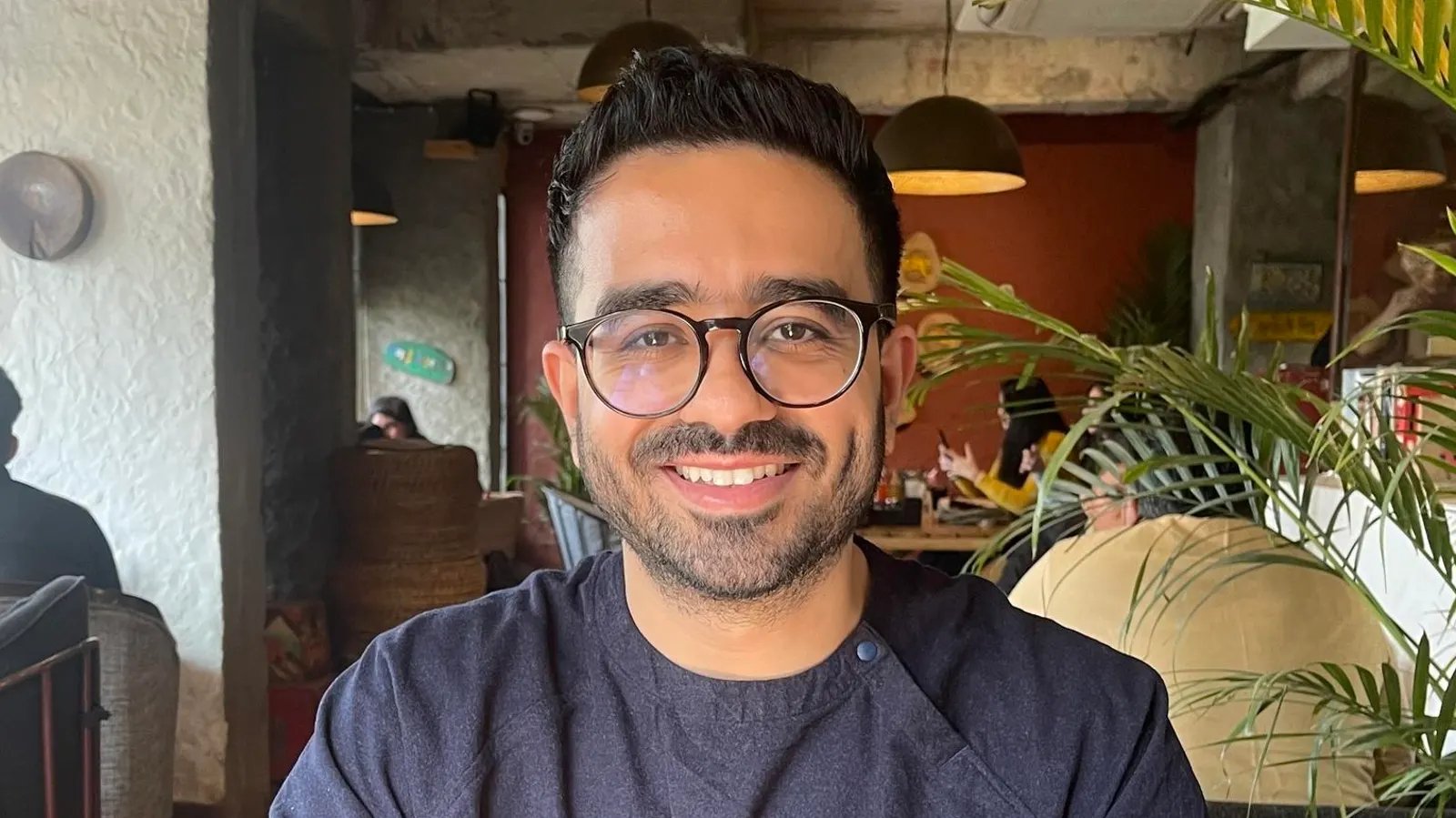
Anshul Tewari, founder
Youth Ki Awaaz
In a country of 1.4 billion people, more than half under the age of 30, the question of who speaks for young Indians is not a small one. Anshul Tewari has spent nearly two decades trying to answer it. As founder of Youth Ki Awaaz (“Voice of the Youth”), India’s largest civic participation platform, he has built a community of 200,000 monthly contributors and a WhatsApp-based polling engine that pulses tens of thousands of young people daily on everything from climate anxiety to mental health. The result is ground-level intelligence, at scale, that governments are beginning to actually use. Tewari spoke with Ashoka’s Simon Stumpf about where the idea came from, what the data is revealing, and why a youth-led accountability moment for climate is coming.
Simon Stumpf: You started Youth Ki Awaaz at 17. What was the frustration that set it off?
Anshul Tewari: I grew up in a household where watching the news was a daily norm — we could discuss it openly. But the outside world was different, there was no engagement on real issues impacting my generation. It gave me this feeling that the news is not something I relate with. Why isn’t the news built for young people? Why is the media so top down? So I decided: I’m not going to wait for a journalist to build a space for young people. I’m going to build it myself. So in 2008, at 17, I started a blog. The first post was titled The Global Warning — about climate change and why I, a young person in India, cared about it. But it also quickly made me realize I still had better access than most. Every time I said something publicly, I was told: you are too young, focus on your career, this is not your age to talk about these issues. If I found it so difficult, what about young people who have zero access whatsoever? That’s really what got Youth Ki Awaaz started.
Stumpf: The platform has always been deliberately unpolished — not filtered through adult editors. Why does that matter?
Tewari: That’s correct. You’re not expected to be a journalist. You’re not expected to have formal training in articulation. That should not be a factor that defines whether you get to speak up or not. The platform has to be raw, it has to be real — which means stories will be of all kinds. You’ll read great ones and maybe not-so-great ones, but they’ll be real. They’ll be what a young person is actually going through. I took that journey myself. I can’t read what I used to write back then without feeling embarrassed — but we’ve kept it on the platform. It shows where we started from. It shows a young person’s journey.
Stumpf: Four years ago you added a WhatsApp polling bot. What was the logic?
Tewari: We realized we were sitting on top of a massive qualitative dataset of young people’s lived experiences. If we added a layer of regularized quantitative data on top of it, this could become a goldmine of information — telling us exactly what a young person is feeling, exactly how to build something for them. So we launched Yoot — named, I’ll admit, after the Guardians of the Galaxy character Groot. The idea was simple: one question a day, something you care about, you earn points for answering, you grow in your regional ranking. The thinking is that participation should be as easy as texting a friend. Today, 25,000 to 30,000 people respond every single day.
Stumpf: What are you learning from the data?
Tewari: On mental health, we’ve been asking questions about how young people understand loneliness, and we’re seeing young men and boys respond very differently than young women. Globally, data shows young men are comfortable confessing to AI chatbots. In India, we don’t see that acceptance at all. If India’s national mental health programs are going to work, they can’t import a Western framework and apply it here. On climate, we’re learning something even more fundamental — about language. When we ask communities, “Do you experience climate change?” many say no. Then we ask: are your schools hotter than before? Are freshwater resources disappearing? Are monsoons shorter but harder? And they say, oh yes, absolutely. They’re describing the impacts without connecting them to that phrase — because “climate change” is, in many ways, a Westernized construct. If we want any significant shift on climate action, decision makers need to speak the language people are actually comfortable using.
Youth Ki Awaaz is now India’s largest citizen participation platform.
Youth Ki Awaaz
Stumpf: Is that insight changing policy on the ground?
Tewari: Yes, and the city of Indore is the clearest example. When we started working there, people didn’t recognize climate change’s impacts through an expert-driven lens. But when we went deeper, things came up immediately: a massive sparrow population that has completely disappeared, significant increases in vector-borne diseases, monsoons causing more waterlogging because the city’s infrastructure wasn’t built for them. The narratives already existed. We just needed to tap into them. Now the city is developing a climate resilience framework informed directly by adolescent input. We’ve partnered with India’s Ministry of Housing and Urban Affairs to create the Adolescents for Climate Transformation (ACT) Indore Framework — a governance mechanism for embedding young voices into city-level climate planning. Even before the framework was finalized, the city government had begun implementing youth-sourced recommendations on waste management, water, and heat stress. The ripple effect is spreading. Representatives from across the country are reaching out asking: can you get citizens to assess our policies? We’ve now partnered with India’s Ministry of Youth Affairs and Sports to run a citizen assessment of a major scheme within the national youth policy.
Stumpf: Policymakers typically want simplification. You’re generating complexity. How do you bridge that?
Tewari: We don’t see ourselves replacing policymakers. We see ourselves making the process more participatory — giving policymakers a mechanism to approach complexity, not flatten it. Our outputs are frameworks, not verdicts. When I say simplicity, I mean participation should be simple for a young person. Our dashboards should be immediately legible to a layperson. But the complexity of what people actually say? That stays. Because that complexity is the value.
Stumpf: Are young people more engaged on climate than a decade ago — is that translating into impact?
Tewari: The conversation has absolutely increased — we see young farmers talking about it, young entrepreneurs building solutions. There was a clear inflection point. But data consistently shows a moment of powerlessness alongside that awareness: the imagination that climate change could be an election issue, that we could demand corporate accountability for it, isn’t fully there yet. What I do see is the natural progression of every conversation like this one — we’ve seen it in gender-based violence, in mental health: you go from recognizing an issue, to asking why you feel powerless, to deciding you don’t want to live with it anymore. That becomes a tipping point, and that tipping point may coincide with today’s 18- and 20-year-olds reaching decision-making positions.
Stumpf: Knowing you can create change is the opposite of powerlessness. How does this come alive for you?
Tewari: Every young person goes through a moment of idealism — they want to change the world. But for any number of reasons, it gets sidelined. I have to get a job, I have to have a career. Very rarely do we come back to it. My strongest belief is that if, at that moment, there’s an experience of changemaking, it lives with you regardless of what you do after. My priorities don’t change — I still have to get a job, care for my family — but the instinct stays, because I know what it really means. That’s how we approach our work: how do we help a young person experience system-level change simply and quickly? Because if they do that at 15 or 16, they never stop asking those questions. And that’s the same principle behind our writing platform and the polling infrastructure — a person speaks up, experiences what it’s like to be heard, and they will always value speaking up. That, for us, is everyone a changemaker.
Anshul Tewari is an Ashoka Fellow. You can watch his 2025 TED Talk here.
