

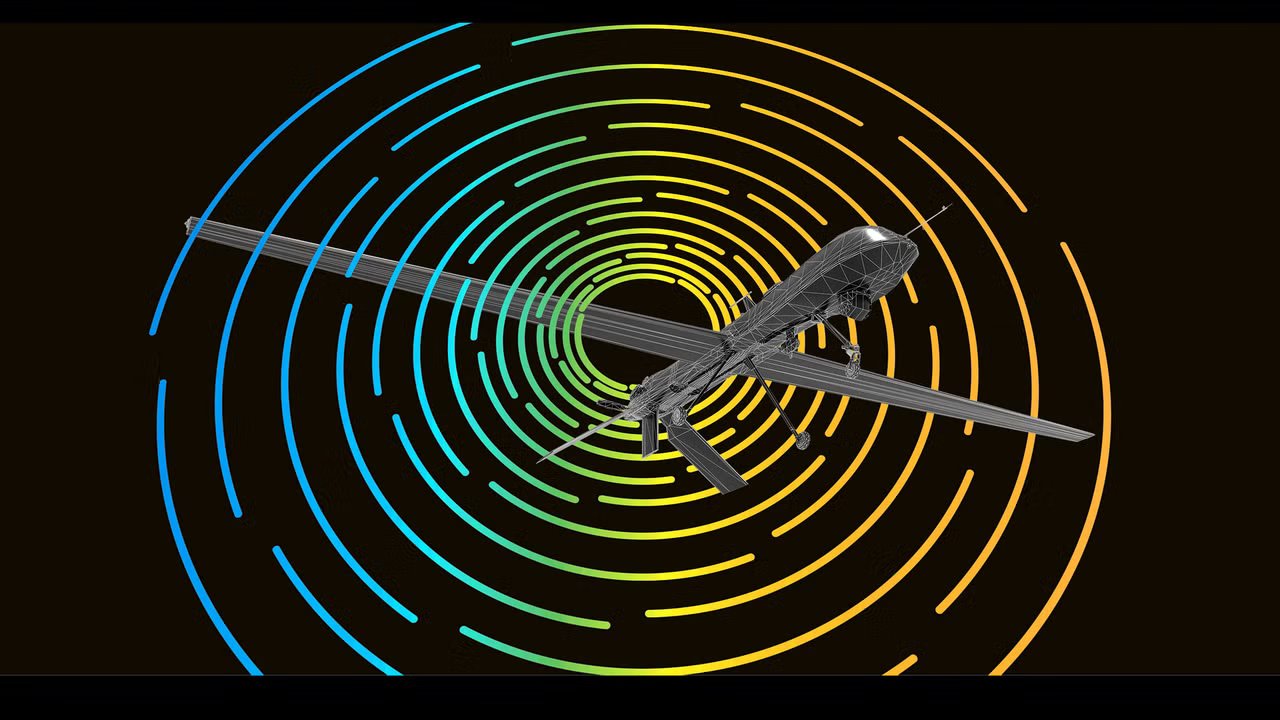
From Ukraine to the Middle East, Shield AI’s autonomous drones are deployed on the front lines. Brandon Tseng, cofounder and president of the San Diego-based company, is in the vanguard of this defense-tech explosion and the fierce debate over the use of AI in modern warfare. He confronts the hard questions: Can we trust the U.S. and its allies to wield AI responsibly? And why does this former Navy SEAL find building a company just as grueling as combat?
This is an abridged transcript of an interview from Rapid Response, hosted by former Fast Company editor-in-chief Robert Safian. From the team behind the Masters of Scale podcast, Rapid Response features candid conversations with today’s top business leaders navigating real-time challenges. Subscribe to Rapid Response wherever you get your podcasts to ensure you never miss an episode.
You started Shield AI with your brother Ryan a little over a decade ago after serving as a Navy SEAL officer. You deployed twice in Afghanistan and saw firsthand how robots could gather intel more safely. For a while, though, defense tech was kind of shunned, particularly in Silicon Valley, because of concerns about autonomous weapons. That’s changed. Shield AI is valued at almost $13 billion. Do you feel vindicated, or do you still feel underappreciated?
You know what’s funny? I would actually say defense tech, quote-unquote, didn’t exist in 2015. People couldn’t even shun it because no one was talking about it. I’ll tell you a quick story. Peter Levine from Andreessen Horowitz sits on our board. He’s an incredible investor and also a Stanford professor. He gave a guest lecture when I was at Harvard Business School. He’s like, “Yeah, I just invest in dumb companies, and I just invested in the dumbest idea yet.” And that dumbest idea was Shield AI.
I called Peter up and was like, “I heard you just invest in dumb ideas.” He’s like, “Yes, I did say I just invest in dumb ideas. It’s a dumb idea to get into a car with a stranger. That’s Uber. It’s a dumb idea to stay at a stranger’s house. That’s Airbnb. Everybody knows it’s a really dumb idea to work with the government to build defense. He said, Now two things are going to happen. Either one, you guys are going to fail, and it will prove to be a dumb idea, or you guys will be successful, and everybody will say, ‘Oh, that was a really clever idea.’”
So 11 years into the journey, I feel like I can breathe a little and say we were a little ahead of our time in terms of thinking about defense and the role of AI and autonomy in defense. So yeah, maybe a little vindicated. But there’s still a long way to go.
Your autonomous military tech is being used in Ukraine against the Russians. It’s been used in Gaza by the Israelis. The core product is software called Hivemind that allows drones and other vehicles to operate without a human in the loop and without GPS. Was that the dumb idea? Was this the capability and impact you were aiming for?
My background is I’m an engineer who has always been fascinated by technology, and the original vision was shaped by reading a lot about AI and autonomy in 2013, 2014, and 2015. I came to the realization that the world is going to be full of autonomous systems. Self-driving cars, humanoid robots, self-driving airplanes—like what Shield AI does—are really just the tip of the iceberg.
I would claim that within this century, you will see autonomous systems outnumber human beings on the planet. The impacts of that are going to be incredible. I think there’s going to be massive positive impact, and I wanted to be part of that. Then it became, okay, what problems can I solve? I kept coming back to the problems that I had faced, and decided that every single military asset by 2035 should be powered, commanded, and maneuvered by artificial intelligence. That was the original vision for the company. And look, probably not every military system by 2035. Maybe it takes until 2040 or 2045. But at this stage of the game, the momentum is unstoppable.
I mentioned to a colleague that I was going to be talking to you, and they asked me whether or how much you monitor if your tech is being used for a “just mission.” I suppose you experienced that as a soldier, too, in terms of how you were being deployed.
The answer is, first, we work with our partners and allies. At the end of the day, they can choose not to share data. They can choose not to share what happens on mission, if they so choose. We obviously want to work with them. We want to get the data because then it can improve the product. They have a right to sanitize that data. But again, I’m going back to defense exports and why we work with these allies and partners. The State Department governs this.
Not every single one of these countries has the same values, justice systems, or laws. But the reason we partner with them is because we say, hey, it’s better that they align with the USA. We can influence them over a period of time, versus having them align with China and China influencing them over time, or Iran or Russia. It’s much better to have them align with the United States.
I have never come across a situation where I’ve said, “Hey, I totally disagree with the State Department.” If it came to a point where there was a big delta between what the State Department was trying to do and how I thought about the world, or Shield AI thought about the world, it’s something we could take a look at, but I just don’t see that happening.
And you trust that the U.S. military’s use will always be just and appropriate. Because you’re in this business, it means that sometimes your services and your technology may be used in ways that maybe you personally might not have wanted, but you trust that.
Having been part of that machine, I absolutely trust it. And look, I’ve had to tell a couple of people this: The care that the U.S. military takes over the utilization of such incredibly powerful technology is astounding.
For every kinetic strike, for every Predator Hellfire that we shot, we turned off the mission 25 times more because we said, “Hey, there’s a risk of collateral damage. There’s a risk of civilian casualties. We don’t know who’s inside that building. We’re not going to do this operation.” Every single one of those missions, you have intelligence analysts, you have geospatial analysts. They’re looking at the risk of collateral damage, the risk of civilian casualties, and the probabilities that the enemy is who we believe they are.
I can’t think of an organization in the world like the U.S. military, where they have the weapons to dominate the world but also have extreme care and stewardship over those weapons and that technology. And look, they’re not perfect, just to be clear. The U.S. military has made mistakes. But I’d call it 1,000 times more wins than mistakes.
I saw somewhere that you said entrepreneurship, day in and day out, is grueling. It’s awful.
Yeah, it is awful.
So is it better or worse than being a Navy SEAL? And are there things that businesses could learn from Navy SEALs, and things the SEALs could learn from businesses?
The suffering is pretty equal. I would stress out more over losing investors’ money. That’s something I never wanted to do. I get more stressed out over that than the missions we would do as SEALs, and the risk to life as a Navy SEAL.
Are there things that you reflect on from your Navy SEAL days that you apply to the business?
Oh, 100%. One is the cultural aspect. I tell people Shield AI has a warrior culture. I would define that as a highly professional, highly disciplined organization that pursues excellence, figures out how to get the mission accomplished, and doesn’t give up. Taking it one step at a time is so important. These are things that you learn in the SEAL teams. When you get knocked down in entrepreneurship, you get back up and move forward. So I think there are a lot of parallels between the experiences I had as a SEAL and what it takes to do what we’ve done at Shield AI.
