
Published October 13, 2026 03:23AM
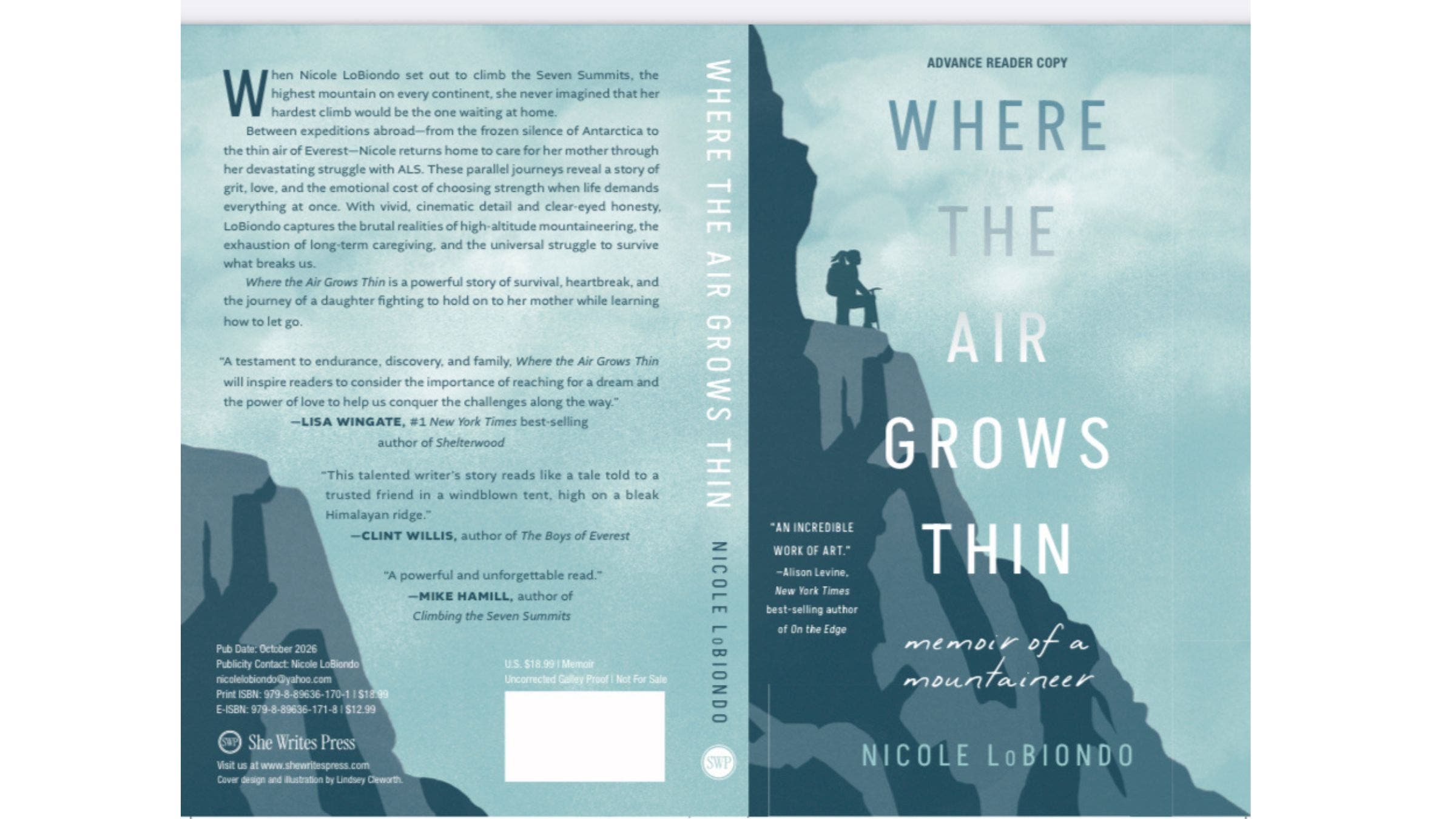
This story is excerpted from Nicole LoBiondo’s debut memoir, Where the Air Grows Thin, which chronicles her quest to climb the Seven Summits while serving as her mother’s primary caregiver through ALS. Blending high-altitude adventure with an intimate story of love, loss, and resilience, the book is available here, or wherever books are sold.
I wanted to know how a body feels when it’s dying.
Not in some distant, abstract way. I wanted to know in the way you know your own breath on a winter morning—intimately, viscerally, unmistakably yours. I wanted to know what it meant to be a body inside the moment the world collapses.
When an avalanche comes, it doesn’t surround you—it consumes you. When it approaches, it sounds like a freight train gone feral, wild on the tracks, its weight bearing down from every direction. But unlike a real freight train, there’s no warning, no brakes screaming before the hit. The terrible weight of white destruction keeps building, rumbling, roaring, until the earth itself moves beneath you. In that moment, all you can do is hope, and wait.
I would become good at both—hoping and waiting—in the last years of my mother’s life. But right now, all I wanted was to survive.
That morning on Everest, we were camped at a place they call, with cruel irony, the Valley of Silence. There is nothing silent about it.
We had just come through the Khumbu Icefall, that broken, heaving maze of blue ice that swallows people whole. Lhotse towered straight above us like a wall meant to keep us out. Nuptse stood off to the right, watching. Everything around us was white and cold and impossibly still, except for the tremble in our breath.
Our bodies were lean with years of preparation, hardened on smaller peaks that now felt like playgrounds. Every movement was muscle memory. Every breath was a calculation. We knew the dangers—hypoxia, pulmonary edema, cerebral swelling that could kill you before you even knew you were dying. But none of it felt theoretical. Up here, you are never more alive than when your death is just a moment away.
The air thinned until it barely existed, but we pressed on. That’s what you do on Everest. You keep going. There is no glory in the stillness. You climb because it’s the only direction left. I was in the tent with Kara—my climbing partner, my mirror in grit and madness. One second, we were sipping water and talking logistics. The next—the ground shifted. A subtle tilt, then a violent lurch. We looked at each other. We knew. Not with panic—with clarity. The kind that burns into you like a brand. The snow outside disappeared into a thick, fast-moving white. The world had gone quiet in that deceptive way it does just before it screams.
We didn’t know about the earthquake yet. Only that something had come unhinged. The tent began to move beneath us, sliding to the right, the avalanche rushing down from the left. Kara and I locked eyes—both of us understanding, without speaking, that this might be it. Her face contorted in terror. I felt the cold rise through my spine like a second skeleton. Then we lifted—just like that—lifted straight into the air and carried with the snow. Our bodies were weightless and useless. We belonged to it now.
Blocks of ice. Fist-sized rocks. The splintered heart of the mountain itself came crashing down around us. Not just snow, this was the whole mountain peeling itself apart, taking everything with it. The sound was thunder but deeper, like something ripping loose from the center of the world.
Kara—who for a living flies commercial planes through lightning storms without flinching—looked out at the wall of snow coming toward us and said it, her voice jagged and breaking: We’re going to die.
She tore open the tent and ran barefoot into the white chaos. I followed. I didn’t think. There was no time to think. Only instinct, only movement, only the bare skin of my feet on the frozen earth.
And then—white.
Only white.
The snow takes me.
It doesn’t feel sudden, though it is. One moment I’m upright, a body in motion; the next I’m airborne—flung like a rag doll, spinning through whiteness. My limbs flail without direction. Up becomes down. Down becomes a concept I can no longer trust.
Then instinct kicks in.
I slam my ice axe into the slope, my whole weight crashing down on top of it. For a second—just one—it holds. And that’s enough. Enough to stop the spinning. Enough to keep me from disappearing entirely.
Around me, everything is moving. Snow pours over me like a second skin. It rushes past my ears, fills the corners of my mouth, shoves its cold fingers beneath the collar of my coat. The sound of it is deafening and yet strangely distant, like listening to a scream from underwater. All I can hear—really hear—is my own breath. Fast. Shallow. Frantic.
I knew that sound. I’d heard it in the nights beside my mother’s bed—the fragile rhythm of a body deciding whether to stay. Survival sounds different depending on who’s listening. To her it was the wheeze of a machine; to me it was the mountain’s howl asking the same question: Do you still want to be here?
And then, out of nowhere, I’m back in my kitchen.
January. The snow outside was gentle then, a kind of lullaby against the windows. I remember the soft golden light in that room—the stained glass throwing sapphire and amber and blood-red across the wood floors. The mug in my hands was hot. I was safe. I was warm.
I remember looking at the avalanche training materials spread out on the counter beside me. The body-disposal form sat on top, absurd in its finality. Name. Date of birth. Preferred method if they find you—or if they don’t. I had signed it with a pen that clicked too loudly, my signature looping too neatly across the line, as if you could prepare for death with handwriting.
If you die on the mountain, your body will be put in a crevasse or buried in a respectful manner by your Expedition team members, unless you specify otherwise, and it is feasible to do otherwise at the discretion of the Expedition Leader.
If you die down low, it might be possible to get your body down where it could be cremated by Buddhist monks from the local monastery. This would cost well in excess of several thousand dollars, including the cost of recovery labor, transport, body preparation, wood, and appropriate donations to the local monastery.
If you die down low, it might be possible to get your body down for repatriation. If you elect for repatriation of the body, it would be via Kathmandu and would be quite complicated and would cost well in excess of ten thousand dollars and might take several weeks.
The words had felt bureaucratic then, almost comically detached. But now, in real time, they pulsed with meaning. I understood their weight in the most human way possible: I might be the body.
I thought I understood what it meant to risk everything for a view. I was wrong. Because nothing prepares you for this kind of fear, the intimate kind. The kind that slides inside your body and presses against your lungs from the inside.
Sometimes survival doesn’t look like strength. It looks like stillness. Like silence. Like staying exactly where you are when everything around you is begging you to let go. The roar stopped.
No more screaming.
No more thunder.
Just stillness—the kind that isn’t peaceful but final.
My body acted before my mind caught up. I rolled to my side and clawed upward, lifting my axe toward light—toward sky, toward breath, toward anything that wasn’t snow. I don’t remember how long it took. I just know that I broke through.
I dug myself out of what could have been my grave.
Everything hurt. My ribs. My shoulder. My sense of time. The avalanche had scrambled me into something unrecognizable. I didn’t stand—I crawled. Crawled through the wreckage of where our camp used to be, through the cold and chaos, through the cruel quiet that comes when death almost happens but doesn’t.
Thirty, maybe forty feet away, impossibly, a Sherpa tent was still standing. From inside, I heard chanting. Not the kind meant to soothe. This was something older. Something more primal. A dirge in a language my body recognized even if my mind didn’t. Low and steady and mournful. A sound that said: We are still here. But we were almost not. I looked around and saw no one. No Kara.
For a moment, I was sure she was still under it—under the snow, under the weight of the mountain. Her last words echoing like a curse: We’re going to die.
I kept crawling. Toward the tent. Toward the chanting. Toward anything. Halfway there, someone grabbed my arm and pulled me the rest of the way in. I fell into warmth—body heat and breath and the wild, uneven rhythm of people who had seen the edge and come back from it.
Faces swam into focus. Sarki. Pemba. Phurba. Fura. Nima.
And then—Kara. In the corner, knees pulled to her chest, her lips moving in time with the others. Alive. Trembling. Whispering prayers into the mountain’s throat.
She looked at me with eyes so full of shock I could barely hold them. But she was here. We both were. And that felt impossible.
The tent was heavy with what we didn’t say.
We had survived—but only just. The mountain had come for us and changed its mind at the last minute. That kind of mercy doesn’t come free.
Outside, everything had shifted. The terrain was no longer a landscape. It was a threat. We were trapped in a bowl of broken snow and silence, surrounded on three sides by steep walls of ice and rock that loomed like judges. The Lhotse Face above us—unclimbable now. The path back to Base Camp—gone. The Khumbu Icefall, that gnarled, deadly maze we had already crossed once, was worse than ever. Seracs the size of houses stood ready to fall. Crevasses waited beneath the snow like open mouths.
We could not go up.
We could not go down.
We could only sit there, alive and unsure what that even meant anymore.
I had sat like that before—at the foot of another mountain, the one called hospice. The same waiting, the same thin air of uncertainty, the same quiet bargain you make with whatever god you still believe in: Just one more breath.
There are things you know before you’re told.
The silence in a room after an avalanche is one of them.
I didn’t need the numbers. I could see it on their faces—the knowing. Not the shock of what just happened but the awareness of what that kind of force leaves behind. The people who won’t crawl out. The bodies that are now part of the mountain. The quiet calculation behind every still breath in that tent: Who didn’t make it? Whose name won’t be spoken aloud again?
Some of the Sherpas cried, quietly. No sobbing. No hysteria. Just saltwater tracking down weather-worn faces. These were the kinds of men who didn’t need to speak to be understood. Grief was there, plain and disciplined. They wept with the restraint of people who’ve buried friends before—who’ve carried the weight of death on their backs like packs and kept climbing anyway.
I looked for my team. I didn’t see them. No familiar shapes. No bright jackets. No names called out in relief. Just snow. Just prayer. Just the terrible wondering.
Maybe they’re gone. Maybe I’m the only one left.
When the chanting stopped, it was like the mountain had inhaled and wasn’t sure whether or not to exhale again. No wind. No movement. Just the long pause where you wait to find out if you’ve been spared—or if you’re next.
The radios were dead. Not broken, just quiet. No one knew what to say. Maybe no one wanted to be the one to speak into the static and say the wrong thing. Or worse, say the truth. Then a voice broke through.
“Is anyone alive at Camp One?”
A Sherpa beside me answered. “Yes. I’m in the tent with a few people.”
A pause. Then:
“Is Nicole alive? We have her brother on the phone with the Seattle office.” That’s the moment it became real. Not the snow or the terror or the breathless clawing toward daylight—but this.
My brother was on the phone. Calling Base Camp. Asking if I was alive.
He was probably in his office or in a stairwell, or sitting down somewhere because someone told him to. He was hearing the same silence we had just lived through, except for him it came through a line in Seattle, where the mountain is just a word. But still, he knew.
That’s the thing about fear—it travels. You think you’re out here alone, doing something brave. But you’re not. You’re tethered to every person who loves you, and when something tries to kill you, it drags them down too.
I thought about the nights I stayed up beside my mother’s bed, checking her breathing every few minutes like it might disappear if I didn’t.
And now here he was—doing that for me.
“Yes,” the Sherpa said. “She’s here with us.”
Those words opened something in me.
It wasn’t about being safe. I wasn’t safe. None of us were. The snow hadn’t stopped falling, and we were still pinned in by the walls of the Western Cwm, still sitting ducks in a bowl of death.
But my name had been spoken. I had been accounted for. And someone I loved had heard it. That would have to be enough. For now.
Then Base Camp came back:
“That’s good to hear, mate. We’ll communicate back to you when medevac is available.” “We need to get you out of there.”
But no one moved. No one reached for their packs or stood to look outside. We knew. There was nowhere to go. Not yet. We had survived one avalanche. We weren’t so sure we’d survive another.
Then the next report:
“Twelve confirmed dead. More unaccounted for. Checking for the walking wounded.” No one said anything. But we all knew what it meant. On Everest, you always know someone. The climbing community is small. You share tents and stories and routes. You share rope and oxygen. You share fear.
I closed my eyes. I thought about who might be gone. Whose face I wouldn’t see again at the next camp. Who I’d laugh with over instant coffee one morning, and by that afternoon, they’d be a body wrapped in nylon, waiting to be flown home.
Time folded. I remembered my kitchen again—the form, the signature, the ridiculous neatness of my own handwriting—and I felt an ache so sharp it bordered on reverence. We think we sign our names on paper, but sometimes it’s on the air itself, a quiet contract with the world to keep breathing.
And then—
The second avalanche came.
