

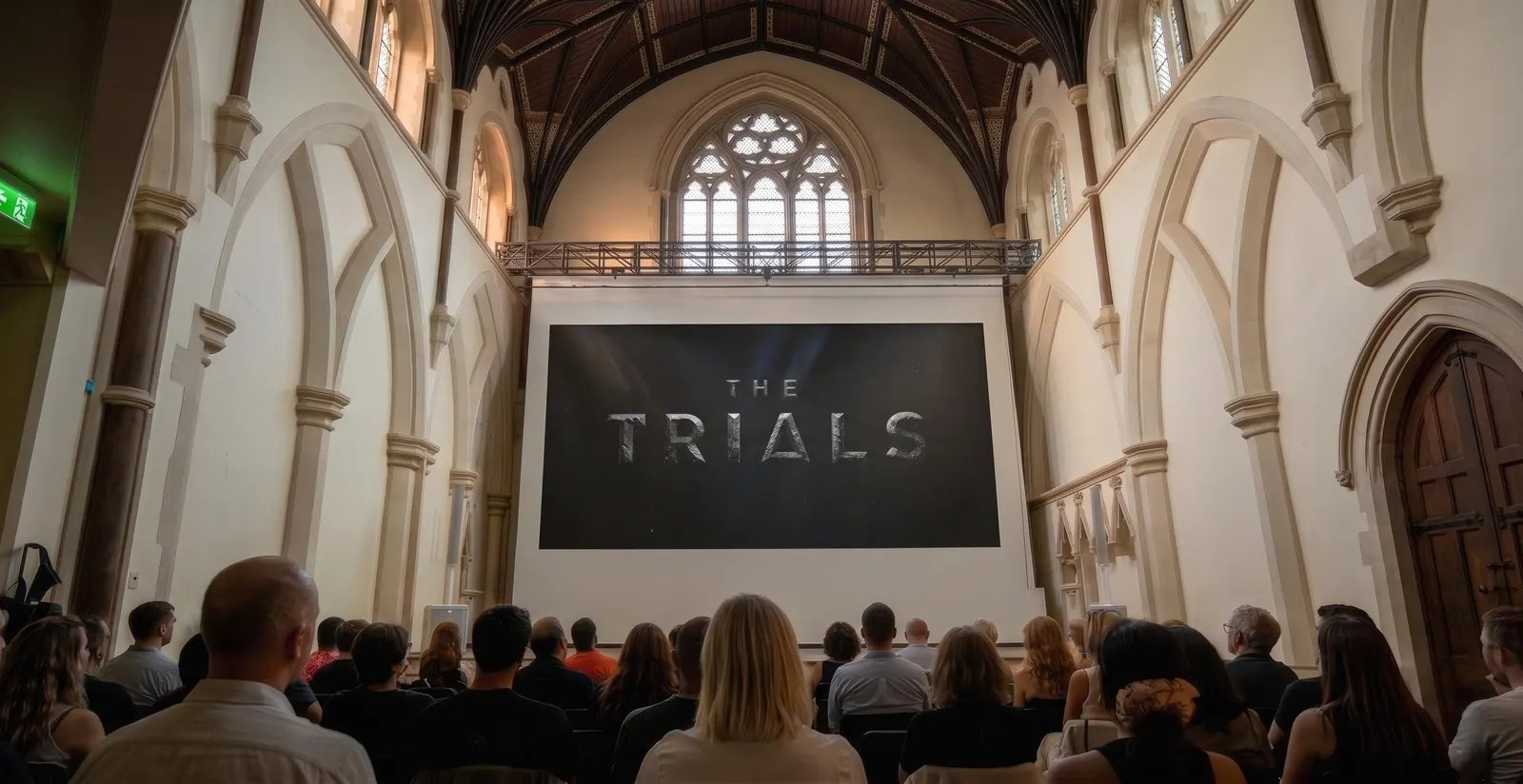
LONDON, ENGLAND: Wonder Studios HQ, East London converted church, June 4, 2026. The private screening of Hal Watmough’s AI film, The Trails
Courtesy of Wonder Studios Limited
Wonder Studios’ headquarters is a converted church in East London. On June 4, it became a screening room for the second season of Beyond the Loop, its anthology of short films made predominantly with artificial intelligence.
I had come to study the tools. For half an hour, watching The Trials, I forgot to.
The Trials, a science-fiction short by BAFTA-winning editor Hal Watmough, is built around a grieving girl, the planet’s apex animals and an injured cheetah. It plays less like a technology demonstration than a film trying to prove something larger: that AI can support story, taste, collaboration and a route to market.
That is where Wonder’s wager becomes interesting.
The company backs creator-led films as proof-of-concept IP, giving filmmakers money, tools, production support and an audience. In return, it takes ownership of the finished short. If the work becomes a feature, series or commercial project, the filmmaker keeps a share of what comes next.
If these films were only prompt demos, the contract would be a footnote. But The Trials is a 33-minute film built through writing, editing, concept art, model work, voice direction, sound design, grading and studio notes. The prompt is the least interesting part. The pipeline is the test.
From The Edit Suite To AI Filmmaking
Watmough walked me through the film in an interview after the screening.
He did not come to AI from software. He came from the edit suite, after years cutting television including the BBC’s The Repair Shop. Editors are trained to make meaning from material they did not shoot. AI changed the relationship: for the first time, he could generate the rushes as well as cut them.
His first instinct was not excitement. “I was concerned about this thing that was going to take our jobs,” he says. Curiosity won, but the anxiety never fully disappears. He talks about AI as an extension of a craft he already had.
“I always wanted this film to be an invitation and not a threat,” he says.
How The Trials Was Made
The story came before the software. Watmough had long been interested in climate and wildlife but resisted the familiar idea that humans must save the planet. “It’s not a victim,” he says of the Earth. “It’s fine whether we’re here or not. We’re just making a mess of it for ourselves.”
That reversal became the premise. Nature would not be saved by humanity. Nature might save humanity.
A second seed was smaller: a walk with his eldest son and a conversation about a universe Olympics, where species rather than nations would compete. Watmough usually begins with character, but here he built the world first and found Shona and her father inside it.
The Human Work Inside The AI Pipeline
The clearest picture of the method is in the creatures. Watmough spent four days in Lisbon with two concept artists, Ben and Camilla. They began by removing the creatures’ eyes, taking away the easiest route to emotion and forcing another question: why no eyes?
Perhaps they came from a world without light. Perhaps they arrived through black smoke. Perhaps they sensed through tongues, tentacles and movement.
For one creature, the team photographed a pinecone from multiple angles and used it as a starting point for an image model. The tool did not invent the creature. It sat inside a loop of drawing, discussion, rejection and refinement.
The process Watmough describes is not a person typing a sentence and receiving a movie. It is closer to a compressed production room, where human collaborators, models and finishing tools keep passing material back and forth.
The moving image ran mostly on Seedance, the ByteDance model Watmough calls the “king of tools” for now, with Kling alongside it and stills from Google’s Nano Banana and an OpenAI image model.
Treating The Models Like Difficult Performers
Watmough treats the models the way a director might treat a difficult performer. They are powerful, but they need managing. He built a look that flattered their limits: grain, low light, handheld movement and a less centered frame than AI images often produce by default. He did not want viewers clocking the film as AI.
“AI has to work harder to earn someone’s investment,” he says.
That applied to performance, too. Watmough says he did not prompt for generic emotions such as “sad” or “scared.” He gave the model the dramatic situation: what the character had lost, what she could not control and what was happening around her. The fuller the context, he says, the more nuanced the result.
Much of the film is not synthetic. Watmough put it through a traditional grade and sound mix, aiming for grain, a 24-frame feel and a wide cinematic frame. The score is human-made library music. He generated the lead’s voice but performed several other voices himself before processing them through ElevenLabs, one of Wonder’s tool partners.
The result is hybrid from end to end.
What Wonder Adds
None of it, Watmough says, could have been made conventionally. The scope would have required something close to a $100 million budget. Wonder gave him $25,000. He made the film in six weeks, largely at night after his children were asleep.
“If AI didn’t exist, this wouldn’t exist,” he says.
Wonder also became part of the edit. One note from a colleague added the riot and special-operations sequence that Watmough says rescued the middle of the film. “I was so far down the rabbit hole I would never have seen it,” he says.
That makes the ownership question sharper. Wonder is funding, shaping and packaging work it hopes can travel beyond the short. The second Beyond the Loop season includes seven films for YouTube and Wonder TV, with CapCut and ElevenLabs among its executive-producer partners. The studio has raised a $12 million seed round led by Atomico.
In New York, Wonder is holding a private screening around the Tribeca Festival, showing the cold open of The Trials alongside three other films. Dreams of Violets, a feature-length AI film Wonder has no part in, is set to be among the first to reach a major festival.
The Ownership Trade-Off
Watmough is clear about the trade. Wonder owns the finished short. “They own the IP of the finished piece,” he says. Asked whether that means 100%, he says: “One hundred percent, yeah.”
The upside comes later. In Watmough’s description, future development would be split 50/50 between him and Wonder. Xavier Collins, Wonder’s cofounder and CEO, says the filmmaker retains “50% ownership of the IP they created” when a short scales, and that the stake travels with the project.
“I saw this as a win-win,” Watmough says. “If it was just making the film, that would have been enough for me.”
That is both the appeal and the unresolved part. Wonder gives filmmakers small budgets, fast production, tool access, feedback and distribution. It also asks them to exchange ownership of the finished work for participation in what it might become.
Two weeks before the premiere, Watmough joined Wonder full time as filmmaker in residence. He says the deal on The Trials remains intact, while future projects would likely sit on separate contracts inside the studio.
The Test Beyond The Short
By the end of the screening, The Trials had held the room. Wonder is not only testing whether AI films can be made cheaply or quickly. It is testing whether a new production pipeline can turn a filmmaker’s idea into developable IP.
The real distinction is not prompt versus camera. It is pipeline versus ownership. One determines whether the film can be made. The other determines who benefits if it works.
