

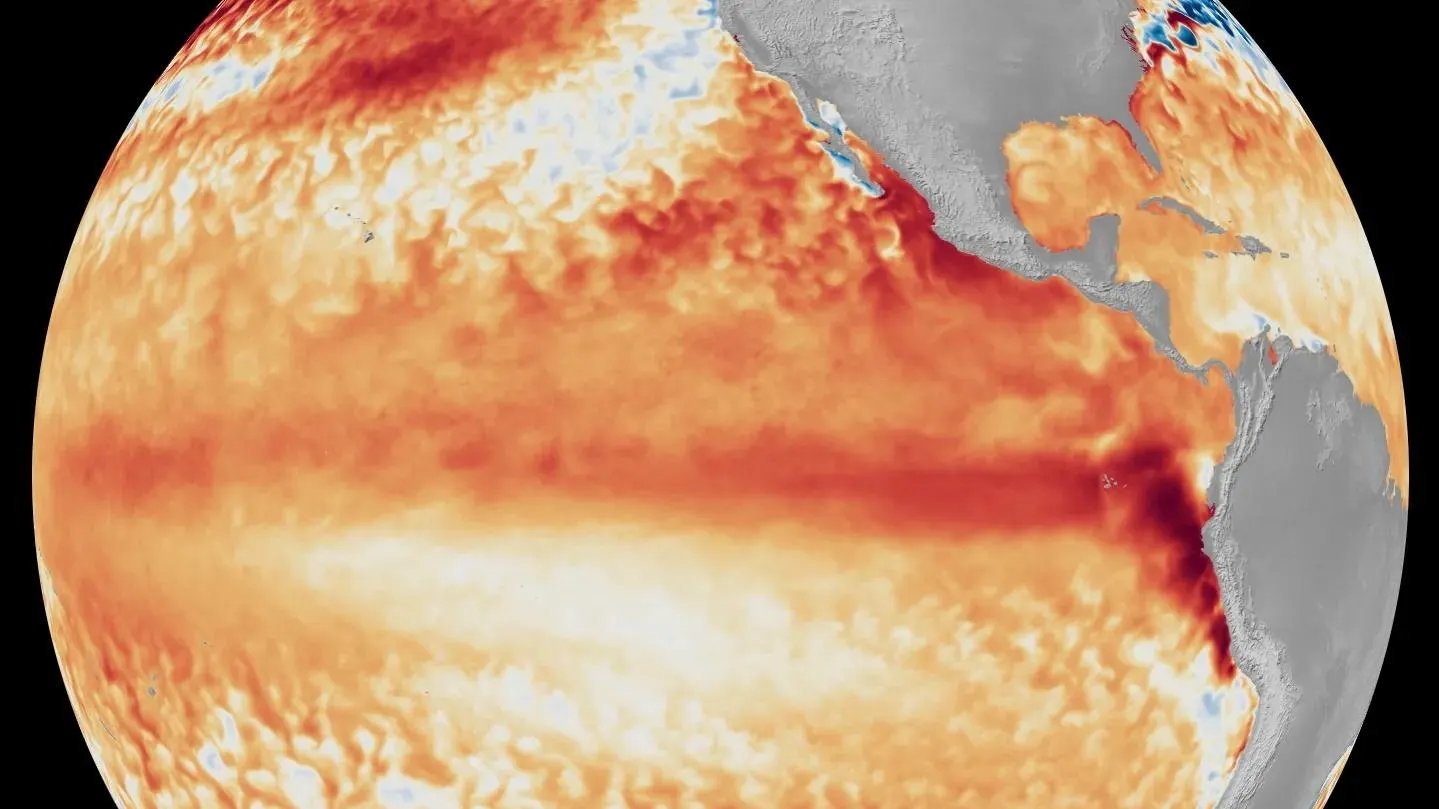
Warm sea surface temperatures during the first week of June indicate the presence of El Niño.
NOAA
The FIFA World Cup matches began this week, but that is not the only thing with global implications in recent days. The National Oceanic and Atmospheric Administration announced that El Niño has formed. Here’s what that means, and why forecasters believe it could be a potentially “super” one.
El Niño Is Here
“El Niño has developed in the tropical Pacific,” wrote a NOAA press release earlier this week announcing an El Nino Advisory. “El Niño, the warm phase of the El Niño Southern Oscillation (ENSO), is predicted to intensify to a moderate or strong level this fall,” the notice continued. NOAA forecasters and experts around the world say there is a 63% chance that the sea surface temperatures in the eastern Central Pacific will exceed 2 degrees Celsius above the neutral threshold.” For those of you who do not speak Celsius, that is 3.6 degrees Fahrenheit. “If this threshold is surpassed, NOAA considers the event a “very strong” El Niño,” the press release stated.
Neutral and El Niño conditions
NASA
That could be conservative. While some climate experts weeks ago cautioned that it was too early to be conclusive about the strength of this event, all signs indicate that the “hype” may be warranted. El Niño is a part of a natural climate oscillation called ENSO. If temperatures are nearly 1.0 degree Fahrenheit above average or greater for consecutive months, then El Niño or the warm phase is declared.
La Niña is the cool phase. The ENSO cycle is related to a coupled relationship between winds, temperature, and pressure in the Pacific Ocean. The global models and indices used to diagnose and predict ENSO phases rely on an array of satellite, ocean, and atmospheric observations. Scientists have noted that global ocean observing systems play an important role in monitoring El Niño, which has significant impacts on agriculture, national security, energy, and other societal activities.
Past El Niño events within the past 75 years.
NASA
So What?
Both phases have an impact on global weather patterns. That’s the “so what?” According to NOAA typical impacts for the U.S. include:
- Less active hurricane season in the Atlantic basin due to stronger upper-level winds, but enhanced storm development in the central and eastern Pacific basins.
- Stormy conditions in the southern tier of the country.
- Increase likelihood of high tide flooding and harmful algal blooms, particularly the West Coast.
“Dry regions of Peru, Chile, Mexico, and the southwestern United States are often deluged with rain and snow, and barren deserts have been known to explode in flowers,” according to NASA’s website. “Wetter regions of the Brazilian Amazon and the northeastern United States often plunge into months-long droughts,” it continued. Agricultural, fishing, and other ecosystem services can be disrupted by strong events.
Jet stream patterns and El Niño.
NASA
Past “super” El Ninos that exceeded maximum thresholds were observed in 1982-1983, 1997-1998, and 2015-2016, respectively. “In the just-released April ENSO outlook from the European Center for Medium-range Weather Forecasts, every one of the 20-plus model ensemble members is predicting moderate or strong El Niño conditions by mid-June,” wrote Bob Henson and Jeff Masters in Yale Climate Connections several months ago. “For October, roughly half of the ECMWF ensemble is calling for sea surface temperatures in the main El Niño region (Niño3.4) to exceed 2.5 degrees Celsius above the seasonal average.” Historically that threshold is considered the trigger for a Super El Niño, but I have not really seen a formal definition,” they cautioned.
Well, it’s here. Let’s see how strong it actually gets.
Bulldozers scoop up debris, including downed palm trees, along the Los Angels river bed, Wednesday, Oct. 29, 1997 in Glendale, Calif., as the Army Corps of Engineers started clear the riverbed. The Corp of Engineers, along with the County of Los Angeles, is completing flood control preparations for El Nino, which includes the removal of accumulated sediment, vegetation and debris from the 95 flood control facilities along the Los Angeles River and flood channels across the county. (AP Photo/Damian Dovarganes)
Copyright 1997 AP. All rights reserved.
