

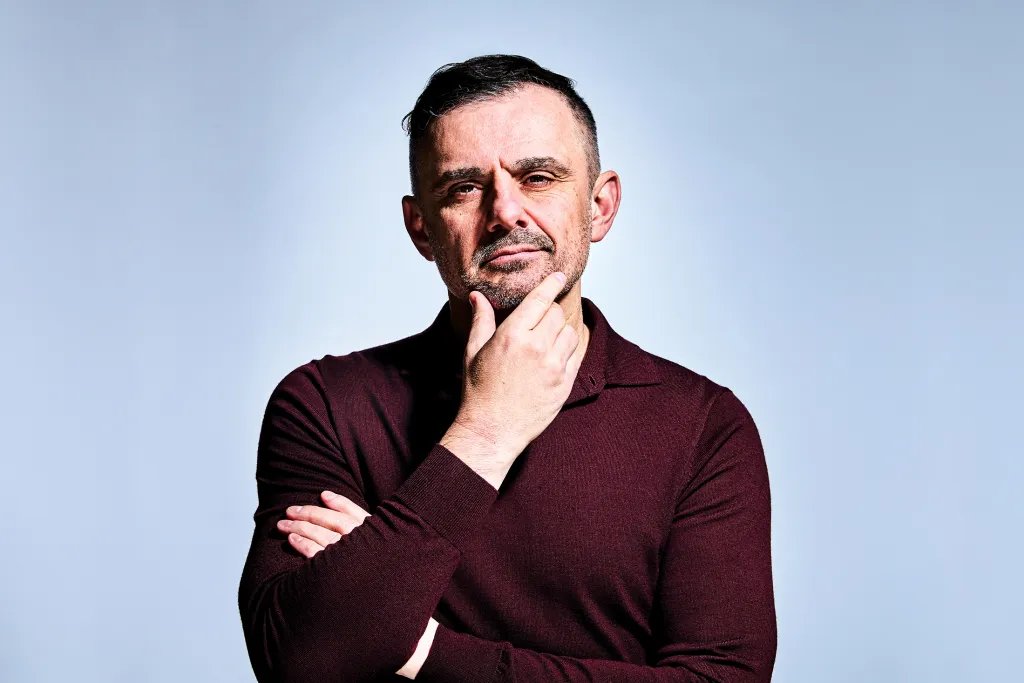
If you want to see the future of work, just look at Gary Vaynerchuk’s DMs.
He’s spent his career pushing people toward action — telling them to build something, to own something, to take control of their lives and financial destinies. Now, millions of entrepreneurs and career-builders turn to him for advice, DMing him their most pressing and personal questions. The patterns of their anxieties tell a story: Here’s what people need now. Here’s what bothers them the most.
Today, Vaynerchuk is seeing something new and interesting: “They’re feeling trapped,” Vaynerchuk tells me. “They’re starving out there.”
Why? Because they have one main job or company, but they want more. Maybe their economic anxiety is pushing them to make more money or to find more lines of revenue. Maybe they’re watching the rise of AI, seeing how it can make their lives more efficient, and wondering what else they can do with their time. Whatever it is, they want to expand. But they don’t think they’re allowed to.
Entrepreneurs and professionals have been told a very specific story: Success requires relentless focus. Pour everything you have into one thing. Commit yourself to it fully. As David Packard (of Hewlett-Packard) famously wrote: “More businesses die from indigestion than starvation.” In other words, the greatest risk to your business isn’t doing too little. It’s doing too much.
Vaynerchuk agrees, to a point. Many people thrive with focus. And a business requires dedicated operators who think nonstop about its needs and opportunities.
But many people are built differently, he says. They are the creative thinkers. The restless builders. The ideas people. They have boundless energy and ambition, and it drives them to start new businesses or seek new accomplishments outside their day jobs. And here’s the most important part: For these kinds of people, doing one thing is stifling. It drains their energy and makes them less productive. But when they’re let loose, everything they do thrives.
So if you want more, Vaynerchuk says, you should get more. “More” means more personal and professional satisfaction. You’ll create more opportunities for your team, and have more energy and enthusiasm and ideas for everything that you do. “For literally more than 50% of you reading this,” he says, “you need this for your soul.”
But it requires know-how to make this happen. Because “more” requires strategy and intention — or else, yes, everything you do really will fall apart.
Vaynerchuk offers himself as living proof of how it can work. He may be known for his social media output, but he’s equally prolific as a builder of companies — having founded the ad agency VaynerMedia, production companies VaynerWatt and Eva Nosidam, media publisher Gallery Media Group, marketing agencies Tamara Group and ChukMedia, corporate barter and trading company Tingley Lane Trading, thought leadership platform Marketing for the Now, VeeFriends, VeeCon, as well as a speaking agency, a sports agency, a food and hospitality group, original content, and…well, more.
And if he didn’t do these things? “I’d be burned out,” Vaynerchuk says, “because I wouldn’t be happy enough.”
If you feel the same, then he wants to show you a path forward.
Image Credit: Nigel Parry
I am sharing Vaynerchuk’s philosophy here because I think he’s right. But also because I’ve struggled with this question too.
I job-hopped my way through my career — because I’d get bored and miserable after about two years of working anywhere. I’m too curious. I crave newness. The same would have been true at Entrepreneur, where I’ve been the editor in chief for 10 years…except that here, I learned how to transform myself into an entrepreneur. While running this magazine, I now juggle many outside projects: I start companies, join advisory boards, and make my own media. Every day is different.
A few years ago, I met a billionaire who wanted to mentor me. We began having monthly calls. But every time we talked, the billionaire would press me on the same point: You’re doing too much, the billionaire would say. Pick one thing and focus. Make a list of all the things you’ll stop doing.
This tore at me. Here was a wildly successful person, known and admired by many, and he was showing me his pathway to success. But deep in my gut, what he said felt wrong for me. I didn’t want to pick one thing. It felt limiting and stifling. So instead, I stopped scheduling calls with the billionaire.
It’s been a few years now. I still wonder if that was a mistake.
Then, a few months ago, Vaynerchuk called me and suggested this article. He said he wanted to talk about being a “juggler” — because that’s what he thinks of himself as, and he wants to give others permission to do the same. And he knew I’d relate. We first met in 2009, just as he was launching VaynerMedia and I was entering national magazines, and our careers grew in parallel frenetic ways.
So I arrived at Vaynerchuk’s office — the one his fans are familiar with, with the shelves full of sports and pop-culture paraphernalia, which serves as the backdrop for so much of his social content. And as we talked about this, he predicted that, five years from now, someone who read this article will approach him about it.
He narrates the future conversation:
“Gary,” they’ll say. “I read your Entrepreneur article five years ago, I listened, and now I actually make less money.”
“Oh?” Vaynerchuk will reply.
“Yeah. I used to make $530,000 as a lawyer. Now I’m a lawyer and I own a beer garden, and I make $330,000.”
“But are you happier?” Vaynerchuk asks the imaginary person.
He feels sure the answer will be yes.
This feels orienting to me. Because it cuts to the heart of a question that every entrepreneur must ask themselves: What do I want from my work? Your answer is what you should optimize for.
Vaynerchuk knows his answer: “I’m doing all of this for myself,” he says. “I want to see how good of an entrepreneur I am.” His goal isn’t to build one specific company. His goal is just to build. It is to take that specific action, and embrace that challenge, and live life as a builder, because that is his core. And that means one company will never do.
This made me think of the billionaire who mentored me. What is that man’s goal? Well, he’d told me: His goal is to build companies toward massive exits. He measures his success by the creation of extreme wealth. And if that’s the case, then of course he wants to focus on one thing! He pours everything into one company, because that’s his pathway to selling it. He’s done it many times.
But me? And maybe you? Money is not what drives me. And that’s why the billionaire and I didn’t understand each other. Yes, I like making money, but I don’t need mountains of it. I primarily want to live a life of my own choosing, free from the demands and restrictions of bosses and corporate life. I want full autonomy of my time. I want to explore unexpected paths, and to push the boundaries of my talents and usefulness.
So I ask Vaynerchuk: How do you do it? How do you become a juggler?
Image Credit: Nigel Parry
Vaynerchuk stands up. He plants both feet on the ground, next to each other. Then he takes a half-step to the right.
This is the visual he wants you to consider. Your weight was fully planted in one place. Now you’re shifting that weight — potentially destabilizing where you started, while also needing to build a solid foundation for your other foot to land on. Before you step, you must do an audit on yourself. Ask: What are you excellent at, and what excellence do you need from others?
Start with yourself. Vaynerchuk remembers when everyone doubted his ability to start VaynerMedia. He was just a guy making YouTube videos out of his parents’ wine store, and then he launched an advertising agency. It seemed unserious at the time. Today it operates as the flagship of a diverse portfolio of brands under parent holding company VaynerX, a nearly $400 million business. So how did he do that? And how, today, can he start a production company that’s creating content for Amazon Prime and the History Channel? And how can he sell eight figures’ worth of assets through VeeFriends? And how can he open a members-only club, Flyfish Club, in Manhattan?
The answer to these questions is the same: “Because we’re good at marketing,” he says. “If I start a doughnut shop or a nuclear power plant or a SaaS business, my competitive advantage is the ability to outmarket anyone and everyone in every sector.”
That’s it. One skill, transferable across industries. He can drive viewers to the TV show, drive excitement to VeeFriends, and drive members to a club. The guy just knows how to market. And in this way, a seemingly incoherent collection of businesses has an internal logic. It is tied together by a core discipline.
“And other people have disciplines too,” he says. Maybe you’re great at finances, or team building, or partnerships, or sales. “Someone could be a great operator — and they could go into a private equity firm, or a flyer shop, and either way they could look at the P&L and say, ‘God, they’re wasting $2 million a year.’”
Whatever it is, you must know this about yourself. Recognize what your transferable value is. Because in this way, every new thing you do is just a new expression of your core skill set.
Next, let’s look at what other people in your orbit are excellent at — because if you’re going to divide your time and energy, other people will need to rise in your place. “It requires humility to let people shine outside of you, even if you are the reason they are shining,” Vaynerchuk says.
At the highest levels, Vaynerchuk has always leaned on people he trusts deeply. He’s built VaynerMedia and VaynerSports with his brother, AJ. He built VaynerSpeakers with Zach Nadler, who was his speaking agent at CAA for six years. He built Wine Library with Brandon Warnke, his best friend since age 14. These are relationships he never has to question.
Then you must get comfortable with not being the person who does everything. That’s a hard adjustment for entrepreneurs, especially if you’ve been laser-focused on one thing for a long time. We come to believe that we are integral to our companies’ success — as if everything must be done by us or else it won’t get done right.
But Vaynerchuk has some tough news for you: “Most things don’t matter,” he says. Not only do entrepreneurs inflate their own sense of value, but they also inflate the importance of the things they’re devoting their time to — which means you’re often putting valuable time into things that just don’t require it. “There’s 15 people in your company that can do it,” Vaynerchuk says, “and most people’s B’s and C’s are actually better than your A’s, because the overall impact on this thing isn’t big enough.”
Whenever there’s a new initiative, Vaynerchuk likes to operate with what he calls the 15-80-5 rule: “I need to be involved in the 15% up front, to really synthesize the idea,” he says. “I’m the offensive coordinator. Then my direct report and their team go away and do 80% of it. And then I get involved in the last 5% to put a cherry on the sundae, and we move on.”
He pulls up his calendar to show me what this looks like. We’re staring at Google Calendar on his monitor, and it is a dense, color-coded wall of appointments. Most of them are just 15 minutes long, which he says is plenty of time to make important decisions. “Hourlong meetings are just 15 minutes of meat anyway,” he says.
Once you start structuring your days like this and empowering your team to operate without you, something tremendous happens: You create more optionality for your top performers, because you now have more opportunities for them to pursue. He offers an example: One of his employees has been at VaynerMedia for nine years. She’s a superstar, but was somewhat frozen in place because the person above her wasn’t leaving. This is often why companies lose great talent; there’s just no more room for advancement. But in this case, the VaynerMedia employee was just able to shift to a more senior executive role at another one of his companies.
“So not only does this create optionality for me,” he says, “but it creates optionality for everyone.” Because Vaynerchuk knows: He isn’t the only guy at his company who wants to do more. By thinking so ambitiously, he’s attracting and retaining exactly that kind of person.
Image Credit: Nigel Parry
If I ran all this by the billionaire who mentored me, he would probably offer the following counterpoint: If you only commit a fraction of your energy to one project, you’ll only see a fraction of the rewards. Companies grow slower when you spread yourself thin.
I share that with Vaynerchuk, and he concedes the point. Yes, if he focused exclusively on VaynerMedia, it would be pulling in significantly more. If he focused solely on VaynerWatt, it might have 50 shows on TV now instead of the 10 in development. But he’d feel trapped inside that success. It wouldn’t feel satisfying.
And that would be even worse for his company. Again, he says, it’s a question of what you’re optimizing for. Is it growth? Or happiness? Which do you need more? To him, expansion is happiness. And a happy half-time Vaynerchuk is vastly more productive than an unhappy full-time one.
I’m reminded of the way brain coach Jim Kwik talks about burnout: “Sometimes we’re burned out or exhausted, not because we’re doing too much, but we’re doing too little of the things that make us come alive,” he says.
Vaynerchuk loves that. And he wants you to consider an important final question: What happens when you do the things that make you come alive?
The answer is: Everything you do benefits. And you could prove that billionaire wrong.
He lays out a scenario: Imagine you run a PR firm, and you also dream of owning a coffee shop. “You haven’t opened the coffee shop in your town because everyone told you to focus,” Vaynerchuk says. But without that coffee shop, your days are feeling sluggish.
So you open it. And at first, your PR firm shrinks a little. You’ve diverted your energy elsewhere. But then…wait. The coffee shop energizes you. It also puts you in touch with more people, who become PR clients. It gives you new ideas about how to reach people and to communicate brand stories, and you become better at PR as a result, and your PR company grows. “It gave you the escape you needed,” he says.
I am living proof of this. People are often surprised at how supportive Entrepreneur is of my own personal entrepreneurship. But Entrepreneur is not foolish; the company directly benefits from my external pursuits. First of all, I’m happier — which is why I’ve stayed in this role so long. But also, I’m constantly meeting people, learning things, and encountering ideas that I then bring back to Entrepreneur. My personal connections often become my employer’s partners and sources.
This shouldn’t be shocking. If you only do one thing, you’re only exposed to one set of contacts and experiences. If you do more, your network and experience expand. You become a source of collective wisdom and experience. Vaynerchuk sees it himself — how he learns something through one of his companies, and then benefits from that learning at another. “I have an unbelievable depth of knowledge,” he says. “I’m fucking unstoppable in every meeting. I have too much context.”
Image Credit: Nigel Parry
Vaynerchuk doesn’t unplug for vacation often. But when he does, he goes all out. “I have no interest in seeing a sight. Do not get me a tour guide,” he says. “I don’t want to do anything.”
Most recently, he went to Turks and Caicos. He pulled up a chair on the pristine beach, plugged in some headphones, and listened to Lil Wayne, Jay-Z, and Biggie for nine hours straight. And as he stared out into the great blue nothingness, he also started to watch a little kid nearby, who was building the most immaculate sandcastle Vaynerchuk had ever seen.
From maybe 8 a.m. to 5 p.m., this kid worked and sculpted. His attention to detail could rival the architects of medieval cathedrals. It was a masterpiece.
Then, as evening approached, the kid’s mom called him in for dinner.
“I watched this kid look at his castle,” Vaynerchuk says. “Then he smashed it. And he left. And I sat there and thought, ‘Oh, my God, I’m this kid.’”
Why do entrepreneurs build?
For some, it’s about belonging. We build something to identify with, and to occupy us, and to immerse ourselves inside.
For some, it’s about outcome. We build toward an exit to make a ton of cash, and to enjoy those spoils.
For others, like Vaynerchuk, and the sandcastle kid, and me — and maybe you — we build for some of those reasons. We love our work, and we want to be rewarded. But mostly, we’re building for ourselves. Because it’s how we explore the world around us. Because one thing will never satisfy us. Because it makes us happy. Because we want to see the boundaries of our potential.
So if you want to build, build. Don’t let someone else’s definition of success hold you back. Build until it’s time to smash it to the ground and walk away. The act of building was always the part that mattered most.
