

Published August 18, 2026 02:54PM
I told my dad I was getting a robot massage. His response? “That’s very bizarre.” I understood his skepticism, because I was doubtful too. I had so many questions: Does it have human-like fingers? Would it know when to stop if the pressure got too intense? Can it actually relieve my aches in a way that’s comparable to a typical massage? Despite my hesitation, I still booked the $89 60-minute Aescape session, hoping it could ease my back and knee pain after a week of long runs. Here’s how that went.
Aescape Is an AI-Powered Masseuse
Aescape is an AI-powered massage robot. Founded by investor and tech entrepreneur Eric Litman, the robot masseuse stepped onto the recovery scene in 2017. It’s billed as “precision bodywork that adapts to your body and builds on every session before it,” according to the website. Once you’re in the system, it saves your preferences so that you don’t have to readjust the machine every visits, saving you time.
This functions as an alternative recovery tool that you can schedule at any time your preferred location is open. Unlike humans, robots don’t need days off making it convenient option for when you have knots you want worked out right away. And it may be cheaper than your usual massage. For example, a one-hour massage with my favorite massage therapist costs about $125 per session.
Aescape is available at over 140 locations across the U.S. and partners with Equinox, so you can easily find one at a nearby gym. However, the Aescape closest to me was at the W Hotel in Boston. I had to book my session online before going over there.
The online form outlines an array of massage types to choose from. The “Express” is just 15 minutes, and “Full Back, Glutes, and Hamstrings” targets knots, relieves tension, and lasts 45 minutes.
I selected “Create Your Own Aescape” so I could customize my experience. I chose glutes, hips, lower back, and calves as my focus areas. I run three to four times a week, logging two to five miles each session. I’ve always had bad knees, but trail running has made them more sensitive over the years—which is not uncommon for runners. And going downhill with admittedly lazy form when I get fatigued has given me some gnarly lower back pain. Even though the emphasis is on the lower body, the upper back and traps are still included. I chose a time slot and was ready to go.
The Aescape Room Feels Like a Solo Spa
I walked in through the giant glass doors of the hotel’s main entrance; the Aescape room was the first door to my right. I checked in at the front desk with a man—let’s call him Rob—and waited for the previous Aescaper to exit. After Rob reset the machine, he told me I could head in and offered to adjust the room temperature. Rob shut the door, and I was alone in a dimly lit room filled with an intoxicating aroma of incense.
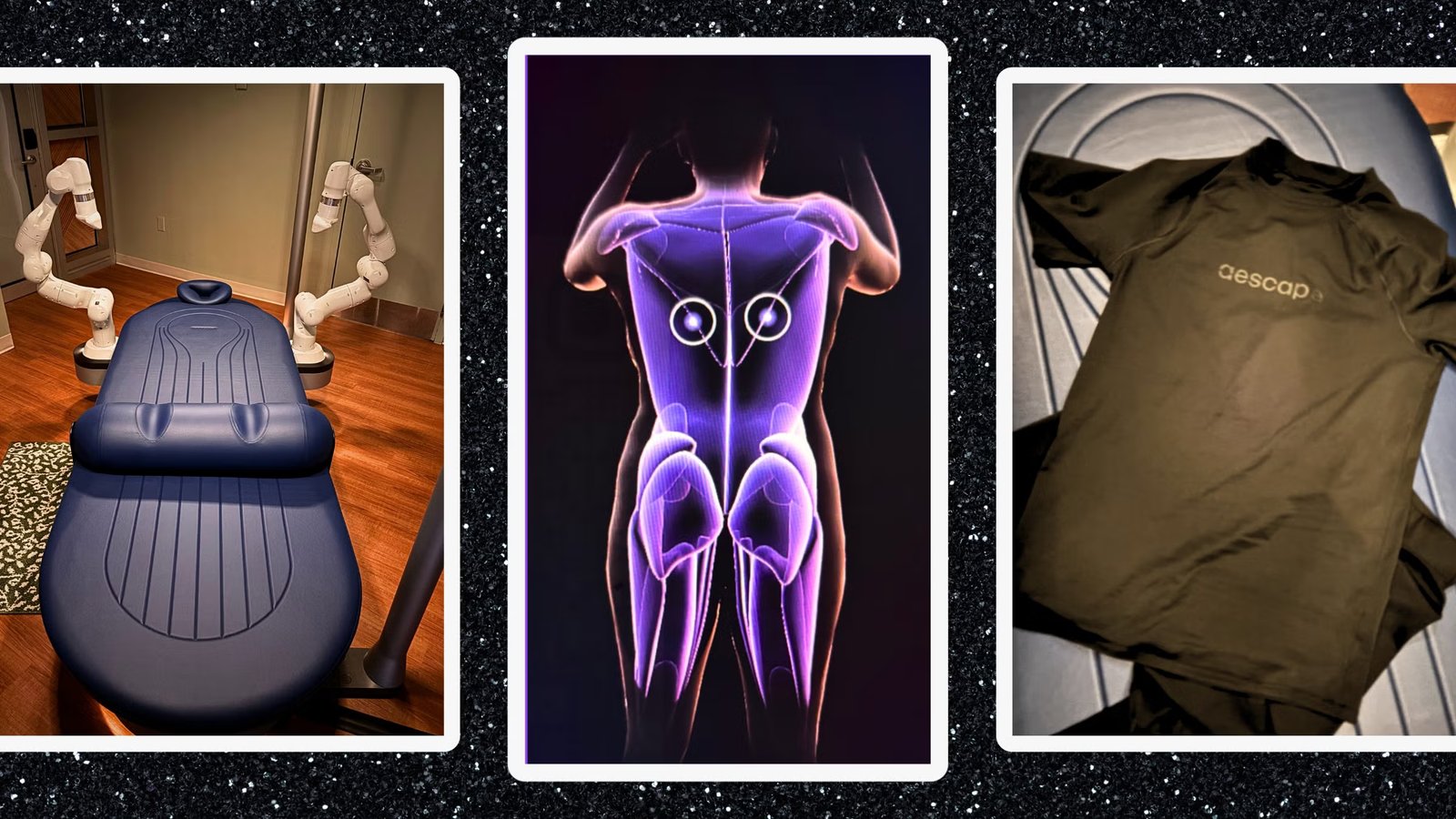
The lightbulb cast a warm golden glow over six wicker bins lining the windowsill. Each bin was labeled with a size—from XS to XXL. Rob had suggested I wear Aescape’s yoga-like apparel so the machine could scan my body more easily. No bras. No shoes. No jewelry. He also cautioned that the massage could potentially rip regular clothes. How intense was this thing? I thought to myself. I heeded his warning because I didn’t bring a second set of clothes. I pulled on the silky navy blue leggings and a short-sleeved shirt.
The machine had long, white spider-leg-shaped arms. To my mild disappointment, there were no fingers and no face. I was lowkey hoping for an I, Robot-style figure. Alas, this wasn’t that, but I was still excited.
Getting Scanned By the Bot
I lay face down on the plush, navy table and put my face inside the opening at the head end. I positioned the fronts of my ankles atop a bolster. My hands rested on the lower level of the table on either side of an iPad-sized screen. The built-in tablet asked me a few questions about my current muscle fatigue level, my activity in the last seven days, and whether I wanted to start with low, moderate, or high pressure. Because I rated my fatigue at seven out of ten and had a high-intensity training week, I chose moderate to start but could still adjust the pressure during my session.
Up next was making adjustments to the massage bed. I adjusted the headrest height, moved the ankle bolster until it rested just above the front of my ankles and kept my toes off the table (the iPad told me to do so), extended the headrest back for better neck support, and lifted the armrest a few notches so my arms weren’t awkwardly hanging down beneath me.
Then the screen told me to stay still while the robot scanned my body from above. A purple-and-white scan of my body then popped up on the screen. I could tell it was accurate because it even captured my slightly bent left arm. I clicked Start and watched as the robot arms cast a shadow over me before making contact.
It Found Almost Every Knot in My Body
This massage was pretty damn great. The tips of the arms alternated between a thumb-like feel and palm-sized pressure. It started at the base of my neck and moved downward, working out all the kinks. I upped the pressure when it hit my traps, and an involuntary sound of relief escaped my mouth. Because I was alone, I ooh’d and aah’d audibly without embarrassment. That’s perk one of a non-human massage. The second was that I didn’t have to engage in the small talk that often precedes a massage. My introverted self was pleased.
There was a huge selection of music genres. I cycled through hip-hop, country, and house. I decided on a genre called Space Dreams, which did, in fact, sound slightly eerie and otherworldly. It was perfect, and I descended into sunken-place level hypnosis.
I loved being able to adjust the pressure, and the steps called “lengthening,” where the bot pulled my muscle fibers and my butt cheeks (yes, really) in opposite directions, felt heavenly. It soothed the pain in my calves and really dug into my lower back. There was a cool “Immerse” option where I could choose from a few moving outdoor scenes. I picked ocean waves. Overall, the massage itself was delightful. There were only a few things I didn’t love.
Con number one of a non-human massage: the no-fingers thing meant that the tiny knots in my upper traps and on the sides of my calves were missed.
Con number two: I had to stay still, except for small movements when I adjusted the pressure or lowered the music volume. I went to adjust my shirt, and the robot immediately pulled its arms away, and the screen lit up with a scathing warning: Multiple body parts are out of alignment. Please readjust. Then, click continue. Oops. I made the bot angry. It re-scanned me and proceeded to knead my lower half.
Con number three: the wearing clothes part took some getting used to. I generally enjoy the lotion-infused skin-to-skin contact of a typical massage. The machine’s arms would sometimes catch on the fabric. It wasn’t annoying enough to be a problem, but it was noticeable.
This brings me to the final and arguably biggest con: there was a scary moment when the machine jolted against my back, a few inches to the right of my spine (aka my most tender spot). But, fortunately, the machine recalibrated itself. While I couldn’t say “stop” or “ouch” like I could to a human, I could push an emergency stop button if things got out of hand.
When the robot finished its work on me, I didn’t want to leave. My body felt looser, and I was in a significantly better mood than when I had arrived. I tossed my yoga clothes in the nearby hamper before leaving the room. Rob offered me a bottle of water so that I could replace the fluids I lost after sixty minutes of constant kneading and prodding.
Overall, I’d recommend Aescape to anyone who needs some tension relief. I’d be lying if I said it can completely replace a human massage. It’s not quite there yet, but it’s an excellent choice for someone who is introverted and whose current masseuse is completely booked. I would go back.
And in a cruel irony, the day after my session, I pulled a back muscle while deep cleaning my bathtub. My next Aescape appointment is in two days.
Want more Outside health stories? Sign up for the Bodywork newsletter. And, for tips on how to train, fuel, and recover better, sign up for the Sweat Science 101 newsletter.
