

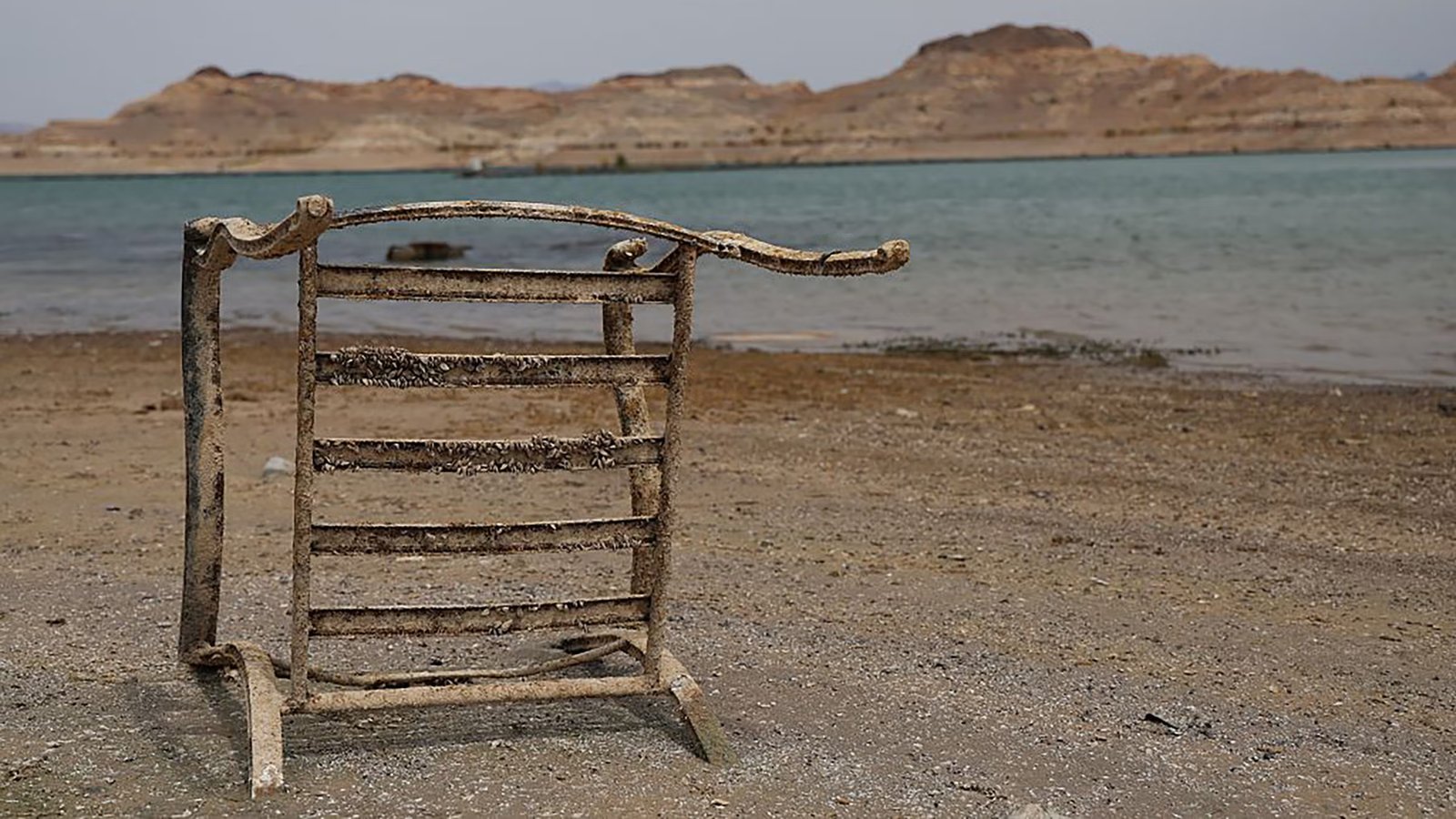
Visitors at Lake Mead recently found human bones on a dry beach. The reservoir recently hit its lowest water level on record.
eng Hui/Xinhua via Getty Images (Photo: Zeng Hui/Xinhua via Getty Images)
Updated August 19, 2026 03:45PM
A visitor to Lake Mead National Recreation Area (LMNRA) discovered human remains on August 16 on a newly exposed stretch of shoreline.
The grisly discovery comes as the country’s largest reservoir has hit its lowest point since it was opened almost 90 years ago.
The office of public information for the Las Vegas Metropolitan Police Department (LVMPD) confirmed the discovery to Outside. “On August 16, at approximately 3:58 P.M., LVMPD received a call of human remains at Lake Mead National Park,” a spokesperson told Outside. “A non-criminal, dead body report was taken for the remains.”
The National Park Service later confirmed in an email statement that there was no indication of criminal activity.
The discovery was reported by a Las Vegas woman, who told local CBS News affiliate 8NewsNow her friend was shifting through the shoreline at Lake Mead’s Boulder Beach when he picked up a human jawbone with teeth still attached. Additional bones were spotted nearby along the shoreline. The group called authorities, who temporarily closed the area to investigate.
No information has been released about the identity of the person, how long the remains had been in the reservoir, or the circumstances of the person’s death. If possible, identification will be determined by the Clark County coroner’s office, though the process can take several months.
A History of Discoveries at Lake Mead
The discovery of human remains on August 16 is not the first at Lake Mead or Boulder Beach. In 2022, several sets of human remains surfaced when water levels fell to then-record lows, including bones and clothing that were found inside a metal barrel near Hemingway Harbor. Other remains, later believed to be from people who had drowned earlier, were also found.
These grisly discoveries are a macabre product of the drought that has gripped much of the Southwestern United States for the last 26 years. Lake Mead and Lake Powell, both of which are fed by the Colorado River, have seen water levels consistently drop since 2000.
“As lake levels continue to drop, new parts of the lakebed will be uncovered as a result,” Gina Gilson, PhD, an assistant professor and interim director of Utah State University’s Center for Colorado River Studies, told Outside. “There were many cultural sites and artifacts that are now underwater, and there’s a possibility that some of those are accessible and visible again.”
The dropping waters have also exposed a wide array of other discoveries, from sunken boats to artifacts from bygone eras of U.S. history.
In 2022, investigators looked into the remains that were located inside the metal barrel in Hemingway Harbor. They determined that the individual had died from a gunshot wound, and was likely dropped in the lake in the seventies or eighties.
Crisis Levels for Two Reservoirs
According to an August 2 hydrologic report by the Bureau of Reclamation, Lake Mead is at 27 percent of its total capacity, while Lake Powell, the Colorado River’s other major reservoir, is 23 percent full.
The entire Colorado River system sits at just 32 percent of of its normal capacity. It’s a near-record low that matches measurements from July 2022—a water level drop Lake Mead hadn’t seen since March 1937, when the reservoir was still filling for the first time.
“This is a significant wake-up call,” J.B. Hamby, chairman of the Colorado River Board of California, told the New York Times. “We need to have long-term solutions that are going to get us away from the precipice.”
However, the receding water levels have the potential to impact more than just additional discoveries, says Gilson. She points to a key elevation: 950 feet above sea level, or the level below which Lake Mead would be too low for the Hoover Dam to generate electricity. The Hoover Dam provides electricity for roughly 1.3 million residents across California, Nevada, and Arizona.
“Currently, Lake Mead sits around 1,039 feet in elevation, and we still have around 89 feet to go,” Gilson says. But she cautions that “significant efforts” are needed to avoid reaching that threshold.
“This year was a bad water year, and water levels will continue to fall,” she says. “Conditions reflect the fact that we have over-allocated the river and are over-using relative to what Mother Nature provides.”
