

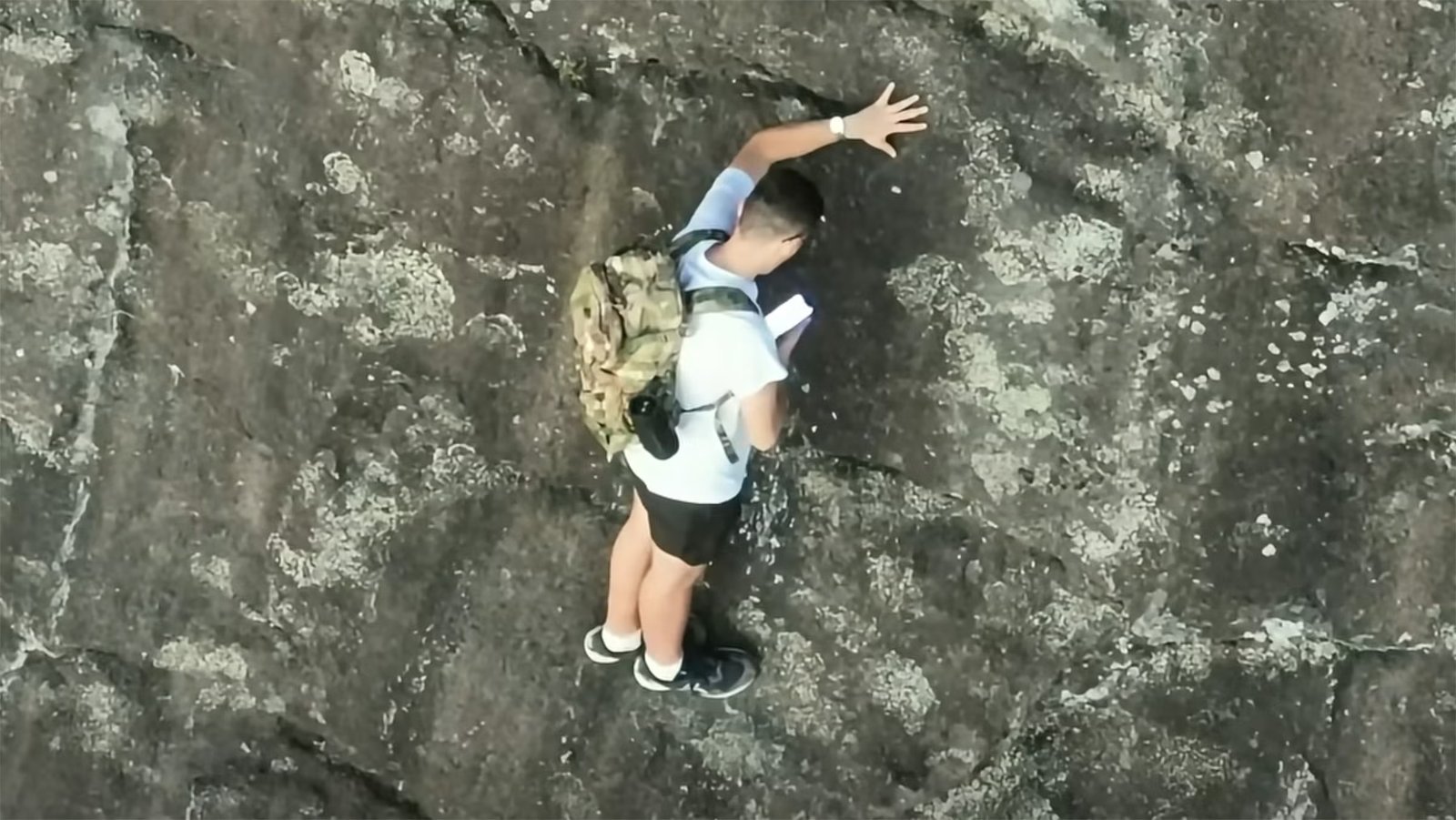
Wearing running shoes and a backpack, a hiker attempted an unroped ascent of Mount Yonah, a popular climbing crag in Georgia. Rescuers plucked him from a tiny ledge.
A screengrab from the drone footage of a rescue on Mount Yonah (Photo: White County Public Safety)
Updated August 27, 2026 12:48PM
Outside features editor Frederick Dreier called rescuers in Georgia who recently saved a hiker on Mount Yonah. Will Roper of the local fire department talked us through the mission to bring the hiker down alive.
A hiker in Georgia is lucky to be alive after he attempted to scramble up a well-known climbing route with little more than sneakers, a backpack, and his cell phone.
On Tuesday, August 25, rescuers from the White County Public Safety (WCPS) division received an SOS call at 7 P.M. According to a WCPS Facebook post, a hiker was stranded on the side of Mount Yonah, a 3,166-foot granite dome located 90 miles northeast of Atlanta.
Crews arrived on the scene and then flew a rescue drone up the mountain to locate the stricken hiker, whose name has not been released. They saw him approximately 260 feet up the mountain’s face on a steep slab of granite. He was standing on a 20-inch by 20-inch ledge and was unable to ascend or downclimb, the report said.
“He was about 40 or 50 feet below the top of the mountain,” Will Roper, a firefighter and EMT who participated in the rescue, told Outside. “The rock face isn’t totally vertical, but there are spots that have some bigger hand holds that are almost vertical. It’s a really exposed face, and there are points at which there’s not a whole lot to grab onto.”
Overhead video shows the hiker clinging to the side of the cliff, his low-top running shoes angled into the ledge to prevent him from falling.
A Popular Crag for Local Climbers
Mount Yonah rises 1,500 vertical feet from the northeastern corner of Cleveland, Georgia, and is a popular destination for local hikers and rock climbers. The eastern flank of the mountain is gradual and wooded, and it’s western face is a 300-foot wall of exposed granite.
Mount Yonah’s granite face is the training site for the U.S. Army Rangers, which operates courses in rappelling and mountaineering on the peak’s steep granite face. Mountain Project, a website that catalogs rock climbing areas, lists 246 different routes, including 49 on the main face. Roper said that the top of the crag has numerous bolts and anchors that rock climbers use to ascend sport routes.
Roper said hikers do occasionally ascend the peak’s rock face via a technical scramble, but reaching the top by foot requires detailed knowledge of the route, as well as proper gear.
“You need to get beta from people or have a guidebook to know where you’re going,” he said. “A lot of people think Mount Yonah is an easy hike. We pluck people off of it all the time.”
A Series of Unfortunate Decisions
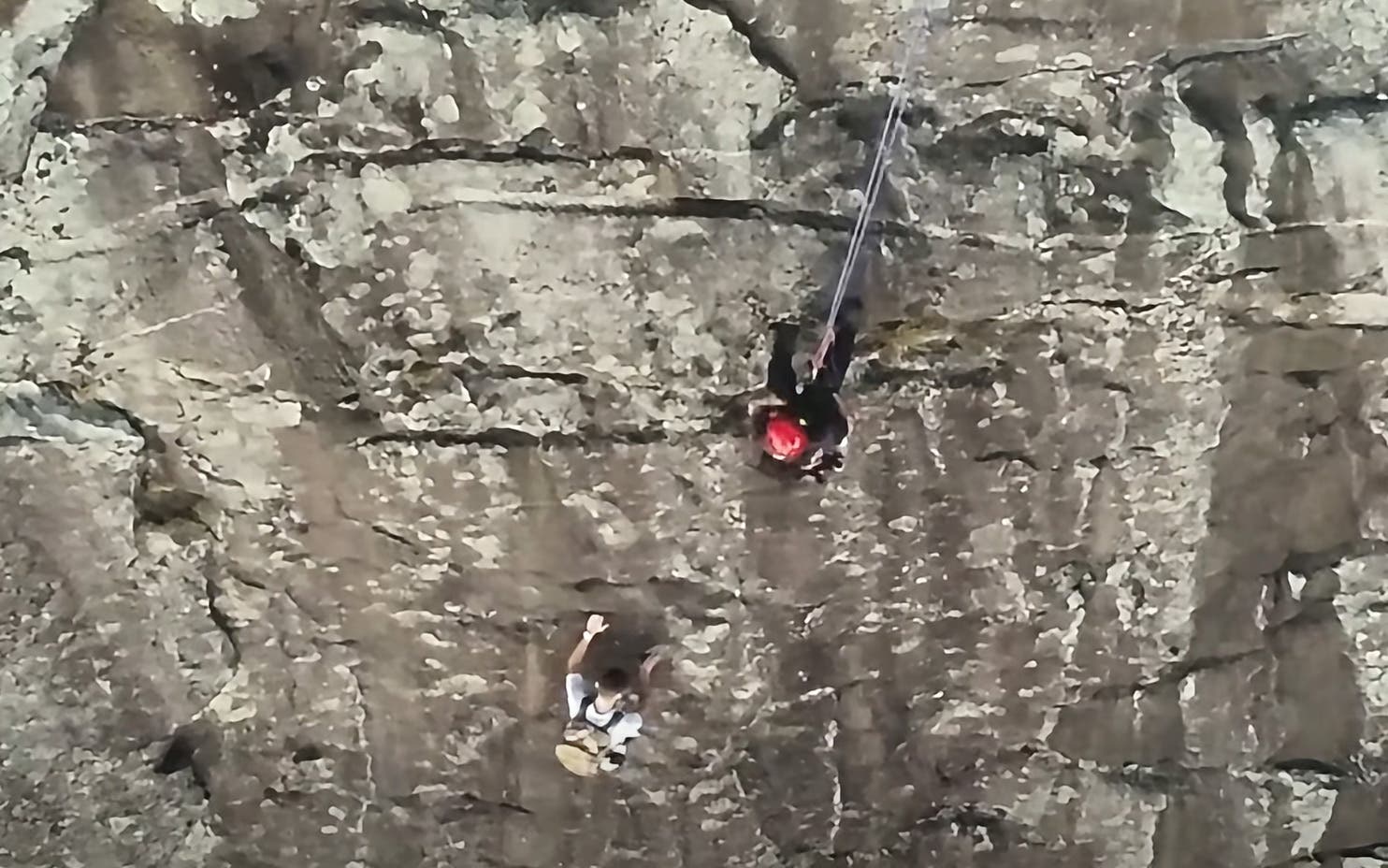
At the top of the peak, Roper and his team fixed webbing and ropes to natural anchors, and he then climbed into a safety harness. He rappelled down to the hiker just as the sun was dipping below the horizon.
“He was very apologetic when I reached him,” Roper said. “He said he’d gotten on the wrong line and just got over his head. I appreciated his attitude.”
Roper affixed a harness to the hiker, and then the two of them rappelled down 250 vertical feet to the nearest flat terrain.
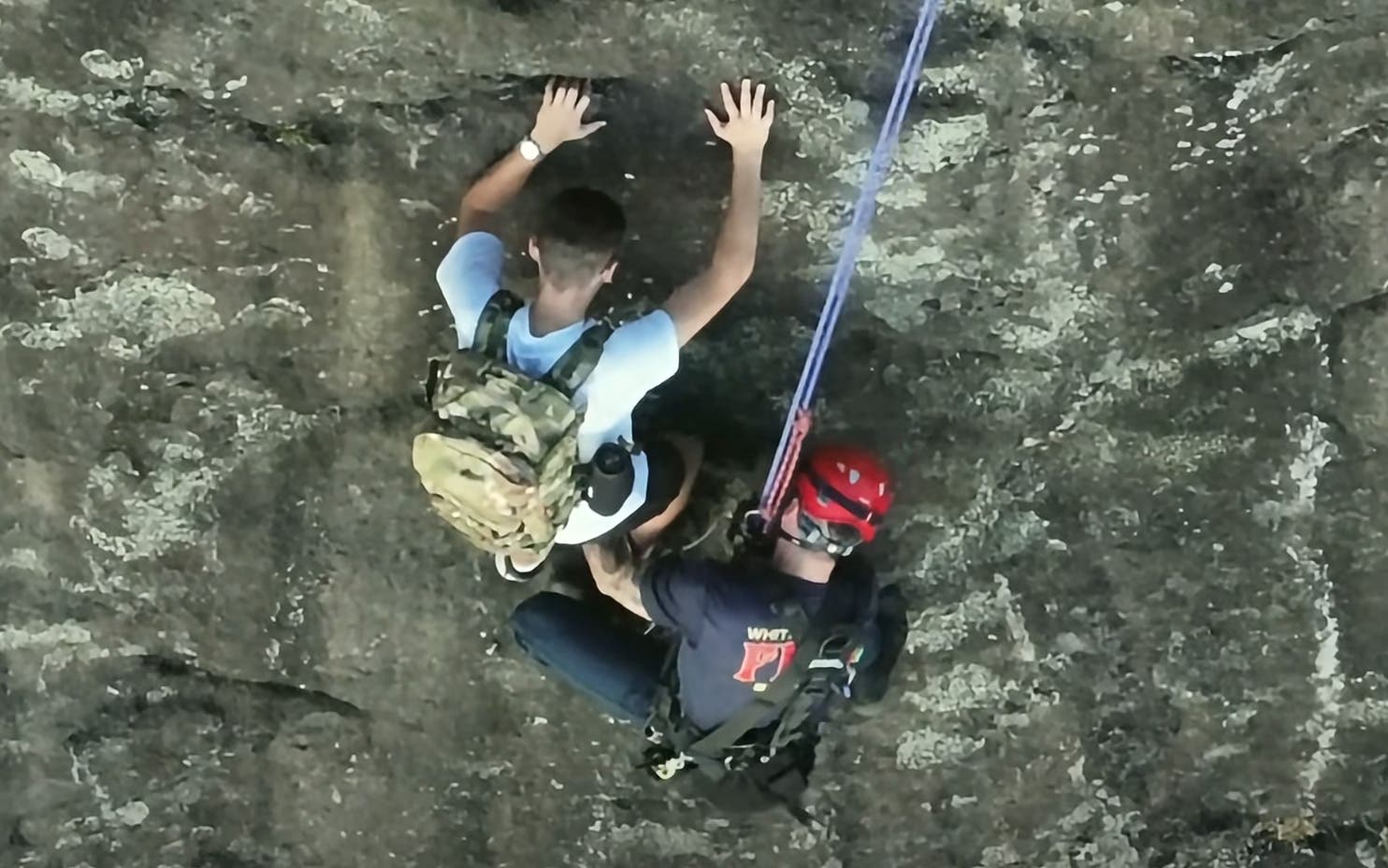
“He was really easy to coach back down once I got the harness on him,” Roper added.
The hiker told Roper that he planned to follow the scrambling route up the peak, but lost his way and quickly found himself unable to ascend or descend. Rather than chance it, he decided to call for rescue.
Roper praised the man’s decision to call for help.
“It was a series of unfortunate decisions that got him into that hairy predicament,” Roper said. “I’m glad he decided to swallow his pride and give us a call. Had he attempted to downclimb or push to the top, there was a low probability of him getting out of the situation without a catastrophic injury, or worse.”
A Plea for Proper Footwear
The hiker, Roper said, was not properly equipped for such a strenuous climb, because he was wearing sneaker and he carried a massive and heavy backpack.
“Most people I see on Yonah are in boots,” Roper said. “He seemed to be the least equipped of anyone I’ve seen.”
Roper frequently climbs and trains at Mount Yonah, and said that when he sees hikers scrambling the rock face, they usually have helmets, day packs, and either hard-soled hiking boots or approach shoes.
That’s because one wrong move, Roper said, can quickly lead a hiker into terrain that’s suited for rock climbers.
