


Published September 1, 2026 10:37AM
Let’s say you’re an adult in your 70s, running or biking or swimming two or three times a week. How hard should you push?
That’s the question posed in a new study in Medicine & Science in Sports & Exercise, from a research team led by Sindre Midttun of the Norwegian University of Science and Technology. The answer isn’t obvious—for reasons that may be familiar if you’ve been following recent debates about zone 2 exercise, polarized training, and other related fitness theories.
Sweat Science 101
Sign up for a ten-part email series from Alex Hutchinson on how to train, fuel, and recover. Each week, Alex covers a new topic, including strength training, supplements, and more!
What the Study Tested
The data comes from a large ongoing study called Generation 100, which was open to everyone between the ages of 70 and 77 in the Norwegian city of Trondheim. Participants were originally randomized into three groups and either told to follow public health guidelines by getting half an hour of moderate exercise per day, or enrolled in twice-a-week supervised sessions of moderate (70 percent of max heart rate) or intense (80 percent of max heart rate) exercise. The program lasted for five years.
The original results were published back in 2020, and they weren’t particularly striking. After just five years, there wasn’t much difference between the three groups in how many of them died. Part of the problem is that there wasn’t that much difference between the groups, because they were allowed to do whatever they wanted outside the supervised sessions. On average, the control group actually ended up exercising more intensely than the moderate-exercise group, which muddies the waters.
For this reanalysis, the researchers decided to forget about who was randomized to what group, and just look at what the subjects actually did, as reported on exercise questionnaires. From the original sample of 1,500 people, they picked out 500 who consistently reported doing either moderate exercise (between 11 and 14 on the Borg scale, which corresponds to “fairly light” or “somewhat hard” on a scale from 6 to 20) or high-intensity (15 or higher, corresponding to “hard,” “very hard,” or—wait for it—“very, very hard”) over the five-year period. Note that the high-intensity group wasn’t necessarily doing intervals; they were just pushing harder.
The question the researchers asked was: Did the choice of exercise intensity make any difference to the aerobic fitness of the subjects, as measured with periodic VO2 max tests?
What We Expect to See
The two groups were pretty well matched. They did a similar amount of exercise (both duration and frequency) over the five-year study period. So we should expect the group that pushed harder to gain more fitness (or, for people in their 70s, to lose less fitness), right?
Not so fast. One of the big trends in exercise in recent years has been the rise of zone 2 training, which involves keeping your intensity slightly below threshold. That’s a moderate effort that enables you to carry on a conversation in full but slightly strained sentences. This is thought to be a metabolic sweet spot that maximizes fat-burning and optimally stimulates your mitochondria. (I did a deep dive into this topic last year.)
One of the key arguments in favor of zone 2 training is that this is how many of the world’s best endurance athletes do most of their training. What’s sometimes called “polarized training” might involve doing 80 percent of your training in or around zone 2, and just 20 percent above it. You could explain this as a matter of practical convenience: doing lots of relatively easy training enables you to accumulate big volumes of training, and leaves you fresh enough to really go hard in the other 20 percent of your workouts.
But another explanation—the one that zone 2 boosters subscribe to—is that pushing above zone 2 actually makes your workout worse. Your metabolism shifts from fat-burning toward carbohydrate-burning, lactate begins accumulating in your muscles and bloodstream, and you no longer trigger the mitochondrial adaptations that you’re looking for. If that’s the case, then harder isn’t necessarily better.
What the Data Shows
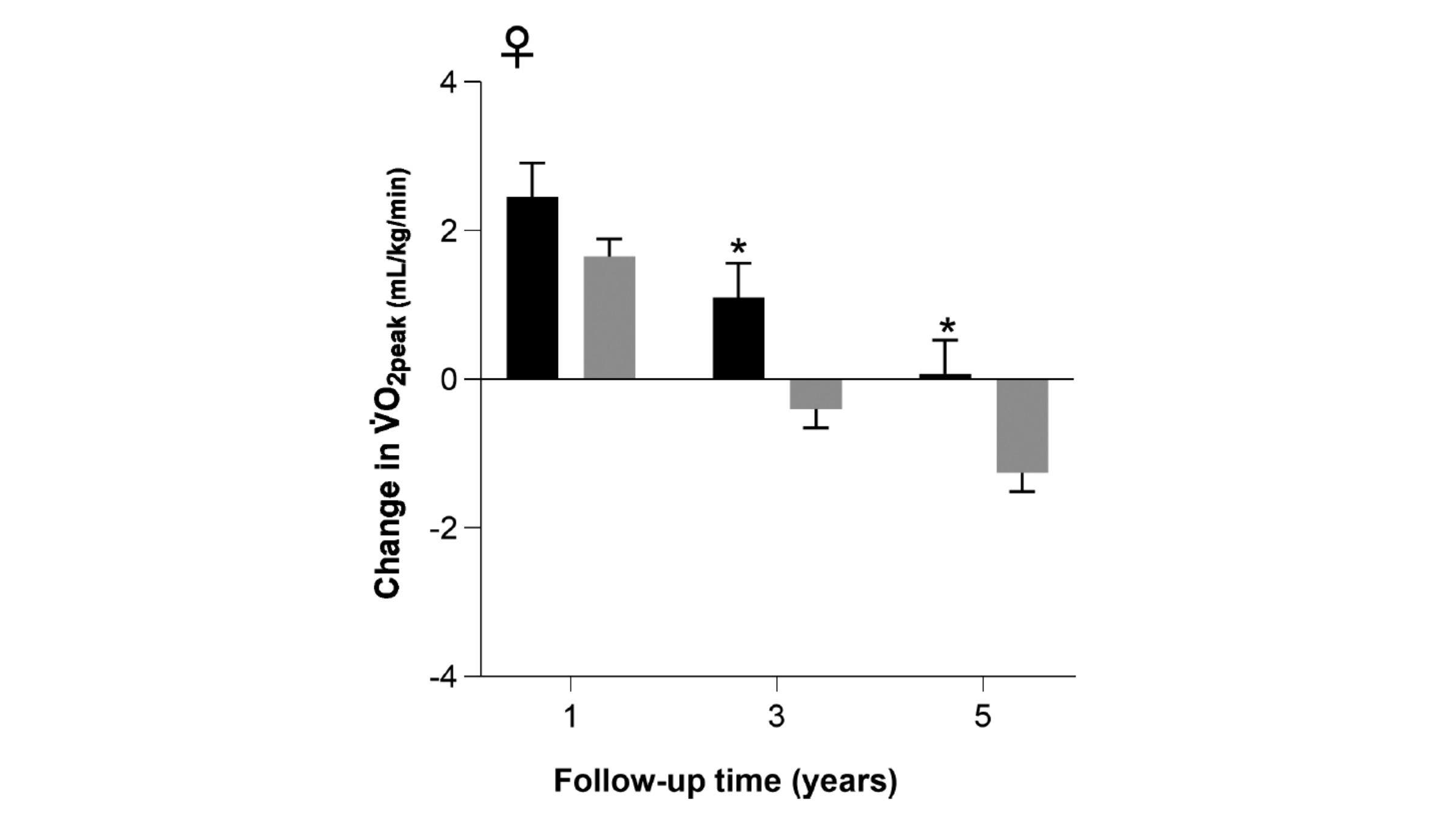
Everybody lost fitness. This is the reality of being in your 70s. But the people who were doing high-intensity training (HIT) lost less fitness than those doing moderate intensity (MIT). Here’s the data for the men, showing an initial increase in VO2 max after one year of exercise followed by a decline after three years and a bigger decline after five years.
You can see that the high-intensity group (black bars) gets a bigger initial boost in VO2 max, and then hangs onto their advantage even as both groups gradually lose fitness. After five years, the high-intensity group is 3.1 percent lower than baseline, and the medium-intensity group is 7.7 percent lower.
And here’s the comparable data for women, who managed to hang on to slightly more of their fitness than the men. In this case, the high-intensity group is actually back to baseline after five years, with no net loss of fitness, while the medium-intensity group is 4.6 percent lower.
This is not, I should emphasize, any sort of grand refutation of the theory of zone 2. We don’t know what zone either of the two groups was in; it’s tricky to triangulate between perceived effort and heart rate and metabolic zones. But it’s a reaffirmation of the idea that, all else being equal and within reasonable limits, harder exercise produces greater fitness gains. This might seem obvious, but it bears repeating.
I actually think the zone 2 framework is a pretty good one. Among both novice exercisers and people who should know better, pushing too hard on supposedly easy days is a very common sin. Any advice that helps people rein that tendency in can be useful. But the underlying logic, to me, isn’t about the metabolic magic of easier training, and it’s definitely not a shortcut to fitness: it’s about holding back so that you can do more or push harder on another day.
For more Sweat Science, sign up for the email newsletter and check out my new book The Explorer’s Gene: Why We Seek Big Challenges, New Flavors, and the Blank Spots on the Map.
