

Published September 8, 2026 04:32PM
My eyes shot open two hours before my alarm, again, and the anxiety train that is my postpartum brain pulled out of the station right on schedule. I’m a journalist and Outside‘s former health history columnist, and I work full-time. I’m also a new parent. Naturally, my work hours and personal life are all over the place.
Four months into motherhood, I find myself managing everything from moments of crushing anxiety to bouts of depression any time I question my parenting abilities. On top of that, as a runner and someone who loves to ski and do anything outdoors, I’m feeling a bit of cabin fever these days and trying to figure out when the hell I can get back on my workout schedule or do any kind of physical activity at all.
That said, you can imagine my surprise—and subsequent elation—when I came across a study, published this year, where people with anxiety and depression climbed rocks to work through it. I interviewed the paper’s lead author and a psychologist who specializes in sports and performance. Here’s what they had to say.
The Study Participants Climbed Ten-Foot Boulders with No Ropes
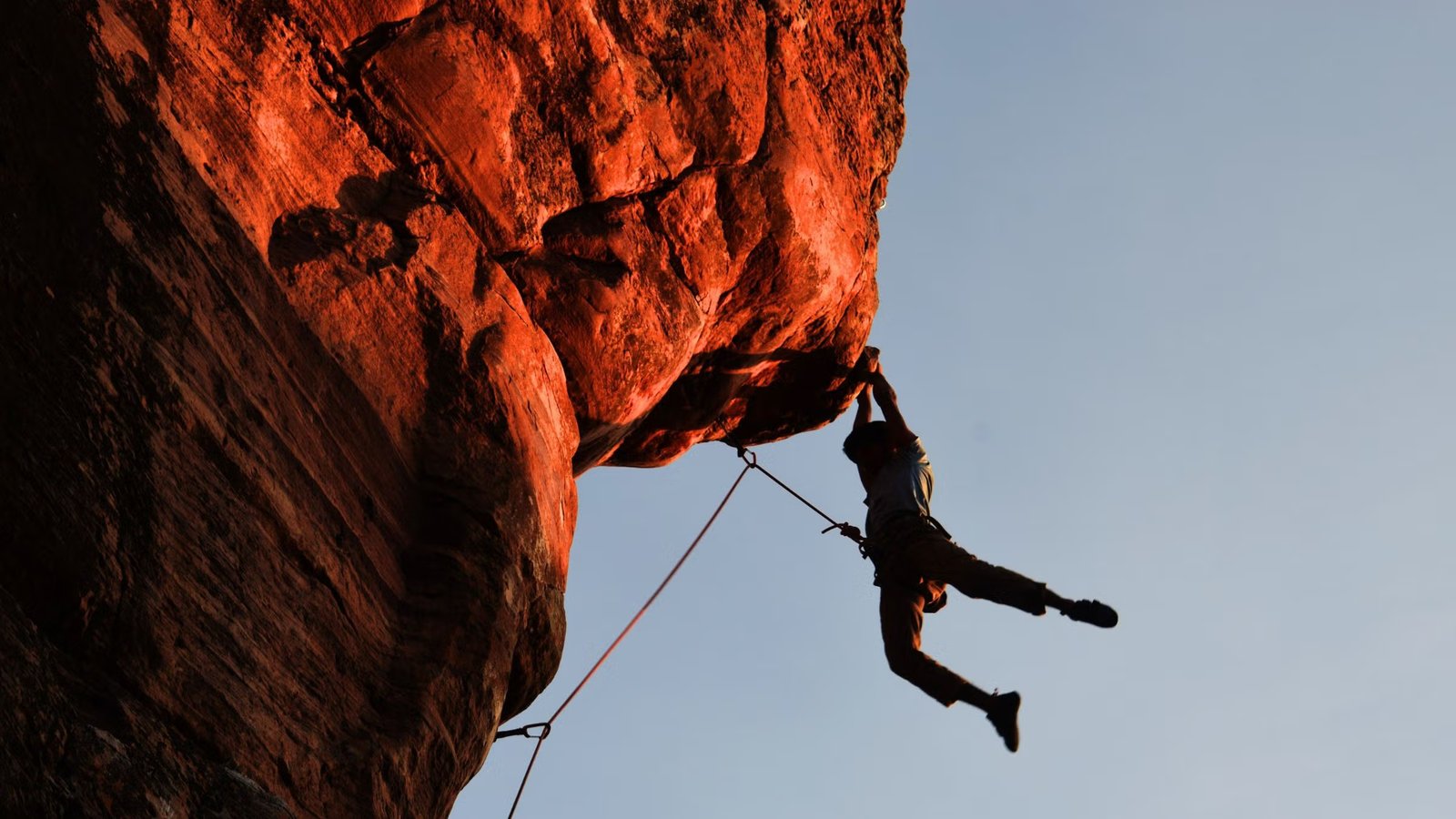
The study, published in the scientific journal BMC Medicine, is the latest from a German research team that has spent over a decade testing bouldering as therapy. Bouldering is a type of rock climbing done on small rock formations (or indoor rock walls) sans rope and harness. For safety, rocks are generally no more than 20 feet high.
Researchers in this 2026 study randomly assigned 128 adults with diagnosed depression into three groups: one did structured bouldering therapy, another tried a newer talk therapy, and a third received standard care as a comparison.
That newer talk therapy is called WISE-T, which stands for What’s Important: Schedule and Engage Therapy, and it focuses on identifying what actually matters to you and following through on it, instead of reacting to whatever feels most urgent. The goal of that therapy is to help combat symptoms that accompany depression, including anhedonia—the inability to feel joy or pleasure.
In this study, bouldering involved climbing moderate heights, up to ten feet, without ropes or harnesses. Thick pads at the bottom broke falls. Each bouldering session involved three parts: a mindfulness exercise beforehand, the climbing portion, and a relaxation component at the end of class.
The two therapy groups ran for ten weeks, once a week, in real settings: a bouldering gym for the bouldering therapy group and a psychiatric clinic for the WISE-T group, led throughout by trained therapists.
The Study Found That Bouldering May Reduce Anxiety and Depression
Both WISE-T and bouldering therapy cut anxiety scores significantly compared with standard care, which barely changed over the same ten weeks. Depression, the study’s main focus, dropped in both groups. On average, people went from moderate depression to mild. Bouldering’s effect was considered moderate; the talk therapy’s was slightly larger, though the gap is small. What matters most is that two very different approaches, one physical, one purely cognitive, both worked. Self-efficacy also improved, most clearly in the talk therapy group. Self-efficacy refers to people’s belief in their ability to handle hard situations. The bouldering group’s effect on self-efficacy appeared, too, but only after some statistical untangling.
As expected, only the bouldering group showed a jump in mindfulness during physical activity, and lead researcher Katharina Luttenberger has a theory as to why. “Thought can never be in the here and now, because thoughts necessarily always deal with the past or the future. Therefore, it makes perfect sense to me that mindfulness is fostered through physical activity rather than through cognitive engagement,” she told Outside.
Because the participants were randomly assigned to groups, the results are more than a coincidence, but researchers can’t say that bouldering itself caused every improvement. Scientists can conclude, however, that there is an association between fewer depression symptoms, reduced anxiety, and bouldering therapy.
Why Does Climbing Make Us Feel Better?
The researchers have a clear explanation for why climbing specifically works: a boulder problem forces total, immediate attention. Every route is a specific puzzle you have to solve with your body, right now, leaving no spare processing power for anything else. That’s different from running or cycling, where your mind can wander for miles. Add real but manageable risk, a fall that’s expected, cushioned, and pretty safe, and you get practice handling uncertainty in a contained space.
A 2025 survey on bouldering found that nearly three-quarters of American climbers said the sport had a real, positive effect on their mental health. Over 70 percent of 748 people surveyed said climbing was more effective at improving their mental state than medication, and nearly 65 percent said bouldering was better than therapy.
Teresa Behrend Fletcher, a psychologist at Adler University who studies sports and human performance, explained that metaphors work in therapy because clients get stuck rehashing a problem the same way, and a metaphor forces a different angle. Bouldering works especially well for this, she said, because a client isn’t just imagining a solution; they’re finding one in real-time. Standing back and reading a route, then adjusting mid-climb when the first plan fails, mirrors the process of working through anything hard. As she put it, the goal is ensuring that “every problem has a solution,” Fletcher told Outside.
A few limitations in Luttenberger’s study are worth noting. This study took place in one city, at one gym, and participants were employed and already getting some kind of treatment for their anxiety or depression. But the appeal here isn’t just the sport itself. It’s finding anything that demands your full attention long enough to interrupt rumination and anxious-thinking loops. Trail running a technical descent might do it. So might reading whitewater, or skiing a double black diamond trail. It’s not the rock that matters. It’s what engaging with the rock or other outdoor entity takes off your plate. When you’re trying to survive, your worries tend to fall away.
Now, is bouldering therapy going to be a widespread method for alleviating anxiety and depression? Not quite. Luttenberger said that it depends on therapists’ qualifications and national regulations. “In Germany, for example, where the study took place, group psychotherapy is covered by health insurance, and under certain conditions, certified therapists can offer group sessions in various settings,” she said. One of the biggest hurdles in group bouldering psychotherapy, she said, is that “therapeutic climbing with a group of people with mental health issues is very demanding and should not be underestimated.” For it to be feasible and effective, “thorough training in all three areas—psychotherapy, climbing safety, and therapeutic climbing—is required.”
I personally haven’t been bouldering, and I’m not claiming it would fix anything. But a researcher and a psychologist, working independently, landed on the same idea, and it’s got me thinking that heading to a climbing gym or even tackling a small boulder on my own might be that way out of my postpartum fog. Whether I climb or find time to get back on the running trails, my goal is to move my body in a way that pulls me out of my head for a while.
Want more Outside health stories? Sign up for the Bodywork newsletter. And for tips on how to train, fuel, and recover better, sign up for the Sweat Science 101 newsletter.
